Pyruvate Oxidation to Acetyl CoA
 Call Kai
 Learn
Learn Practice Test
 Spaced Repetition
 Match
Match Flashcards
 Knowt Play
1/46

There's no tags or description
Looks like no tags are added yet.
Name | Mastery | Learn | Test | Matching | Spaced | Call with Kai |
|---|
No analytics yet
Send a link to your students to track their progress
47 Terms
Under anaerobic conditions, what can pyruvate be fermented into?
In yeast: ethanol and CO2
In muscle cells: Lactic acid
Pyruvate enters TCA cycle as… This only happens in what kind of conditions?
Acetyl-CoA. Aerobic!
Remember, fermentation occurs to…
Regenerate NAD+
Respiration produces ___ ATP than glycolysis alone. Evolutionarily, this gave organisms the chance to produce multicellular and more complex structures
More!
What is the final e- acceptor in cellular respiration?
O2
Respiration occurs in 3 major stages…
Acetyl CoA Production (Uses the pyruvate dehydrogenase complex)
Acetyl CoA Oxidation (TCA Cycle)
e- transfer and oxidative phosphorylation
Is anabolism or catabolism breaking things down?
Catabolism!
Respiration can also use __ and __ as a fuel to produce ATP. They all are converted into ___.
Fats and proteins. Acetyl-CoA
After glycolysis, the following steps of respiration occur in…
The mitochondria!
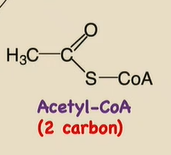
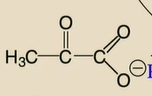
The oxidation of pyruvate to Acetyl-CoA is a __ carbon to __ carbon reaction.
3 carbon to 2 carbon.
Draw acetyl-CoA
Draw pyruvate
What are the 5 cofactors involved in pyruvate oxidation?
Lipoic acid, FAD, TPP (thiamine pyrophosphate), CoASH, NAD+
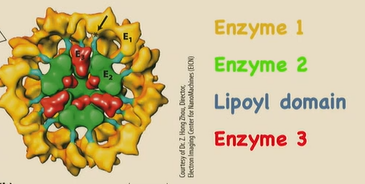
The PDC is very __. It is made of 3 kinds of peptides:
Complex. E1, E2 and E3
Pyruvate oxidation occurs in what part of the mitochondria?
Matrix!
PDC is inhibited by __ and __
NADH and GTP (can interconvert to ATP)
These are high energy states, which means we don’t need to make anymore ATP
PDC is stimulated by ___.
Insulin (high glucose state)
What cofactors does E1 use?
Thiamine pyrophosphate
What cofactors dos E2 use?
Lipoate, CoA
What cofactors does E3 use?
NAD+, FAD
E1:E2 ratio is…
1:1
(Can vary)
E1/E2:E3 ratio is…
2:1
Describe the structure and relative positioning of the enzymes making up the PDC
Lipoyl domain connects E1 and E2 → needed for physical transfer of a substrate later in the rxn
Lipoyllysine has 3 forms….
Oxidized lipoyllysine, acetyl and reduced
E3’s primary function is to…
Regenerate oxidized lipoyllysine by reducing FAD
Then, regenerate FAD by reducing NAD+
E1is called __. E2 is called __. E3 is called __.
Pyruvate dehydrogenase
Dihydrolipoyl transacetylase
Dihydrolipoyl dehydrogenase
What is the functional part of TPP?
The thiazolium ring
What happens to the thiazolium ring so it can attack pyruvate?
It gets deprotonated and forms a carbanion
Which carbon does deprotonated TPP attack?
The carbonyl
After TPP attacks pyruvate, what happens?
A decarboxylation which releases CO2 and leaves a 2 carbon intermediate covalently attached to the thiazolium ring
After the decarboxylation step with TPP, what happens?
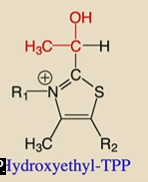
Resonance changes the structure from an enol to an alcohol. Then, a proton is added to neutralize the compound, which leaves us with hydroxyethyl-TPP, and it is ready to interact with E2
Draw hydroxyethyl-TPP
What does the oxidized lipoic acid cofactor do with hydroxyethyl-TPP?
It picks up the hydroxyethyl and frees the TPP, so E1 can act on the next incoming pyruvate
What is E2 called when it picks up the hydroxyethyl?
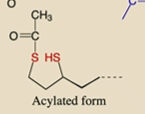
Acylated form
What happens after the lipoic acid grabs the hydroxyethyl group?
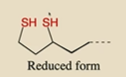
A free-floating CoA’s thiol group (-SH) attacks the carbonyl C of the 2 carbon intermediate, and releases Acetyl-CoA off of E2. This process reduces Lipoic acid.
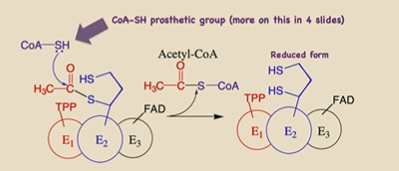
What is the function of E3?
It regenerates oxidized lipoic acid by having FAD+ get reduced to FADH2.
Then, it regenerates FAD by reducing NAD+.
How is FAD+ regenerated on E3?
FADH2 transfers a proton to NAD+, which also releases 1 proton into solution (2 H+ taken off of FADH2, total). NADH is formed, and FAD is regenerated.
CoA is __ __ in the mitochondtial matrix
Free floating
What is the important reactive group on CoA?
The thiol group
CoA and Lipoic acid have what are called…
Swinging thiol groups
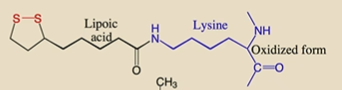
Lipoic acid is conjugated to E2 via a __ residue
Lys
Draw the oxidized business end of Lipoic acid (poised to pick up 2 carbon compound)
Draw the acylated business end of Lipoic acid
Draw the reduced business end of lipoic acid
The CO2 produced by the PDC is ____.
Exhaled
What are the total inputs and outputs of the PDC?
Inputs:
1 pyruvate (3 C)
1 CoA
1 NAD+
Outputs:
1 Acetyl-CoA (2 C)
1 NADH
1 H+ (??)
CO2
What two cofactors have a swinging thiol group?
CoA and lipoic acid ( an acyl carrier protein)