GE-101 Introduction to Geography - Population and Demography
 Call Kai
 Learn
Learn Practice Test
 Spaced Repetition
 Match
Match Flashcards
 Knowt Play
1/69

Earn XP
Description and Tags
This set of vocabulary flashcards covers key concepts, definitions, and stages of demographic transition based on the GE-101 Introduction to Geography materials.
Name | Mastery | Learn | Test | Matching | Spaced | Call with Kai |
|---|
No analytics yet
Send a link to your students to track their progress
70 Terms
Labor Force
The economically active and productive group of a population, generally consisting of individuals between the ages of 15-64.
Most if not all ancient//early civilizations such as Egyptian and Mesopotamian civilizations sprung up from areas with good source of water (such as rivers) for irrigation and rich soil (i.e. alluvial deposits)
True
Overpopulation specially in urban areas result to increase in crimes, due to higher densities of people living in crowded and limited spaces, leading to a phenomenon called "Urban Sprawl"
True
Population distribution is important in determining the provision and location of community facilities such as education, health etc
True
Experts predict that world population will peak between 8 and 9 billion, followed by population decline
True
Geographical barriers such as long mountain ranges influence the distribution of human populations. A good example is that of the Rocky Mountains in US mainland. There are higher densities of populations to the east of the Rocky Mountains
True
Future growth will mostly occur in developing countries
True
Stage 4 in the Demographic Transition is characterized by Subsistence agriculture where the society is highly dependent for its economy
False
Stage 4 is characterized by low birth rates and low death rates, with flow or stable population growth, countries are highly industrialized/urbanized
ex: United States, Japan, Germany
Population
The total number of people in a defined territory at a particular time or during a specific period.
The global rate of population growth sharply increased during three periods. The SECOND period of huge population growth happened around 1750 A.D. This was a result of industrial revolution
True
Sex Ratio
The number of males per 100 females in a population.
In terms of Global Population Distribution, Europe accounts for the largest at 12% of total world population
False
Europe has roughly 9–10% of the global population, not the highest percentage
Terrain characteristics or Relief have an influence on populations. People are concentrated in low lying areas as compared to higher elevations like the Himalayas and Rockies and Alps where there are colder climates due to altitude
True
A population pyramid with a large base of Young Dependents (meaning a huge percentage of the population belong to age groups from 0 years to 15 years old) is an indication of a healthy population, since the economy will be sustainable in the foreseeable future because there is a steady supply of workforce in the future
True
Young Dependents
The segment of the population belonging to age groups from 0 to 15 years old.
Physiographic Density
A way of expressing population density in relation to the pressure on arable or agricultural land.
Another way of making population density more relevant is by expressing it in relation to pressure on arable or agricultural land. This is called physiographic density
True
Another reason for the "aging" population in Japan is the longer life expectancy of its senior or old dependents
True
Underpopulation
A condition that occurs when the population is less than the available resources in a specific area.
One of the reasons for the "aging" population in Japan is due to low birth rates or smaller number of young dependents (or simply fewer babies are being born each year)
True
Dependency Ratio
The measure of the number of dependents (both young and old) being supported by 100 people in the economically active group.
A high dependency ratio (meaning more older dependents and young dependents in a population or society) puts a lot of pressure on the resources of government and individual households
True
Population data, such as composition and structure, are NOT important for national development planning
False
Population data is very important for national development planning
The population below 15 and above 64 years of age constitute the dependent groups
True
Demography
The statistical study of human populations, including their size, composition (e.g., race, age), and how they change through fertility, mortality, and migration.
One of the major causes of overpopulation is High birth rate and declining death rate
True
Agriculture or agricultural activities is/are one of the hallmarks of Primary economic activities in a Stage 1 society
True
One of the reasons why there are high birth rates in DEVELOPING countries is the lack of access to modern contraceptives and limited family planning. For instance, only 17% of married women in Ghana are using modern contraceptives (Ghana Demographic and Health Survey Report, 2008)
True
Approximately 75% of the world’s population live on 5% of the earth's surface
True
The population pyramids of the developing countries have very broad bases formed by the 0-10 years group indicating a youthful or young population
True
Crude (Arithmetic) Density
The number of people per unit area of land.
Rule of 70
A calculation used to determine the number of years it takes for a variable to DOUBLE by dividing the number 70 by the variable's growth rate: growth rate70.
Doubling Time
The time it takes for a population to double its number if the current growth rate remains constant.
Crude Birth Rate
The number of live births per year for every 1,000 people alive in a society.
Climate does not affect the distribution of populations around the world.
False
Stage 1 in the Demographic transition is characterized by High birth and death rates
True
The THIRD rapid change in world population began in 1950s: This has been brought about by advances in medical sciences (such as new vaccines and new drugs and medicines), which has helped to eliminate traditional causes of death in poorer countries
True
One of the ways to control over population is through institution of Birth control methods by use of modern contraceptives
The fewer number of MALE senior or older dependents of ages 75 years and older in Russia, compared to larger number of females of the same age group, can be attributed to the effects of the 2nd World War, when many Russian men died and widows were left
True
Soil conditions particularly fertile soils and water for irrigation encourage high population densities. The highest rural densities in the world are found on rich alluvial soils such as those along the Nile River in Egypt
True
The pyramids of most developed countries bulge out in the middle and this indicates that the bulk of the population is in the active working group
True
Population geography focuses on the number, composition, and distribution of humans in relation to variations in the conditions of earth space
True
The FIRST of three periods of marked increases in global rate population growth happened in 8000 BC when agriculture was invented or developed
True
A reason why there is low birth rates in developed countries (such as Japan)
People marry late. Women are starting to be highly educated and they delay in having a family so that they can have a career
Crude Death Rate
The number of deaths per 1,000 people living in a society.
Migrant
A person who moves from one place to another, often back and forth for work-related reasons, rather than permanent relocation.
Immigrant
A person who moves to a different country with the implication of permanent relocation.
The year 2011 is estimated to have been the year when world population reached its 7 billion mark
True
Overpopulation
Occurs when the number of births in a given period EXCEEDS the number of deaths
Emigrant
A person who moves away from a country.
Ecumenes
The permanently inhabited areas of the earth.
J-curve
A graphical curve that depicts the exponential or geometric growth of populations.
Total Fertility Rate (TFR)
The average number of children a woman will have throughout her child-bearing years, typically defined as ages 15-49.
Population Pyramid
A graphical illustration showing the distribution of various age groups and gender/sex in a population.
Crude arithmetic density
The number of people per unit area of land
Total fertility rate (TFR)
The average number of children a woman will have throughout her child bearing year (15-49)
Stage 1: High Stationary
A stage in demographic transition characterized by high birth and high death rates.
Stage 2: Early Expanding
A stage in demographic transition characterized by high birth rates and declining death rates.
Stage 3: Late Expanding
A stage in demographic transition characterized by declining birth rates and low death rates.
Stage 4: Low Stationary
A stage in demographic transition characterized by low birth and low death rates.
Stage 5: Decline
A stage in demographic transition where death rates exceed birth rates.
Population Geography
A field that focuses on the number, composition, and distribution of humans in relation to variations in the conditions of earth space.
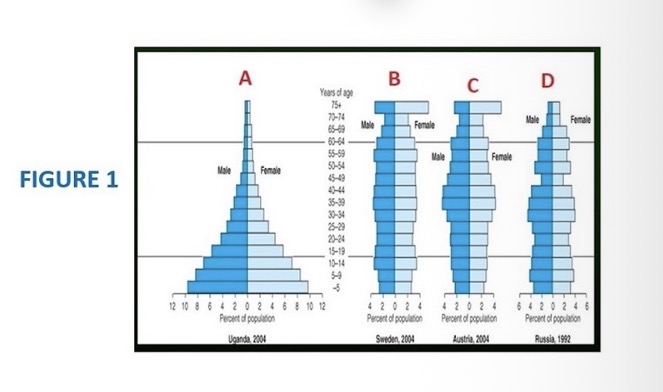
Identify the type of population growth in Figure 1 labelled "B"
Slow growth
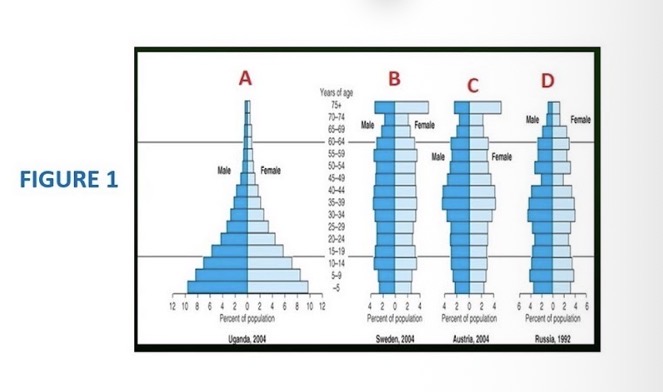
Identify the type of population growth in Figure 1 labelled "D"
Disrupted growth
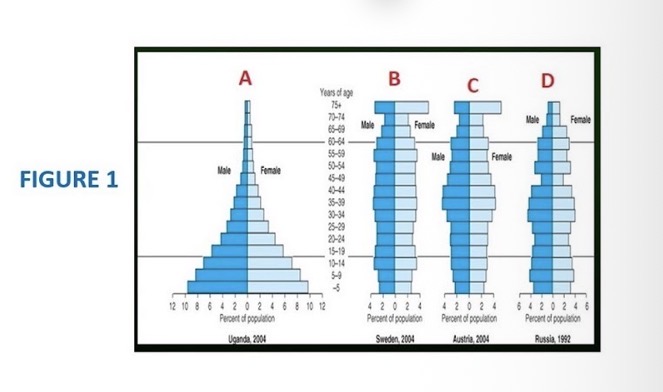
Identify the type of population growth in Figure 1 labelled "A"
Rapid growth
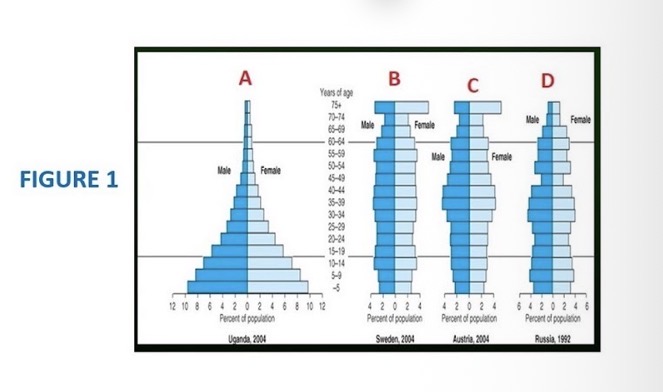
Identify the type of population growth in Figure 1 labelled "C“
Decline
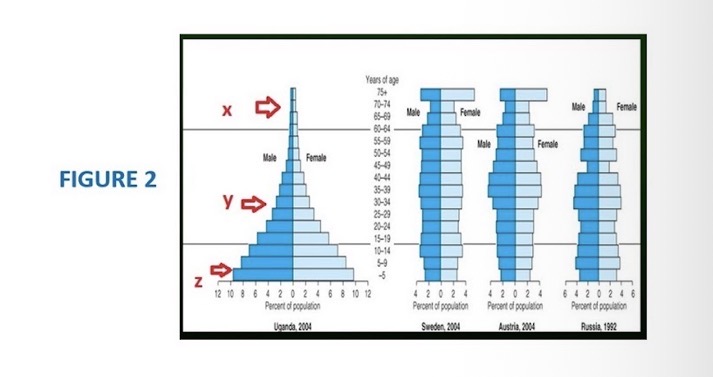
Identify the age groups labelled "y"
Labor force or working class or economically active
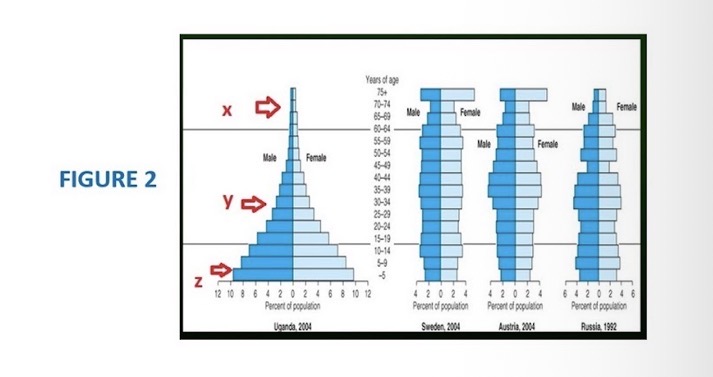
Identify the age groups labelled "x"
Senior or old dependents
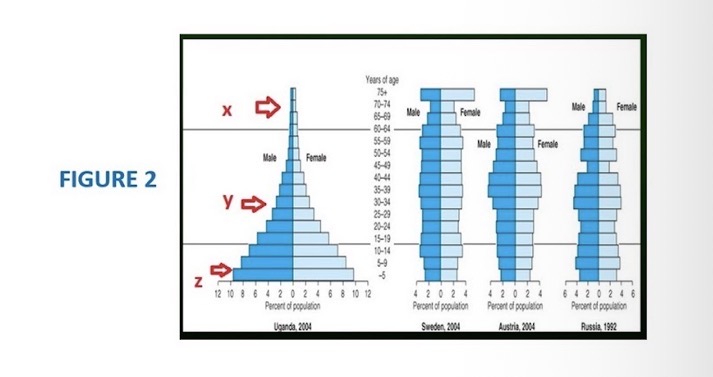
Identify the age groups labelled "z"
Young dependents
Using the RULE OF 70, if the population of Kenya in 2025 is 57,500,000 in how many years (or in what year) will the population of Kenya become double if the annual growth rate is 2.0% annually?
35 years or the year 2060