7. Balance of Payments + Externalities + Inequality
 Call Kai
 Learn
Learn Practice Test
 Spaced Repetition
 Match
Match Flashcards
 Knowt Play
1/16

There's no tags or description
Looks like no tags are added yet.
Name | Mastery | Learn | Test | Matching | Spaced | Call with Kai |
|---|
No analytics yet
Send a link to your students to track their progress
17 Terms
What is the balance of payments?
Records all financial transactions between the UK + rest of the world including exports + imports
What are the three components of the balance of payments?
Current account - trade of goods + services + primary income (money used in transactions) + secondary income (only 1 way - e.g aid)
Capital account - capital transfers (e.g debt forgiveness) + non-financial assets (e.g patents)
Financial account - movement of investments (e.g FDI, buying stocks)
What are two ways to balance the balance of payments?
If there’s a current account deficit, the gov needs a surplus in the capital/financial account by:
Borrowing money from abroad
Selling gold/foreign currency reserves
What are two short term + two long term reasons for the deficit in the current account?
Short term:
Inflation
Inelastic demand for imports
Long term:
Productivity gap
Switched from oil exporters to importers
What are two impacts of a deficit + two impacts of a surplus in the current account?
Deficit impacts:
Decreased AD
Increased unemployment
Surplus impacts:
Decreasing foreign assets
Indicates decreased competition + unsustainability
What is the acronym for exchange rates?
Stronger
Pound
Imports
Cheaper
Exports
Dearer
How can a change in the current account influence the exchange rate?
Inflation
UK goods are less price-competitive
Imports increase + exports decrease → current account worsens
Increased supply of pounds in the foreign exchange market (forex) to pay for imports
Pound depreciates
What are two advantages + two disadvantages of trade?
Adv:
Specialisation
Efficiency
Choices
Dis:
Overdependency/overspecialisation
Decreased jobs (due to globalisation)
What are the four protectionist policies?
Tariffs - tax on imports
Quotas - restrictions on the quantity of product that can be imported
Voluntary export restraint - exporting country voluntarily restricts the n. of goods it ships to a country
Export subsidy - payment to a domestic producer who exports
What are two advantages + two disadvantages of protectionist policies?
Adv:
Protecting domestic industries
Control externalities
Dis:
Inefficiency
Risk of retaliation
What are three ways to reduce a current account deficit?
Increased use of protectionist policies
Join a single currency (e.g Euro)
Decrease ER
Increase IR
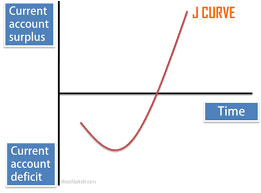
What is the J-curve?
In the SR, a depreciation of the ER can worsen the current account because of inelastic demand of imports + exports
What is the Marshall Lerner condition?
A depreciation of the ER will only have a positive effect on the current account if the sum of the elasticities of demand for exports + imports is negative + greater than 1
What does external cost mean?
Cost to a third party not involved in the economic decision
What are two ways to reduce externalities?
Decrease AD (e.g decrease gov spending)
Increase level of env-friendly tech
Use policies like tradable permits
What does inequality mean?
Unequal distribution of income
What are two ways to reduce inequality?
Benefit payments
Progressive tax
Education + training