P-Chem Final
 Call Kai
 Learn
Learn Practice Test
 Spaced Repetition
 Match
Match Flashcards
 Knowt Play
1/34

There's no tags or description
Looks like no tags are added yet.
Name | Mastery | Learn | Test | Matching | Spaced | Call with Kai |
|---|
No analytics yet
Send a link to your students to track their progress
35 Terms
Planck’s constant
(h) defines the size of energy packets (quanta) in quantum mechanics. It relates the energy (E) of a photon to its frequency with E=hv
Photon
the fundamental particle or "tiny bundle" of light and all other forms of electromagnetic radiation
De Broglie wavelength
It shows that particles (like electrons) can act like waves and vice versa.
λ= h/mv or λ=h/p
Schrodinger equation
predicts how the wave function (quantum state) of a physical system changes over time. It calculates the probability of finding a particle (like an electron) at different locations
-Time independent
Wave function
ψ a mathematical formula that describes the quantum state of a particle, such as an electron
Born Interpretation
Represents the probability of finding a particle in a specific location.
ψ2 is a probability density. The larger the number, the higher the probability of finding a particle.
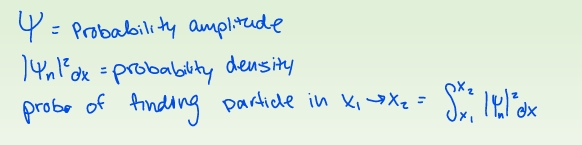
Heisenberg uncertainty principle
-A wave does not have a definite location at a single point in space.
-You cannot know both the exact position and exact speed at the same time
-The more precisely you measure one, the less precisely you know the other
ΔpΔx > ½ ħ
Quantization of energy levels
electrons in an atom can only exist at specific, discrete energy levels (like rungs on a ladder) rather than having any continuous range of energy. Electrons must "jump" between these allowed levels, emitting or absorbing specific packets of energy, rather than sliding smoothly between them.
Particle in a box
-When box is closed, the particle becomes a wave (y=sinx²)
-Particles cannot sit still and they possess “quantized” energy E= (n²h²)/(8mL²)
-Lowest energy can never be 0
Quantum mechanical harmonic oscillator
a quantum system where a particle, such as an atom or electron, moves in a potential well that is parabolic. It vibrates backwards and forwards, restrained by a spring that obeys Hooke’s law
Potential energy of harmonic oscillator: V(x) = ½ mw²x²
Quantized energies of the harmonic oscillator: En = ħw (n+1/2)
Rigid Rotor
a physical or quantum mechanical model of a system (usually a molecule) that rotates about its center of mass without changing its shape, size, or interatomic distances
Reduced mass
"mathematical trick" that simplifies a complex two-body problem (like a rotating or vibrating diatomic molecule) into a much easier one-body problem
μ = (m1m2) / (m1+m2)
H-atom spectrum
-Energetically excited atoms emit electromagnetic radiation of discrete frequencies as they discard energy, then return to ground state.
-Emission spectrum: The record of frequencies/wavelengths of the radiation emmitted
v = RH (1/n12 - 1/n22)
Lyman, Balmer, Paschen series
The first 5 series of lies correspond to n1
1(Lyman)
2(Balmer)
3(Pashen)
4(Brackett)
5(Pfund)
Shielding
the reduction in electrostatic attraction between the positive nucleus and outer valence electrons due to the repulsive force of inner, Core electrons. These inner electrons "block" the full nuclear charge, resulting in valence electrons experiencing a lower effective nuclear charge
Born-Oppenheimer approximation
the assumption that because atomic nuclei are much heavier and slower than electrons, the motions of electrons and nuclei can be separated in quantum calculations
-Nuclei can be treated as stationary
LCAO
Linear Combination of Atomic Orbitals (LCAO) is a quantum mechanical method used to approximate the shape and energy of molecular orbitals by adding or subtracting the wavefunctions of individual atomic orbitals
Electronic States
a specific, stable arrangement of electrons within an atom or molecule, defined by their energy level, orbital shape, and spin
Frequency, intensity, line-width
-Frequency: Molecular Transitions: The frequency (v) or wavelength (λ) corresponds to the energy difference (ΔE=hv) between two molecular energy states (rotational, vibrational, or electronic)
Spectra Types:
Rotational (Microwave/Far-IR): Low frequency, narrow line-widths.
Vibrational (Mid-IR/Near-IR): Intermediate frequency.
Electronic (UV-Vis): High frequency, broad linewidths.
-Intensity: Intensity indicates how likely a molecule will absorb or emit radiation, generally determined by the population difference between states and the transition dipole moment.
-Line-width
-Doppler effect: radiation is shifted in frequency when the source is moving towards or away from the observer
-the width of the 'line' at half its maximum height (Sv): Sv = 2v/c ( 2RTln2 / M)1/2
Electromagnetic spectrum
the entire range of all possible frequencies of electromagnetic radiation, spanning from low-energy radio waves to high-energy gamma rays
Intrinsic line width
the fundamental, minimum width of a spectral line (in optics, NMR, or atomic physics) determined solely by the particle's internal properties, such as its natural lifetime, rather than external factors
-Energy and time have uncertainty
SE*St ≥ ħ/2
Selection rules for rotational and vibrational transitions
For a molecule to give a pure rotational spectrum it must be polar.
ΔJ = +- 1
Vibrational rules require a change in dipole moment during vibration,
ΔV = +- 1
Force constant
measures the stiffness or strength of an elastic object, like a spring or chemical bond. It represents the amount of force needed to stretch or compress an object by a unit distance
-A higher k value means a stiffer spring (harder to stretch)
Derived from Hooke's Law: k=F/x , where F is force and x is displacement
Normal modes of vibration
the specific, natural patterns of motion in which all parts of a mechanical system or molecule vibrate together at the exact same frequency
Nonlinear = 3(N) - 6
Linear = 3(N) - 5
Electronic transition selection rule
Selection Rule forbids transitions between states with different total spin, and thus different spin multiplicity
Types of electronic transition
Electronic transitions are the movement of electrons between energy levels (orbitals) in an atom or molecule upon absorbing UV or visible light. They move from a filled (ground state) to an empty (excited state) orbital
sigma → sigma*
n → sigma*
pi → pi*
n → pi*
Vibronic transitions
simultaneous changes in both the electronic state and vibrational state of a molecule, usually triggered by absorbing or emitting a photon
Frank-Condon
when a molecule absorbs or emits light (electronic transition), the transition happens so quickly (almost instantly) that the nuclei of the atoms do not have time to change their positions. Therefore, the transition is depicted as a "vertical" line on a potential energy diagram.
Fluorescence, phosphorescence
types of luminescence (light emission) caused by materials absorbing energy.
- Fluorescence is the immediate, temporary glow that stops instantly when the light source is removed (e.g., highlighter ink).
-Phosphorescence is a delayed, "glow-in-the-dark" effect that persists for seconds or hours after the source is gone.
Absorption vs emission
Absorption occurs when atoms or molecules take in energy (like light or heat), causing electrons to jump to higher energy levels.
Emission occurs when those excited electrons lose energy and fall back to lower levels, releasing the energy as light
Radiative/non-radiative
Radiative processes involve energy changes in materials (like electrons changing states) that emit or absorb photons, appearing as light or heat.
Conversely, non-radiative processes involve energy transitions that release energy through heat or vibration rather than photons, often reducing luminescence
Jablonski Diagram
"energy-level diagram" that illustrates the electronic states of a molecule and the radiative (light-emitting) or non-radiative (heat-releasing) transitions between them
Singlet and triplet state
describe how electron spins are arranged in a molecule, dictating its magnetic and reactivity properties. A singlet state has all electrons paired (opposite spins, total spin ), resulting in no net magnetic moment. A triplet state has two unpaired electrons with parallel spins (), producing a net magnetic moment
Internal conversion
a radiation less conversion to another state of the same multiplicity (that is, spin state).
Intersystem crossing
non-radiative, "spin-forbidden" process where an excited molecule shifts between two electronic states with different spin multiplicities—typically from an excited singlet state (S1) to an excited triplet state (T1)