MM Assumptions
 Call Kai
 Learn
Learn Practice Test
 Spaced Repetition
 Match
Match Flashcards
 Knowt Play
1/4

Earn XP
Description and Tags
List of MM assumptions and what happens when they fail
Name | Mastery | Learn | Test | Matching | Spaced | Call with Kai |
|---|
No analytics yet
Send a link to your students to track their progress
5 Terms
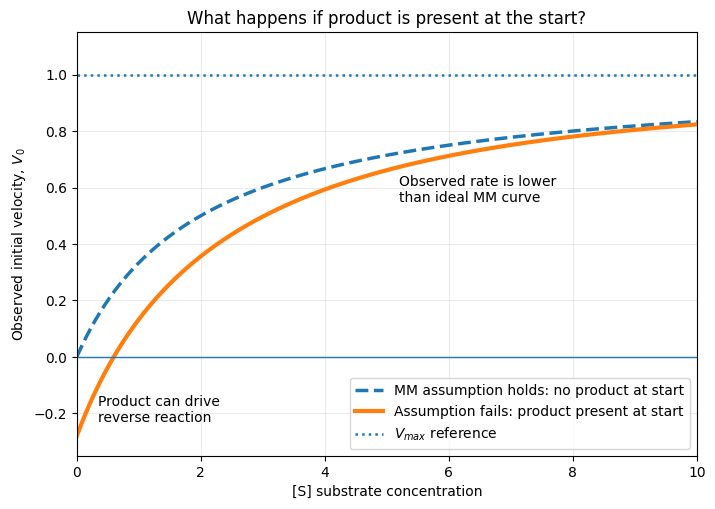
Assumption #1
No product is present at the start of catalysis
When it fails:
the reverse reaction becomes significant
product can rebind to the active site and act like a competitive inhibitor
the forward run would slow down
the rate measured is no longer the true initial velocity
Assumption #2
The rate of formation of the ES complex is equal to the rate of dissociation plus breakdown
When it fails:
if steady state is not maintained then [ES] is still building up OR [ES] is declining
if it is still building up, then the run is still in pre-steady state phase and the ES complex is still accumulating!
if it is declining, the substrate is being depleted and there would be less substrate available to form new ES
for both scenarios the Vo measurement would be inaccurate
![<p>The rate of formation of the ES complex is equal to the rate of dissociation plus breakdown </p><p></p><p>When it fails: </p><ul><li><p>if steady state is not maintained then [ES] is still building up OR [ES] is declining</p></li><li><p>if it is still building up, then the run is still in pre-steady state phase and the ES complex is still accumulating!</p></li><li><p>if it is declining, the substrate is being depleted and there would be less substrate available to form new ES</p></li><li><p>for both scenarios the Vo measurement would be inaccurate</p></li></ul><p></p>](https://assets.knowt.com/user-attachments/f5791e62-a02d-40b7-b31c-486bdd5e8c5b.png)
Assumption #3
The concentration of substrate is greater than the concentration of free enzyme
When it fails:
enzyme molecules are present in amounts comparable to or exceeding substrate
this assumption is directly linked to assumption 2 (steady state requires [S]»[E]
both assumption #2 and #3 fail together
[ES] never stabilizes, it rises and falls too quicly
steady state breaks down simultaneously
Km and Vmax are underestimated and unreliable
![<p>The concentration of substrate is greater than the concentration of free enzyme</p><p></p><p>When it fails:</p><ul><li><p>enzyme molecules are present in amounts comparable to or exceeding substrate</p></li><li><p>this assumption is directly linked to assumption 2 (steady state requires [S]»[E]</p><ul><li><p>both assumption #2 and #3 fail together</p></li></ul></li><li><p>[ES] never stabilizes, it rises and falls too quicly</p></li><li><p>steady state breaks down simultaneously </p></li><li><p>Km and Vmax are underestimated and unreliable </p></li></ul><p></p>](https://assets.knowt.com/user-attachments/57759cd0-f346-4822-a9d1-6bb90b8f6368.png)
Assumption #4
Only the initial velocity of the steady state reaction is measured
When it fails:
substrate is depleted
enzymes see less S than you think and the rate appears lower than it should for a certain [S]
product accumulates
[P] is no longer = 0, so the product can rebind to the active site (causing product inhibition)
the reverse reaction becomes significant and slows down the observed rate
steady state breaks down
as [S] drops, ES complex started to decline
MM equation is no longer valid
enzyme may be unstable
overtime an enzyme can denture or degrade
there is less functional enzyme available
random rate drops unrelated to kinetics
![<p>Only the initial velocity of the steady state reaction is measured</p><p></p><p>When it fails:</p><ul><li><p>substrate is depleted</p><ul><li><p>enzymes see less S than you think and the rate appears lower than it should for a certain [S]</p></li></ul></li><li><p>product accumulates</p><ul><li><p>[P] is no longer = 0, so the product can rebind to the active site (causing product inhibition)</p></li><li><p>the reverse reaction becomes significant and slows down the observed rate</p></li></ul></li><li><p>steady state breaks down</p><ul><li><p>as [S] drops, ES complex started to decline</p></li><li><p>MM equation is no longer valid</p></li></ul></li><li><p>enzyme may be unstable</p><ul><li><p>overtime an enzyme can denture or degrade</p></li><li><p>there is less functional enzyme available </p></li><li><p>random rate drops unrelated to kinetics</p></li></ul></li></ul><p></p>](https://assets.knowt.com/user-attachments/8aa2bdd4-6f7f-488e-abee-a8de289ed9db.png)
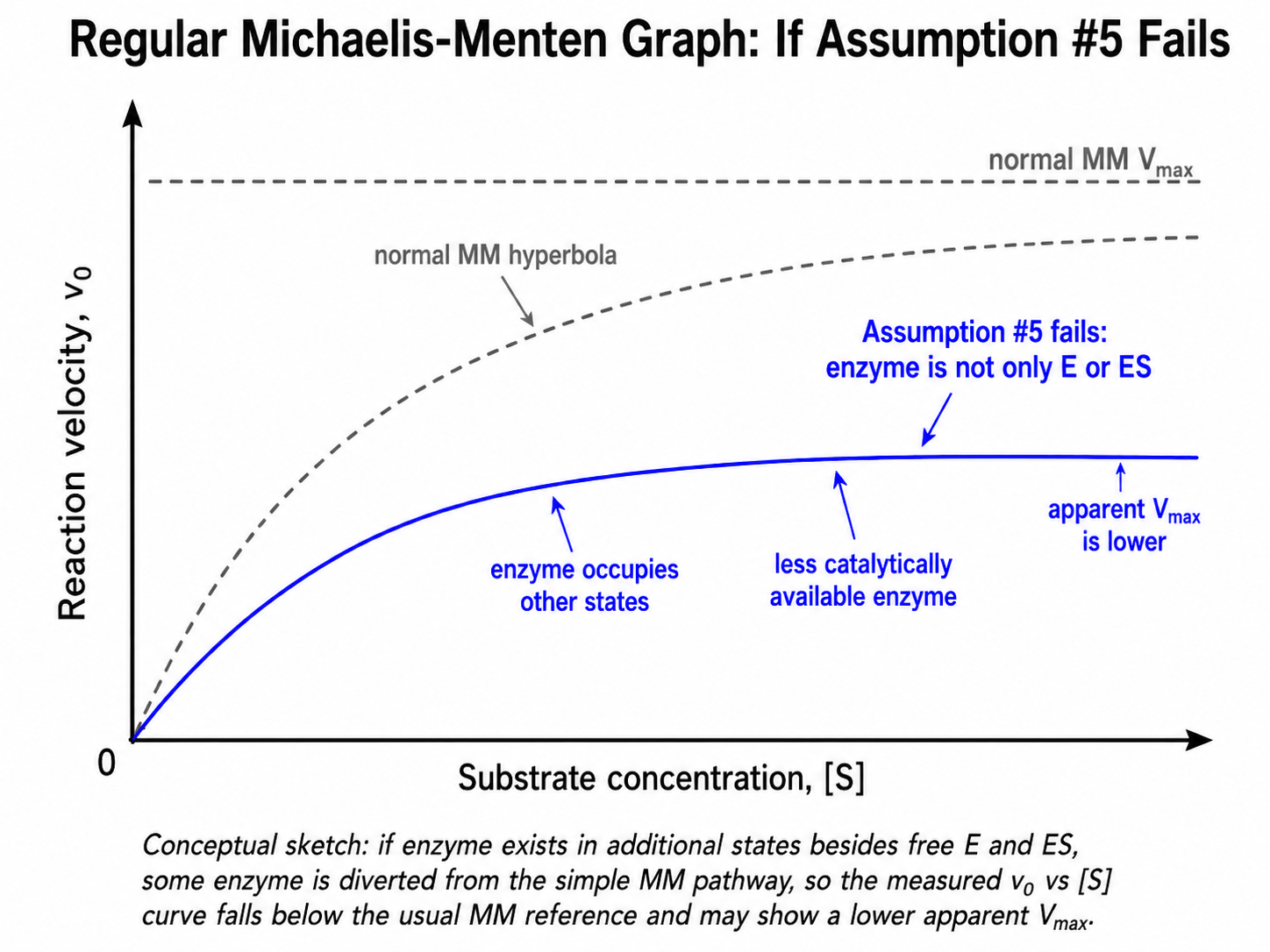
Assumption #5
Enzyme is present as either a free enzyme or as the ES complex
When it fails:
the mass abalone equation breaks down since some enzyme is unaccounted for, the MM equations does not recognize this
scenario #1: Inhibitor is Present
Inhibitor binds to enzyme or ES and now the enzyme exists as E, ES, EI, and/or ESI
Standard MM equation is no longer valid
scenario #2: Product is still bound (EP complex)
Enzyme is temporary stuck as EP complex (relevant in multi-step rxns)
EP is a third state that the MM equation ignores
scenario #3: Multiple Substrates (ternary complex)
Bisubstrate rxns and enzyme can exist as E, EA, EB, EAB
Basic MM only handle one substrate
scenario #4: Enzyme Denaturation or Aggregation
some enzymes become inactive through denaturation and they are lost from the system
calculations would be wrong due to the nonfunctional enzyme being accounted for
scenario #5: Allosteric Enzymes
allosteric enzymes can exists but MM equation fails for allosteric enzymes (hence sigmoidal kinetics w/allosteric instead of hyperbolic)