ceutics drug discovery and approval
 Call Kai
 Learn
Learn Practice Test
 Spaced Repetition
 Match
Match Flashcards
 Knowt Play
1/19

There's no tags or description
Looks like no tags are added yet.
Name | Mastery | Learn | Test | Matching | Spaced | Call with Kai |
|---|
No analytics yet
Send a link to your students to track their progress
20 Terms
where can leads for new drugs come from
- competitor compounds
- endogenous ligands
- random screening/ compound file
- natural products
- scientific literature
- combinatorial libraries/ AI
drug discovery may take from ____ to _____ years
1-5 years
a lot of research and time to come up w one new marketable drug
what is determined in preclinical testing?
how?
how long does it take?
- pharmacological action, MOA, specificity of effect, toxicity
- conducted in cell cultures, isolated cells/organs, lab animals
- about 1yr for exploratory development, and half a year to submit data, CMC, and proposed studies to FDA
preclinical submissions should include what kind of information
- drug info (structure, metabolism, toxicity, contraindications, overdose treatments, etc)
- objective, methods, manufacturing, investigators, institutions
etc
t/f: preclinical studies involve in vitro human testing on healthy patients
false. preclinical studies do not involve humans. this is general drug study that gets sent to FDA for approval before in vitro studies begin. once approved, it is now investigational drug
t/f: a drug that is in preclinical studies is an investigational drug that needs FDA approval before in vitro studies begin
false. it does not become an "investigational drug" until preclinical studies are DONE and the FDA has approved it
in which phase is a drug first administered to humans
phase 1-> NOT patients, but rather healthy humans
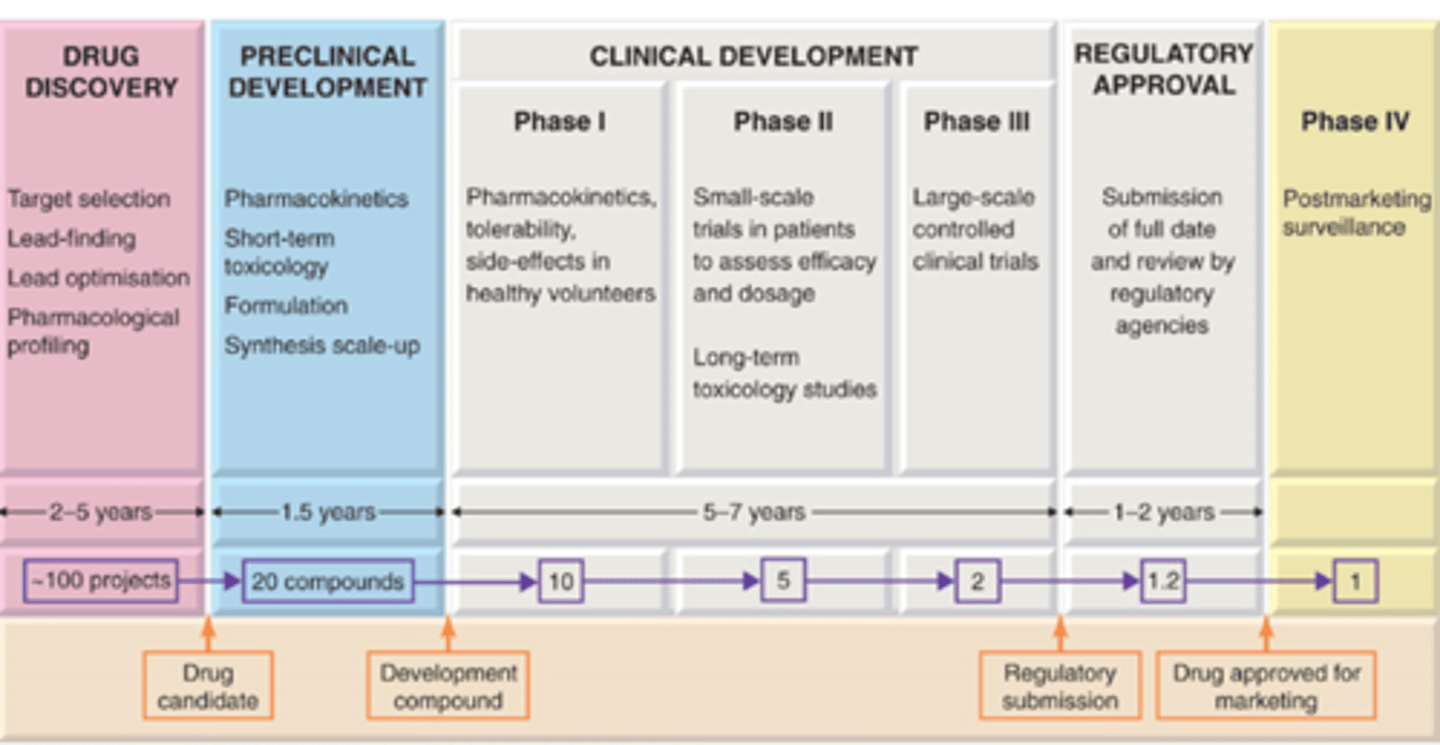
summarize what happens in phase 1
- first time drug given to HEALTHY humans (not pts)
- given in increasing doses, establishes dose-response relationships and pharmacokinetics, tolerance, drug-drug intrxns, bioavailability, etc
- about 0.5-2 years
t/f: phase 1 involves giving a drug to patients to establish drug elimination and effect
false. phase 1 is given to healthy humans, not patients, to know how drug affects ppl normally
when is the first time an investigational drug given to patients
phase 2 (phase 1 = healthy humans)
t/f: phase 1 testing involves establishing therapeutic benefits, side effects, and dose ranges
false. phase 1 is given to healthy patients. we are not looking for therapeutic effects here, just how drug affects normal volunteers
what is important to monitor in phase 2 testing and why
1. drug elimination= pts often metabolize differently than normal
2. therapeutic benefits/ side effects
3. definitive dose range (since giving to actual pts now)
(1-3 years)
in which phase does the following occur
- determine efficacy of drug in reducing disease
- compare efficacy to other marketed drugs
LATE PHASE 2
what does phase 3 consist of
- double blind randomized trials large enough to provide statistical data
- continue to measure toxicity/ efficacy/ safety like other phases
(3-5 years)
if phase 3 studies suggest that the drug is effective, what does the company file and why?
New Drug Submission/ Application -> may now market new drug
New Drug Application (NDA) process
- following successful phase 3 trials
- takes about 1-2 years
- ALL preclinical and clinical data, proposed product packaging and labeling submitted
- FDA reviews application
phase 4 summary
- after NDA has been approved by FDA for marketing
- drug is marketed, and MONITORED since it is now being used widespread
- rare side effects, toxicity, interactions, new dosages are identified
t/f: a drug may remain in "New Drug" status for several years until the FDA is confident enough info has accumulated from general use in phase 4 and rigid controls are released
true
summarize all of the phases of the drug approval process (overview)
preclinical studies= determine MOA, toxicity, metabolism, and other drug properties----> submit to FDA to be used as "investigational drug" (1.5 years)
phase 1= drug is given to HEALTHY humans for the first time, establish dose-response curves and pharmacokinetics (0.5-2 years)
phase 2= drug is given to few PATIENTS, elimination/metabolism, therapeutic benefits, dose ranges, efficacy (1-3 years)
phase 3= double blind, randomized controlled clinical trials on more patients-----> file NDA to request marketing (3-5 years)
NDA process: submit all data, FDA reviews (1-2 years)
phase 4= drug is now marketed and monitored worldwide; may see rare side effects and adjust dosing
= drug remains in new drug status until FDA is confident and stops monitoring
t/f: while phase 1 is generally used to determine whether a drug is safe in humans, phase 2 is used to identify whether it works
true