4. Bond Markets and Bond Yields
 Call Kai
 Learn
Learn Practice Test
 Spaced Repetition
 Match
Match Flashcards
 Knowt Play
1/17

There's no tags or description
Looks like no tags are added yet.
Name | Mastery | Learn | Test | Matching | Spaced | Call with Kai |
|---|
No analytics yet
Send a link to your students to track their progress
18 Terms
Advantages of Bonds
Receive income through interest payments
Hold the bond to maturity to get all of the principle back
Profit by reselling the bond at a higher price
Disadvantages of Bonds
Bonds pay lower returns than stocks
Companies can default on your bonds
Bond yields can fall
What is the relationship between yield to maturity and bond prices?
They are negatively related; as price increases, the yield to maturity decreases
Additionally, bond prices rise when interest rates fall
Facts about bond prices
A bond with a higher coupon payment has a higher price
A bond with a higher face value or years to maturity has a higher price
A bond with a higher yield to maturity has a lower price
Which factors present a risk to the bond price?
Credit rating or creditworthiness of an issuer
Liquidity of the second market for bonds
Time for the next payment of bonds
Interest rates/Inflation rates
What is market risk?
The risk of unexpected changes in the prices of goods in the market
What is credit risk?
The increased risk of default or decline in value of a bond due to a change in the creditworthiness of issuers or counterparties
Default risk
Possibility that a counterparty in a financial contract will not fulfil an obligation of the contract and thus default on it
Credit rating
Evaluates the creditworthiness (trustworthiness) of an issuer to lend money to; often done by a credit-rating agency
Quantifies the ‘probability of default’
Given by three main companies who give ratings like AAA, AA, A, BBB, and so on to represent the credit-worthiness of a company
The Big Three Credit Rating Agencies
Moody’s Investor Services
Standard and Poor’s (the same S&P as the S&P 500)
Fitch Group
The two main factors affecting credit rating
Business risks
Measures strengths and weaknesses of the operations of the entity including market position, geographic diversification, market cyclicality and competitive dynamics
Financial risk
Measures the financial flexibility of an institution, looking specifically at total sales and profitability measures, growth expectations, liquidity, funding diversity and so on
Determinants of sovereign (national) credit ratings
A high capita per income, lower inflation and external debt are both consistently linked to higher ratings
GDP growth, fiscal balance, and external balance lack a clear link to ratings
Yield curves
Show the interest rate associated with different contract lengths for a debt instrument, summarising the relationship between the term (time to maturity) and the interest rate
The gradient gives an indication of the market belief about future interest rates
If financial markets expect the short-term interest rates to rise over the next three years then the 3-year rate will be higher than the current 1-year rate
The US Treasury Yield Curve
Fixed income securities with different maturities must be considered of comparable credit quality
Consists of bonds, notes, and bills and is the most frequently cited yield curve
Normal Yield Curve
Upwards sloping, depicting higher interest rates for longer held maturities
Considered normal because investors usually demand higher interest rate payments for holding a bond for a longer period of time
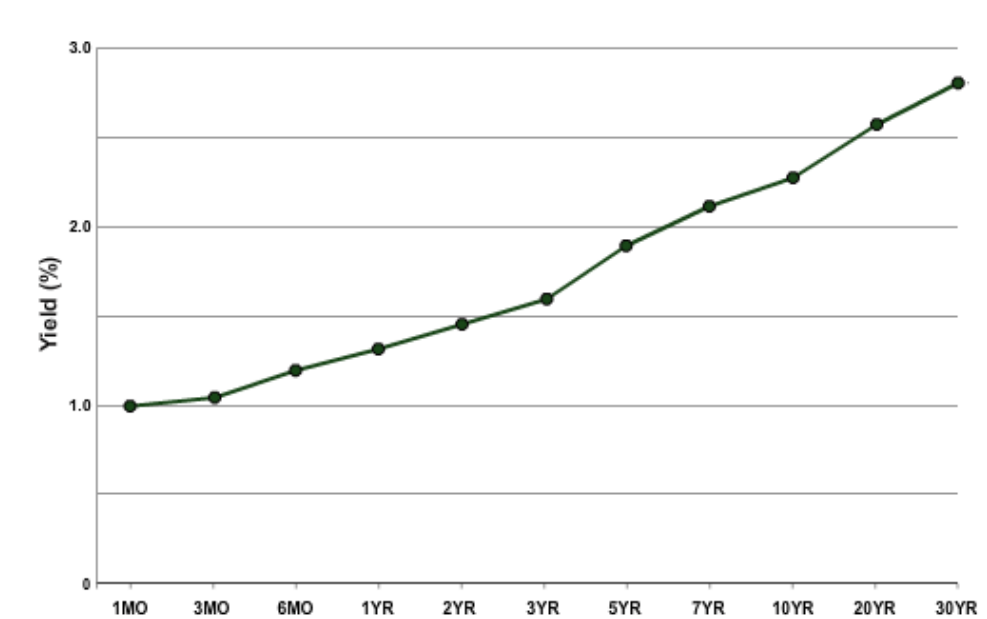
A steep yield curve means…
The spread between long and short-term rates rises (better to hold long-term bonds as they have much higher rates)
Occurs during periods of economic expansion and signals positive economic sentiment
A flat yield curve means…
There is very little difference between having short term bonds and long term bonds
It might signal uncertainty in the market; investors are reticent to commit to either short or long term bonds
Could signal a transition from a normal curve to an inverted one
The Central Bank might be maintaining a steady inflation rate while gradually changing MP
An Inverted Yield Curve means…
Securities with longer maturities yield less than short term securities
Can be influenced by CB MP, investor uncertainty, and global events
The main determinants of the yield curve are changes in monetary policy and inflation expectations
It might signal a recession; often the yield curve is inverted before a recession occurs