Chapter 14 - DNA Structure and Function
 Call Kai
 Learn
Learn Practice Test
 Spaced Repetition
 Match
Match Flashcards
 Knowt Play
1/60

There's no tags or description
Looks like no tags are added yet.
Name | Mastery | Learn | Test | Matching | Spaced | Call with Kai |
|---|
No analytics yet
Send a link to your students to track their progress
61 Terms
Mitochondrial DNA is inherited only from the
mother
One set of 23 human chromosomes represents the human
haploid genome
Transformation discovered by _______
Griffith
Transformation
a chemical substance from one cell can pass information to another cell
R strain; S strain
was not deadly to mice; deadly
Transformation Experiment
-Inject R —→mouse lives
-Inject S —→mouse dies
-Inject S destroyed by heat —→ mouse lives
-Inject a mixture of destroyed S with live R —→ mouse dies!
Transforming factor
Genetic material escaped from the dead S cells and entered the live R cells.
Avery, McCarty, and MacLeod Discovered
the CAUSE of transformation
____ is responsible for the genetic transformation.
DNA
Hershey and Chase Confirmed that DNA was responsible
How:
--They used bacteriophage with either the DNA or the protein labeled.
--They looked to see if DNA or protein was injected into bacteria (to turn them into phage-making factories.
They showed that only rough cells given smooth cell’s DNA could be ________
transformed
The Hershey and Chase Experiment
-Label DNA with 32P (no P in proteins). If it enters the cell, then DNA is the genetic material
-Label bacteriophage proteins with 35S (no S in DNA). If it enters the cell, then protein is the genetic material.
When Phage infect bacteria, the _________ is injected into the bacterium. The phage stays outside.
genetic material
If phage DNA enters the bacterial cell _________
DNA must be the genetic material
If phage protein does NOT enter the bacterial cell ________
Protein is NOT the genetic material
Complementary Base-pairing
(Adenenine) A = T (Thymine)
(Guanine) G = C (Cytosine)
If humans have 30% A and 20 % G, what percent T and G would be expected?
50%
The Building Blocks of DNA are _________
Nucelotides
Nucleotides
have a phosphate, sugar (ribose or deoxyribose), and base (A, T, G, C or U)
Pyrimidines
nucleotide base with a single ring structure: C, T and U
Purines
nucleotide base with a double ring structure: A and G
Watson and Crick Discover _____
structure of DNA
DNA is a ________
helix
The Structure of DNA
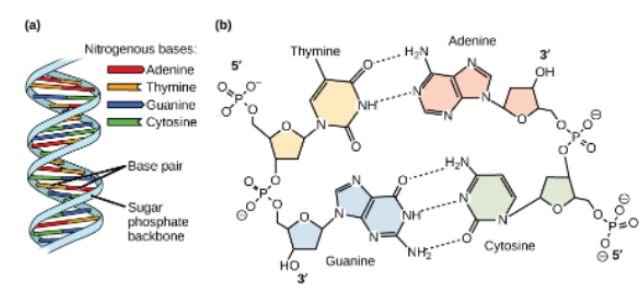
Sugar–phosphate backbones are on the outside of the helix.
Nitrogenous bases point toward center of the helix.
Complementary base pairing with H-bonds helps hold the strands together.
A always pairs with T (two hydrogen bonds).
G always pairs with C (three hydrogen bonds).
The Structure of DNA (Part 2)
Antiparallel strands run in opposite directions.
Each strand has a 5’ end (phosphate) and a 3’ end (-OH group hydroxyl).
One strands runs 5’ to 3’ from top to bottom (left), the other strand runs 5’ to 3’ from
bottom to top (right). NOTE: DNA is made in 5’-3’ direction (by adding to the 3’ end)
DNA Sequencing
Fred Sanger discovered
Dye-labeled ddNTPs are added to stop DNA chain from being synthesized at different lengths.
The DNA sequence is determined by passing the DNA fragments through a capillary tube. A laser detects each labeled ddNTP at the end of each fragment.
Three suggested models of DNA replication:
1) Conservative
2) Semi-conservative
3) Dispersive
Meselson and Stahl Showed DNA Replication is
Semi-conservative
___________ helped them distinguish new strands from old strands.
Radioisotope-labeled DNA
Semiconservative Replication Experiment Results:
New DNA is Half Heavy (15N) Half Light (14N)
DNA Replication in Prokaryotes
The single circular chromosome is replicated bidirectionally, starting at the origin
A DNA Replication Fork
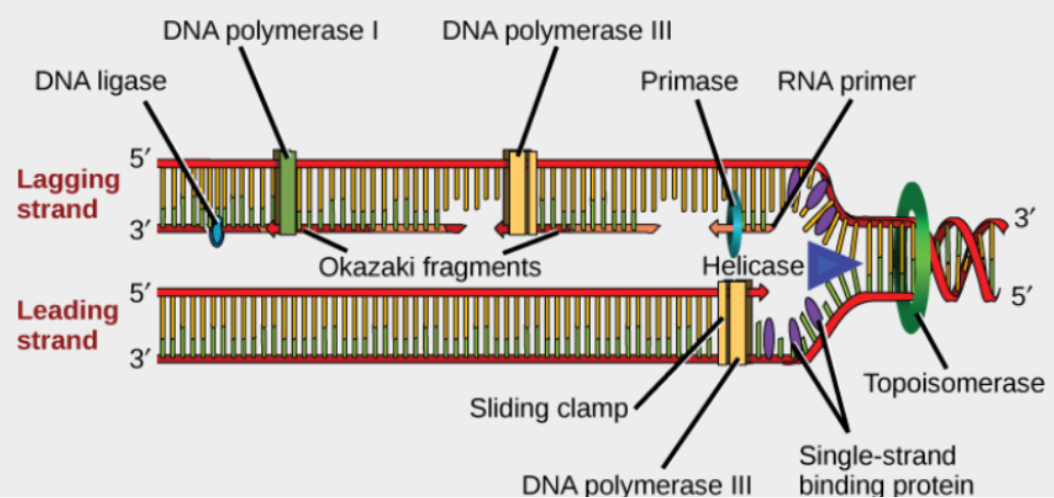
DNA replication creates a
Replication Fork
DNA is unwound by
Helicase
DNA needs help to start replication from
RNA Primers
Primase
adds the RNA primer, required for new DNA to have something to attach to.
DNA polymerase III
adds new DNA continuously in the 5’-3’ direction towards the replication fork.
RNA primers are replaced by ______
DNA Polymerase I
Leading vs Lagging
Synthesized Continuously vs Synthesized in Fragments
DNA polymerase synthesizes DNA in 5’-3’ direction away from replication fork, creating
Okakzi Fragments
DNA pol I replaces _________ with DNA
RNA Primers
DNA Ligase
Links the fragments (during lagging)
DNA Replication Summary
DNA Replication in Eukaryotes
The large, multiple, linear chromosomes are replicated bidirectionally, simultaneously from many origins.
Telomeres (Only in eukaryotes)
The sequences at the ends, known as telomeres, do not contain functional genes.
Human chromosome telomeres have
TTAGGG
Chromosomes can lose _____ base pairs with each replication
50-200
After 20–30 divisions, most cells
die
Telomerase
enzyme that adds back the telomere sequences
Telomerase is found in 90% of ______ cells
cancer
DNA Repair Corrects ________ and Damage
Mutations
If proofreading fails, ___________ can recognize incorrect base pairs
and fix them. This can only happen very soon after DNA replication.
mismatch repair
Nucleotide excision repair
can fix problems even long after DNA replication.
Mutations in ____ have been known to cause cancer.
repair genes
Proofreading
corrects errors during replication. (Done by DNA Polymerase)
Mismatch Repair
-Incorrectly added base is detected soon after replication.
-Proteins detect this base and remove it from the newly synthesized strand by nuclease action.
-The gap is now filled with the correctly paired base
Nucleotide Excision Repair
-Nucleotide excision repair can repair thymine dimers.
-When exposed to UV, thymines lying adjacent to each other can form thymine dimers. In normalcells, they are excised and replaced.
Types of Mutations in DNA
Mutations are variations in the nucleotide sequence of DNA.
Induced mutations
result from an exposure to chemicals, UV rays, x-rays, or some other environmental agent.
Spontaneous mutations
occur without any exposure to any environmental agent; they are a result of natural reactions taking place within the body.
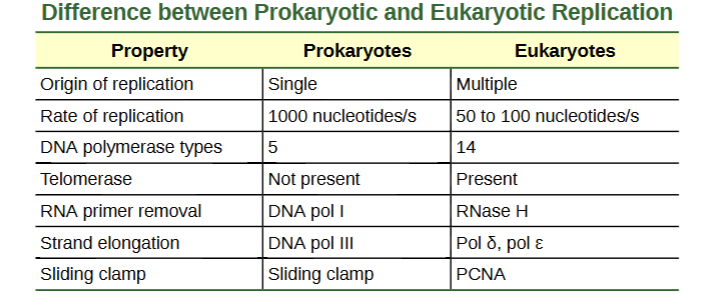
Difference between Prokaryotic and Eukaryotic DNA Replication