RP 12: Investigation of the inverse-square law for gamma radiation.
 Call Kai
 Learn
Learn Practice Test
 Spaced Repetition
 Match
Match Flashcards
 Knowt Play
1/14

There's no tags or description
Looks like no tags are added yet.
Name | Mastery | Learn | Test | Matching | Spaced | Call with Kai |
|---|
No analytics yet
Send a link to your students to track their progress
15 Terms
What is the method to investigate how the intensity of gamma radiation varies with distance? (5)
- Place the Geiger counter far from the gamma source and record the background count over a 20-minute interval.
- Bring the source into the lab and set the distance between the source and Geiger counter to 0.600 m.
- Start the stopwatch and measure the number of counts in a 5-minute period.
- Reduce the distance between the source and counter by 0.100 m each time down to 0.100 m, measuring with a metre ruler.
- For each distance, repeat the reading twice more and calculate the mean count rate.
What equipment is needed to investigate the inverse square law for gamma radiation? (4)
- Gamma source.
- Geiger counter.
- Metre ruler.
- Stopwatch.
What does a setup used to investigate how the intensity of gamma radiation varies with distance look like? (3)
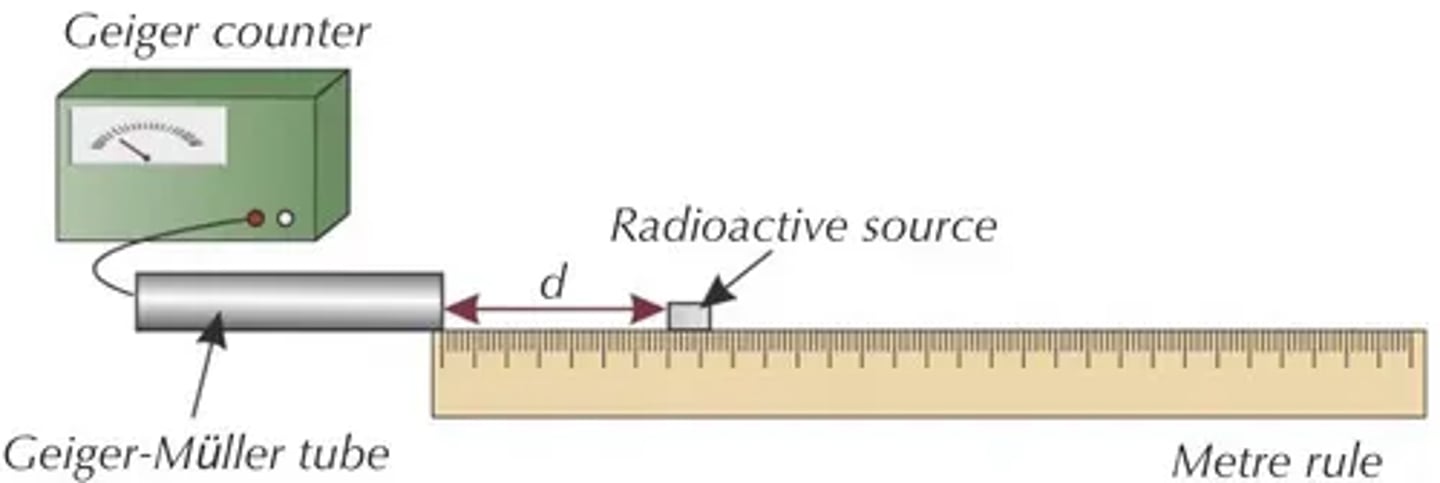
What is the independent variable in the gamma radiation experiment? (1)
The independent variable is the distance between the source and the Geiger counter.
What is the dependent variable in the gamma radiation experiment? (1)
The dependent variable is the corrected count rate (after subtracting the background count rate).
What are the controlled variables in the gamma radiation experiment? (3)
- The controlled variables are the gamma source used.
- Another controlled variable is the time duration for each count measurement.
- Another is the Geiger counter and its settings.
How is the corrected count rate obtained in this experiment? (1)
Calculate the count rate for each distance and subtract the background count to get a corrected count rate.
What graph is plotted to check the inverse-square law for gamma radiation? (1)
Plot a graph of corrected count rate against distance squared.
What does a graph plotted to check the inverse-square law for gamma radiation look like? (3)
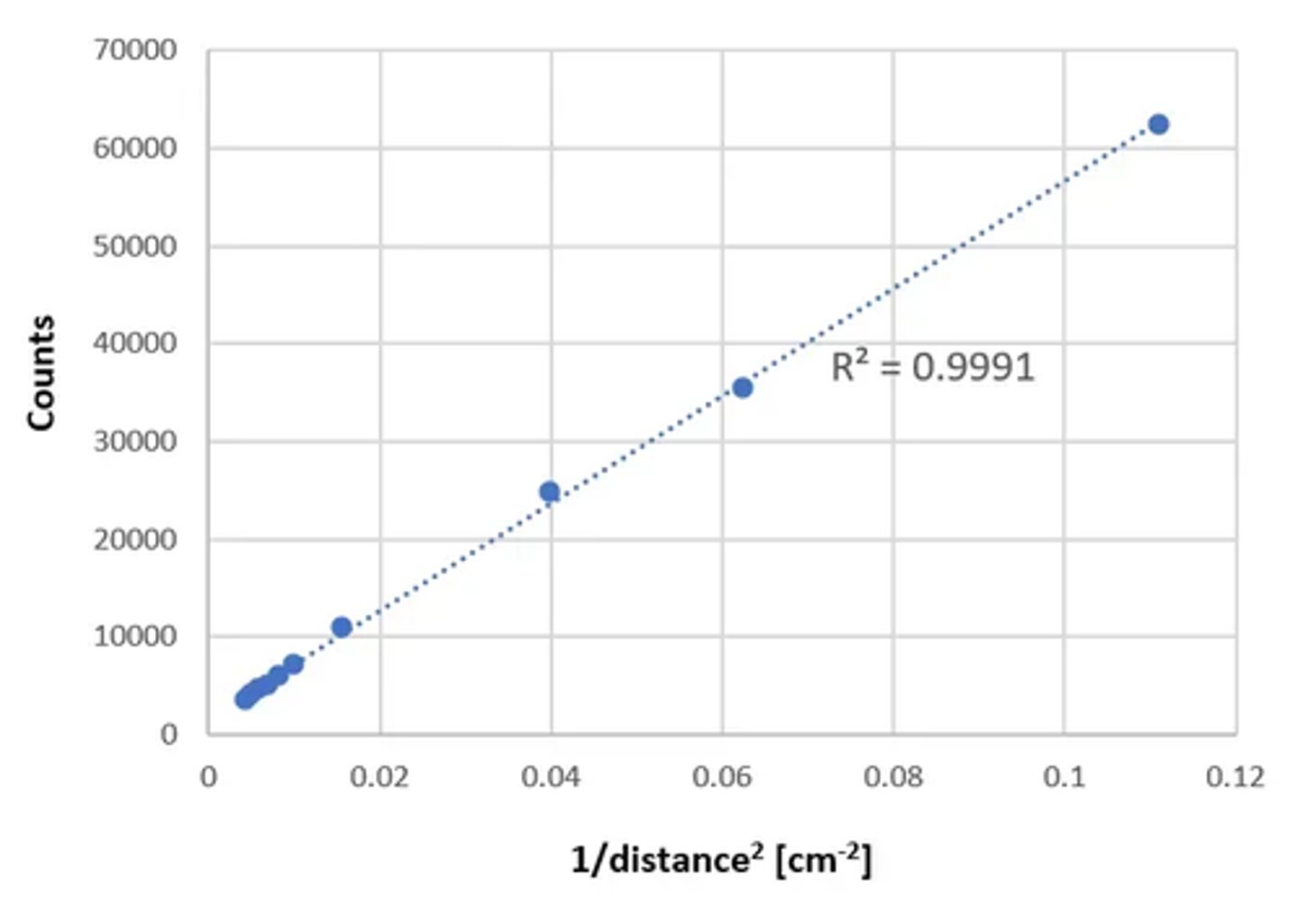
What type of graph of corrected count rate against distance squared confirms an inverse-square relationship in this experiment? (1)
A straight-line graph indicates an inverse square relationship between intensity and distance.
What is one safety precaution when handling a gamma source? (2)
- Use tongs to handle the gamma source and never touch it directly.
- Keep it as far away as possible to limit exposure due to the inverse square law.
What is another safety precaution for gamma radiation? (1)
Keep the source in a lead-lined container when not in use and minimise exposure by spending as little time near it as possible.
How should distance be measured in the inverse-square law experiment? (2)
- Measure distances as accurately as possible.
- This should ideally be from the centre of the source to the detector face.
Why might the graph not pass through the origin in the gamma experiment? (2)
- The graph may not pass through the origin due to the unknown exact position of the gamma-emitting material inside the sealed source.
- This causes a systematic error.
How can systematic error be reduced in the inverse-square experiment? (1)
Systematic error can be reduced by removing all radioactive sources from the room and resetting the counter before use.