StemUp: AQA A level Physics 3.7.3 Electric fields
 Call Kai
 Learn
Learn Practice Test
 Spaced Repetition
 Match
Match Flashcards
 Knowt Play
1/51

There's no tags or description
Looks like no tags are added yet.
Name | Mastery | Learn | Test | Matching | Spaced | Call with Kai |
|---|
No analytics yet
Send a link to your students to track their progress
52 Terms
What does Coulomb's law state? (2)
- Coulomb's law states that the force between two point charges in a vacuum is directly proportional to the product of their charges.
- It is also inversely proportional to the square of the distance between them.
What is the formula for Coulomb's law? (2)
- The formula is
F = (1 / 4πε₀) × (Q₁Q₂ / r²).
- Where F is the force (N), Q₁ and Q₂ are the magnitudes of the charges (C), r is the distance between them (m), and ε₀ is the permittivity of free space (8.85 × 10⁻¹² F/m).
What does Coulomb's law say about the direction of force between charges? (2)
- Coulomb's law states that if the charges have the same sign, the force is repulsive.
- If they have opposite signs, the force is attractive.
Where is the charge assumed to act from? (1)
The charge is treated as acting from the centre of the sphere.
Why can air be treated as a vacuum in Coulomb's law? (1)
Air can be treated as a vacuum because the difference is small, air is close enough to a vacuum for most calculations.
Why is the electrostatic force greater than the gravitational force between protons? (1)
The electrostatic force is greater than the gravitational force because the charge-to-mass ratio of protons is extremely high.
What is the gravitational force between two protons 2 × 10⁻¹² m apart? (1)
F = 4.65 × 10⁻⁴¹ N.
What is the electrostatic force between two protons 2 × 10⁻¹² m apart? (1)
F = 5.75 × 10⁻⁵ N.
How much stronger is the electrostatic force compared to the gravitational force between two protons 2 × 10⁻¹² m apart? (2)
- The calculation is 5.75 × 10⁻⁵ / 4.65 × 10⁻⁴¹ = 1.24 × 10³⁶.
- So the electrostatic force is 1.24 × 10³⁶ times stronger.
What is electric field strength? (1)
Electric field strength is the force per unit positive charge in an electric field.
What does electric field strength represent? (1)
Electric field strength represents the force that a 1 coulomb charge would experience if placed in the field.
What is the direction of the electric field vector? (1)
The electric field vector points in the direction a positive charge would move.
What are the units of electric field strength? (2)
- Newtons per coulomb (N/C).
- Volts per meter (V/m).
What is the general equation for electric field strength? (2)
- The equation is E = F / Q.
- Where E is the electric field strength (N/C), F is the electric force (N), and Q is the charge (C).
When is E = F / Q used? (1)
This equation is the general definition used for all cases.
What is the equation for electric field strength in a uniform field? (2)
- The equation is E = V / d.
- Where E is the electric field strength (V/m), V is the potential difference between the plates (V), and d is the distance between the plates (m).
When is E = V / d used? (1)
This equation is used for uniform electric fields between parallel plates.
What is the equation for electric field strength in a radial field? (2)
- The equation is E = (1 / 4πε₀) × Q / r².
- Where E is the electric field strength (N/C), Q is the magnitude of the charge (C), r is the distance between the point the field strength is being calculated at and the charge (m), and ε₀ is the permittivity of free space (8.85 × 10⁻¹² F/m).
When is E = (1 / 4πε₀) × Q / r² used? (1)
This equation is used for calculating field strength in radial fields.
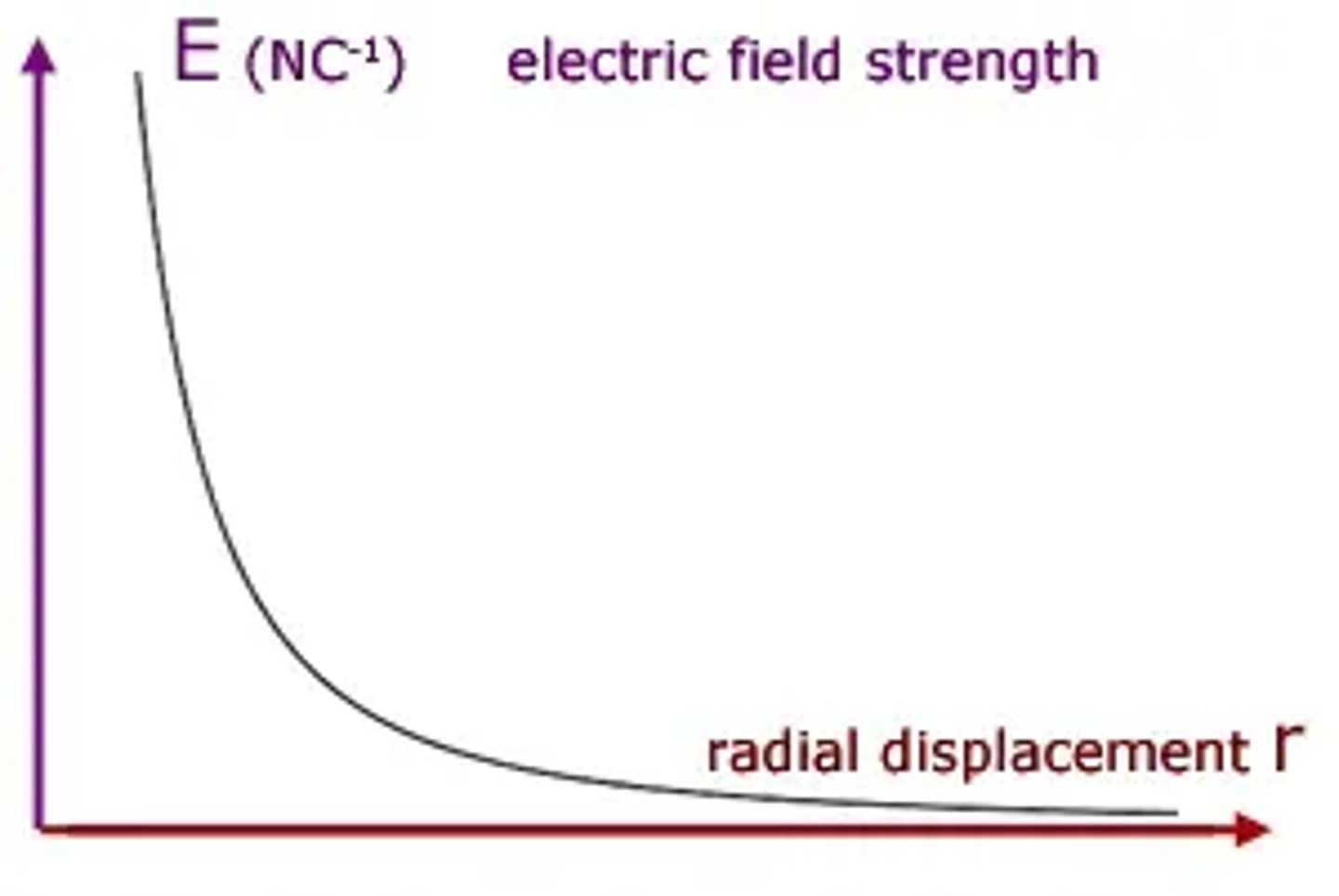
What does a graph of electric field strength against radial distance look like? (2)
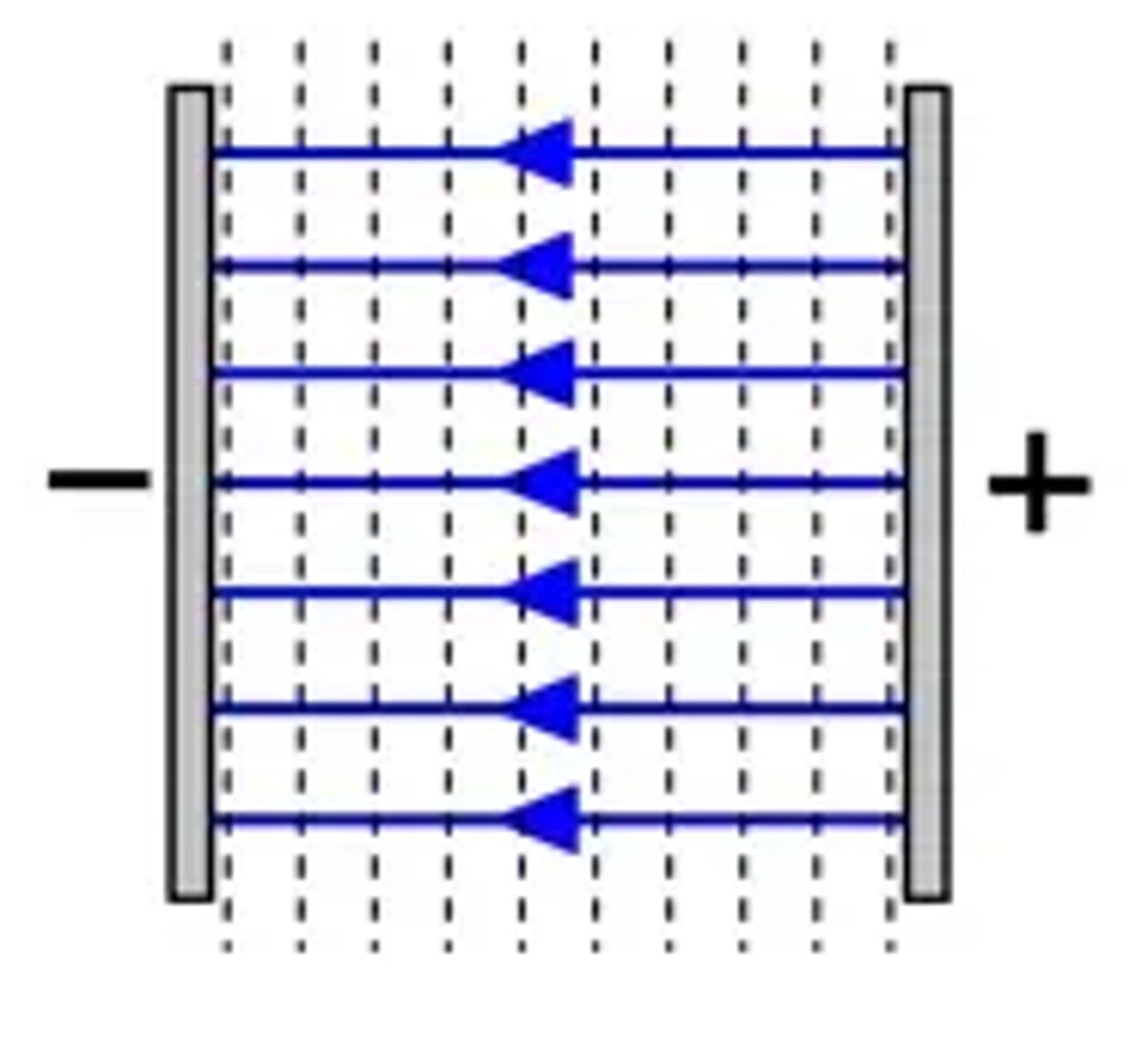
What do field lines look like in a uniform electric field? (2)
- Field lines in a uniform electric field are parallel and equally spaced.
- This shows a constant field strength.
What does a uniform electric field look like? (2)
What do field lines look like in a radial electric field? (2)
- Field lines in a radial electric field diverge from or converge toward a point charge.
- This shows that field strength decreases with distance.
What does a radial electric field look like? (2)
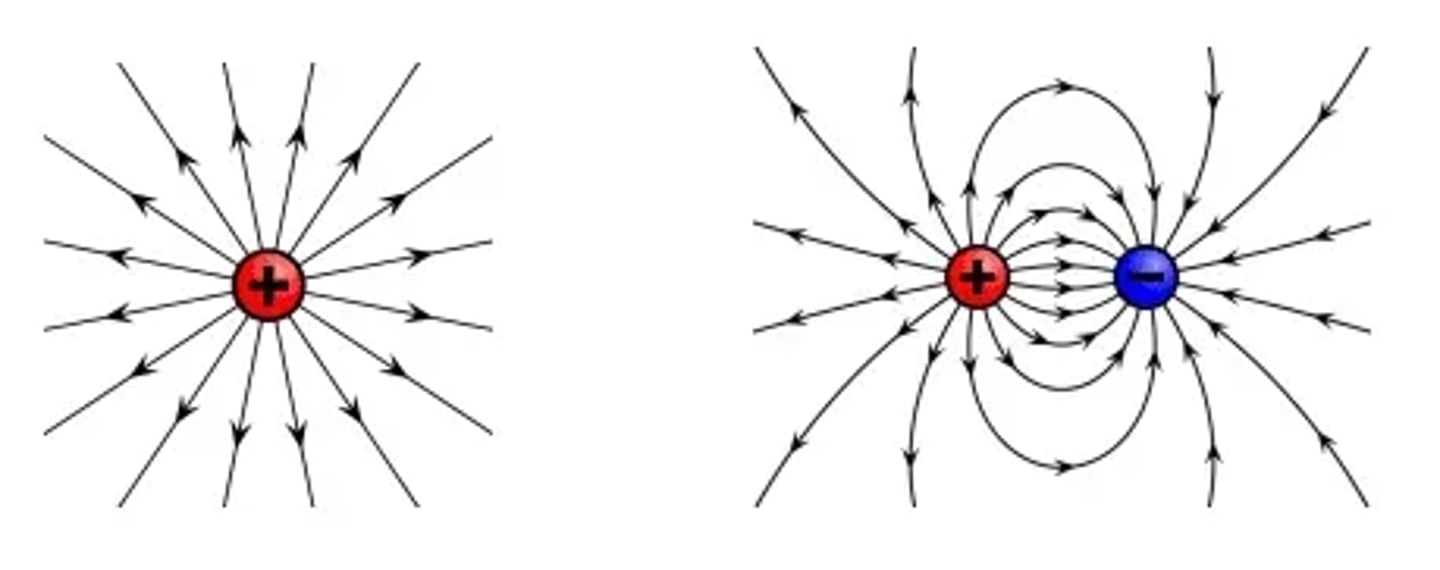
What determines field line direction in a radial field? (1)
Field lines point away from positive charges and toward negative charges.
How is a uniform electric field produced? (2)
- A uniform electric field is produced by connecting two parallel plates to opposite terminals of a battery.
- This produces a potential difference between the plates.
What direction do field lines go in a uniform field between plates? (1)
Field lines go from the plate at higher potential to the plate at lower potential in a uniform field.
What is the field strength like between two charged parallel plates? (1)
The field strength between two charged parallel plates is uniform and constant throughout.
How is the equation for the work done between two charged parallel plates derived? (5)
- The work done is W = F × d.
- Force can be rewritten using electric field strength (E) to get
F = EQ.
- The distance is rewritten using electric field and voltage d = V / E.
- F and d are substituted in to get W = QV.
- Where W is work done (J), Q is charge (C), and V is potential difference (V).
How does a charged particle behave in a uniform electric field? (1)
A charged particle experiences a constant electric force parallel to the field lines.
What type of trajectory does a charged particle follow in a uniform field? (1)
A charged particle follows a parabolic path, similar to projectile motion, in a uniform field.
How can the direction of a particle's path indicate its charge? (2)
- If the particle's path curves in the direction of the field, it is positively charged.
- If it curves against the field, it is negatively charged.
What is absolute electric potential at a point? (1)
Absolute electric potential is the potential energy per unit charge of a positive point charge at that point in the field.
Where is electric potential highest near a charge? (1)
Electric potential is greatest at the surface of the charge.
How does electric potential change with distance in a radial field? (2)
- Electric potential decreases with distance.
- It approaches zero at infinity.
How do you find total electric potential in a system with multiple charges? (1)
Add the individual potentials from each point charge at that location.
What potential does a positive charge create? (1)
A positive charge creates a positive potential.
What is the force on another positive charge near a positive charge? (1)
The force is repulsive.
What potential does a negative charge create? (1)
A negative charge creates a negative potential.
What is the force on a positive charge near a negative charge? (1)
The force is attractive.
What is the equation for electric potential in a radial field? (2)
- The equation is V = Q / (4πε₀r).
- Where V is electric potential (V), Q is the point charge (C), ε₀ is the permittivity of free space (F/m), and r is the distance from the charge (m).
What does a graph of electric potential against distance look like? (2)
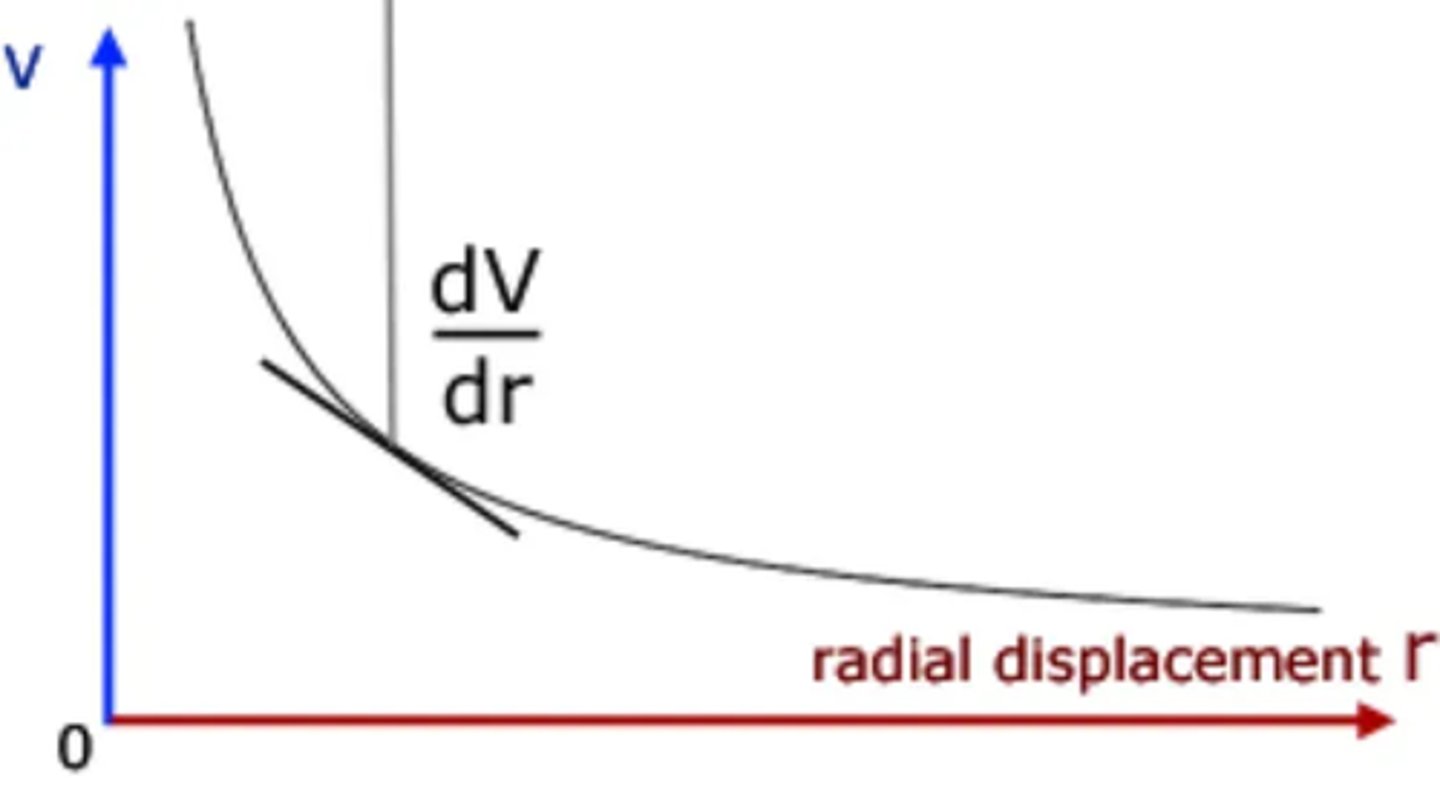
How do you determine electric field strength from a graph of electric potential against distance? (2)
- Draw a tangent to the graph at the point of interest.
- Find the gradient of the tangent and multiply it by -1.
What is the equation for electric field strength in terms of potential gradient? (2)
- The equation is E = ΔV / Δr.
- Where E is electric field strength (V/m), ΔV is change in potential (V), and Δr is the distance (m).
What is electric potential difference? (1)
Electric potential difference is the energy needed to move a unit charge between two points.
What is the formula for work done using electric potential difference? (2)
- The formula is ΔW = QΔV.
- Where ΔW is work done (J), Q is charge (C), and ΔV is potential difference (V).
What are equipotential surfaces in an electric field? (1)
Equipotential surfaces are surfaces where the electric potential is constant.
How much work is done moving a charge along an equipotential surface? (2)
- No work is done.
- This is because there is no change in electric potential.
What do equipotential surfaces look like in a uniform electric field? (1)
Equipotential surfaces are evenly spaced planes in a uniform electric field.
What do equipotential surfaces look like in a radial electric field? (1)
Equipotential surfaces in a radial electric field are concentric circles (circles with the same centre but different radii) centred on the charge.
How do you find potential difference from an electric field strength against distance graph? (1)
The potential difference is the area under the graph.
What does the area under an electric field strength against distance graph represent? (1)
The area under the graph represents the energy per unit charge required to move between two points.