Shapes of molecules.
 Call Kai
 Learn
Learn Practice Test
 Spaced Repetition
 Match
Match Flashcards
 Knowt Play
1/9

Earn XP
Description and Tags
https://www.youtube.com/watch?v=lmPiydJfGrk
Name | Mastery | Learn | Test | Matching | Spaced | Call with Kai |
|---|
No analytics yet
Send a link to your students to track their progress
10 Terms
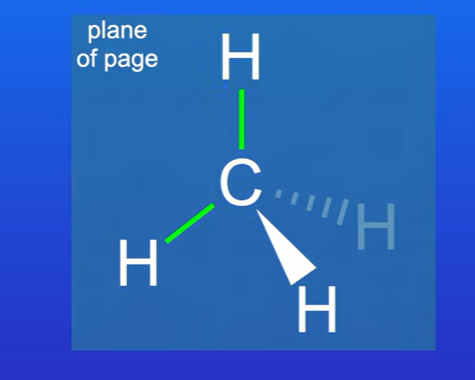
What do solid lines tell us in the structure of methane / compounds
The two bonds lie on the plane of the screen, or the page
That means that these two hydrogen atoms also lie on the plane of the page
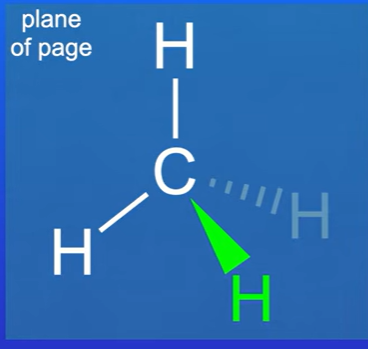
What does solid wedge tell us in structure of methane / compounds
Tells us that this bond is coming out of the plane of the page
This means that this hydrogen atom is also coming out of the plane of the page
What does dotted wedge tell us
The bond is projecting back behind the plane of the page, means hydrogen is behind the plane of the page
Electron pair repulsion theory
The shape of a molecule is determined by the electron pairs surrounding the central atom.
We are only referring to the outer shell in this case
This is based on the fact that pairs of electrons repel all of the otheer electron pairs.
The electron pairs now move as far apart as possible to minimise this repulsion.

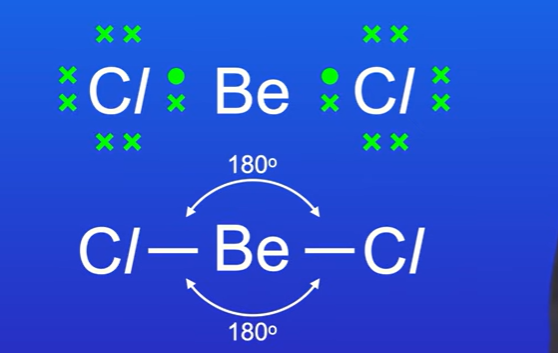
Work out bond angles of beryllium chloride.
Cenntral atom is beryllium, this is covalently bonded to two atoms of chlorine, 2 electron pairs around the central atom
These two pairs of electrons repel each other and move as far apart as possible.
The furthest they cna move apart is in a straight line like this, its said they have a linear structure,
Angle between these two bonds is 180 degrees
What happens if a central atom has two bonding areas.
Will have linear shape with 180 degrees bond angle. Not the case if atom has lone pair of electrons

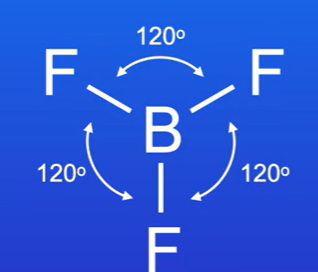
What is bond angle in boron trifluoride ( 3 bonding areas)
The bonds repel and arrange themselves towards the points of a triangle.
The bond angle between them is 120 degrees. It is called trigonal, as its based on a triangle,
If its viewed from the side, its flat, this means its planar (flat).
This shape is called trigonal planar.
What happens if molecule has 4 bonding areas
We have a tetrahedral molecule.
All bond angles in tetrahedral molecules are 109.5 degrees.
What happens if we have molecule with 6 bonding areas
The shape is called octahedral.
Bonds pointing up and down are at 90 degrees to the central plane.
The angle between bonds lying on central plane is also 90 degrees.