Judgements and probabilities
 Call Kai
 Learn
Learn Practice Test
 Spaced Repetition
 Match
Match Flashcards
 Knowt Play
1/36

There's no tags or description
Looks like no tags are added yet.
Name | Mastery | Learn | Test | Matching | Spaced | Call with Kai |
|---|
No analytics yet
Send a link to your students to track their progress
37 Terms
What is a judgement?
Calculating likelihood of events using incomplete information. E.g. given past experience, how well will I do in next exam.
Different from ‘decision’, actively choosing 1 from number of possible actions. E.g. multiple choice exam, judgement about likelihood each option correct.
How does judgement differ from decision?
Before making decision, likely to make judgement about likelihood of events using incomplete information.
Tends to lead to decision
What is hit (sensitivity) in disease diagnosis?
Positive result if you have disease
What is ‘miss’ in disease diagnosis?
Negative result if you have disease
What is correct rejection (specificity) in disease diagnosis?
Negative result if you don’t have disease
What is false alarm in disease diagnosis?
Positive result if you don’t have disease.
How does base rate (prevalence rate) link to disease diagnosis?
Low base rate (1% population) → even if positive result more likely to think false alarm.
High base rate (50% population) → more likely to think it’s a miss.
What is Bayes’ Theorem (Thomas Bayes)?
Probability of an event, based on current information and prior beliefs.
What is Bayes’ rule?
Posterior ∝ likelihood x prior
How can Bayes’ rule be applied to disease diagnosis?
Prior = probability of having disease (base rate).
Likelihood= probability of test result (e.g. positive) given that you have the disease.
Posterior = belief that you have disease given the test result.
How do probabilities link to Bayes’ rule?
Prior → p(H) – probability of hypothesis being correct.
Likelihood → p(D|H) – probability of data GIVEN hypothesis.
Posterior → p(H|D) – probably of hypothesis GIVEN data.
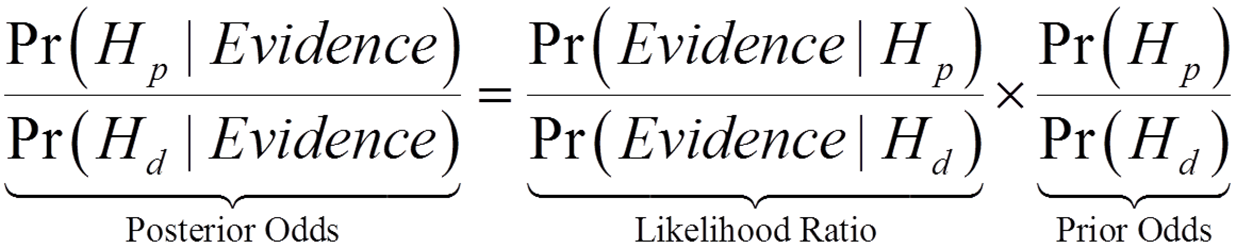
What is odds ratio version of Bayes’ rule used for?
Comparing two hypotheses (e.g. having disease vs not having disease).
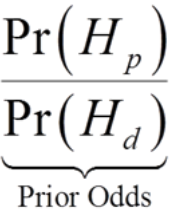
What is prior odds in odds ratio version of Bayes’ rule?
Ratio of probability for one hypothesis over another before seeing the data.
What is likelihood ratio in odds ratio version of Bayes’ rule?
Ratio of probability for data given hypothesis 1 vs 2.
What are posterior odds in odds ratio version of Bayes’ rule?
Ratio of probability for hypothesis 1 vs 2 given the data
What is odds ratio version of Bayes’ rule?
What did Kahneman and Tversky find in a study of base rate neglect where people had to read a description of a man Jack and asked to judge whether Jack was a lawyer or engineer in condition 1 (70 lawyers, 30 engineers) or 2 (30 lawyers, 70 engineers) where Jack was said to be present in both conditions?
90% said engineer, regardless of 70:30 or 30:70 split.
Ignored base rate, based more on description given of Jack.
What did Cascell et al (1978) find in study of faculty and advanced students at Harvard medical school when given statement → –“If a test to detect a disease whose prevalence is 1/1000 has a false positive rate of 5%, what is the chance that a person found to have a positive result actually has the disease, assuming that you know nothing about the person’s symptoms or signs?”
45% of ppts said 95% (i.e. 1 false positive rate). Actual answer 2%.
Neglect of base rate even among trained professionals.
What did Tversky and Kahneman find in study of conjunction fallacy using bank teller problem → “Linda is 31 years old, single, outspoken & very bright. She majored in philosophy. As a student, she was deeply concerned with issues of discrimination and social justice, and also participated in anti-nuclear demonstrations”
Is Linda:
1.A bank teller
2.A bank teller active in the feminist movement?
Many choose statement (2), despite (1) being inclusive of statement (2).
Conjunction fallacy.
What is conjunction fallacy?
Mistaken assumption that probability of conjunction of two events > probability of one of them.
How can bank teller problem and conjunction fallacy be criticised?
Maybe we value precision/specificity → i.e. balance between probability of being correct and specificity of answer.
We may ignore redundant information in answers,i.e. given ‘bank teller’ in both answer, that must be true so we focus on extra info.
What is the representative heuristic?
Assume object/individual belongs to specific category because it is representative.
What is availability heuristic?
Frequencies of events estimated by ease of memory retrieval
E.g. estimate probability of contracting disease based on number of people you know with disease
What did Lichenstein (1978) find in a study of likelihood of causes of death and the availability heuristic?
Publicised estimated higher probability than non-publicised → e.g. murder vs suicide
What did Pachur et al (2012) find as the three main drivers for availability heuristic?
Direct experiences
Emotional responses (affect heuristic)
Media coverage
E.g. risk of being involved in terrorist attack rated highly cause high emotional response and lots of media coverage
What did Oppenheimer (2004) find in study of reversed availability heuristic where ppts had to say which surname more common, famous or non famous?
Ppts more often chose non-famous despite ‘availability’ of famous surname.
However, availability of famous name perhaps reduced as only retrieving instances related to specific individual vs all individuals with non famous surname.
Why are heuristics important?
Important in explaining possible reasons we aren’t always optimal or logical.
How are heuristics criticised?
Somewhat vaguely defined
Doesn’t define WHEN specific heuristics used
Not necessarily biased processing but poor information
List of heuristics doesn’t equate to theory.
What is dual process theory (Kahneman)?
Judgements based on two distinct systems
System 1 → fast, automatic, effortless. System 2 → slow, serial, effortful
Often system 1 used → heuristics → not optimal, prone to errors
Can use system 2 to produce correct answer but often use 1 cause it’s easier.
How is dual process theory criticised?
System 2 can also lead to errors
Really evidence for hard distinction?
Both relatively ill defined, hard to predict priori which will be used and what answer it will give.
Some evidence for intuitive use of base rate
What are fast and frugal heuristics (Gigerenzer)?
Allow for rapid processing with little information, useful.
Correct high percentage of time
Trade off between time and accuracy
What is recognition heuristic?
Select object that is recognised
E.g. most (in UK) would choose New York over Guanghzou due to familiarity when asked which is bigger.
What did Goldstein and Gigerenzer (2002) find in relation to recognition heuristic when US students chose between 2 German cities?
Chose recognised city 90% of time
What did Pachur et al find in criticism for recognition heuristic?
Doesn’t make sense in some situations, e.g. which city further North
0.64 correlation between validity and usage
What did Richter and Spath (2006) find in study of recognition heuristic where German students judged which of two US cities is bigger, given additional information about which city has an international airport?
When recognised city has an airport, ppts chose the recognised city 98% of time.
When unrecognised city had an airport, ppts chose recognised city only 82% of time
Recognition combined with another cue
What is support theory of judgement?
An event appears more or less likely depending on how it is described
Explicit description draws attention to aspects of event less obvious in non explicit description
Memory limitations may prevent people remembering all the relevant info if it is not supplied.
What is sub additivity effect?
Judged probability of the whole is less than the combined probabilities of its parts