MCAT - UWORLD behavioral sciences
 Call Kai
 Learn
Learn Practice Test
 Spaced Repetition
 Match
Match Flashcards
 Knowt Play
1/683

There's no tags or description
Looks like no tags are added yet.
Name | Mastery | Learn | Test | Matching | Spaced | Call with Kai |
|---|
No analytics yet
Send a link to your students to track their progress
684 Terms
What did Freud's psychoanalytic approach focus on in terms of human development and behavior?
how unconscious factors, such as drives and conflicts stemming from childhood, impact human development and behavior.
Define the unconscious mind as defined by the psychoanalytic approach.
part of the mind lying just beyond conscious awareness.
What is a key difference between the behaviorist perspective and the psychoanalytic perspective in psychology?
The behaviorist perspective emphasizes the scientific study of observable actions.
The psychoanalytic perspective focuses on how unconscious factors (eg, drives, conflicts stemming from childhood) influence human development and behavior.
B.F. Skinner studied the impact of reinforcement and punishment on behavior in his studies on classical conditioning. (True or False)
False.
B.F. Skinner, a behavioral psychologist, studied the impact of reinforcement and punishment in his studies on operant conditioning.
Which area of psychology takes a more holistic approach to the individual, emphasizing the higher aspects of human nature?
Humanistic psychology
Match each humanistic psychologist with their correct contribution:
Humanistic psychologists:
(1) Abraham Maslow
(2) Carl Rogers
Contributions:
(A) Emphasized the concept of unconditional positive regard
(B) Proposed that humans are motivated to achieve needs in a hierarchy of importance, and at the highest level, self-actualization
Key contributions for humanistic psychologists are listed below.
(1) Abraham Maslow – (B) Proposed that humans are motivated to achieve needs in a hierarchy of importance, and at the highest level, self-actualization (ie, fulfilling one’s greatest potential).
(2)Carl Rogers– (A) Emphasized the concept of unconditional positive regard (ie, acceptance and support, regardless of someone's behavior)
Which area of psychology takes a more holistic approach to the individual, emphasizing the higher aspects of human nature?
Suppose a researcher conducting a study on memory gives one participant group a memory training exercise and another group no training and then compares memory test scores between the groups.
This study is best described as a(n) _______________ study.
experimental
Scientists manipulate the independent variable (memory training) by giving training to only one of two groups and then measure the dependent variable (memory test scores).
This allows them to establish a cause-and-effect relationship between memory training and test performance.
Experimental studies can demonstrate a cause-and-effect relationship between variables. (True or False)
True.
In experimental studies, changes to the dependent variable are assumed to be caused by the independent variable. Therefore, experiments can demonstrate a cause-and-effect relationship between variables.
Correlational studies can demonstrate a cause-and-effect relationship between variables. (True or False)
False.
Correlational studies cannot demonstrate cause and effect between variables because no variables are manipulated.
[Reliability/Validity] refers to the extent to which an experiment or measure can consistently produce similar results every time. In contrast, [reliability/validity] refers to the accuracy of a study or measure.
Reliability refers to the extent to which an experiment or measure can consistently produce similar results every time.
validity refers to the accuracy of a study or measure.
_______ validity refers to the extent to which a measure or experiment produces a true result, while ________ validity is the extent to which study results can be applied outside the laboratory to real-life situations.
Internal
external
What is the role of ethical research?
protects vulnerable populations, minimizes risks while maximizing benefits, maintains confidentiality, and respects the rights and dignity of participants.
Define informed consent.
process of instructing potential research participants about the study, its risks, and their rights (eg, to withdraw, to have their information protected) so they can voluntarily decide to participate.
What are included in descriptive statistics?
Descriptive statistics, which describe a dataset, include:
Measure of central tendency (ie, mean, median, mode)
Variation (eg, range)
Match each descriptive statistics to its value for the following data set:
Data set: [7, 3, 2, 5, 3]
Descriptive statistics:
(1) Mean
(2) Median
(3) Mode
(4) Range
Values:
(A) 3
(B) 4
(C) 5
The descriptive statistics and their values for the given data set [7, 3, 2, 5, 3] are shown below.
(1) Mean - (B) 4
Explanation:
Mean refers to the average data point. The mean represents the sum of the data points divided by the number of data points.
(7+3+2+5+3)/5 = 20/5 = 4
(2) Median - (A) 3
Explanation:
Median refers to the middle value when the data points are arranged in numerical order. The median is the midpoint at which half the data points are above and half are below. If there is an even number of data points, the two middle data points are averaged.
2, 3, 3, 5, 7
(3) Mode - (A) 3
Explanation:
Mode refers to the most frequently occurring data point.
7, 3, 2, 5, 3
(4) Range - (C) 5
Explanation:
Range refers to the difference between the highest and lowest data points
7, 3, 2, 5, 3
7 – 2 = 5
What is the purpose of inferential statistics in research?
Inferential statistics are used to draw conclusions that reach beyond the sample's dataset.
The value of Pearson correlation coefficient r ranges from ____ to ____ and the closer r is to these margins the stronger the relationship. The sign of the r-value indicates a _______ or ______ association
correlation coefficient r
positive
negative
Match each correlation coefficient r value with its correct indication:
Values:
(1) r = +0.5
(2) r = 0
(3) r = -0.5
Indications:
(A) As one variable increases, the other decreases
(B) Both variables increase or decrease together
(C) Lack of linear relationship between variables
The correlation coefficient r value with its correct indication are shown below:
(1) r = +0.5 – (B) Both variables increase or decrease together
Explanation:
A positive correlation (r > 0) means both variables increase or decrease together.
(2) r = 0 – (C) Lack of linear relationship between variables
Explanation:
A lack of linear relationship between variables is called a zero correlation.
(3) r = -0.5 – (A) As one variable increases, the other decreases
Explanation:
A negative correlation (r < 0) means that as one variable increases, the other decreases.
An r-value gives information about the causal nature of changes between two variables. (True or False)
False.
An r-value does not give information about the causal nature of changes between two variables.
Because a correlation describes relationships, it does not imply causation.
(1) Gray matter
(2) White matter
Statements:
(A) Myelinated axons that allow for long-distance communication between neurons
(B) Unmyelinated axons, neuronal cell bodies, and dendrites
The CNS is composed of white matter and gray matter.
(1) Gray matter – (B) unmyelinated axons, neuronal cell bodies, and dendrites
(2)White matter– (A) myelinated axons that allow for long-distance communication between neurons
(1) Sympathetic division
(2) Parasympathetic division
Functions:
(A) Promotes energy conservation and storage when stress is low
(B) Mobilizes the body for action during stress
Each division of the autonomic nervous system and its function are shown below.
(1) Sympathetic division – (B) Mobilizes the body for action during times of stress
(2) Parasympathetic division – (A) Promotes energy conservation and storage when stress is low
What are the two branches of the peripheral nervous system?
Autonomic nervous system
Somatic nervous system
How does the sympathetic division of the autonomic nervous system function during stress?
The sympathetic ("fight or flight") division mobilizes the body for action during stress by:
Providing greater oxygen delivery to skeletal muscles
Increasing heart rate
Increasing dilation of airways
Constricting blood vessels supplying blood to visceral organs
All movements carried out on a voluntary basis involve the autonomic nervous system. (True or False)
False.
All movements carried out on a voluntary basis involve the somatic nervous system.
Note: The autonomic nervous system controls functions that are not subject to voluntary control.
Describe two types of neurons found in the somatic nervous system.
The somatic nervous system includes:
Sensory neurons that relay information from the body to the CNS
Motor neurons that relay commands from the CNS to the body
The ___________ nervous system consists of all neurons located outside the brain and spinal cord.
peripheral
The _________ nervous system integrates, processes, and coordinates sensory data and motor commands.
central
Which division of the autonomic nervous system is most active in a relaxing setting, and what related changes would be expected to occur in the body?
The parasympathetic division is most active in a relaxing (ie, low stress) environment.
Expected changes in the body would promote energy conservation and storage and include:
Lowered heart rate
Decreased airflow through the lungs
Increased blood flow to visceral organs
Promotion of digestive processes.
The sympathetic nervous system innervates the adrenal glands, stimulating them to secrete ___________ and ____________.
norepinephrine
epinephrine
Describe the pathways of afferent and efferent bundles of axons in the spinal cord.
Afferent (ascending) bundles of axons carry sensory information to the brain via the spinal cord.
Efferent (descending) bundles of axons in the spinal cord carry motor commands from the brain to the body.
Efferent neurons send signals toward the brain, and afferent neurons carry messages away from the brain. (True or False)
False.
Afferent neurons send signals toward the brain, and efferent neurons carry messages away from the brain.
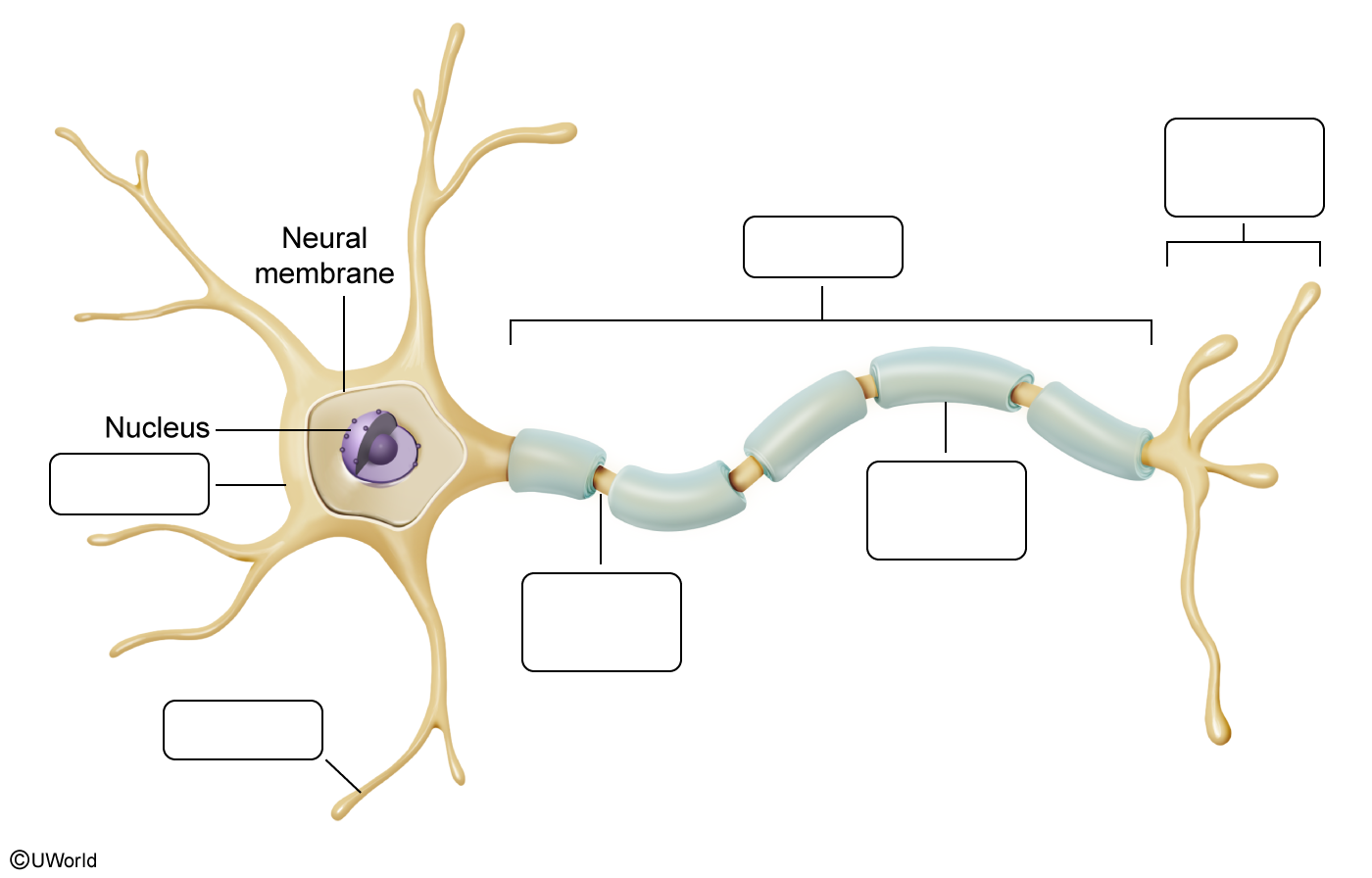
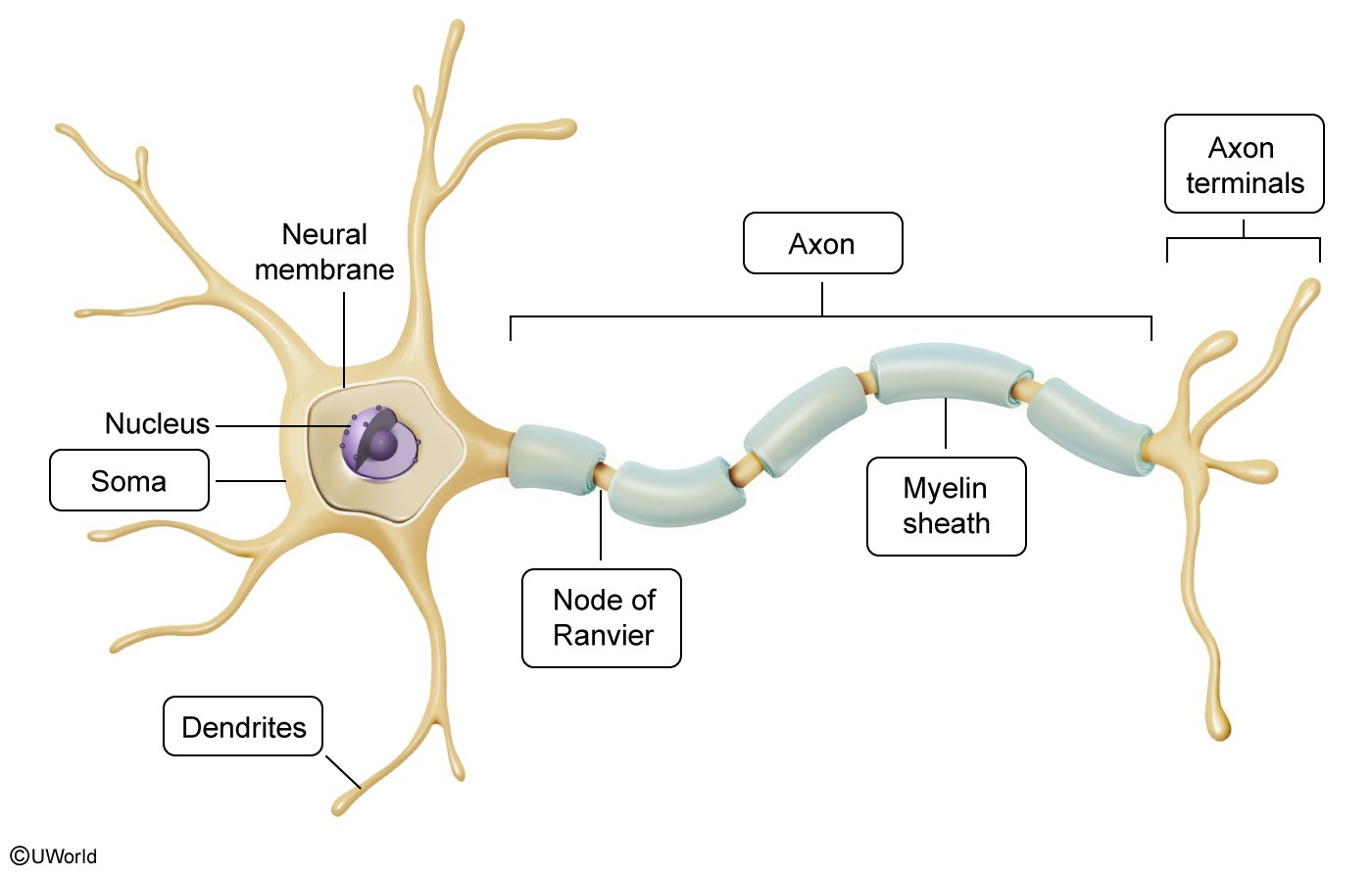
The nodes of Ranvier are small, regularly spaced interruptions in the _______ ________along the length of the axon.
myelin sheath
What is the correct order of the events below in chemical synaptic transmission?
(A) Neurotransmitters bind to postsynaptic receptors.
(B) Action potential reaches presynaptic axon terminal.
(C) Neurotransmitters are released into the synaptic cleft.
(D) Ions flow into or out of the postsynaptic neuron, altering its resting membrane potential.
Correct order: B, C, A, D
At chemical synapses:
(B) An action potential reaches the presynaptic axon terminal.
(C) Neurotransmitters are released into the synaptic cleft.
(A) Neurotransmitters bind to postsynaptic receptors.
(D) Ions flow into or out of the postsynaptic neuron, altering its resting membrane potential.
What type of cell provides support functions to neurons and the nervous system?
glial cells
What is the role of myelin in the propagation of an action potential?
Myelin greatly increases the speed with which the action potential travels down the axon by insulating the axon.
________ mimic or enhance the effects of a neurotransmitter.
________ block or reduce the effects of a neurotransmitter.
Agonists
Antagonists
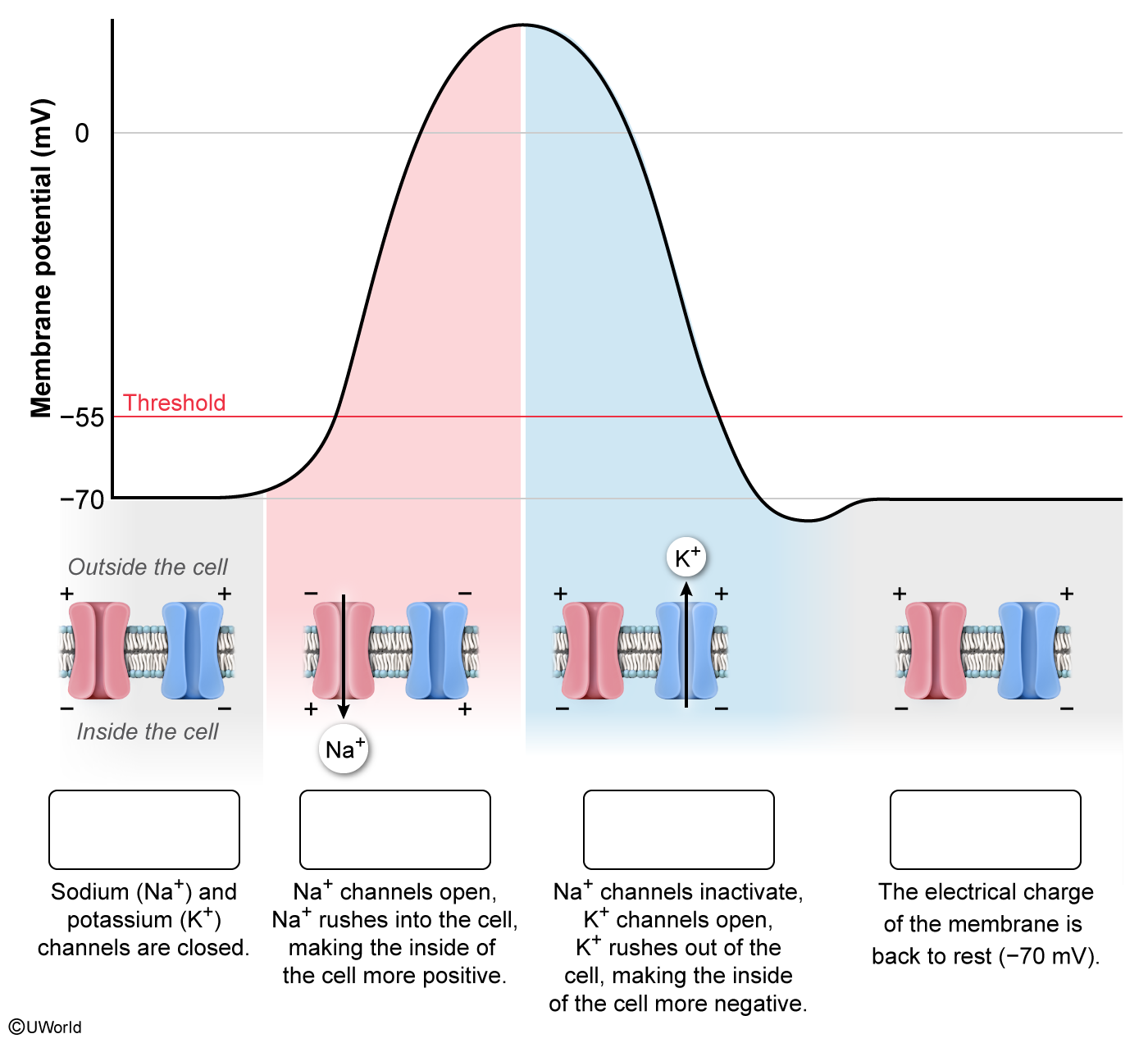
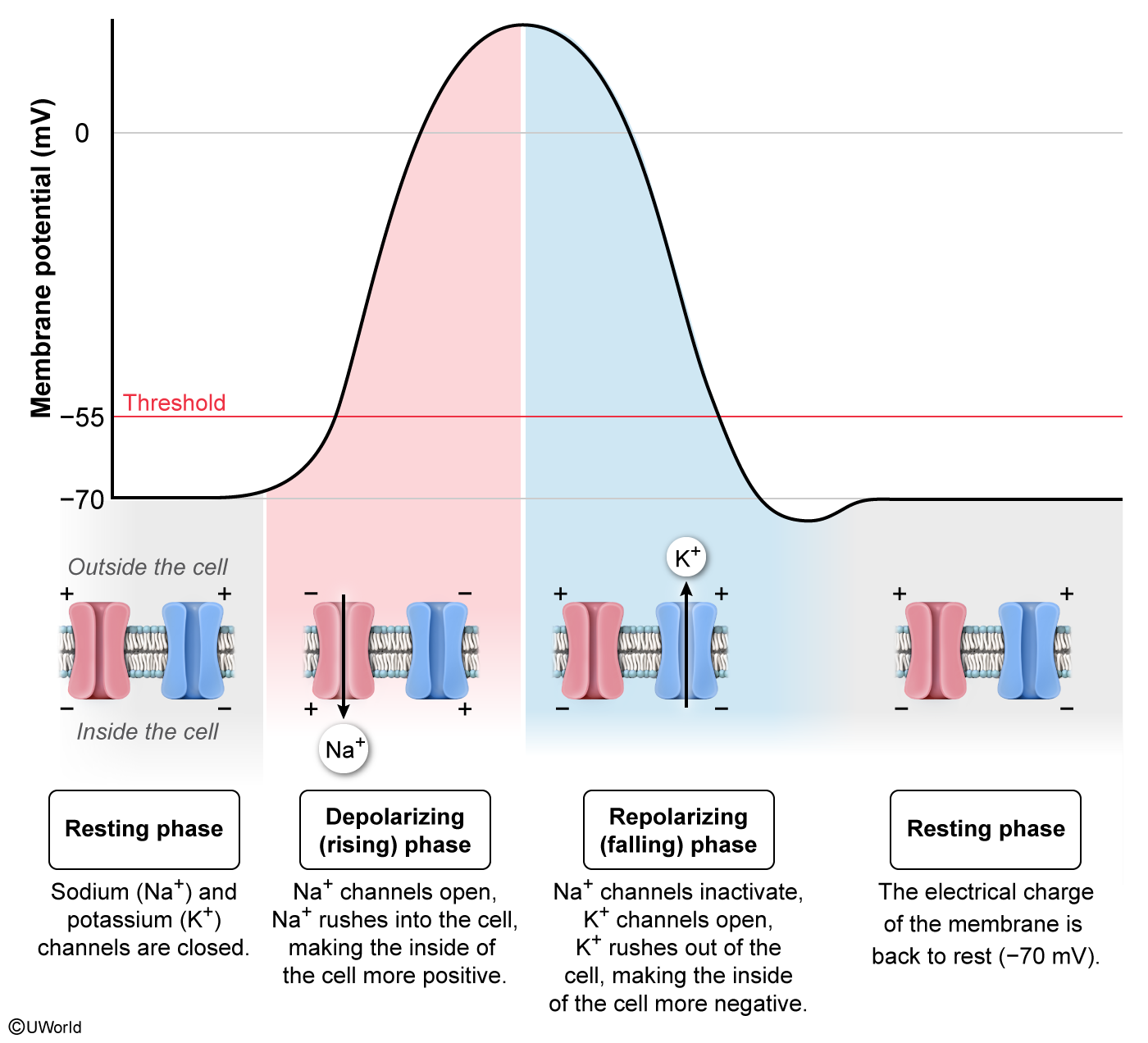
What is a synapse?
a junction formed between the axon terminal of a presynaptic neuron and the dendrites (in most cases) of a postsynaptic neuron, where neurotransmitters are released.
Describe the difference between an excitatory synapse and an inhibitory synapse.
Excitatory synapses: membrane potential of the postsynaptic neuron becomes more positive (ie, depolarizes), and if it exceeds threshold, an AP is initiated.
Inhibitory synapses: neurotransmitters affect the postsynaptic neuron by causing the cell’s the membrane potential to become more negative, inhibiting AP initiation.
The resting membrane potential (RMP) of neurons is due primarily to the high concentration of ____________ ions and the low concentration of ____________ ions inside neurons compared to outside.
potassium ions
sodium ions
Define dendrites and state their function.
branches that extend from the cell body and receive input from other neurons when neurotransmitters bind to postsynaptic receptors, causing the neuron to respond.
list 1-2 examples of how glial cells function.
Provide structural support and chemical buffering for neurons
Produce cerebrospinal fluid
Serve as immune cells in the brain
Form myelin sheaths around neurons' axons
(1) Gamma-aminobutyric acid (GABA)
(2) Glutamate (Glu)
(3) Glycine
Definitions:
(A) Primary excitatory neurotransmitter of the CNS; Involved in learning and memory
(B) Primary inhibitory neurotransmitter of the spinal cord
(C) Primary inhibitory neurotransmitter of the brain
(1) Gamma-aminobutyric acid (GABA) – (C) Primary inhibitory neurotransmitter of the brain
(2) Glutamate (Glu) – (A) Primary excitatory neurotransmitter of the CNS; Involved in learning and memory
(3) Glycine - (B) Primary inhibitory neurotransmitter of the spinal cord
__________ are opioids produced by the body that, similar to morphine, modulate pain, as well as contribute to elevated mood following exercise.
Endorphins
What is the absolute refractory period?
the time during which no new action potentials can be generated, regardless of the strength of the stimulus received.
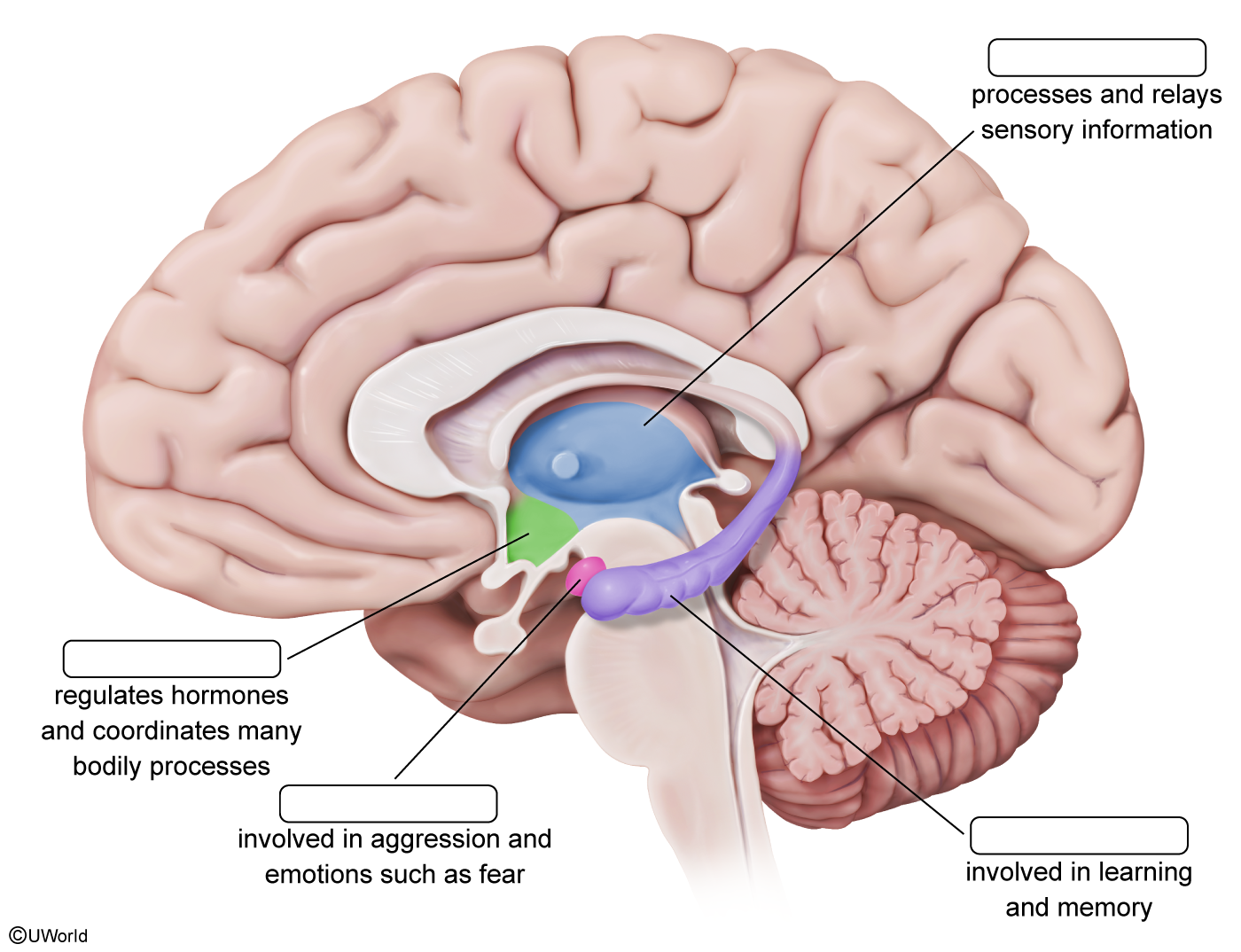
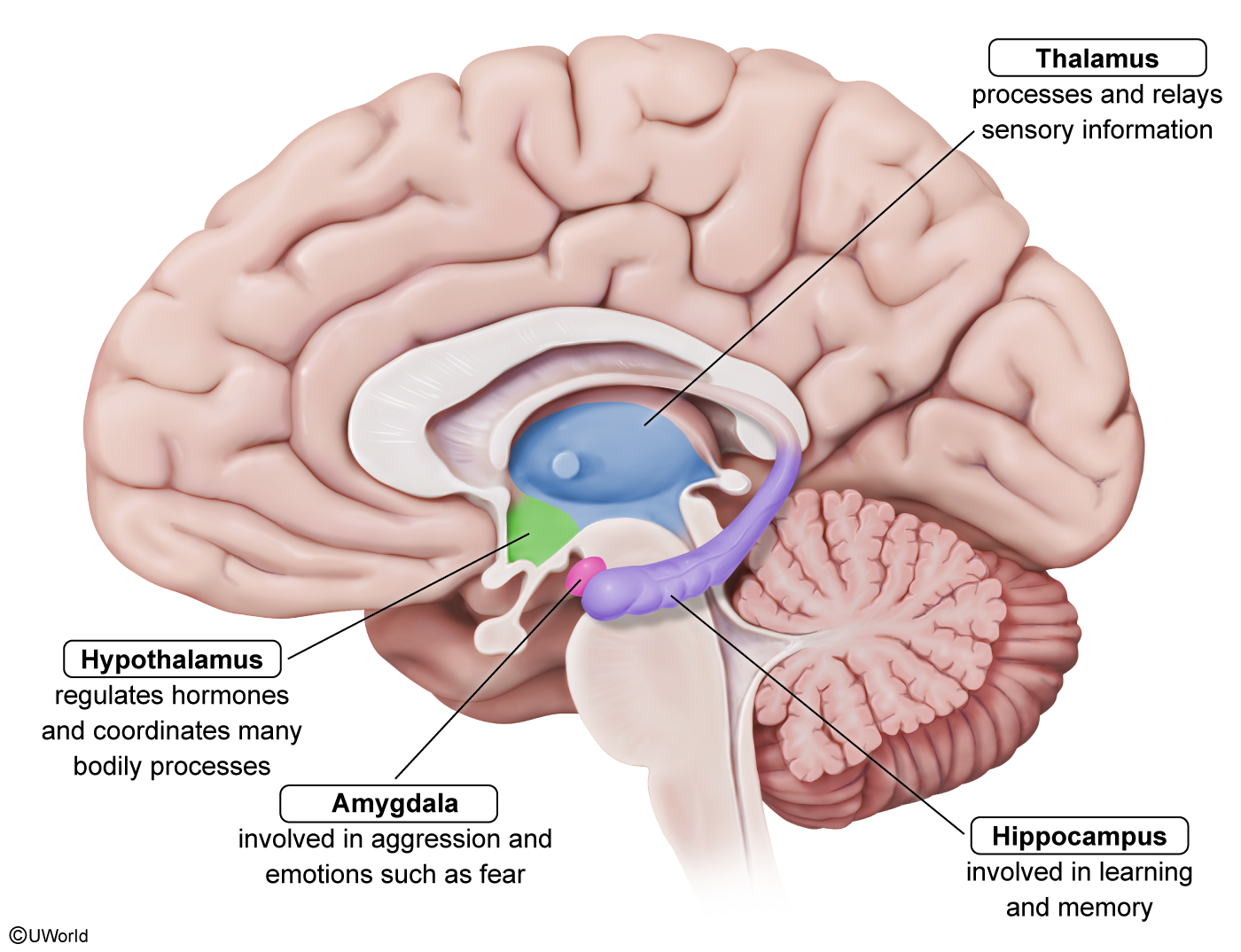
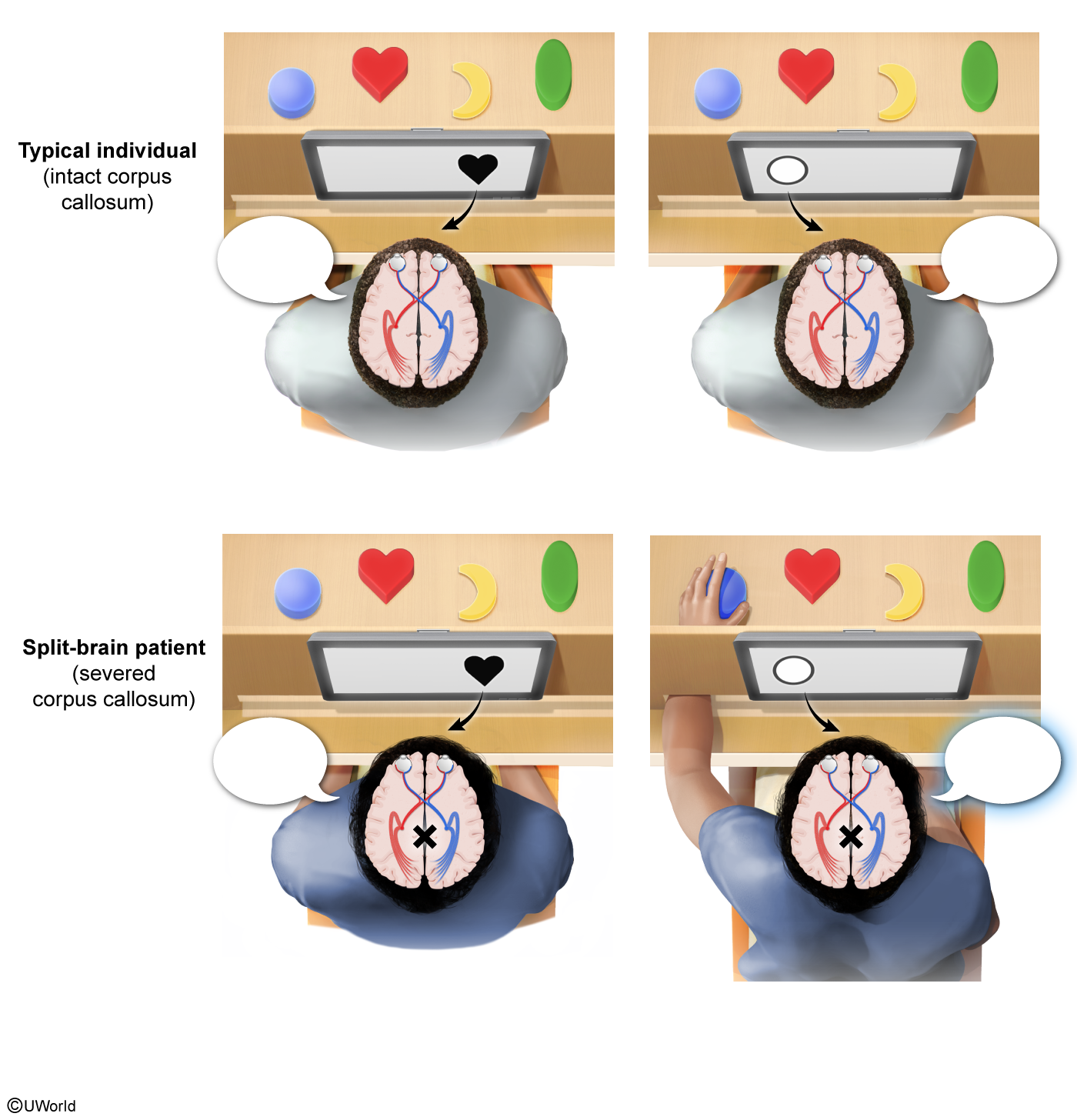
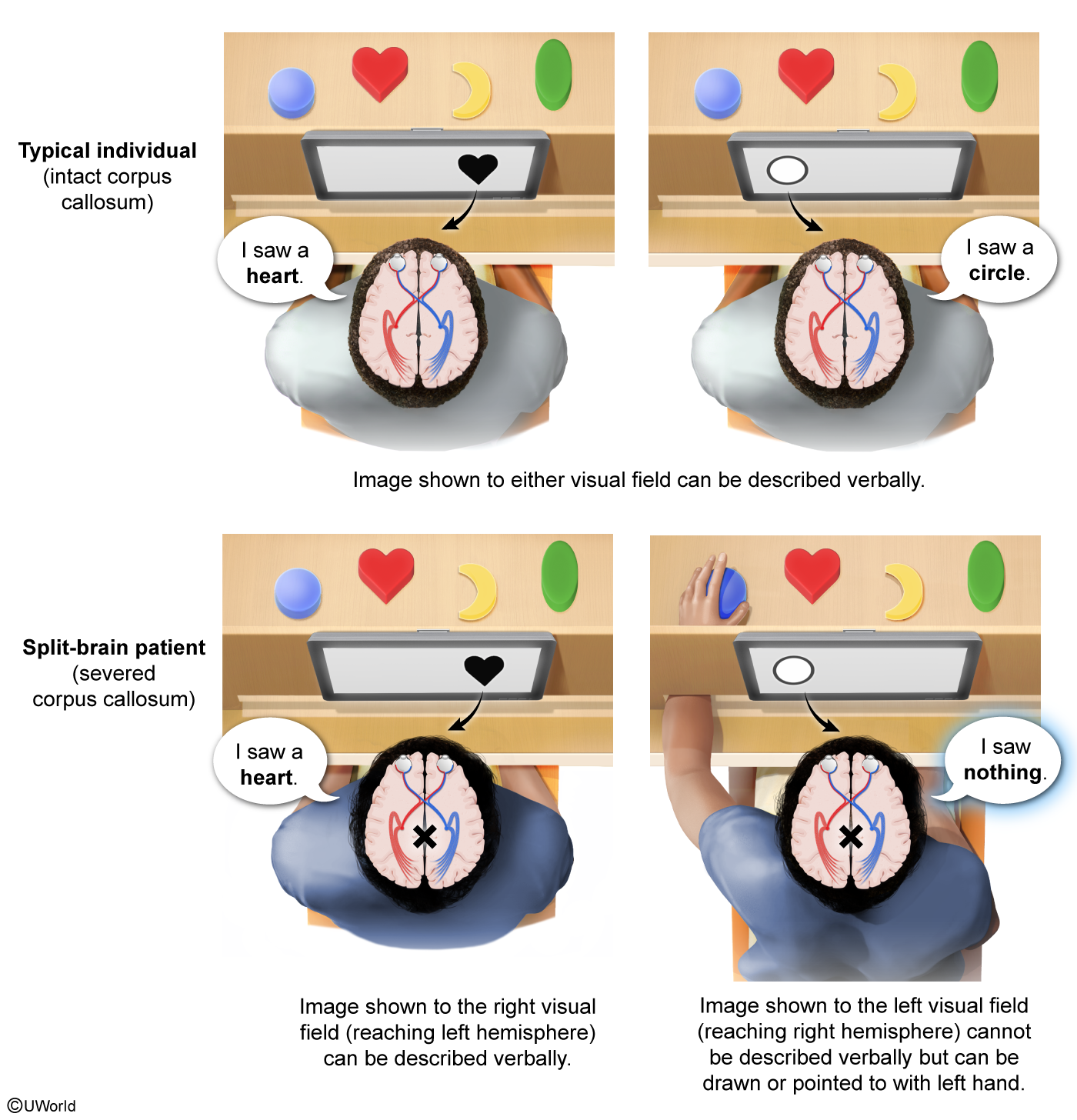
Based on the scenarios shown below, label what these two individuals would say they can see on the monitor.
The scenarios shown below describe what a typical individual would say they can see on the monitor compared to an individual with a severed corpus callosum.
Midbrain structures:
(1) Superior colliculus
(2) Inferior colliculus
Processed information:
(A) Visual information
(B) Auditory information
The midbrain structures and the information it processes:
(1) Superior colliculus - processes (A) Visual information
(2)Inferior colliculus- processes (B) Auditory information.
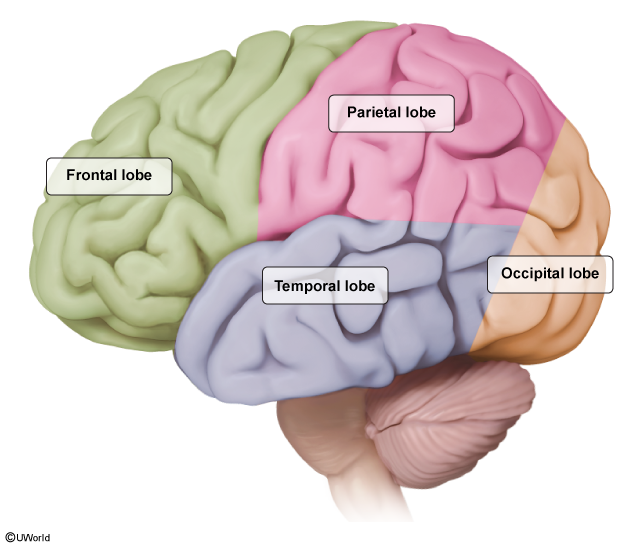
The _______ lobe is responsible for higher-order processes (eg, planning, decision-making, personality, judgment).
frontal
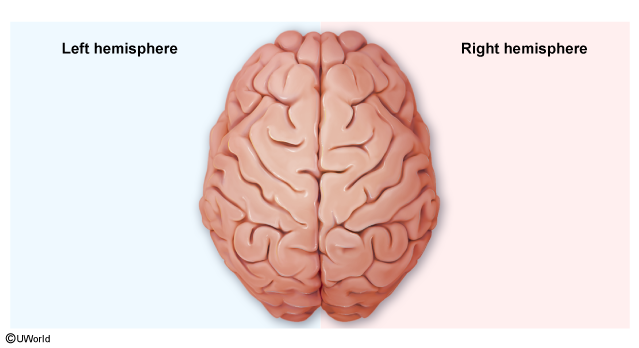
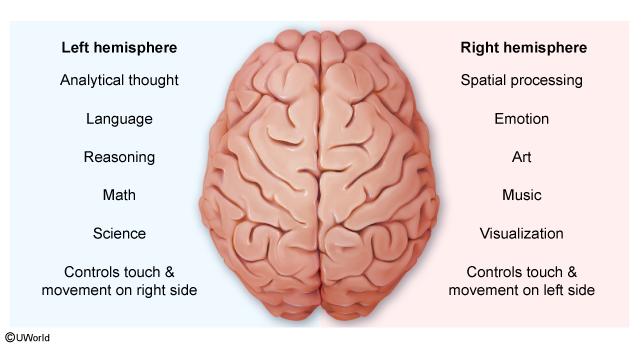
Give two examples of specialized processes or skills carried out by each brain hemisphere below.
Hemispheric lateralization: the brain's right and left hemispheres are each specialized for certain processes (examples shown below).
Name the two areas of the midbrain with large numbers of dopaminergic neurons and their associated functions.
Substantia nigra (SN)
Projects axons to the basal ganglia
Involved in voluntary movements
Ventral tegmental area (VTA)
Projects to different parts of the forebrain
Plays an important role in reward
Describe the function of the occipital lobe.
The occipital lobe is responsible primarily for visual processing.
Which lobe of the brain contains the auditory cortex?
The temporal lobe contains the auditory cortex, an area primarily responsible for processing auditory stimuli based on input from the ears.
Cortices:
(1) Somatosensory cortex
(2) Motor cortex
Lobes:
(A) Frontal lobe
(B) Parietal lobe
Specific brain cortices and the lobes where they are found are listed below.
(1) Somatosensory cortex – (B) Parietal lobe
(2) Motor cortex – (A) Frontal lobe
There are three major regions of the brain. The olfactory bulbs, basal ganglia, and pineal gland are found in which major region of the brain?
forebrain
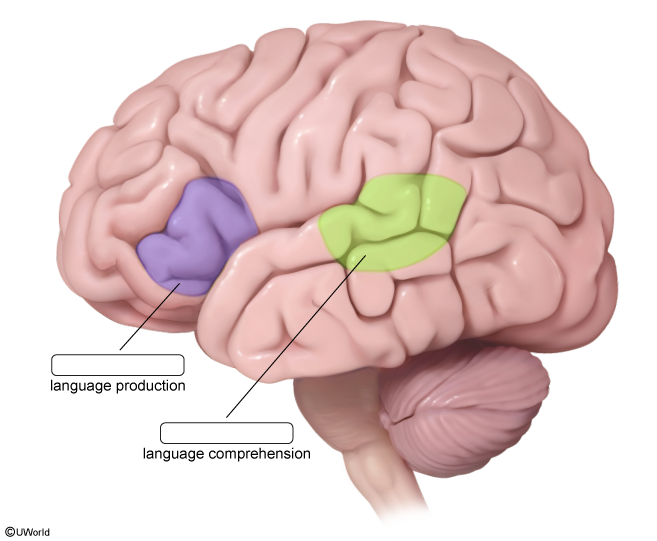
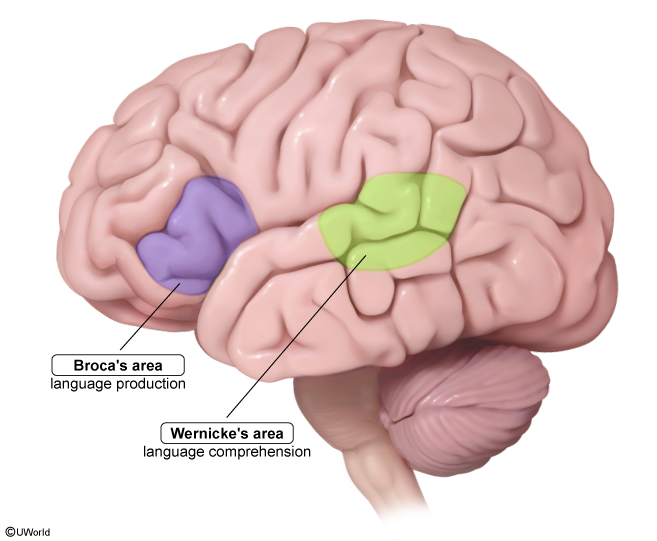
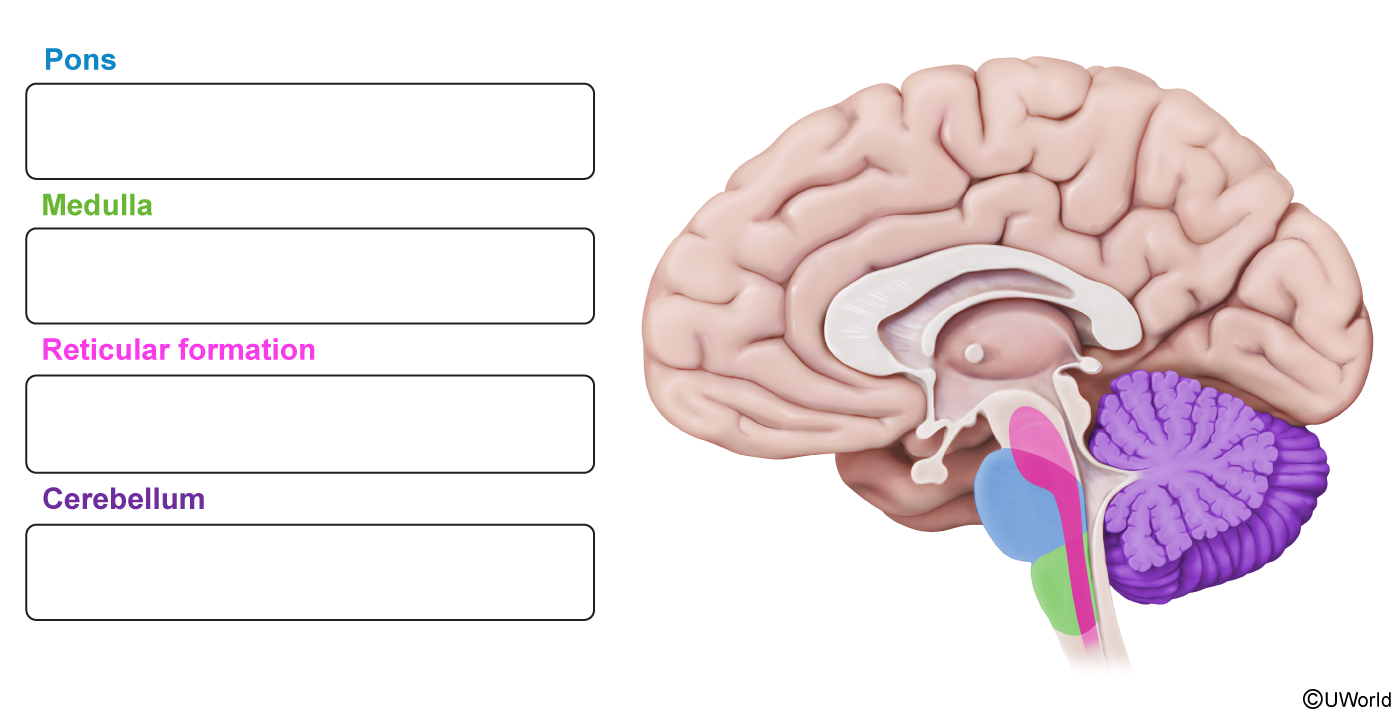
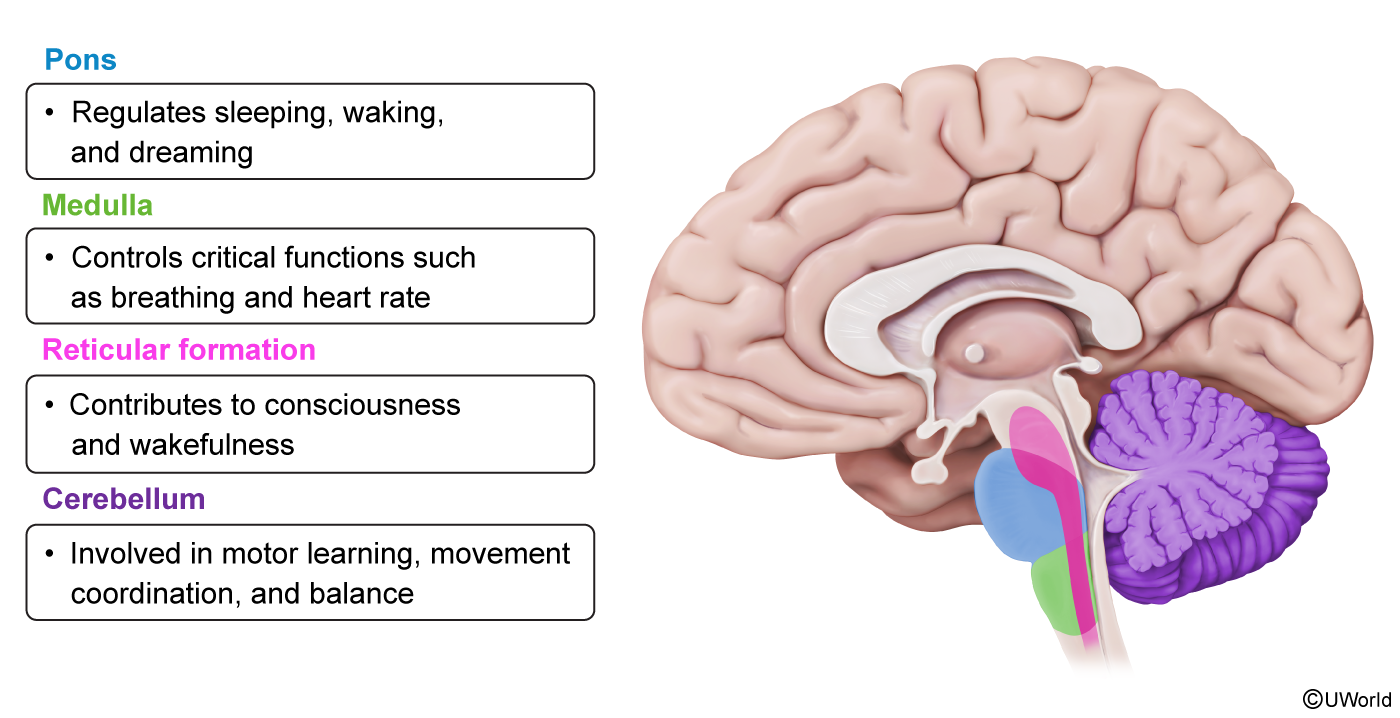
The bundle of myelinated axons that connects the right and left hemispheres of the brain to allow communication between the two is the ______ ______.
corpus callosum
The prefrontal cortex contributes to decision-making, personality, and memory. (True or False)
True
The prefrontal cortex is an area of the frontal lobe that contributes to decision-making, personality, and memory.
Describe the steps of the spinal reflex response to a painful stimulus.
(A) Afferent sensory neurons relay information to spinal interneurons.
(B) Efferent motor neurons relay motor commands to skeletal muscles, causing the muscles to respond.
(C) Spinal interneurons process the information before it travels to the brain and directly stimulate efferent motor neurons.
(D) A prick from a sharp needle stimulates somatosensory receptors in the skin.
Correct order: D, A, C, B
The steps of the spinal reflex response to a painful stimulus are shown below:
(D) A prick from a sharp needle stimulates somatosensory receptors in the skin.
(A) Afferent sensory neurons relay information to spinal interneurons.
(C) Spinal interneurons process the information before it travels to the brain and directly stimulate efferent motor neurons.
(B) Efferent motor neurons relay motor commands to skeletal muscles, causing the muscles to respond.
Spinal cord tracts:
(1) Afferent (ascending)
(2) Efferent (descending)
Signals:
(A) Sensory signals
(B) Motor commands
Afferent and efferent spinal cord tracts are matched with the signals they carry below.
(1) Afferent (ascending) – (A) sensory signals
(2) Efferent (descending) – (B) motor commands
The spinal cord contains only white matter. (True or False)
False
The spinal cord contains tracts of white matter (myelinated axons) and gray matter (cell bodies and dendrites).
Describe the function of the suprachiasmatic nucleus.
The suprachiasmatic nucleus is a brain area that regulates circadian rhythms, which are cycles in physiological activity or behavior that occur over 24-hour intervals (eg, the sleep/wake cycle).
How does the hypothalamus respond to stress and activate the body's stress response?
During periods of stress:
The hypothalamus releases a hormone that triggers pituitary release of ACTH.
ACTH travels through the bloodstream to the adrenal glands.
ACTH stimulates the adrenal glands to release more stress hormones (eg, cortisol), helping the body deal with stress.
________ are chemical messengers secreted by the endocrine system that travel throughout the body via the _________ and bind ________ in target tissues to elicit specific responses.
Hormones
bloodstream
receptors
Which brain structure controls endocrine function by facilitating and regulating hormone release from the pituitary gland?
hypothalamus
In contrast to neural communication, endocrine communication is a [faster/slower] form of [short/long]-distance cell-to-cell communication.
In contrast to neural communication, endocrine communication is a slower form of long-distance cell-to-cell communication.
Explanation:
This is because in neural communication, cells communicate faster by forming synapses with nearby cells.
What brain area regulates hunger and satiety?
ventromedial nucleus
Are most human behaviors learned, innate, or both?
Most human behaviors involve both genetic and environmental contributions, falling along the continuum from innate to learned.
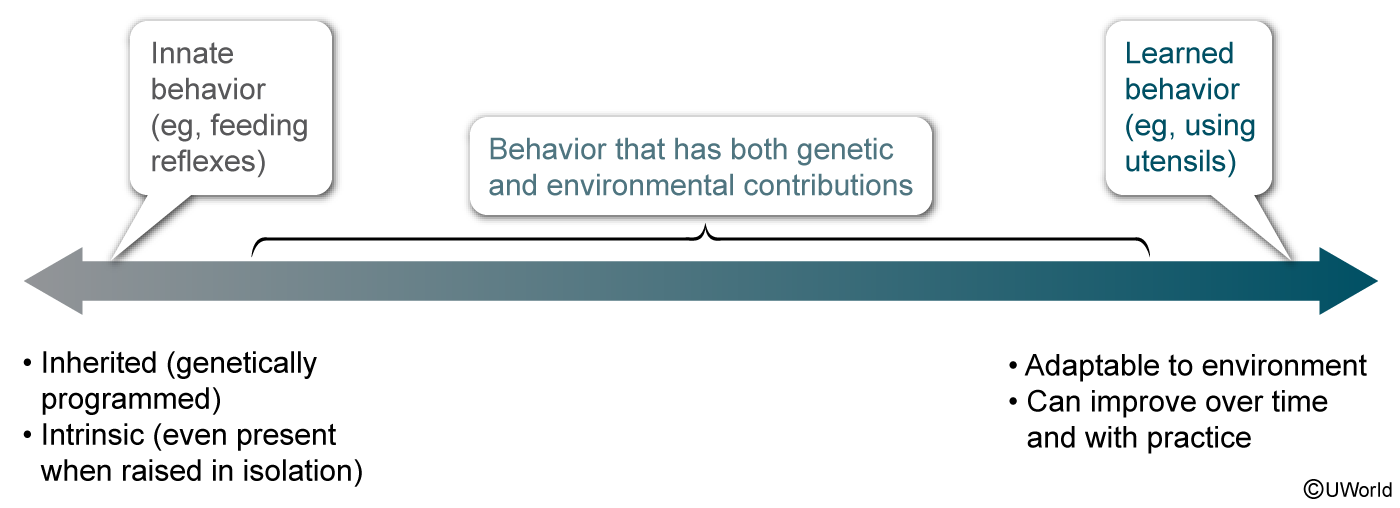
Learned behaviors can change over time with practice or environmental demands. (True or False)
True
Learned behaviors can change over time with practice or environmental demands.
What is the role of twin adoption studies?
Twin adoption studies:
Estimate the relative contribution of genetic versus environmental factors
Help clarify the role of heredity and the environment for complex human traits
Heredity describes _________ influences on development, while the environment describes all __________ influences.
genetic
non genetic
Define the adaptive value of a trait or behavior.
Adaptive value refers to the extent to which a trait or behavior helps an organism survive and reproduce.
Learned behaviors result from __________ and __________; innate behaviors result from __________ __________.
observation
experience
genetic influences.
Scenarios:
(1) Identical twins raised together share similar traits
(2) Identical twins raised apart share similar traits
(3) Identical twins raised apart are more similar to their adoptive families
Indications:
(A) Traits are most likely determined by genetics
(B) Traits are most likely determined by environmental influences
(C) It is difficult to determine whether genetics or the environment influences similar traits
(1) Identical twins raised together share similar traits – (C) It is difficult to determine whether genetics or the environment influences similar traits
(2) Identical twins raised apart share similar traits – (A) Traits are most likely determined by genetics
(3) Identical twins raised apart are more similar to their adoptive families – (B) Traits are most likely determined by environmental influences
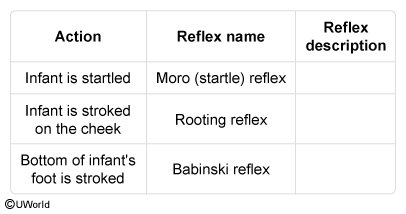
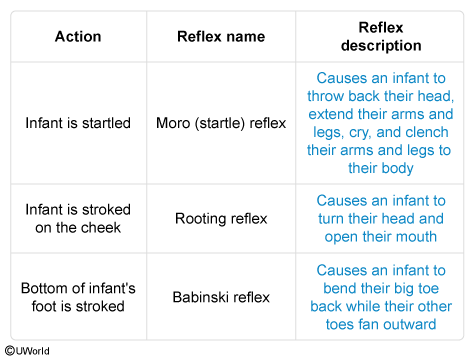
Gross motor skills develop after fine motor skills. (True or False)
False.
Gross motor skills develop before fine motor skills.
Example: Children can wave their arms before they can hold a crayon.
The prenatal period of development occurs during __________, which is the time between conception and birth.
gestation
_____ motor skills involve large muscle movements; _____ motor skills involve smaller muscle movements.
Gross motor skills involve large muscle movements; fine motor skills involve smaller muscle movements.
Examples include:
Gross motor skills: waving an arm
Fine motor skills: pinching an object between the thumb and index finger
Name the reflex that causes the leg to extend when the patellar tendon is tapped.
The patellar reflex occurs when the patellar tendon (below the kneecap) is tapped, causing the leg to extend.
Define teratogen and give an example of one.
A teratogen is any factor (eg, a drug or virus) that negatively impacts prenatal development.
Example: Alcohol is a teratogen that when consumed during pregnancy can negatively affect the fetus.
Which neuroimaging technique uses powerful magnets to create detailed images of the brain?
magnetic resonance imaging
What is electroencephalography (EEG)?
Electroencephalography (EEG) is a neuroimaging technique that measures electrical brain activity through the use of electrodes attached to the scalp.
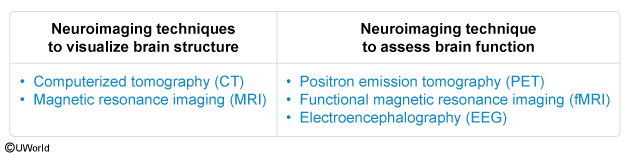
Positron emission tomography (PET) generates images of the brain by combining x-ray images taken from different angles. (True or False)
False.
Computerized tomography (CT) or computerized axial tomography (CAT) generates images of the brain by combining x-ray images taken from different angles.
Neuroimaging techniques:
(1) Positron emission tomography (PET)
(2) Functional magnetic resonance imaging (fMRI)
Descriptions:
(A) Visualizes brain activity by measuring changes in blood oxygen levels in the brain
(B) Provides information about physiological activity in the brain by monitoring glucose metabolism
Neuroimaging techniques and their descriptions are shown below:
(1) PET – (B) Provides information about physiological activity in the brain by monitoring glucose metabolism
Explanation:

(2) fMRI – (A) Visualizes brain activity by measuring changes in blood oxygen levels in the brain

_______ is a research tool used in studies with animals that involves destroying specific areas of the brain.
Lesioning is a research tool used in studies with animals that involves destroying specific areas of the brain.
Electrical stimulation of the brain (ESB) can be used to determine the function of specific brain areas. (True or False)
True.
Electrical stimulation of the brain (ESB) stimulates precise brain areas with an electric current and can be used to determine the function of specific brain areas.
Describe how lesioning is used to learn about the function of a brain area.
Scientists destroy or lesion specific brain areas to determine what processes are disrupted due to the damage. This allows them to learn about the function of the damaged brain area.
Sensory adaptation occurs when the constant presence of a sensory stimulus causes sensory receptor cells to send more messages to the brain about that stimulus. (True or False)
False.
Sensory adaptation occurs when the constant presence of a sensory stimulus causes sensory receptor cells to send fewermessages to the brain about that stimulus.
___________ occurs when sensory receptors convert environmental stimuli into neural signals.
transduction
Scientists:
(1) Gustav Fechner
(2) Ernst Weber
Contributions:
(A) Difference threshold
(B) Absolute threshold
(1) Gustav Fechner – (B) Absolute threshold
(2) Ernst Weber – (A) Difference threshold (also called the just-noticeable difference (JND)
Outcomes:
(1) Correct Detection (“Hit”)
(2) False Negative (“Miss”)
(3) False Positive
(4) Correct Rejection
Descriptions:
(A) Signal is present and detected
(B) Signal is absent, but perception is reported
(C) Signal is present, but not detected
(D) Signal is absent, and no perception is reported
(1) Correct Detection (“Hit”) – (A) Signal is present and detected
(2) False Negative (“Miss”) – (C) Signal is present, but not detected
(3) False Positive – (B) Signal is absent, but perception is reported
(4) Correct Rejection – (D) Signal is absent, and no perception is reported
Define each of the variables in the Weber’s law equation below:
∆I/I=k
∆I - size of the just-noticeable difference
I - the original stimulus intensity
k - proportionality constant
The absolute threshold is the point at which an individual can detect a new sensation 50% of the time. (True or False)
True.
The absolute threshold is the point at which an individual can detect a new sensation 50% of the time.
The difference threshold, also called the __________ __________, is the point at which an individual can detect a difference between two stimuli ___% of the time.
The difference threshold, also called the just-noticeable difference (JND), is the point at which an individual can detect a difference between two stimuli 50% of the time.