Labs and Diagnostics LECTURE
 Call Kai
 Learn
Learn Practice Test
 Spaced Repetition
 Match
Match Flashcards
 Knowt Play
1/139

There's no tags or description
Looks like no tags are added yet.
Name | Mastery | Learn | Test | Matching | Spaced | Call with Kai |
|---|
No analytics yet
Send a link to your students to track their progress
140 Terms
Ask yourself these questions before ordering laboratory tests
Is the test clinically indicated? What are the consequences of not ordering the test? Will the result change management? Is the test safe and appropriate? Is the test cost effective?
Order laboratory tests...
AFTER completing the HPI, AFTER performing a physical examination, BEFORE invasive procedures.
Important: Always try to proceed from least to most invasive testing.
A non-invasive test versus invasive test
non invasive - without penetrating skin or entering body
invasive - penetrating skin or entering body
3 ordering priority options
routine - hours to days
ASAP - as soon as possible, but not as quick as STAT
STAT - requires results immediately
Turnaround Time
The time between the moment when the order is placed and the time when the result is released
rifle vs. shotgun approach
rifle approach - used when the clinician has a strong presumptive diagnosis (focussed)
shotgun approach - ordering broad panels of tests without a clear clinical indication (uncertain)
best practice: start with rifle and expand only if clinically necessary
What is the most important step in specimen collection
accurate patient identification
Ask the patient to provide....... to verify identity
at least 2 identifiers (ex full name and date of birth)
Never ask leading questions such as
Are you , Mr. Smith?
When should you label a specimen?
Always BEFORE sending them to the lab
Where should you attach the label on a specimen?
to the container/tube, NOT THE LID
should you double label or pre-label?
NEVER
What is the most common reason for specimen rejection?
specimen contamination
Should you follow standard precautions in all circumstances?
ALWAYS YES!
What should you place all collected specimens in before sending?
biohazard transport bag/container
If anything has blood on it, what bucket do you put it in?
BIOHAZARD RED BUCKET
Where can you dispose of sweat, tears, saliva, urine, feces, vomitus?
Regular trash or flushed down the toilet
How should laboratory test results be analyzed?
In correlation with the clinical presentation
What is a quantitative test?
Provide an exact NUMERIC measurement
What is a semi quantitative test?
Provides an approximate or graded estimate (trace, 1+, 2+, 3+)
What is a reference range?
A test statistically derived set of values that is seen in approximately 95% of healthy people
What are some factors that can cause variation in reference ranges?
Age, sex, type of specimen, fasting status, exercise, equipment, Regents, analytical methods
Does a value outside of a reference range always indicate a disease?
it may or may not
Does a normal result in a reference range always mean the absence of a disease?
no
What are critical (panic) values?
Lab results that indicate a potentially life-threatening condition requiring immediate clinical attention
It provider is receiving a critical value via the phone, what must they do?
repeat the value back to confirm accuracy
Sensitivity vs. specificity
sensitivity - how well a test identifies truly positive people
specificity - how well a test identifies truly negative people
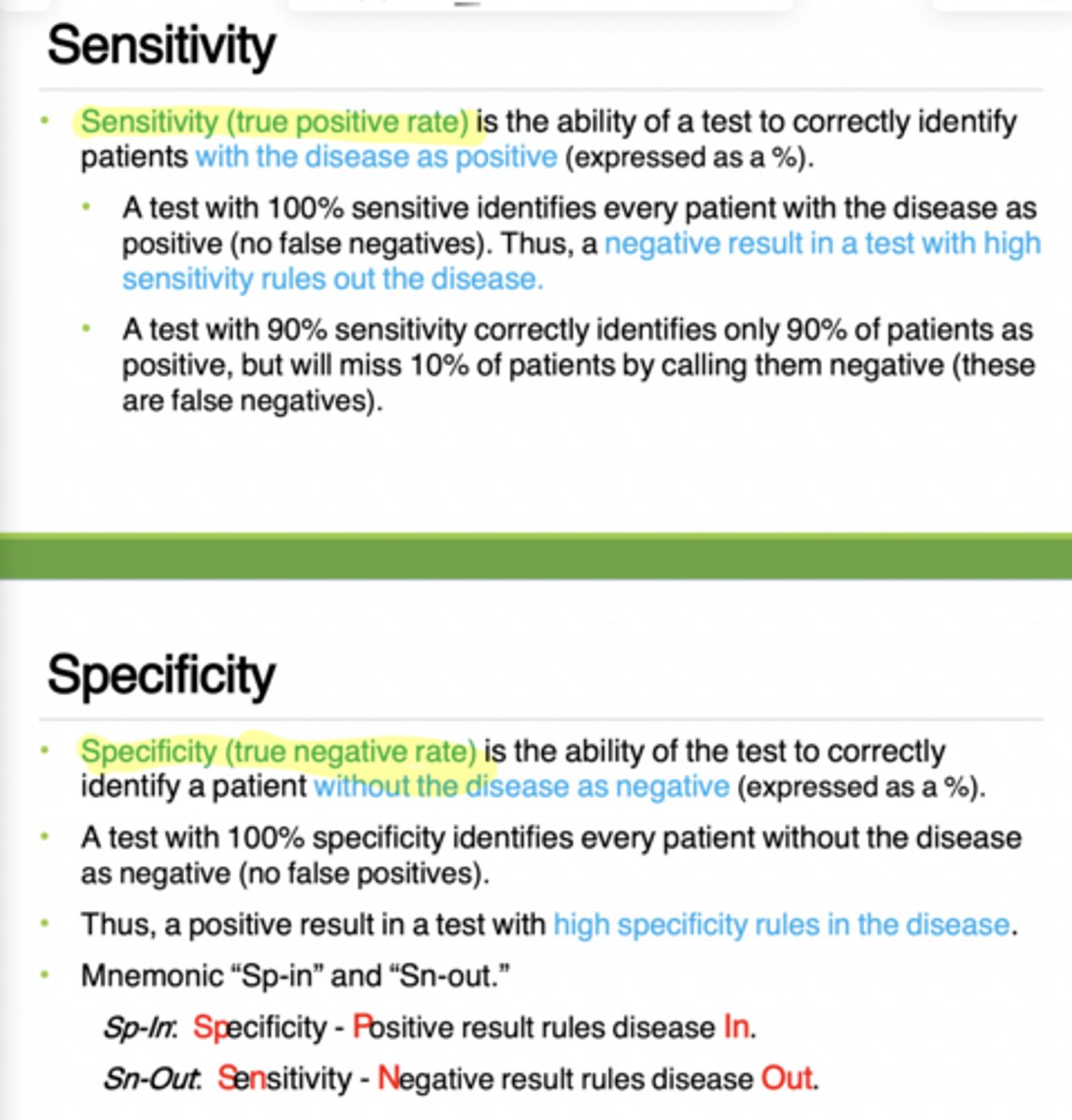
What should lab tests in healthcare ensure to maximize benefit while minimizing harm?
Have a balance between sensitivity and specificity
What is predictive value? (PPV vs. NPV)
the extent to which an observation or test result is able to predict the presence of a given disease or condition
Positive predictive value versus negative predictive value
ppv-probably that patient with a positive test has a disease
npv-probability that a patient with a negative test does not have a disease
What is prevalence?
Proportion of a population affected by a disease at a SPECIFIC POINT IN TIME
The higher versus the lower the prevalence....
The higher the prevalence, the greater the positive predictive value. The lower the prevalence, the greater the negative predictive value.
If you receive highly abnormal results, what should you do?
Question for possible pre-analytical or analytical errors
If results do not match the clinical picture, what should you do?
reorder the test (order a REDRAW, NOT a REPEAT)
Diagnostic test are typically ordered in symptomatic patient to
Confirm or exclude a suspected diagnosis
Usually in a screening test, negative versus positive means what
Negative means no disease
positive means order diagnostic test to confirm
What is a gold standard test?
Best available method for diagnosing a particular disease. Ideally, a cold standard would have 100% sensitivity and specificity, but this is rarely achievable in clinical practice
What is a reflex test?
An additional test that is automatically performed by the laboratory based on the result on the initial test. they are predefined and protocol-driven
What is an add-on test?
Provider initiated additional tests on an existing specimen (you don't need a new specimen, just do more to the specimen that was already sent)
What is a test panel?
A group of related test performed on a single specimen to evaluate a specific condition or organ systems
when to order a panel vs. individual tests
panel-to evaluate a broad differential diagnosis or investigate a new or unclear clinical problem
individual test-to monitor a known condition or to follow a specific perimeter overtime
What is point of Care testing?
Also known as bedside or near patient testing, is performed at or near the patient site rather than an central laboratory (covid car swabs)
What are some examples of point of care testing besides car Covid swabs?
urine dipstick, capillary glucose, portable ultrasound and x-ray
What is two-tier testing?
A diagnostic strategy in which an initial screening test is followed by a confirmatory test to improve overall diagnostic accuracy
What are the two steps to a two-tier testing?
Step one - screening test(designed to detect as many positive cases as possible, may produce false positives)
step two - confirmatory test (designed to confirm true disease by ruling out false positives)
ex. HIV, lyme disease
What bacteria causes Lyme disease?
Borrelia burgdorferi
What is radiology?
Branch of medicine that uses imaging techniques to diagnose and treat disease (diagnostic vs. interventional)
What are the examples of diagnostic imaging modalities?
X-ray, CT, MRI, PET, ultrasound
What is interventional radiology?
Uses imaging guidance to perform minimally invasive diagnostic and therapy procedures through small incisions (x-ray fluoroscopy, ultrasound, ct, sometimes mri)
What imaging platforms have ionizing radiation?
x-ray- single image
ct- multiple cross-sectional images
fluoroscopy- REAL-TIME continuous x-ray (lots of radiation)
Where do most healthcare facilities store digital imaging?
Picture archiving and communication system (PACS)
what is radiology
Branch of medicine that uses imaging tech technologies to diagnose and treat disease
What is the difference between diagnostic radiology and interventional radiology?
diagnostic - uses imaging modalities to visualize internal structures can assist in the diagnosis of disease
interventional - uses imaging guidance to perform minimally, invasive diagnostic and therapeutic procedures through small incisions or percutaneous access
Examples of diagnostic radiology
X-ray, CT, MRI, PET, US
What are examples of interventional radiology?
X-ray fluoroscopy, ultrasound, CT and sometimes MRI
What forms of imaging involve ionizing radiation?
X-ray - single image
CT - multiple cross-sectional images (more radiation)
Fluoroscopy - REAL TIME continuous x-ray imaging (LOTS OF RADIATION!)
Where do most healthcare facilities store digital imaging?
Picture archiving and communication system (PACS)
When and by whom was the first x-ray image?
1895, Wilhelm Röntgen
What is the difference between x-rays and radiation?
x-ray - a form of ionizing radiation
radiation - (umbrella term) transfer of energy in the form of particles or electromagnetic waves
Describe the appearance of x-ray imaging in terms of density of structures
greater density and thickness = whiter (bone) (rays are absorbed and show white)
lower density = darker (air in lungs) (rays went through the tissue and reach the detector)
Compare x-ray versus CT or MRI
X-ray imaging is a projection technique and does not isolate a single structure. It is a 2-D image formed by the superimposition of all tissues along the path
CT and MRI produce 3-D cross-sectional images, allowing visualization of individual slices of the body with minimal overlap
What is contrast radiography?
Uses x-rays in combination with a contrast agent to enhance the visualization of structures that are not well seen on conventional images
(contrast helps to highlight soft tissues and blood vessels because they don't hardly absorb the x-rays)
Are there absolute contraindications for an x-ray?
virtually none, just ask about pregnancy to weight benefits and risks
What are the benefits of x-rays?
Not invasive, painless, fast, cheap and widely available
Risks associated with x-rays
Since it uses ionizing radiation, the risk increases drastically with cumulative exposure, and increases cancer risk
what is the ALARA principle
As low as reasonably achievable
When appropriate, what sorts of imaging should you use preferably to avoid ionizing radiation?
ultrasound or MRI
When is the fetus most radiosensitive and why?
The first trimester, due to primarily organogenesis period
What is the one question you should ask all female patients of childbearing age before imaging?
"Are you pregnant?"
"Is there a possibility of you being pregnant?"
What do x-rays do when imaging is done?
They do not remain in the body afterward, and do not make it into breastmilk
What is the average cost for an x-ray in the United States?
$100-$400 per image
what is another slang term for a CT scan?
CAT scan
How does a CT work?
Same principal as an x-ray, but uses a motorized table that moves through a donut shape frame called the gantry
What are the types of CT scans
non-contrast CT - ex. blow out fracture, open globe injury
contrast-enhanced CT - vessels, organs, pathologies
CT angiography (CTA) - for blood vessels
What is the most common used contrast agent for CT contrast
Iodinated contrast (shellfish allergy warning!)
Where on the body can you perform a CT?
virtually any part!
What is virtual CT endoscopy?
Uses CT data to create 3-D reconstructions that simulate endoscopic views of internal structures
What is radio frequency ablation? (CT GUIDED RFA)
Minimally invasive procedure that uses thermal energy(heat) to destroy tumor tissue
Any contraindications for CT?
non for CT itself when clinically indicated
be cautious of iodinated contrast in those with allergic reactions or significant renal impairment
pregnancy and CT
Pregnancy is not an absolute contraindication, consider alternative imaging and only use if clinically necessary
What patient population should you be most cautious with to use a CT?
children (due to longer life ahead with radiation damage)
What hospital setting are CT's used frequently in?
Emergency department! (quick and less sensitive to movement)
What are the weight limits for a CT scanner table?
440-550lbs
What is the standard gantry diameter?
27.5inches
What is the average cost of a CT scan in the US?
$300-$7000 (depending on body part, use of contrast and facility)
about 10times more than x-ray
What does MRI stand for?
magnetic resonance imaging
what does CT stand for?
computed tomography
Does an MRI use ionizing radiation?
NO!
How does an MRI work?
Uses strong magnetic field and radio frequency waves to generate detailed images
What is the biggest downside to doing an MRI?
Scanning takes a long time, sometimes hours
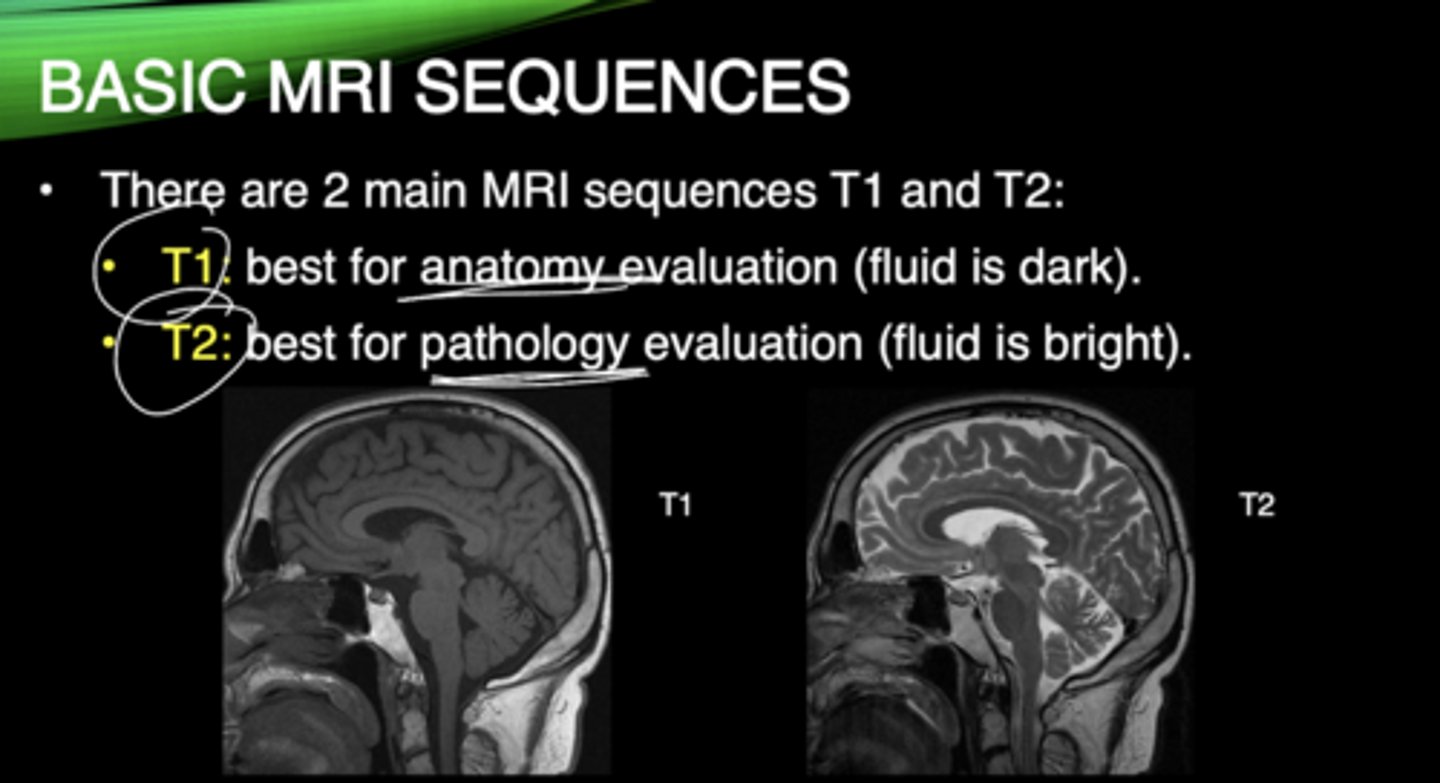
What are the two main MRI sequences?
T1 - best for anatomy (fluid is dark)
T2 - best for pathology (fluid is bright)
What are examples of advanced MRI sequences?
DWI - diffusion-weight imaging (strokes, abscesses, tumors)
FLAIR - fluid-attenuated inversion recovery (white matter lesion like MS)
STIR - short tau inversion recovery (tissue edema and inflammation)
MRA - magnetic resonance angiography (blood vessels)
What is the contrast agent used in MRI's with contrast?
gadolinium-based contrast
What is gadolinium based contrast?
a metal given IV in MRI's with contrast, rare allergic reactions but should be used with caution in Nephrogenic systemic fibrosis
Where can MRIs be used on the body?
Virtually any part of the body!
What are the contraindications to getting an MRI?
METAL IN THE BODY! DO NOT USE MRI!
Implanted medical devices (ex. pacemakers, neurostimulators)
metallic foreign bodies(especially in eye)
bullets or shrapnel
METAL IN THE ROOM CAN ALSO GET SUCKED IN THE MRI MACHINE
What are some relative contraindications for MRI?
obesity
inability to remain still
children (may need to sedate)
claustrophobia and anxiety
pregnancy and MRI?
generally safe
What are some benefits of an MRI that aren't true for x-ray or CT?
no radiation
excellent soft tissue and more detailed
can evaluate anatomy AND Function (fMRI)
What is the average cost for an MRI?
$400-$10,500