Final Exam-Mahfouz Notes
 Call Kai
 Learn
Learn Practice Test
 Spaced Repetition
 Match
Match Flashcards
 Knowt Play
1/166

Earn XP
Description and Tags
Lipid Digestion/Absorption 1-16 Fatty Acid Oxidation 17-31 Ketogenesis 32-46 Fatty Acid Biosynthesis 47-78 Sphingolipid Metabolism 79-108 Protein Digestion 109-126 Amino Acid Degradation 127-149 Amino Acid Biosynthesis 150-160 Biosynthesis of Nitrogenous Compounds 161-167
Name | Mastery | Learn | Test | Matching | Spaced | Call with Kai |
|---|
No analytics yet
Send a link to your students to track their progress
167 Terms
What must happen to triacylglycerols in order to be absorbed?
they need to be hydrolyzed to FAs and glycerol
What happens during lipid emulsification?
the oil phase is broken down into microscopic droplets that are readily accessible to digestive enzymes in the GIT
Where does lipid digestion occur?
starts in the duodenum; the stomach contracts to stimulate the liver/pancreas to release enzymes (lipase and bile) that aid in digestion
What is lipase’s function in digestion? Bile?
lipase hydrolyzes the ester bonds in triacylglycerols to form glycerol and FAs
bile emulsifies lipids to speed up the lipase rxn and lipid digestion
How does lipase hydrolyze triacylglycerols?
lipase allows the molecules to enter (based on location) and get broken down via hydrolysis. There are three ester bonds in the molecule, so it has to undergo three hydrolysis reactions before it is completely broken down
aqueous media: closed active site
oil/water interface: open active site
Bile is stored in the ____ and made from ____ . They function in _____
liver, cholesterol, speeding up lipase reactions by emulsifying lipids
What is the purpose of emulsification?
to increase the oil/water interface and allow lipid digestion to occur much faster
What do intestinal cells do after absorbing FAs and glycerol?
re-esterify glycerol with FAs to re-assemble the triacylglycerols
emulsify the re-assembled triacylglycerols to prepare them for release into the main circulation
What is the function of intestinal cells?
break down absorbed lipids and cover them with apoproteins, creating lipoprotein particles
What are chylomicrons?
lipoproteins made by the intestine, they get released into the intestinal lymph vessels and then large blood vessels
What is the function of lipoprotein lipase?
to hydrolyze ester bonds within dietary triacylglycerols
What is the function of liver cells?
absorb chylomicron remnants via receptor mediated endocytosis and clear them from circulation
make its own lipids; lipids are emulsified into VLDL before getting released into circulation
import and destroy HDL particles
What is the main component of LDL and what happens when it enters the cells?
Cholesterol, once inside cells the LDL particles are destroyed and their cholesterol/triacylglycerol content is released into cytoplasm
What is cholesterol needed for?
to make cell membranes, excess is emulsified into HDL
What are the 2 parts of lipoproteins?
lipid part: emulsified lipids and phospholipids layer that surrounds them
protein part: apoproteins
What are the functions of each lipoprotein? (chylomicrons, VLDL, LDL, IDL, HDL)
chylomicrons: transport absorbed lipids from intestine to circulation
VLDL/LDL/IDL: transport lipids from liver to all body tissues
HDL: transport lipids from all body tissues to liver to be excreted in feces
What is produced when glucose is oxidized? Fatty acids?
carbon dioxide and water vapor
acidic byproducts that can accumulate in circulation
What is the purpose of acetyl CoA?
to start and maintain the citric acid cycle (provides cells with NADH and FADH2)
produces ATP when entering the oxidative phosphorylation pathway
What happens when glucose becomes scarce?
cells hydrolyze triacylglycerols stored in the adipose tissues to release FAs, which are oxidized to acetyl CoA to feed the citric acid cycle
What is the difference between saturated and unsaturated double bonds?
saturated have no double bonds in the hydrophobic chain
unsaturated have double bonds in the hydrophobic chain
What are the steps of FA activation for oxidation?
activation occurs in the cytoplasm when a FA is attached to a CoA molecule
activated FAs are transported to the mitochondria
FAs are oxidized in cycles, no more than 2 carbons are separated at the end of each cycle and the reaction consumes energy
What are synthetases?
a group of enzymes that use energy from ATP hydrolysis to link two smaller molecules to give a larger one
What are synthases?
enzymes that catalyze covalent bond formation between two molecules and do not require ATP
What is the function of acylCoA synthetase?
Activates FAs and hydrolyzes two high energy phosphate bonds to covalently link a CoA molecule to the fatty acid
What is needed so CoA can cross the mitochondrial membrane?
cartinine palmitoyl transferase (CPT1) removes CoA from activated FAs and replaces it with a carnitine molecule (becomes fatty acyl carnitine)
What happens once fatty acyl carnitine is in the mitochondria?
carnitine palmitoyl transferase 2 (CPT2) replaces carnitine with CoA and FA reactivates so it can be oxidized
When does fatty acid oxidation take place and what enzyme is needed?
when cells are deficient or lacking glucose
CPT1 allows FA oxidation, its activity is controlled by glucose metabolism
What happens in cells with an abundance of glucose? with no glucose?
part of the glucose is converted to malonyl CoA, an inhibitor of CPT1
if there is no glucose, malonyl CoA conc. drops and CPT1 is activated to turn on FA oxidation
What occurs in FA oxidation?
the long hydrophobic chain is broken down to acetyl CoA by adding a double bonded oxygen to carbon #3 (weakens the bond so it can be broken easier)
What are the four steps in an oxidation cycle?
Dehydration
two hydrogens are removed from carbon 2/3 and a double bond is created between them so it can accept an oxygen atom; cofactor is FAD
Hydration
a water molecule is added to the trans double bond of the unsaturated FA; does not require a cofactor or energy from ATP
2nd Dehydration
Hydroxyacyl CoA dehydrogenase removes an H from the OH on carbon 3 and an H from carbon 3 to create a double bond between the two atoms; uses NAD as a cofactor and produces NADH and a hydrogen
Thiolysis
the bond between carbon 2/3 is broken by inserting a CoA molecule via thiolase; does not require a cofactor or energy from ATP but uses sulfur instead
the FA is split into two fragments
What is a dehydrogenase?
an enzyme that removes hydrogens and catalyzes dehydrogenation reactions, require a cofactor (1st FAD 2nd NAD)
What is a hydratase?
an enzyme that adds a water molecule to a double bond
What is the energy yield from FAs?
acetyl CoA generates 3 NADH and 1 FADH2 (GTP is generated when succinyl CoA gets converted to succinate
one acetyl CoA is equivalent to 12 ATPs
What is the function of dehydrogenases?
remove hydrogens
What is the function of reductases and what cofactors do they require?
adds hydrogens; requires NADH or FADH2 as a cofactor
What is the function of carboxylase and what do they require?
adds a carboxyl group via CO2 or HCO3, requires ATP and biotin (B7) as cofactors
What is the function of racemase?
an enzyme that interconverts between the R and S isomers of chiral molecules, does not require cofactors or ATP
What is the function of mutase and what does it require?
shifts functional groups form one carbon to the directly adjacent carbon, requires cyanocobalamin (B12)
The ATP yield from succinyl CoA is ____ than acetyl CoA because it enters half-way through the cycle
less
The number of enzymes needed for and oxidation cycle depends on the number of ____ present
double bonds
one double bond: one additional enzyme
more than one double bond: three enzymes
Why can’t brain cells oxidize FAs to acetyl CoA?
they do not make the enzymes needed, they instead use ketone bodies
if neither glucose or ketone bodies are available, the brain shuts down and the person goes into a coma
When/where does ketogenesis occur and what is its purpose?
when glucose levels drop, occurs in the mitochondria of liver cells
provides ketone bodies for brain cells to maintain the CAC and make ATP
what are examples of ketone bodies?
acetoacetate, beta-hydroxybutyrate, and acetone
Ketone bodies are acidic because they have a ____
carboxyl group; large amounts can overwhelm blood buffers and cause systemic acidosis
What reactions occur during ketogenesis?
1st condensation
two acetyl CoA molecules combine to give acetoacetyl CoA, catalyzed by thiolase in a reversible reaction
2nd condensation
a third acetyl CoA is added to produce HMG CoA, catalyzed by HMG CoA synthase (no ATP)
HMG CoA split
HMG CoA is split into acetyl CoA and acetoacetate, catalyzed by HMG CoA lyase
part of acetoacetate is absorbed by the brain, the other part is reduced by beta-hydroxybutyrate dehydrogenase to give beta-hydroxybutyrate
What is the function of ketoacyl CoA transferase and what does it require?
it converts acetoacetate to acetoacetyl CoA
requires succinyl CoA to catalyze the reaction and produces acetoacetyl CoA and succinate
What is the function of the produced succinate?
it feeds the CAC and produces 6 ATPs via biosynthesis as well as acetoacetyl CoA
In relation to ketogenesis, what happens in patients who don’t take their insulin?
they experience a shift in metabolism for FA oxidation, severe cases cause a drop in pH and eventually systemic acidosis
As glucose levels rise insulin is released to allow absorption and conversion to ______
acetyl CoA
What enzyme does insulin inhibit and what effect does this have?
HS lipase in adipose tissue; stops the hydrolysis of triacylglycerols
When the liver is saturated with glycogen, what happens to the excess glucose in circulation?
it is absorbed by adipose tissue and converted to FA, which are esterified to glycerol to make triacylglycerols for storage (unlimited in adipose)
What are FAs used to make?
lipids and cell membranes
How are FAs made?
cells use malonyl CoA to elongate the hydrophobic chain on acetyl CoA
oxidation occurs in the mitochondria, biosynthesis occurs in the cytoplasm
What is FA degradation activated by and what cofactor(s) are needed?
activated by acetyl CoA
cofactors are FAD+ and NAD
What is FA biosynthesis activated by and what cofactor(s) are needed?
activated by ACP
cofactor is NADPH
What is the function of acetyl CoA carboxylase? What cofactor does it require?
it allows cells to convert acetyl CoA in the cytoplasm to malonyl CoA
requires biotin (B7) as a cofactor
What compounds activate acetyl CoA carboxylase?
insulin (helps store excess glucose)
citrate (made when glucose is abundant)
What compounds inhibit acetyl CoA carboxylase?
glucagon/epinephrine (inhibits nutrient storage)
palmitoyl CoA (feedback inhibition)
What must occur for activation in FA biosynthesis?
attaching to the acyl carrier protein (ACP)
the activating enzyme attaches the FA to a sulfur atom at the end of a long hydrophobic chain made from vitamin B5
What compound do both CoA and ACP require to function?
pantothenic acid (vitamin B5)
What are the steps of hydrophobic tail elongation? How many carbons are made per cycle?
Condensation
Reduction (reductase, cofactor)
Dehydration (dehydrase enzyme, no cofactor)
Reduction
2 carbons per cycle
The default FA is _____
palmitic acid
How are FAs with more than 16 carbons elongated?
the FA is transported to the ER and activated by COA
2 carbons are added from malonyl CoA (elongase)
What are elongases?
enzymes that elongate the hydrophobic chain
How are unsaturated FAs made?
cells start with the saturated portion of the enzyme and desaturase removes hydrogens to create double bonds (not beyond carbon #9)
Human desaturases cannot remove hydrogens beyond carbon #9. What are FAs with double bonds beyond carbon #9 called?
essential FAs
What is an example of an essential FA and what is it used for?
arachidonic acid
used to make eicosanoids, which are needed for the inflammatory response
Triacylglycerols are storage molecules, so their biosynthesis pathways are only activated when nutrients are _____
plenty
What reactions occur when FAs are esterified to glycerol and stored in adipose?
glucose in circulation triggers insulin release
insulin activates acetyl CoA carboxylase
malonyl CoA elongates the FA hydrophobic chain (depending on desired # of carbons)
glycerol is made from glucose and is esterified by FAs to make triacylglycerols
What must happen before esterification can occur?
glycerol and FAs need to be activated
How is glycerol activated? FAs?
glycerol: activated by phosphorylation, becomes glycerol-3-phosphate
FAs: activated by attaching CoA
What is the function of kinases?
adding phosphate groups
________ is produced after two esterification steps of glycerol
phosphatidic acid
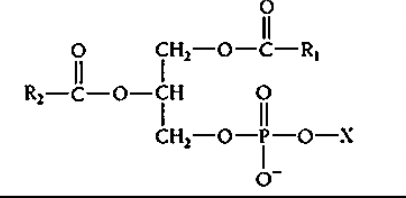
True or False: the first hydroxyl, R1 is saturated
true
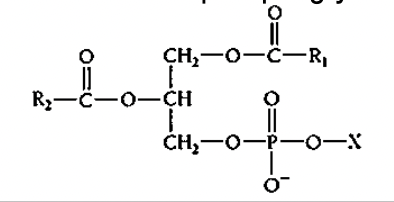
True or false: the second hydroxyl, R2, is saturated
false
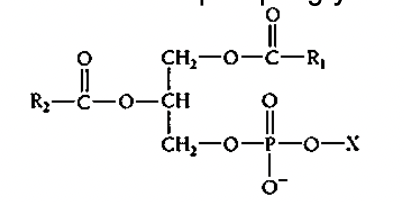
In the diagram, what is the charged state of the phosphate group (X)?
charged/uncharged, polar
What are the various functions of insulin?
secreted when glucose is high
decreases cAMP (eventually stops FA release)
activates pyruvate dehydrogenase (acetyl CoA is made and converted to citrate)
activates acetyl CoA carboxylase (makes malonyl CoA)
Malonyl inhibits ____ and is used to make ____
FA oxidation, FAs
Sphingolipids are membrane lipids found in _____
nervous tissue
What are ceramides made of?
a sphingosine molecule covalently link to a FA through an amide bond
What are sphingomyelins made of?
ceramides with a phosphocholine group linked to sphingosine’s OH group
What are cerebrosides made of?
a ceramide with a single carbohydrate bond linked to sphingosine’s OH group
What are gangliosides made of?
a ceramide with a multiple carbohydrate bonds linked to sphingosine’s OH group
How are ceramides made?
by condensing together palmitic acid and serine
Condensation: catalyzed by synthase, no ATP
Reduction: addition of hydrogen, cofactor is NADPH
Sphingolipids are broken down in _____ by _____
lysosomes, hydrolyzing enzymes
What is the final product of sphingolipid degradation?
FAs and sphingosine (these are safe but their intermediates are cytotoxic)
What is cholesterol used to make?
bile salts (50%) and steroids (10%)
What is the precursor for cholesterol?
acetyl CoA
What are the three steps of cholesterol biosynthesis?
condensation of three acetyl CoA molecules to isoprenoid intermediates
condensation of isoporene intermediates into squalene
cyclization of squalene to cholesterol
What are the sources of cholesterol?
endogenous (made by the body) and exogenous (obtained from diet)
Dietary cholesterol is absorbed by intestinal cells and incorporated into ____ particles, which are packaged into _____ particles and released into circulation
chylomicron; VLDL
What process is used to absorb LDL particles?
receptor mediated endocytosis
How are LDL particles absorbed?
LDL receptors (clathrin coated pits) identify the particles by binding to the ApoB protein and then import them into the cytoplasm
What is the body’s response to a cholesterol rich meal?
LDL levels rise, which inhibits the HMG CoA reductase enzyme and stops cells from making their own cholesterol
Cholesterol also stops ribosomes from making the HMG COA reductase enzyme
What are the two groups of cholesterol lowering drugs?
statins ex: Lipitor (inhibit HMG CoA)
resin molecules ex: Zetia (block intestinal absorption of dietary cholesterol)
What are the biological roles of the steroid hormones? (androgens, estrogens, progestins, glucocorticoids, mineralocorticoids)
androgens: male sex hormone
estrogens: female sex hormone
progestins: regulate events during pregnancy
glucocorticoids: anti-inflammatory
mineralocorticoids: regulate salt/water retention
Eicosanoids are biologically _____ FAs and are made from ______.
active; arachidonic acid
The action of eicosanoids is _____ and they are synthesized by ______
localized; all cells (except RBCs)
What is the function of prostaglandins?
inflammatory response (tissue swelling, pain, fever)
What is the function of thromboxanes?
platelet aggregation and blood clotting