River Grading
 Call Kai
 Learn
Learn Practice Test
 Spaced Repetition
 Match
Match Flashcards
 Knowt Play
1/8

There's no tags or description
Looks like no tags are added yet.
Name | Mastery | Learn | Test | Matching | Spaced | Call with Kai |
|---|
No analytics yet
Send a link to your students to track their progress
9 Terms
Graded River
A river that has achieved a BALANCE between its gradient, volume and channel shape, so it has just enough energy to flow — erosion rates are balanced with deposition rates. Ideal profile is smooth and concave.
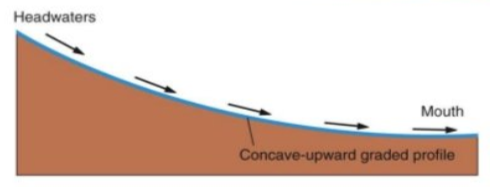
Ideal Longitudinal Profile
Smooth and CONCAVE in shape. Steep gradient in upper course → more energy needed (steep slope). Gradual gradient in lower course → large volume provides enough energy.
Overgraded River
A river with EXCESS ENERGY that erodes its channel. Has a steep gradient, large volume or smooth bed (less friction). Can carry a heavy load and flow quickly.
Undergraded River
A river with INSUFFICIENT ENERGY to transport its load. It slows down and DEPOSITS its load. Caused by: volume decreasing, gradient lessening, or friction increasing.
Knick Point
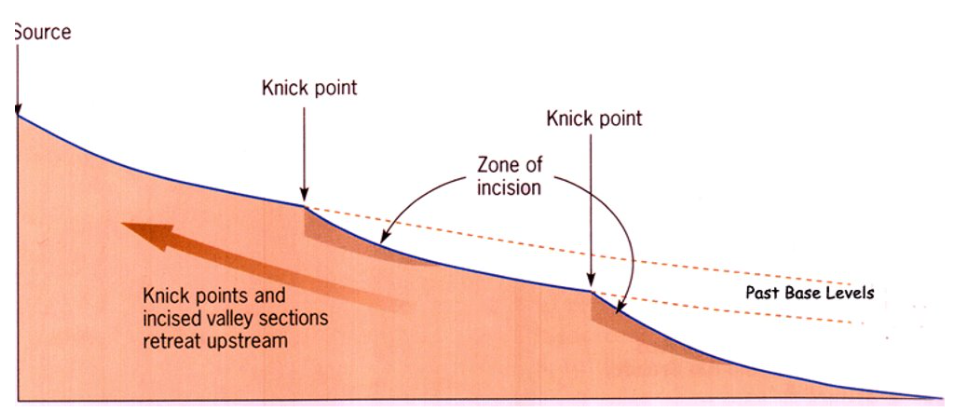
A SHARP CHANGE in gradient along a river's course, located at the old base level. Often marked by a waterfall. Caused by rejuvenation (uplift of land or drop in sea level). The river erodes back from the knick point upstream.
Upper course (graded): why steep gradient?
In the upper course, the river has a SMALL volume, uneven bed, turbulent flow, narrow channel — MORE friction. A steep slope is NEEDED to provide enough energy to flow.
Lower course (graded): why gentle gradient?
In the lower course, the river has a LARGE volume, laminar flow, wide channel — LESS friction. A gentle (gradual) gradient gives sufficient energy to flow.
What makes a river overgraded?
Steep gradient OR large volume OR smooth/even bed (less friction) → excess energy → river erodes.
What makes a river undergraded?
Volume decreases OR gradient lessens OR friction increases → insufficient energy → river deposits load.