Chapter 7 - Team Decision Making
 Call Kai
 Learn
Learn Practice Test
 Spaced Repetition
 Match
Match Flashcards
 Knowt Play
1/60

There's no tags or description
Looks like no tags are added yet.
Name | Mastery | Learn | Test | Matching | Spaced | Call with Kai |
|---|
No analytics yet
Send a link to your students to track their progress
61 Terms
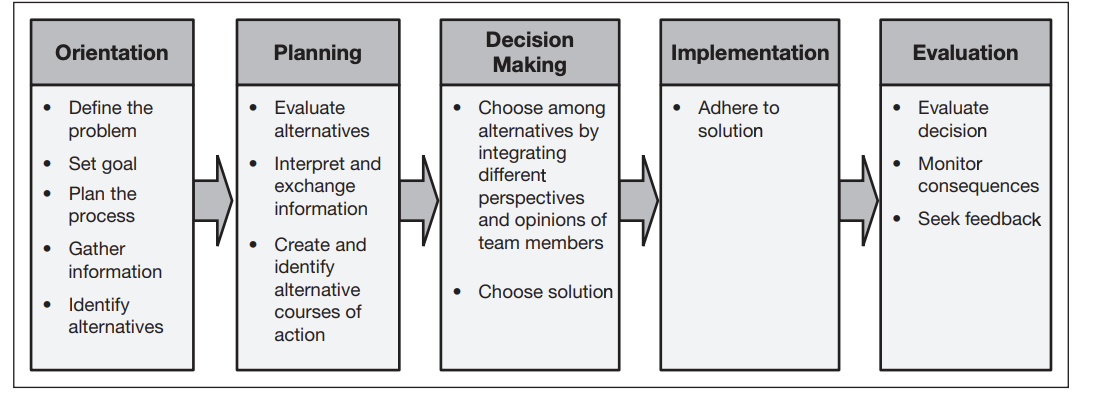
decision making
integrated sequence of activities including gathering, interpreting and exchanging information, creating and identifying alternative courses of action; choosing among alternatives by integrating different perspectives and opinions and implementing a choice and monitoring its consequences.
framing bias
almost any decision can be reframed as a gain or loss relative to something. Questions are worded differently to sway opinions
overconfidence bias
tendency for people to place unwarranted confidence in their judgements. Causes focus to be on strengths in our team and weaknesses in others
confirmation bias
tendency for people to consider evidence that supports their position, hypothesis, or desires and disregard or discount (equally valid) evidence that refutes their beliefs. Selectivley expose themselves to confirmatory information
tunnel vision → can augment this bias
regulatory focus → affects the incidence of the confirmation bias in groups. Prevention focus → such as security, leads to a greater bias when pursuing an individual goal over promotion focus
decision fatigue
get fatigued as they make more difficult decisions
demonstrable task
has an obvious correct answer
group-to-individual transfer
group members become more accurate during the group interaction
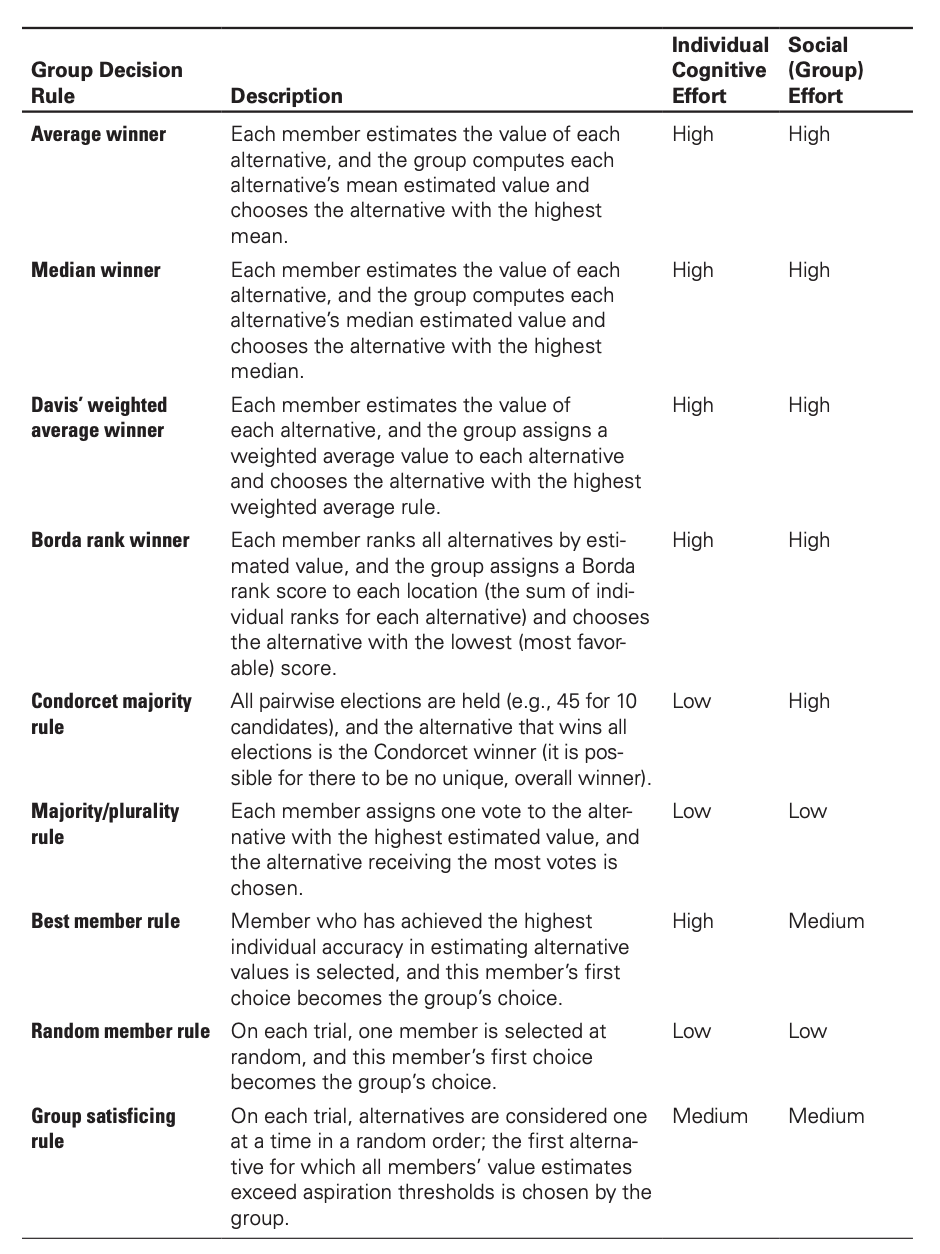
majority rule
most common decision rule, use because of ease and familiarity
doesn’t promote creative trade offs
form coalitions or subgroups
group decision rules
method to combine individual decisions to yield a group decision
motivated information processing in groups model
people refuse to make decisions and reject all options and delay choice. Epistemic motivation and social motivation affect the likelihood that groups will refuse to make decisions. When low they make decisions quickly otherwise if high they refuse.
when pro-self → longer discussions and engage in more focusing behavior
symptoms of group think
overestimation of the group → regard themselves as invulnerable and morally correct. Decision makers to believe they are exempt from standards
closed mindedness → members of the group engage in collective rationalization with stereotyping out group members
pressures toward uniformity → strong intolerance in groupthink situation for diversity of opinion. Dissenters are subject to enormous social pressure, often leads group members to suppress their reservations.
group think shortcomings
incomplete survey of alternatives and objects, failure to reexamine alternatives, failure to examine preferred choices, selection bias, poor information search, and failure to create contingency plans
precipitous conditions
likely to lead to group think
preventative conditions
likely to engender effective decision making
groupthink prevention
stimulation of constructive, intellectual conflict, and reduction of concerns about how the group is viewed by others - conformity pressure
team size
larger teams = more group think. Greater than 10 may feel responsible for team outcomes
face-saving mechanism
afraid of being blamed for poor decisions. More likely to succumb if they have an excuse for poop performance
risk technique
structured discussion situation designed to reduce group members fears about making decisions. Talk about dangers and risks first with devils advocate or anonymous feedback
different perspectives
assume perspective of other constituencies with a stake in the decision
devils advocate
disagree with the dominate proposal and ask questions
genuine dissent over contrived dissent or no dissent at all in terms of simulating original ideas, considering opposing positions nad changing attitudes
structured discussion
delay solution selection and increase the problem-solving phase. Prevents premature closer on a solution
protect alternative viewpoints
can generate high quality decision alternatives, they fail to adopt them. Record all presented alternatives
second solution
develop an alternative to 1st choice
time pressure
leads to risky decision making. Stressor, impares effectiveness
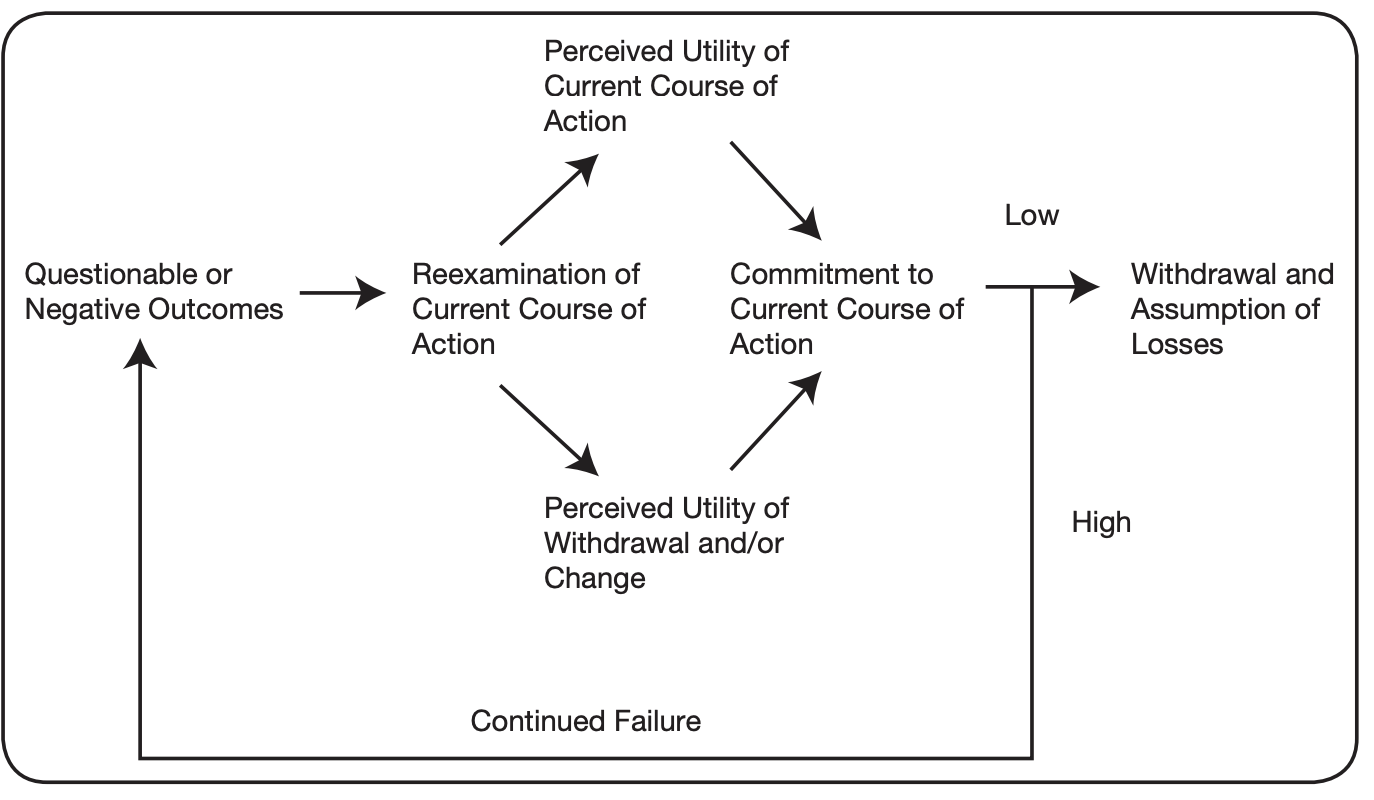
escalation of commitment
teams persist with a losing course of action, even in the face of clear evidence to the contrary
escalation dilemma → people involved would make a different decision if they weren’t involved up until that point
resources are allocated to try to “turn the decision around”
project determinants
object features of the situation. Ask whether the perceived setback is permanent or temporary, if temporary they’ll more likely to escalate commitment
psychological determinants
cognitive and motivational factors that propel people to continue that course of action
when negative outcome may occur ask…
what are my personal rewards? → self-perpetuating reinforcement trap (rewards for continuing aren’t aligned with organization objectives)
Is my ego and my team’s reputation on the line? Ego protection over success
social determinants
engage in actions and behaviors they think will please most of the people most of the times even at the expense of the right thing, which may not be popular. Heightened among groups of friends
structural determinants
when removed from critical evaluation a project can become institutionalized. This makes it impossible to consider removal or extinction of the project. Political support can also keep alive a project that should be terminated
minimize escalation of commitment
set limits → what criteria and performance justify continued investment in the project or program
avoid bystander effect
avoid bad mood → when upset they choose higher risk and higher payoff options
recognize sunk costs
external review → remove or replace original decision makers from deliberations because they are biased
abilene paradox
group members desire to avoid conflict and reach consensus at all costs.
Pluralistic ignorance → adopt a position because they feel other members desire it; don’t challenge one another because they want to avoid conflict or achieve consensus
self limiting behavior
less likely to speak up if individual team members are intimidated or feel that their efforts won’t be worthwhile
causes…
presence of an expert, a strong argument (especially if there’s decision fatigue), lack of self-confidence, rival decisions (don’t see how the decision impacts themselves or something important, they’ll self-limit), conformity, a faulty decision-making climate (when easily frustrated and believe others are dispassionate, involved or apathetic)
to avoid the Abilene paradox
confront the issue in a team setting, conduct a private vote, minimize status differences, utilize the scientific method (evidence makes the decision, not their beliefs), provide a formal forum for controversial views, take responsibility for failure
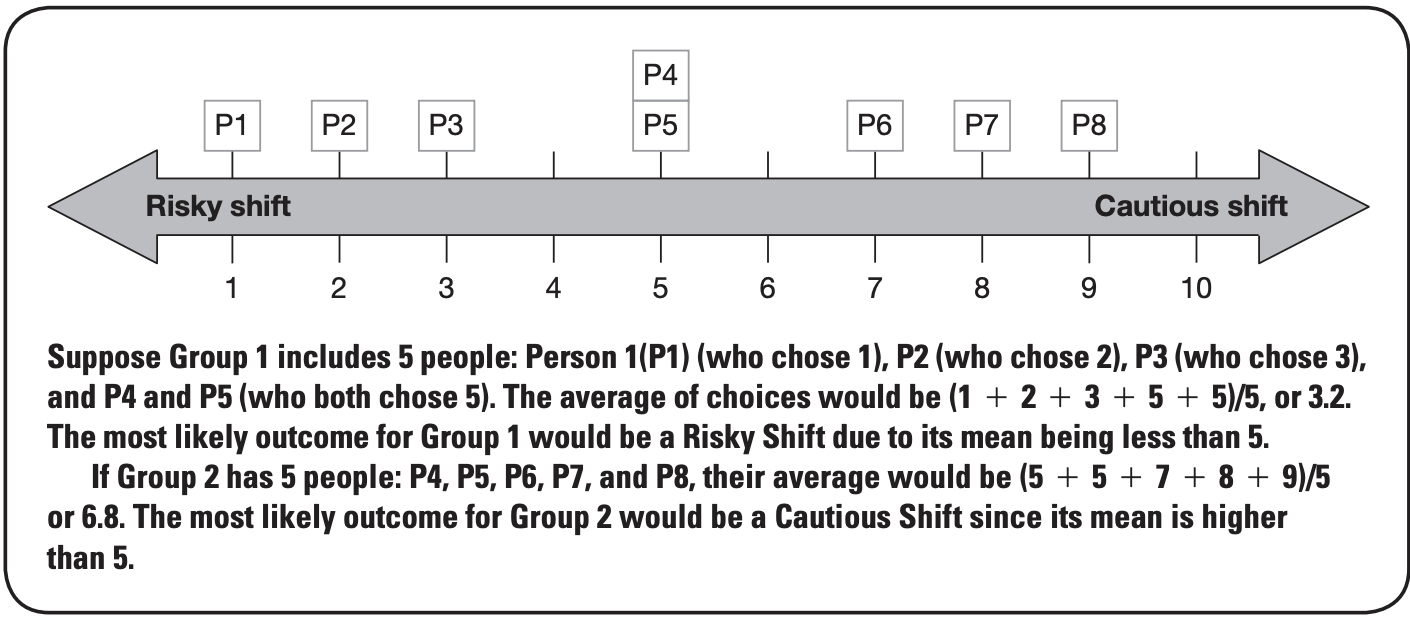
risky shift
when someone is advised to do something even if it has only a slightly better than 50-50 change of success
cautious shift
individual advisors are cautious but when the same people are in a group that collectively insist on even lower odds
group polarization
tendency for group discussion to intensify group opinion, producing more extreme judgements than might be obtained by pooling the views seperatly → grows stronger with time
information dependent
lack information that another member has
need to be right
tendency to look to the group to define what reality is the more people that hold the opinion, themkore right the answer seems to be
informational influence
stronger when people make private responses and communicate with the majority indirectly
need to be liked
tendency for people to agree with a group so that they can feel more like a part of that group
normative influences
need to be liked, stronger when people make public responses and are face-to-face with a majority
conformity
people bring their behaviors into alignment with a groups expectations beliefs → greater when people are uncertain, when they admire their team, need to be liked not ostracized
rational expectations model
people are fundamentally motivated to maximize their own utility which equals maximizing self-interest
norm of self-interest
no pervasive that people “invent” self-interest explanation about why they perform non-self serving acts (ex. Charity)
false consensus effect
tendency for people to believer others share their own views when they actually don’t
vicarious licensing
more likely to express prejudiced and immoral attitudes when their group members past behavior has established non-prejudiced credentials
desensitization
after the behavior line is crossed it often becomes desensitized
accountability
implicit or explicit expectation that one may be called on to justify one’s beliefs, feelings and actions to others
accountability in organization decision making
to an audience with known vs unknown views → people who know what conclusion the audience wants to hear often conform
pre-decision vs post-decision → once people commit to a decision they attempt to justify their decisions
outcome vs process → accountability for outcomes → greater escalation behavior but for process increase effectiveness
legit vs illegitimate → if illigitiment (intrusive and insulting) any beneficial affects of accountability may fail or backfire
contemplation
morally oriented conversation in the face of decision making
eliminate conflicts of interest
when a person isn’t incentivized to act in accordance with the best interest of the organization
create cultures of integrity
culture emerges as a result of design factors in the organization and the team t
trickle-down model
leaders play a prominent role in influencing employees propensity to be ethical and helpful
hypocrisy-by-association effect
employee fails to practice what an organization preaches
future self orientation
people who feel continuity with their future selves are more likely to behave in ethically responsible ways
inquiry
open process designation to generate multiple alternatives foster the echange of ideas and produce a well-tested solution
advocacy
approach decision making as a contest although they don’t necessarily compete openly or conspicuously. Advocate for different options. Hold back information buttress their arguments. Personalities and egos come to play, solution comes from test of strength.
make vigorous debate the norm and structure debates (point-counterpoint and intellectual watchdog
construction conflict
critical thinking and rigorous debate, brings issues into focus and allows leaders to make more informed choices
cognitive (substances) → relates to the work at hand. Healthy, disagreements over ideas, assumptions and differing views
affective (interpersonal) → emotional, personal friction rivalries and clashing personalities. Diminishes people want to cooperate
consideration
if they felt the process was fair they’re willing to commit themselves to the resulting decision even if their views don’t prevail. Did the leader actually listen and weigh their views carefully
closure
deciding too early → people desire to be team players overrides their willingness to engage in critical thinking and thoughtful analysis so they go for the first plausible option
deciding to late → unchecked advocacy, gridlock, bend over backwards to ensure even participation.
to periodically assess the decision making process
multiple alternatives (avoid settling to quickly)
assumption testing (confirm assumption by critically examining them)
well-defined criteria
dissent and debate
perceived fairness