Chem 41A - Midterm 2
 Call Kai
 Learn
 Practice Test
 Spaced Repetition
 Match
 Flashcards
 Knowt Play
1/117

Earn XP
118 Terms
What is this functional group

Alkane

What is this functional group
Haloalkane

What is this functional group
Alcohol

What is this functional group
Ethers

What is this functional group
Thiols

What is this functional group
Alkenes
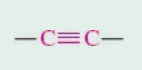
What is this functional group
Alkynes

What is this functional group
Aromatic Compounds

What is this functional group
Aldehydes

What is this functional group
Ketone

What is this functional group
Carboxylic Acid

What is this functional group
Anhydrides

What is this functional group
Esters

What is this functional group
Amides

What is this functional group
Nitriles

What is this functional group
Amines
What is the valence electrons in order from Boron to Fluorine. What about the amount of bonds they like
Valance electrons: 3, 4, 5, 6, 7
Amount of bonds they line: 3, 4, 3, 2, 1
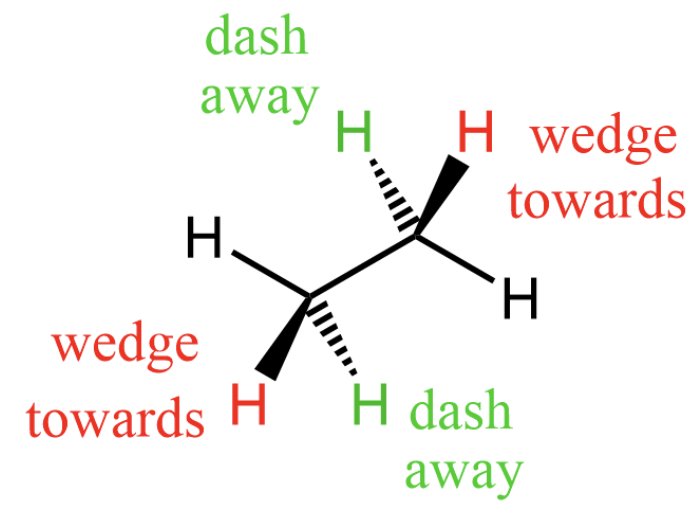
How should the wedge be placed when with a dash.
The dash should always be above the wedge
As you increase in orbitals is there an increase or decrease in energy
There is an increase in energy
What is the difference between a trans-, cis-, and

What is a simple way to assigning hybridization to an atom
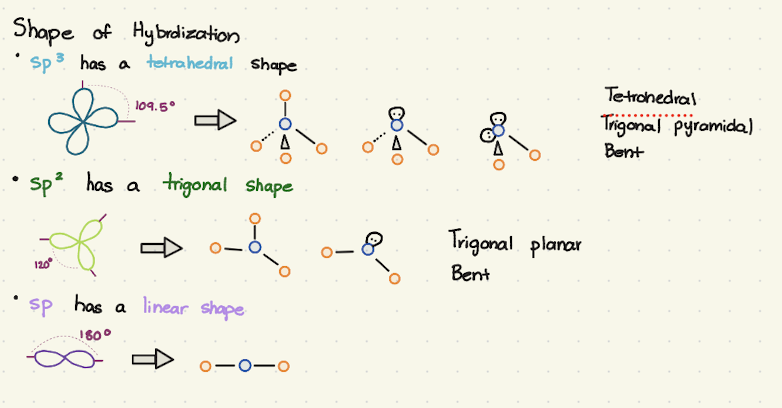
If 4 groups → sp3
If 3 groups → sp2
If 2 groups → sp
Electron pairs are counted as a group, an odd electron is not counted as a group
What does the sign of ΔG tell us about K

What does a ΔG value of -4.09 mean
means that the reaction is spontaneous and exergonic under standard conditions. This indicates that the reaction releases free energy and will naturally proceed forward to form products without needing external energy.
What is the relationship between ΔS, ΔH, and ΔG

What sign of ΔS means more disorder
A positive sign
In an acid-base reaction which side does the equilibrium side go towards
Goes towards the side of the weaker acid or weaker base
What shows that an acid is stronger than the other?
Increased size of A → going down the periodic table
Stronger electronegativity
More resonance
Smaller pKa or greater Ka
Cations - ones with positive charges are stronger
What is the names of Alkanes from C1 to C10

What happens to boiling point and melting point as you increase the number of carbons
The boiling point increases and the melting point increases
What characteristics do branched alkane isomers have
They have smaller surface areas → smaller London attractions and lower boiling points
They are more compact → better crystal packing and higher melting points
True or False: The labels primary, secondary, and tertiary only apply to sp3 carbons and hydrogens on those carbons. Not other hybridizations
True
What is an alkyl group
An alkyl group is an alkane fragment that is missing one hydrogen atom and is represented by the generic symbol R
What are the different Alkyl groups

In newman projects where do the wedge marks go and the dashed ones
The wedge ones go to the rights and dashed ones go to the left
What is more stable in newman projects a staggered or eclipse
staggered
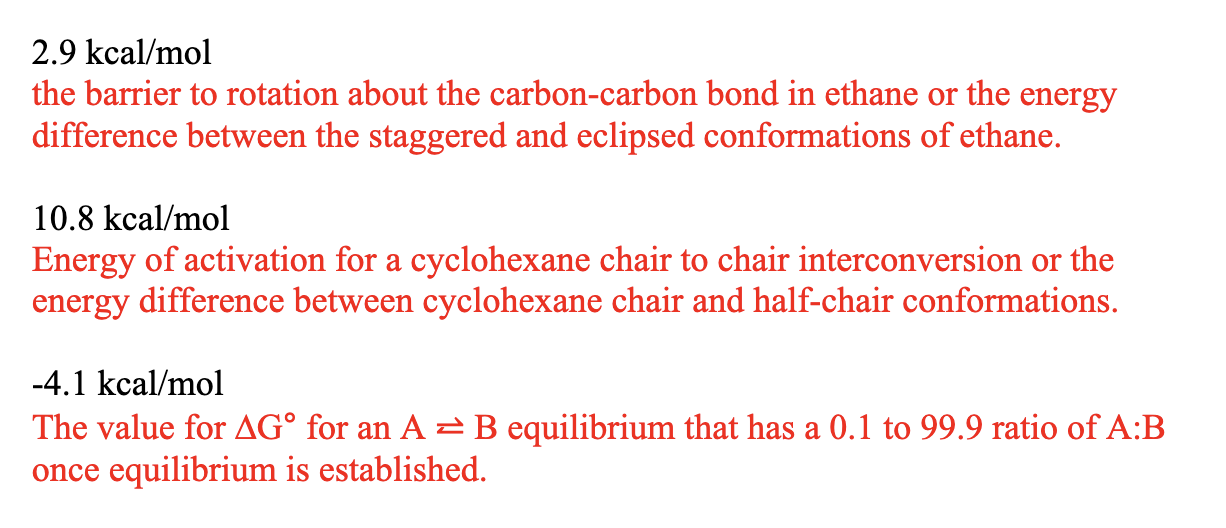
For each of the following energy values give a description of a phenomenon the value relates to
2.9 kcal/mol
10.8 kcal/mol
-4.1 kcal/mol
What happens to ΔH as you go down this series:

Decreases
Out of primary carbon, secondary carbon, and tertiary carbon which one is the highest/lowest in energy and the most stable/least stable
Most stable and lowest in energy: tertiary carbon
Least stable and greatest in energy: primary carbon
What is the range values for C-H bonds. What happens when you increase the amount of carbons
96 to 105 kcal/mol. The bond energy decreases
What is the range of values for C-C bonds. What happens as you increase the amount of carbons
78 to 90 kcal/mol. The bond energy decreases.
What is hyperconjugation
p-Orbital (with a single e) overlaps with bonding molecular orbital of the neighboring C-H (or any other) bond
How does hyperconjugation look like for an ethyl radical, Isopropyl, and ter-butyl

What asked to draw a transition state what do you have to include
No formal charges, dipole charges, and brackets with this sign on upper right

When doing a halogenation what happens to ΔH values from the initiation, propagation, and termination phase

Initiation: ΔH values are at their lowest
Propagation: ΔH values increase at their highest
Termination: ΔH values are not high but not low
Which out of the halogens has the higest reactivity and which one has the lowest
F has the highest and I has the lowest because its endothermic
What does a halogenation need in order to occur. If a halogenation has Iodine will the reaction occur
It needs heat or light, if there is none there won’t be a reaction. If there is iodine no reaction will occur because its endothermic
What level of carbon does Br atoms connect to because they are very seletive
They attach to tertiary carbons

Where do fluorine atoms connect to because they are unselective
They connect to the one will the lowest amount of hydogren to make it lose one. Then it connects at the end and make it lose a hydrogen

When looking for the level of a carbon atom what do you look for.
Look for the amount of carbons it is connected to
4 carbons - quaternary
3 carbons - tertiary → most stable
2 carbons - secondary
1 carbon - primary
When labeling the primary, secondary, and tertiary hydrogens, what do you look for
Count the number of hydrogens connected to the carbon
3 hydrogens - primary
2 hydrogens - secondary
1 hydrogen - tertiary
How do you identify how many constitutional isomers can form
Find a line of symmetry and count how many carbons there are. If there is no symmetry then the amount of carbons is the amount of constitutional isomers.

Where do chlorine connect when in a halogenation
connects at the end of the structure or beginning
When doing curve arrow notation where do electrons flow
They flow from high electron density to low electron density (nuc→elec)
What shape geometrys have a sp3, sp2, sp
What do chair confirmations for A and B look like. What is axial and what is equatorial

From a ring diagram to a chair confirmation what happens to wedge and dash
Wedges → Up direction
Dash → Down direction

When going from A to B, what happens to the elements
Going from A to B they move clockwise. They go counter-clock wise from B to A. Axial also turn to equatorial. Equatorial turn to axial
When doing chair confirmations what is a good pattern to remember which does axial and equatorial for cis and trans
Cis: Both point in the same direction
Trans: Both point in opposite direction

When making a more stable chair confirmation, how do you know what to put equatorial and axial.
The larger atom should be equatorial. Larger going down periodic table. CH3 is also larger than trigonal planar oxygens
Which ring is more stable and why

The more CH2 the more stable the ring is as CH2 relieves ring strain, making it more stable (adds 157.4 kcal/mol to heat of combustion -→ lower heat of combustion → more stable)
Between two chairs, where does equilibrium lie
Towards more stable ring
How do you use this table

When drawing chair conformations, the amount of delta G is based on which groups are axial. The one with lower delta G is more stable

What do you look for in ring strain
Bond angle especially in small rings
Eclipsing
Transanular, especially in medium sized rings
How to find the configuration at a sterocenter
1.) Identify priority of atoms (higher atomic # wins —> CH3 below CH2CH3)
2.) See which way you read
Clockwise: R
Counter-clock wise: S
3.) If the lowest priority group is not in the back then switch configuration
How to know two atoms are enantiomers
Same connectivity and mirror image of each other. If stereocenter the configuration should be the opposite (RR → SS) or (SS → RR)
Are the C-C bonds in a chair staggered or eclipsed?
Staggered. A boat has eclipsing interactions
Does a ring flip create a difference configurational steroisomer
No it produces another conformation of the same molecule
How do you identify R/S on a chair
Identify if attachments are wedges or dashes → redraw as ring → assign priorities → determine R/S
What are constitutional isomers
Same molecular formula but different atom connectivity
What are diastereomers
Same connectivity but different configurations without being mirror images. Some wedges turn to dashes, but not all. (RS → SS) or (RS → RR).
Example: cis/trans (or E/Z) isomers across a double bond or in a ring structure are classic examples of diastereomers that do not rely on tetrahedral chiral/stereocenters.
How do recognize identical molecules
Nothing changed, just the way you view it
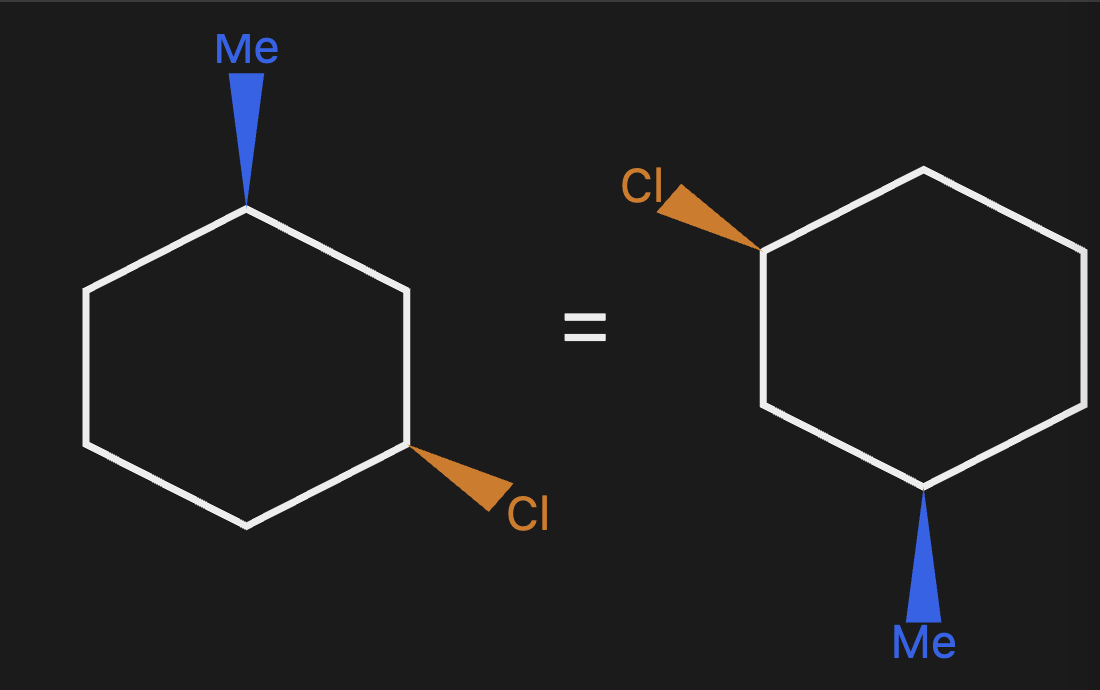
(RR → RR) or (SS → SS)
If configurations are RS → SR. How do you know they are enantiomers or meso
If there is symmetry then its meso, if no symmetry then enantiomers
What is a meso compound
An achiral molecule containing sterocenters whose overall symmetry make its mirror image superimposable
How do you solve for entantiometric excess
% of major enantiomer - % minor enantiomer
How to find how many stereoisomers there are
2number of stereocenters make sure there are no duplicates, if there is symmetry they are identical
What do the horizontal bonds of a Fishcer projection represent
Bonds pointing toward the viewer
What do the vertical bonds of a Fischer projection represent
Bonds pointing away from the viewer
What happens if you exchange two groups at a stereocenter, in fisher
One exchange inverts configuration, two exchanges preserve it
What is levoratory and dextrorotary
Levoratory: rotates light towards the left (-)
Dextrorotary: rotates light towards right (+)
If you have two pure enantiomers, how do their optical rotations occur
Equal magnitude and opposite sign
What is the optical rotation of a racemic mixture or pure meso compound
Zero
Racemic: cancellation between enantiomers
Meso: achiral
How do you find major % and minor % from enantiomeric excess

How do enantiomers compare in physical properties (density, melting point, boiling point, solubility)
Same ordinary physical properties. But they have opposite optical rotations so they could have different interactions with chiral substances
Does Sn2 inversion always change R into S
Not always. Geometry inverts but the priority of the groups attached may change, it depends
What is a nucleophile
An electron pair donor that attacks an electrophilic atom such as carbon
What is the difference between a base and nucleophile
A base attacks a proton. In substitution, a nucleophile attacks an eletrophilic carbon
Why is carbon attached to a halogen electrophilic
The halogen gives the carbon a partial positive charge
How many elementary steps does Sn2 have?
One transition step, bond formation and bond breaking occurs together
What is the rate law for Sn2

What is the Sn2 substrate reactivity trend? (Substrate - carbon connected to leaving group)

Why do tertiary substrates not undergo ordinary Sn2
Steric crowding prevents backside attack
What sterochemical change occurs during Sn2
Backside attack causes inversion of geometry at the reaction carbon

Does Sn2 have a carbocation intermediate
No one transition state and no intermediate
How do Sn2 transition state energies compare for R and S reactants
They are equal under otherwise identical achiral reaction conditions
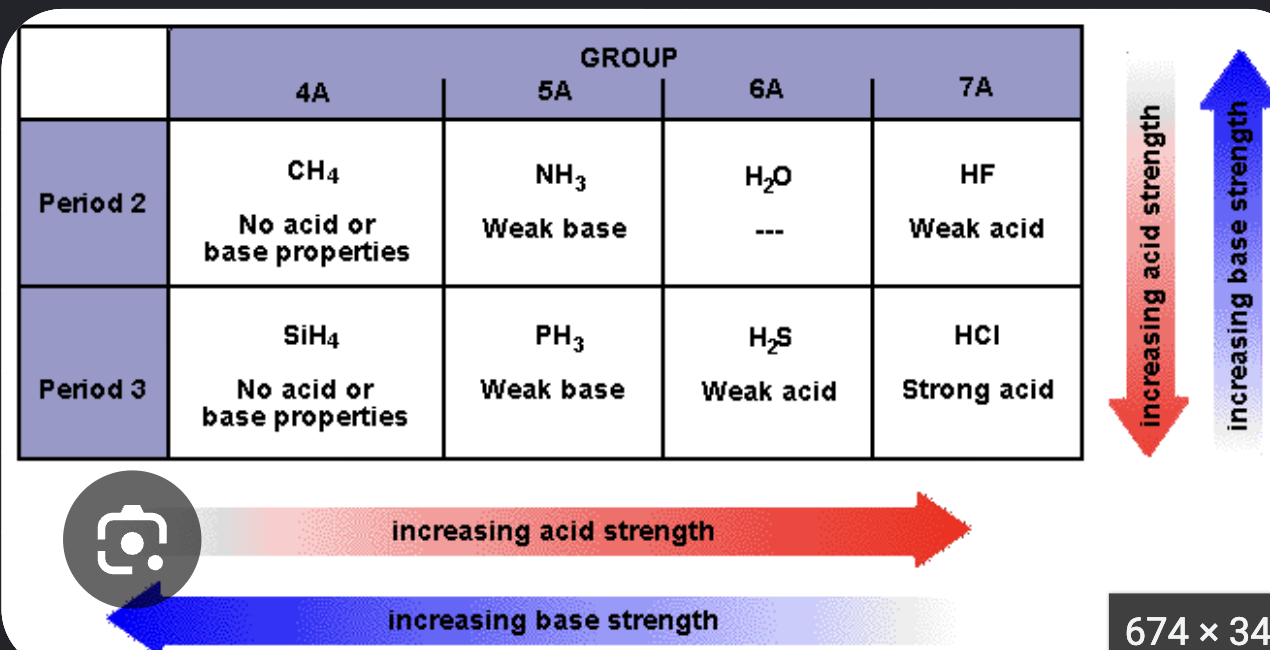
What are the trends for comparing the strengths of leaving groups and nucleophiles

What is the connection between basicity and leaving group ability
Weaker bases are generally better leaving groups
What is the trend for bases on periodic table
Why does halide nucleophilicity reverse between solvent types
Protic solvents hydrogen bond strongly to smaller anions, decreasing their availability. Aprotic solvents do not provide the same hydrogen bond solvation
What are protic solvents
Polar O-H or N-H or H-F bond like Water, Methanol(CH3OH), or ethanol (CH3CH2OH), IPA
What are the aprotic solvents
Acetone, acetonitrile, DMF, DMSO, HMPA, Nitromethane