Phys test 1 (part 3
 Call Kai
 Learn
Learn Practice Test
 Spaced Repetition
 Match
Match Flashcards
 Knowt Play
1/48

There's no tags or description
Looks like no tags are added yet.
Name | Mastery | Learn | Test | Matching | Spaced | Call with Kai |
|---|
No analytics yet
Send a link to your students to track their progress
49 Terms
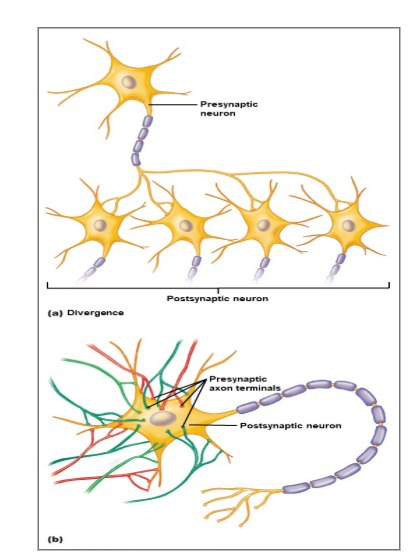
What is a synapse?
junction where one neuron communicates with another neuron or target cell.
What is the presynaptic neuron?
neuron sends signal ; releases neurotransmitters
What is the postsynaptic neuron?
neuron receives signal ; transmits impulses away from synapse
What is the synaptic cleft?
gap (30-50 nm wide) between presynaptic & postsynaptic cells ; where neurotransmitters are released
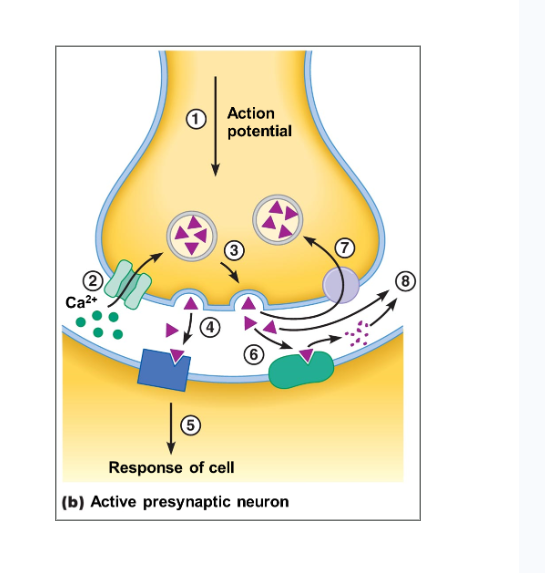
How is information sent from one neuron to another?
Through neurotransmitters released into the synaptic cleft, which bind to receptors on the postsynaptic neuron.
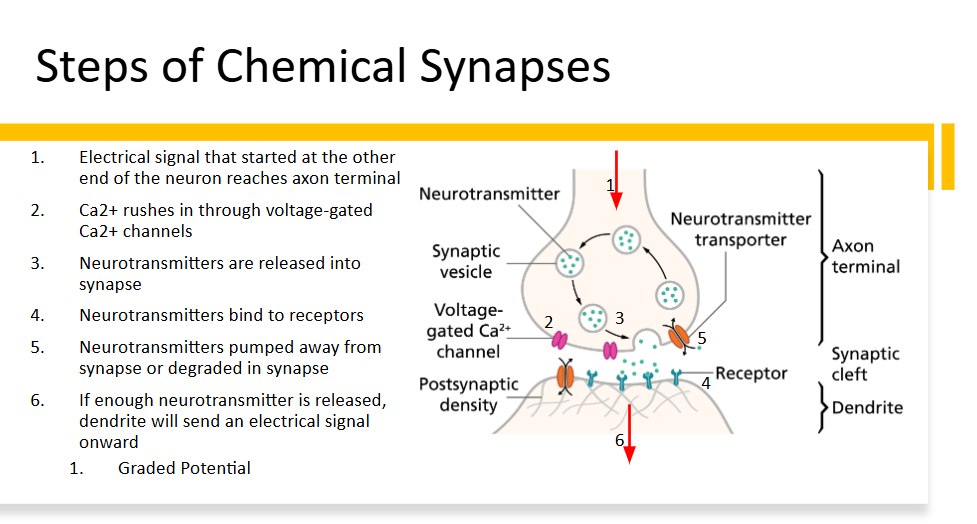
What is a ligand?
A chemical messenger (NT) binds to a receptor to produce a response.
What are neurotransmitters?
Chemical messengers released by neurons to send signals to other cells.
Where are neurotransmitters stored?
In synaptic vesicles in the presynaptic neuron.
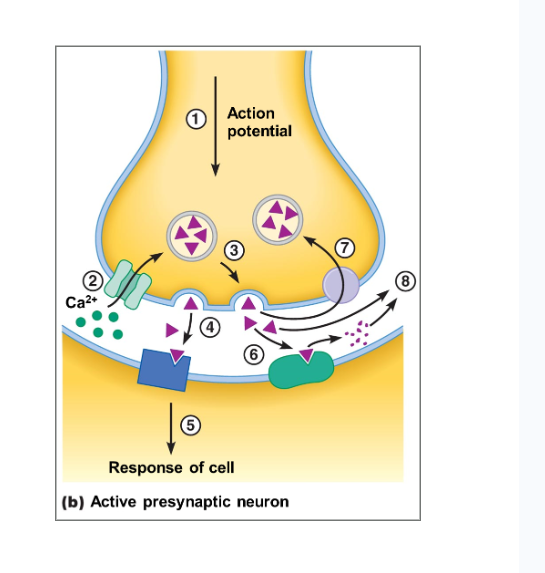
How are neurotransmitters released?
By exocytosis when an action potential triggers Ca2+ influx.
How quickly do neurotransmitters take effect?
milliseconds at chemical synapses.
What is the role of the Ca2+ pump in neurotransmission?
regulates intracellular calcium levels, triggering vesicle release.
What are channel-linked receptors?
Receptors that open ion channels when a ligand binds → rapid effects.
What are G-protein-coupled receptors?
Receptors that activate secondary messenger systems indirectly, causing slower but longer-lasting effects.
What are the possible effects of receptor activation?
Excitation, inhibition, or modulation of the postsynaptic neuron.
What is an excitatory postsynaptic potential (EPSP)?
A small depolarization that makes a neuron more likely to fire an action potential.
What is temporal summation?
Summation of multiple EPSPs from the same synapse over time.
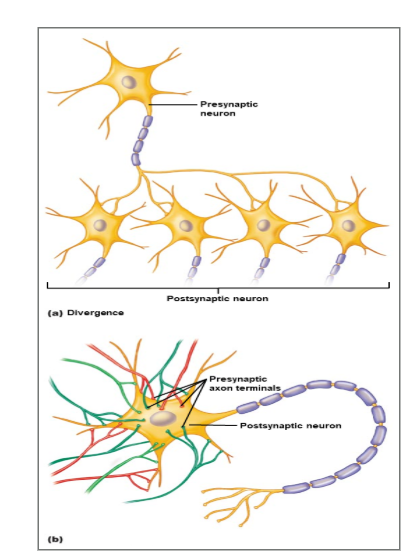
What is spatial summation?
Summation of EPSPs from multiple synapses at the same time.
How are EPSPs related to graded and action potentials?
EPSPs = graded potentials that can summate to reach threshold for action potential.
What is an inhibitory postsynaptic potential (IPSP)?
A small hyperpolarization ; neuron less likely to fire an action potential. (becomes negative)
How can movement of K+ and Cl- cause IPSPs?
K+ leaving/Cl- entering the cell causes hyperpolarization
key concept of neurotransmitters, ligands, and receptors?
ligand binds to receptor → type of receptor determines the outcome of chemical signal.
What is the difference between sense and perception?
Sense = detection of stimuli; perception = the brain's interpretation of stimuli.
What is transduction in sensory systems?
The conversion of a stimulus into an electrical signal in a sensory receptor.
What is modality in sensory systems?
The type of stimulus a receptor detects (e.g., light, sound, touch).
Why are transduction and modality important?
Allows sensory systems to detect specific stimuli & convert them into meaningful signals.
What are the four main sensory receptors?
Mechanoreceptors, thermoreceptors, photoreceptors, and chemoreceptors.
What do mechanoreceptors detect?
touch, pressure, and vibration.
Where are mechanoreceptors found? 4 areas
Skin, muscles, joints, inner ear.
What do thermoreceptors detect?
temperature changes.
Where are thermoreceptors found?
Skin and hypothalamus.
What do photoreceptors detect?
Light.
Where are photoreceptors found?
Retina of the eye.
What do chemoreceptors detect?
chemical stimuli: taste, smell, or blood chemistry.
Where are chemoreceptors found?
Nose, tongue, blood vessels.
How do sensory receptors adapt?
By decreasing their response to a constant stimulus over time.
What is phasic adaptation?
Rapid adaptation; receptor responds then stops. (ex. smell/taste)
What is tonic adaptation?
Slow or no adaptation; receptor continues as long as stimulus is present. (pain/balance)
What is the autonomic nervous system (ANS)?
PNS part that controls involuntary functions (ex. heart rate and digestion)
What are the two divisions of the ANS?
Sympathetic and parasympathetic divisions.
Where do sympathetic nerves originate?
Thoracic and lumbar regions at spinal cord.
What is the function of the parasympathetic division?
Promotes rest, digestion, and energy conservation.
Where do parasympathetic preganglionic axons synapse?
With postganglionic neurons in or near target organs.
Which cranial nerve is critical to parasympathetic function?
Vagus nerve (cranial nerve X).
What activities are associated with parasympathetic division?
rest-and-digest, “D activities”: digest, defecation, diuresis
What is the function of the sympathetic division?
fight-or-flight responses
What activities are associated with the sympathetic division?
Increased heart rate, pupil dilation, blood flow to muscles, breathing.
What neurotransmitter is used at all motor neuron synapses?
Acetylcholine (ACh).
What brain centers control key aspects of the ANS?
Hypothalamus and brainstem centers.
Name some major neurotransmitters.
Integrative
Sensory
Motor:
Acetylcholine (ACh), Norepinephrine (NE), Dopamine (DA), Serotonin (5-HT), GABA, Glutamate.