bio 1000 - unit 4 (cell division)
 Call Kai
 Learn
Learn Practice Test
 Spaced Repetition
 Match
Match Flashcards
 Knowt Play
1/149

There's no tags or description
Looks like no tags are added yet.
Name | Mastery | Learn | Test | Matching | Spaced | Call with Kai |
|---|
No analytics yet
Send a link to your students to track their progress
150 Terms
cell division / cellular reproduction
the splitting of one parent cell into 2 genetically identical daughter cells; happens through duplication of the genome and division of the cytoplasm
what role does cell division play in our bodies?
growth, repairing damaged tissues, and replacing old cells in our bodies, which allows us to develop from a single cell into a multicellular organism.
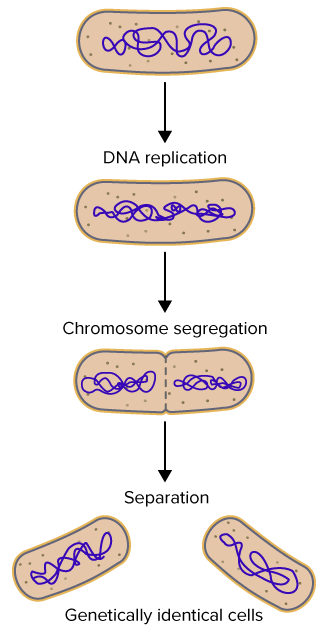
describe the process of cell division in prokaryotic cells
1) duplication of prokaryotic chromosome and separation of the copies
2) continued elongation of the cell and movement of the copies
3) division into 2 daughter cells
asexual reproduction
the creation of genetically identical offspring by a single parent without the participation of sperm and egg
asexual reproduction gives rise to _____
clones
clones
a group of genetically identical individuals derived from a single ancestor
what types of organisms undergo asexual reproduction
single celled organisms and some multicellular organisms
what is the difference between asexual reproduction and cellular division?
Cellular division is the process by which a single cell splits into two or more daughter cells — it's a mechanism that happens in nearly all living organisms, both for growth/repair and reproduction.
Asexual reproduction is a mode of reproduction where an organism produces offspring without fertilization, often using cellular division as its tool.
sexual reproduction
reproduction that requires the fusion of gametes
gametes
egg and sperm cells
why are offsprings not identical to the parents of the other offsprings?
because there will be a mix of genetic material from egg and sperm cells
sexual reproduction results in a _____
zygote
zygote
fertilized egg
cell division allows the single cell zygote to develop into an ______ and then a mature organism
embryo
binary fission
a means of asexual reproduction in which a parent organism, often a single cell, divides into two genetically identical individuals of about equal size
what is the difference between offspring produced through asexual reproduction and sexual reproduction?
Asexual reproduction produces offspring that are genetically identical (clones) to the parent, since no mixing of genetic material occurs.
Sexual reproduction produces offspring that are genetically unique, inheriting a combination of genes from two parents through the fusion of gametes (egg and sperm)
what processes are used for cell division in eukaryotes?
mitosis (for growth and repair) and meiosis (for sexual reproduction)
mitosis
the division of a single nucleus into 2 genetically identical nuclei.
mitosis function
responsible for the growth and maintenance of multicellular organisms and for asexual reproduction
meiosis
in a sexually reproducing organism, the division of a single diploid nucleus into 4 haploid daughter nuclei
meiosis function
production of egg and sperm cells in the testes and ovaries … these gametes are used in sexual reproduction
chromosome
a single strand o DNA that is hundreds or thousands of genes long… there are different numbers of chromosomes for each speceis
how many chromosomes are in a human?
46 chromosomes
what maintains the structure of chromosomes and control gene expression?
proteins
chromatin
the structure of DNA and its associated proteins
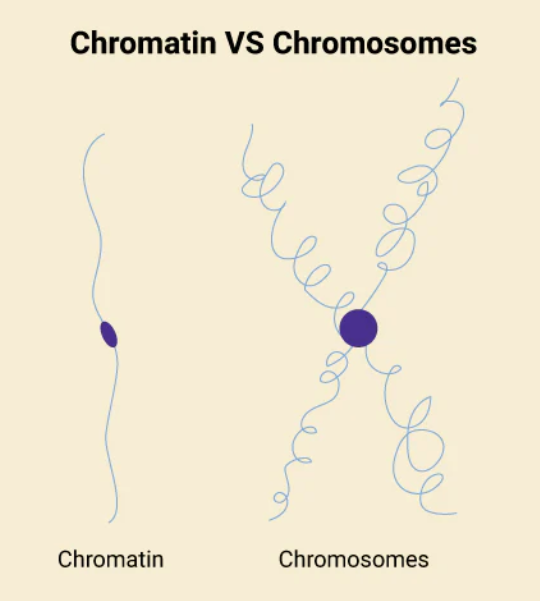
what is the difference between chromosomes and chromatin?
CHROMATIN is the relaxed, normal state of DNA when the cell is not dividing
CHROMOSOMES are chromatin that has been tightly coiled and condensed for cell division
what does a chromatin look like?
it is a diffuse mass of long thin fibers
when the cell prepares to divide, what happens to the chromatin?
chromatin will coil into tight, distinct chromosomes… each chromosome can be seen with a light microscope
before cells divide it needs to _______ DNA
replicate
DNA replication
chromosomes are replicated and attached to proteins ; ensures each daughter cell receives a complete set of genetic instructions
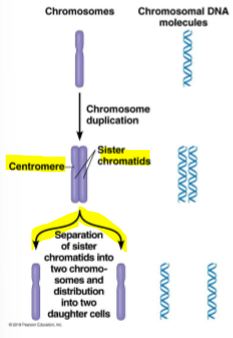
process of DNA replication
chromosomes duplicate, turning into sister chromatids
sister chromatids separate into two chromosomes and will be distributed into 2 daughter cells
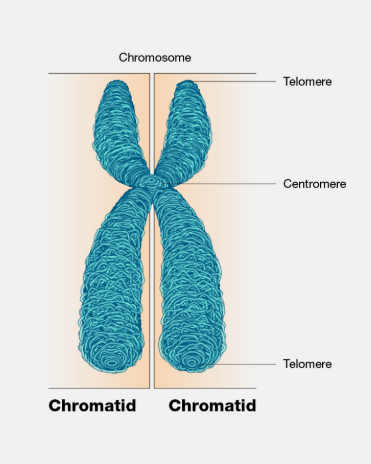
chromatid
A chromatid is one of the two identical halves of a chromosome that has been replicated in preparation for cell division
sister chromatids
the 2 copies of each chromosome that separate during division ; attached together by proteins
centromere
the region where sister chromatids are most closely attached
what types of cells divide often and what types divide rarely or never?
some human cells divide MORE OFTEN THAN OTHERS…
some will divide ALMOST EVERY DAY because they are KILLED OR DAMAGED QUICKLY (e.g. cells that line the stomach)…
some are also highly specialized and NEVER divide (e.g. mature muscle and nerve cells)
cell cycle
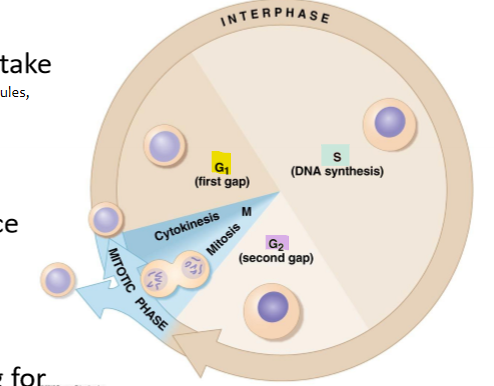
an ordered sequence of events form the instant a cell is formed to the moment it divides into new daughter cells … organized into 2 stages (INTERPHASE and MITOTIC)
interphase
the period in the eukaryotic cell cycle when the cell is not actually dividing. interphase constitutes the majority of the time spent in the cell cycle
what are the 3 phases of INTERPHASE, a stage from the cell cycle?
G1 phase: 1st gap … where normal cellular functions take place (making + breaking molecules, interacting with other cells, etc.)
S phase: synthesis phase … where DNA replication takes place (cell makes copy of all DNA)
G2 phase: 2nd gap … where normal cellular functions occur, and where the cell finishes preparing for cell division
what are the normal cellular functions?
making proteins, copying organelles, growing larger, chemical reactions
mitotic phase (M Phase)
the part of the cell cycle when the nucleus DIVIDES (via mitosis), the chromosomes are then distributed to the daughter nuclei, and the cytoplasm divides (via cytokinesis), producing 2 identical daughter cells
what are the 2 sages of the MITOTIC PHASE (M Phase), the second stage of the cell cycle?
1) mitosis: division of the nucleus and its contents
2) cytokinesis: the division of the cytoplasm and separation of the two daughter cells
what are the 6 stages of mitosis?
prophase, prometaphase, metaphase, anaphase, telophase, cytokinesis
what occurs during the PROPHASE stage in the NUCLEUS?
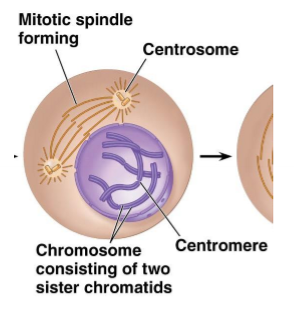
chromatin coils and folds into discreet chromosomes… the chromosomes are 2 sister chromatids bound together … nucleus remains intact
mitotic spindle
microtubule fibers and proteins that guide the separation of the daughter chromosomes
centrosomes
microtubule-organizing regions in the cytoplasm ; found in animal cells only
while prophase occurs in the nucleus, what else occurs simultaneously in the CYTOPLASM during PROPHASE?
MITOTIC SPINDLE emerges from the CENTROSOMES and the centrosomes separate
kinetochores
protein structure on each sister chromatid
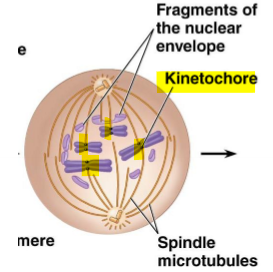
what occurs during PROMETAPHASE?
2nd stage of mitosis
nuclear envelope fragments
mitotic spindles reach the chromosomes
microtubules attach to KINETOCHORES
some microtubules attach to microtubules from the opposite pole
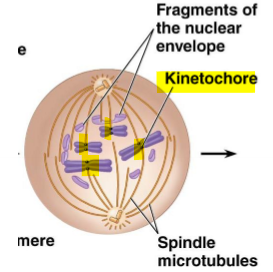
what moves the chromosomes towards the center of the cell during PROMETAPHASE?
proteins associated with the microtubules
metaphase plate
imaginary plane equidistant between the two poles of the spindle
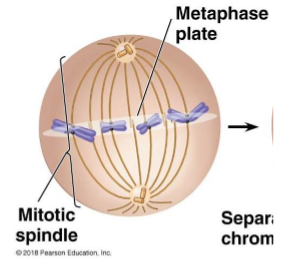
what occurs during METAPHASE?
3rd stage of mitosis
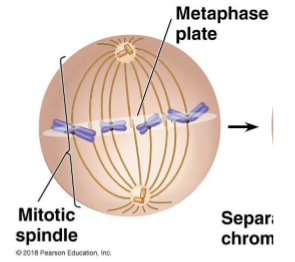
mitotic spindle is fully formed
centrosomes are at opposite poles of the cell
chromosomes line up on the METAPHASE PLATE
kinetochores of sister chromatids are linked to microtubules from opposite poles
what occurs during ANAPHASE?
4th stage of mitosis
the two centromeres come apart
the sister chromatids separate
daughter chromosomes go towards opposite ends of the cell
microtubules attached to kinetochores shorten
microtubules not attached to chromosomes lengthen; cell elongates
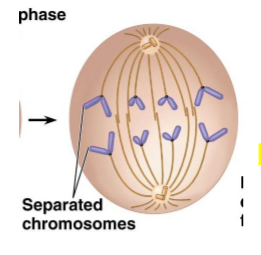
what “walks” the daughter chromosomes along the microtubule towards opposite ends of the cell in ANAPHASE?
motor proteins attached to kinetochores
what occurs during TELOPHASE?
5th and final stage of mitosis
cell continues to elongate
daughter nuclei are formed at the poles of the cell (nuclear envelopes form around the chromosomes)
chromatin fibers uncoil
mitotic spindle disappears
happens together with cytokinesis
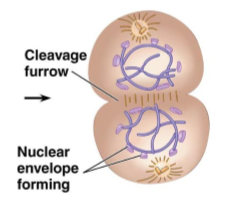
cytokinesis
division of the cytoplasm to form two separate daughter cells ; occurs simultaneously with telophase
difference between cytokinesis and mitosis
MITOSiS splits the nucleus
CYTOKINESIS splits the cytoplasm
Mitosis divides the genetic material; cytokinesis divides the rest of the cell.
what is the cleavage furrow
the first sign of cytokinesis during cell division in an ANIMAL CELL ; a shallow groove in the cell structure (where the cell will be cut in half)
how is the cleavage furrow separated?
actin interacts with myosin for the ring to contract … furrow deepens and eventually pinches the parent cell in two
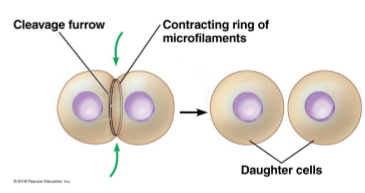
why can’t plan cells divide in the same way animal cells do?
because of the rigid cell wall only found in plant cells
cell plate
a MEMBRANOUS DISK across the midline of a dividing plant cell
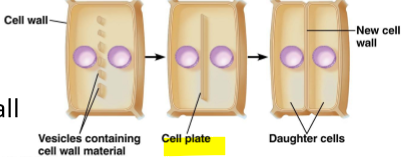
process of CYTOKINESIS in PLANT CELLS
vesicles carries new cell wall material to the middle of the parent cell
cell plate forms as more vesicles fuse together
cell plate fuses with plasma membrane
cell plate joins the parental cell wall
2 daughter cells are now each bound by their own plasma membrane and cell wall
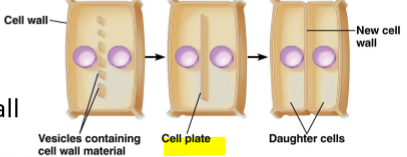
types of environmental factors that influence cell division?
anchorage dependence, density dependent inhibition, chemical + growth factors
anchorage dependence
cells must be in contact with a SOLID SURFACE TO DIVIDE ; happens to most animal cells
density-dependent inhibition
when crowded cells stop dividing ; animal cells grow in a single later and stop dividing when they touch each other
chemical factors that influence cell division
cells need certain nutrients to grow
growth factors that influence cell division
division only if certain proteins are present
cancer
disease of the cell cycle ; cells do not recognize signals that regulate the cell cycle, which results in tumors
tumor
a mass of abnormally growing cells within an otherwise normal tissue
2 types of tumors and what are they?
benign: abnormal ells remain at their original location
malignant: abnormally reproducing cells that can spread into other tissues in other parts of the body
metastasis
the spread of cancer cells beyond their original site
blood vessels grow toward the tumor, cancerous cells enter the bloodstream for distribution around the body
how does the malfunctioning of cell division result in cancer?
cancer occurs when mutations damage genes that normally control cell division / regulate the cell cycle …
Proto-oncogenes (accelerators) mutate into oncogenes, causing the cell to divide uncontrollably
Tumor suppressor genes (brakes) become inactivated, removing the "stop" signals for division
somatic cell
typical body cell other than the reproductive cells (sperm + egg)
how many somatic cells do humans have? how many matched chromosomes?
46 somatic cells, and 23 matched chromosome
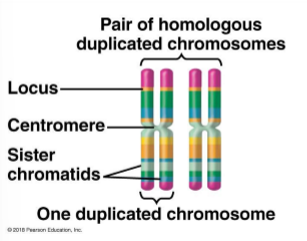
homologous chromosomes
the two chromosomes that make up a matched pair in a diploid cell.
how are homologous chromosomes twins of each other?
they are of the same length, centromere position, and staining pattern
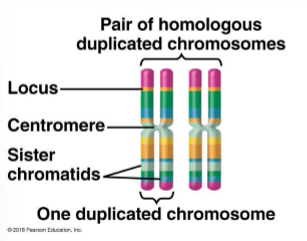
homologous chromosomes function
carries genes for the same inherited characters (they may be different versions of that gene)
same gene (i.e. eye colour) but different versions of it (i.e. blue or brown)
why do you have homologous chromosomes in your cells?
because you inherit one set of chromosomes from each parent (23 from mom, 23 from dad), totaling 46 chromosomes (23 pairs) in most cells.
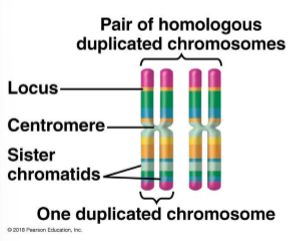
locus
position on a chromosome where a gene is located (i.e. pink section for hair, green section for eyes)
sex chromosomes
chromosomes that determine the sex of an individual; in humans these are the X and Y chromosomes
autosomes
all chromosomes other than sex chromosomes
how many autosomes do humans have? how many sex chromosomes?
humans have 44 autosomes (22 sets of homologous chromosomes) and 2 sex chromosomes
sex vs. gender
sex: classification into a group with shared anatomical and physiological traits ; determined based on chromosomes
gender: an individual’s own experience of identifying as male, female, or otherwise
how is sex not a binary state?
individuals with intermediate or indeterminate sexual characteristics exist, and individuals with anatomical features that do not match their gender also exist
what is an exception to the pattern of homologous chromosomes?
females have homologous chromosomes (XX), therefore the sex chromosomes (X and Y) in males are the exception because only a small part of the X and Y chromosomes are actually homologous
diploid cell
cell that contains 2 sets of chromosomes
contains the total number of chromosomes in an organism
diploid number is abbreviated to …
diploid number is abbreviated to 2n … n = number of chromosomes in 1 set (e.g. humans: 2n = 46)
haploid cell
a cell with a single set of chromosomes
1 member of each homologous chromosome pair is present
what types of cells are typically diploid and what types are typically haploid?
haploid: gametes (sperm and egg cells)
diploid: somatic cells
haploid number is abbreviated to …
haploid number is abbreviated to 1n … e.g. humans: 1n = 23
diploid vs. haploid cells
Haploid cells () contain one set of chromosomes, while diploid cells () contain two sets.
Diploid cells are produced via mitosis for growth and repair, while haploid cells are produced via meiosis for sexual reproduction
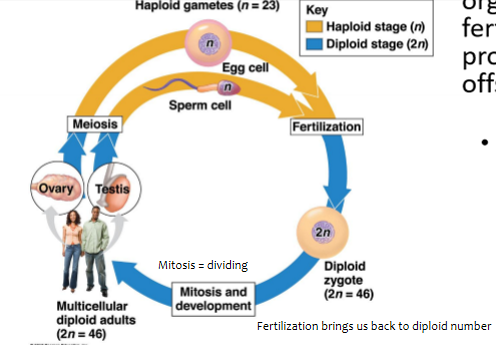
life cycle
sequence of stages for an organism, from fertilization until the production of its own offspring
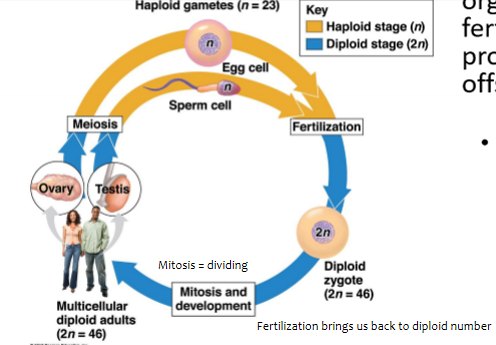
what is a key component of the LIFE CYCLE in organisms that undergo sexual reproduction?
the presence of 2 sets of chromosomes, one from each parent
what is the process of meiosis (meiosis I and II)?
Meiosis is cell division that produces 4 genetically unique haploid cells (gametes) from 1 diploid cell
Meiosis I: separates homologous chromosomes
Meiosis II: separates sister chromatids like Mitosis
3 stages of meiosis
interphase, meiosis I (prophase I, metaphase I, anaphase I), meiosis II (prophase II, metaphase II, anaphase II, telophase II and cytokinesis)
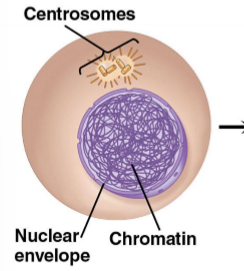
interphase
chromosomes duplicate
each chromosome consists of two genetically identical sister chromatids
chromatids are bound to each other in centromere position
centrosome duplicates
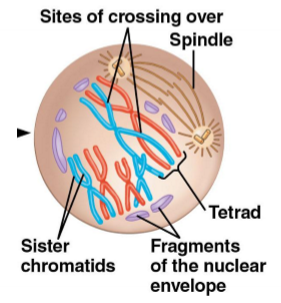
prophase I
1st stage of meiosis I
homologous chromosomes come together as pairs to form a tetrad (4 chromatids)
chromosomes are aligned gene by gene
crossing over occurs
chromosomes coil tightly and a spindle forms
nuclear envelop fragments
tetrads are captured by spindle microtubules and moved towards the center of the cell
how does crossing over happen in prophase I?
sister chromatids from homologous chromosomes exchange segments to rearrange the genetic information … trading bits of DNA (i.e. same height as dad, same eyes as grandma, etc.)
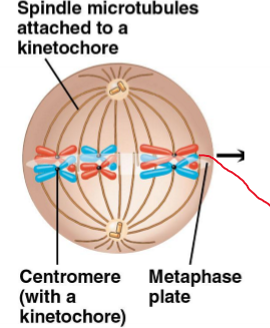
metaphase I
2nd stage of meiosis I
chromosome tetrads are aligned at the METAPHASE PLATE (aka “equator” of the cell)
spindle microtubules are attached to the kinetochores at the centromeres
homologous chromosomes are held together at sites of crossing over
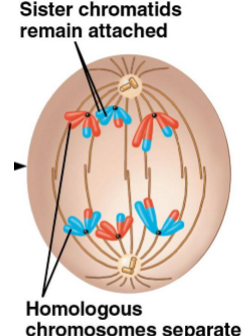
anaphase I
3rd stage of meiosis I
chromosomes migrate to the 2 poles of the cell
sister chromatids of a chromosome stay attached to each other; only the tetrads separate
in anaphase I, how do the chromosomes migrate to the two poles of the cell?
motor proteins “walk” the chromosomes to opposite poles along the microtubules