Diabetes & Ketogenesis
 Call Kai
 Learn
Learn Practice Test
 Spaced Repetition
 Match
Match Flashcards
 Knowt Play
1/7

There's no tags or description
Looks like no tags are added yet.
Name | Mastery | Learn | Test | Matching | Spaced | Call with Kai |
|---|
No analytics yet
Send a link to your students to track their progress
8 Terms
Type 1 vs. Type 2 Diabetes?
Type 1 - lack insulin production & signaling
Type 2 - insulin resistance / sensitivity
How does hyperglycemia occur?
glucose binding N-terminal Val of hemoglobin beta chains → HbA1c
what happens when injecting insulin?
insulin helps recruit glucose transporter, facilitating glucose entry into cells
what happens when patient inject too much insulin?
excessively activating glucose uptake & storage → hypoglycemia (low blood glucose)
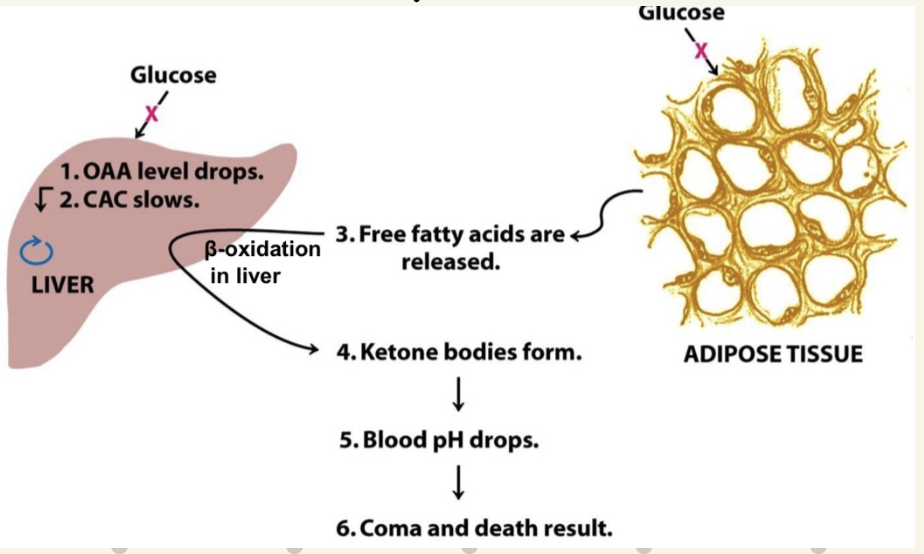
when does ketogenesis occur?
⬆acetyl-CoA (due to increased fat & AA catabolism)
glucose absence (when glucagon & epinephrine signaling dominate)
no enough carb - no enough OAA - limiting factor
ketone bodies can be used as alternate fuel in other tissues & brain
what are the 3 types of ketone bodies?
β-hydroxybutyrate, acetoacetate, acetone
acetone - waste
How many ATP does each acetyl-CoA make thru TCA?
10
NADH - 3×2.5 = 7.5
FADH - 1×1.5 = 1.5
GTP - 1
how does ketoacidosis occur?
accumulation of ketone bodies
blood buffering system initially compensate + H+ absorption bone bicarbonate & renal secretion
eventually bicarbonate depleted → acidosis
in absence of insulin:
⬇insulin - can't recruit GLUT transporter
fat catabolism starts → ⬆acetyl-CoA
but ⬇OAA → TCA can’t occur → ketogenesis