Enthalpy changes
 Call Kai
 Learn
Learn Practice Test
 Spaced Repetition
 Match
Match Flashcards
 Knowt Play
1/12

There's no tags or description
Looks like no tags are added yet.
Name | Mastery | Learn | Test | Matching | Spaced | Call with Kai |
|---|
No analytics yet
Send a link to your students to track their progress
13 Terms
Enthalpy changes
Enthalpy change (∆H) = energy transferred during a chemical reaction.
Exothermic reactions release heat to surroundings → (negative ∆H).
Endothermic reactions absorb heat from surroundings → (positive ∆H).
Energy profile diagrams
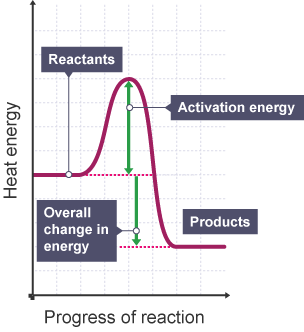
Activation energy
Activation energy (Ea) = minimum energy particles need for a reaction to happen.
Particles must collide with enough energy to break bonds before new ones form.
On an enthalpy profile diagram, activation energy is the energy gap from reactants to the peak of the curve.
Standards
Standard conditions / standard states = conditions of 100 kPa pressure and usually 298 K; substances are in their normal physical states under these conditions.
Marked if the reaction has ° e.g. ΔH°
∆rH
Enthalpy change of reaction (∆rH) = enthalpy change for a reaction as written in the stated chemical equation.
∆fH
Enthalpy change of formation (∆fH) = enthalpy change when 1 mol of a compound is formed from its elements in their standard states.
∆cH
Enthalpy change of combustion (∆cH) = enthalpy change when 1 mol of a substance is completely burned in oxygen.
∆neutH
Enthalpy change of neutralisation (∆neutH) = enthalpy change when 1 mol of water is formed in a neutralisation reaction.
q=mcΔT
q = energy transferred (J)
m = mass (g or kg)
c = specific heat capacity
∆T = temperature change (final − initial)
Average bond enthalpy
Average bond enthalpy = energy needed to break 1 mol of a specific type of bond in gaseous molecules.
Measured in kJ mol⁻¹.
Called “average” because bond energies vary slightly in different compounds.
Endo and exothermic reactions
Breaking chemical bonds requires energy → endothermic process.
Making chemical bonds releases energy → exothermic process.
If more energy is released than absorbed, reaction is exothermic; if more is absorbed than released, reaction is endothermic.
Hess’s law
Hess’ Law = the total enthalpy change for a reaction is the same regardless of the route taken
Measuring enthalpy changes
Direct method (calorimetry): measure temperature change (∆T) when a reaction happens, then calculate enthalpy using q=mcΔTq; used for reactions like neutralisation or combustion in simple calorimeters.
Procedure (direct): measure mass/volume, record initial & final temperatures, ensure insulation to reduce heat loss, and calculate energy transferred.
Indirect method (Hess’ Law): use known enthalpy data (formation or combustion) to calculate unknown enthalpy changes via an enthalpy cycle instead of measuring directly (could be needed if high activation energy, unwanted side products and slow reaction)