PSYC260 FINAL
 Call Kai
 Learn
Learn Practice Test
 Spaced Repetition
 Match
Match Flashcards
 Knowt Play
1/43

Earn XP
Description and Tags
lessgetit
Name | Mastery | Learn | Test | Matching | Spaced | Call with Kai |
|---|
No analytics yet
Send a link to your students to track their progress
44 Terms
Correlational methods
A method in which researchers systematically measure two or more variables with the goal of describing the relationship between the two variables
Ex. TV violence and aggression in kids
Advantages/Disadvantages of Correlational Methods
Advantages
Quantify a relationship between 2+ variables
Disadvantages
Need to pay attention to survey features like order effects to maintain accuracy
Correlation =/= causation
Experimental methods
A method in which researchers have the goal of establishing causality and they can claim that one variable causes another because of two key features: random assignment, and holding everything constant except the manipulated variable (IV)
Advantages/Disadvantages of Experimental methods
Advantages
Experiments can determine causality
Disadvantages
More complex to conduct
Need to balance internal and external validity
Elaboration Likelihood Model (ELM)
Two routes to persuade people - to change their attitudes, beliefs, or behaviours
Route 1: Central route
Direct, relevant, and logical messages
Useful when audience is motivated/able to listen to/pay attention to central argument, and when audience cares about the topic at hand
Results in thinking carefully on the content, and examining its logic and evidence + long-term change in thought
Route 2: Peripheral Route
Surface level cues rather than logic
Useful when audience is not motivated to pay attention/think carefully, and when audience doesn’t care about the topic at hand
Results in use of heuristics and attention paid to superficial cues to draw conclusions
Cognitive dissonance
Feeling of discomfort caused by holding two conflicting cognitions or conflicting cognition and behaviour
Motivates people to remove the discomfort by either
1. Changing the thought (ex. Recycling isn’t that important)
2. Changing the behaviour (ex. Start recycling soda cans)
3. Making a special exception (ex. I would normally recycle, but there was just no convenient recycling bin to place the soda can in this time)
Normative Social Influence (NSI)
We conform to be liked and accepted by others
We want to have relationships, be liked and belong, so we try to be similar (vs different) than others
NSI leads to:
Public compliance: we match and do what other people are doing (ex. Rachel smoking)
BUT NOT:
Private acceptance: a genuine belief that the copied thoughts or actions are correct (ex. Rachel doesn’t want/believe it is ok to smoke)
Asch Line Study
Testing conformity in a social setting
How far will people go to fit into the group, will they ignore obvious truths?
Consisted of a number of trials in which participants were asked to match a line with another line in length, whilst 4 other confederates often voted unanimously incorrectly to mess their judgements up
Very often the participants would vote incorrectly despite knowing the “other participants” were incorrect as to not stand out
Participants publicly complied, but did not privately accept!
When did people not conform?
When asked to privately write their answers
When even one of the “other participants” voted against the group’s decision
Milgram’s obedience experiments
Learner + teacher experiments w/electric shocks up to 450V
80% of people continued after learner verbally protested
62.5% of people delivered maximum shock
Social Impact Theory
Suggests that when and whether people conform will depend upon 3 key features:
Strength: how psychologically important the group is to you
Immediacy: how physically close/proximal people are to you in terms of time and space
Number of people: the overall size of the group-- more people = more pressure EXCEPT after a certain threshold
In smaller groups, having 5v4 or 6v5 people can add pressure. Once the group is larger (ex. 25v26), more people doesn’t add much pressure
Informational Social Influence (ISI)
When people conform or follow others to gain information about how to act or think (ex. When we look to others for advice)
Common in ambiguous or new situations when we don’t know how to act/think
Informational social influence has both public compliance (ex. Do what others do)
AND…
Private acceptance (ex. Believe people are right and this is the right thing to do/think)
We look to others for advice a lot, especially in unfamiliar situations!
Hannah’s france train stop example (do i get off the train? Panic? Remain seated? Checked with other passengers to see what to do
More likely when…
People are in ambiguous situations
People are in crisis situations
When an expert is present
Aggression
An intentional behaviour done to cause pain-- either physical or psychological (ex. verbal/emotional)
Can be direct-- done face-to-face (ex. Physical assault, teasing right to face)
Can be indirect-- not done face to face (ex. Gossiping and spreading rumors abt someone behind their back)
Types of Aggression
Hostile aggression: goal is to inflict physical or mental pain, often due to feelings of anger
Instrumental aggression: inflicting physical or mental pain is a means to achieve another goal
Albert Bandura’s Social Learning Theory
States that we learn to engage in various social behaviours-- like aggression and violence-- by observing and imitating others
Bandura’s Bobo doll experiments
Kids came to lab and watched an adult interact w/bobo doll, then given chance to play with bobo doll w/their behaviour analyzed for aggression
Control condition: watch a non-aggressive interaction between the adult and bobo
Experimental condition: watch the adult beat, kick and throw bobo
Kids in control condition w/o modeled aggression did not display aggressive behaviour
Kids in experimental condition w/modeled aggression enacted that behaviour AND went beyond, coming up with new ways to harm the doll
Catharsis
Blowing off steam by performing, watching or imagining an aggressive act in an inappropriate, non-threatening way
Concept from Freud’s aggressive impulses-hydraulic system: if aggression builds and doesn’t get released in a safe way, it may explode
Reducing Aggression: effective strategies
Provide non-aggressive role models
Offer an immediate apology for any misdeeds (ex. Being late) to diffuse someone’s frustration to ensure it doesn't translate to aggression
Empathy and perspective taking: putting yourself in someone’s shoes, imagining what their emotional experiences or personal circumstances might be like
Social identity theory
Social categorization
Humans classify themselves and others into various social groups
Completely natural and inescapable
Functional: helps us understand our social world
Social identity
group/category becomes part of self-concept
Groups provide meaning, guidance, self worth
Ingroups (us) vs Outgroups (them)
Stereotype threat
When the anxiety of confirming a negative stereotype about one’s group places pressure on the individual, which in turn worsens their performance on the stereotype-relevant task, thereby confirming the stereotype
Can happen to anyone based on a salient negative stereotype
Can happen without the presence of discrimination
The target does not believe in or agree with the stereotype
Happens to those most identified with the group being stereotyped
Happens to those working at the frontiers of their ability
It is possible to overcome
Prejudice
A judgement or evaluation of a group and its members, often a particular feeling toward a group
Primarily affective
They include emotions and evaluations
Can be positive, though more often negative
They are a normal-- albeit unfortunate consequence of social categorization and comparison
Can be overt/covert (ex. explicit/implicit prejudice)
Explicit prejudice
Prejudice that is consciously held about a specific group
We know we have these
Can be consciously controlled
Implicit prejudice
Prejudice that is unconsciously held about a specific group
We don’t know we have these
Unconscious and automatic
Based on quick associations that reflect internalized societal messages
Can be held by ingroup and outgroup members
Stereotypes
Social beliefs shared by members of a group about the shared characteristics of members of a group
Primarily cognitive (thoughts or beliefs about a group, including one’s own)
The normal result of social categorization
Can be positive, negative, or neutral
Can be functional
Simplify our social world
Provide basic knowledge about groups
Guide our social interactions
Discrimination
Behaviours or actions, usually negative, towards an individual that are based on their actual or perceived membership in a certain group (e.g., gender, race)
It is based in behaviours
Is positive and negative
Can be overt/covert
Can be perpetuated by individuals, groups, and institutions/systems (not always consciously or intentionally)
Method of reducing stereotype threat
Raising awareness of stereotype threat (Johns et al., 2005 experiment)
Contact hypothesis
Intergroup contact under appropriate conditions can reduce prejudice
Conditions:
1. Equality between groups
2. common/shared goals
3. Intergroup cooperation
4. Supportive social norms/authorities
Jigsaw classroom
A cooperative teaching method intended to desegregate classrooms and reduce prejudice by facilitating productive intergroup contact experiences
1. Lesson broken into chunks
2. Jigsaw groups & independent work
3. Expert groups & presentation development
4. Teach chunk to jigsaw group
Conditions of contact:
1. Equality between groups
All given same responsibilities
2. common/shared goals
Learning the lesson and doing well
3. Intergroup cooperation
Reliance on each other to put lesson material together and to learn
4. Supportive social norms/authorities
Class structure and teacher
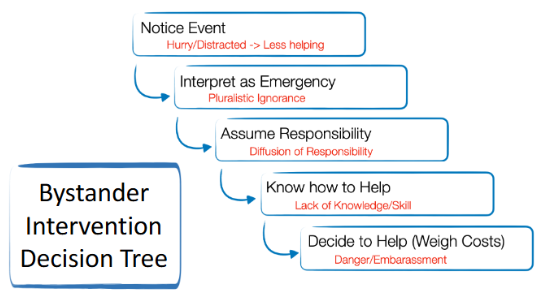
Bystander Intervention Decision Tree
Notice event
In hurry/distracted → less helping
Interpret as emergency
Pluralistic ignorance: a phenomenon whereby bystanders assume nothing is wrong because everyone else looks unconcerned
Feedback loop forms where nobody raises cause for alarm and people simultaneously use these cues to inform their own reactions. Thus, people in that context come to share an overall ignorance to the idea that an emergency may be happening
Recall smoke-filled room study where having confederates together in smoke filled room caused people to leave much slower than when alone
Assume responsibility
Diffusion of responsibility
As more people are present at an emergency, people are less likely to help because there is a diffusion of responsibility: that is, each bystander’s sense of personal responsibility to help drops as the number of bystanders increases
Ex. as the only witness, more incentive to call 911
Ex. as one of many witnesses, less incentive to call as someone else might
Know how to help
Lack of knowledge/skill
Decide to help (weigh costs)
danger/embarassment
Ways to increasing helping
1. Positive mood
People who are in a more positive mood tend to be more willing to help
Ex. people who receive a windfall to boost their positive mood had higher helping rates than people who did not have their positive mood induced
2. Prosocial modeling
Seeing another person model prosocial behaviour can increase helping
Ex. people who do (vs don’t) see an instance of someone with car trouble being helped were more likely to stop and offer help to someone having car trouble down the road
3. Education
Greater education about prosociality (ex. The bystander effect) can increase helping rates
Ex. students randomly assigned to learn about the bystander intervention (vs. an unrelated topic) were more likely to help a student in need 2 weeks later, even among some unconcerned confederate bystanders
Tri-part model of subjective well-being (happiness)
Positive affect (PA) and negative affect (NA) are your moment to moment feelings
PA and NA are orthogonal, meaning they are largely independent of each other
Life satisfaction is a more stable, overarching assessment of your life
Does money buy happiness?
Generally money is positively linked with happiness
The happiest people experience the greatest benefits of higher income
For the unhappiest people, the happiness benefits of money cap at 100k
Depends on how you spend it!
Whillans, Dunn, Smeets, Bekkers, & Norton (2017)
Increasing wealth also leads to time scarcity
Buying time promotes happiness
Dunn, Gilbert, and Wilson (2011)
Buy experiences over things
Buy small pleasures instead of big ones
Dunn, Aknin, & Norton (2008)
Spending money on others (“Prosocial spending”) not on ourselves is associated with greater happiness
Goody Bag Paradigm (Aknin, Dunn, Proulx, Lok, & Norton, 2020)
~700 participants rated baseline happiness
Received extra $2.50 for participation in form of a $2.50 voucher
Had the option to purchase goody bag or keep cash
Randomly assigned to one of 2 spending conditions:
Personal spending vs Prosocial spending
If purchased, received thank you note reinforcing condition
Finally, rated their post-spending happiness
Choosing to buy a goody bag for a sick child in the prosocial condition led to greater positive emotions than participants in the personal spending condition
5 key predictors of attraction
Proximity
Similarity
Reciprocal liking
Physical attractiveness
Misattribution of arousal
Social exchange theory
Sees relationships through the lens of costs and benefits
Feelings about your relationships depend on 3 things:
Cost/reward ratio - how many good vs bad things there are about the relationship
Costs and rewards = what you are getting out of the relationship
Ex. your outcomes will be poor if costs > rewards
Comparison level - what you feel like you deserve (i.e., your standards)
How you expect to be treated
Ex. high comparison level - expect to be treated well, high standards
Predicts relationship satisfaction - if our outcomes are lower than our standards, = not happy!
Comparison level of alternatives - alternatives to the relationship (other people you could be with, or being single)
High comparison level of alternatives
Has an attractive potential alternative to the relationship!
Predicts relationship stability - if costs > rewards and there are attractive alternatives = less committed!
Different types of love
Companionate love
Intimacy + commitment
Feelings of care and motivation to stay in a relationship with that person
Romantic love
Intimacy + passion
Close emotional bond, with passion/sexual arousal etc.
Fatuous love
Passion + commitment
passion/sexual arousal, and motivation to maintain relationship
Consummate love
Intimacy + passion + commitment
Close emotional bond, passion/sexual arousal, and motivation to maintain relationship
Investment model
The level of investment in the relationship also matters for commitment!
Investments can be both tangible and intangible
Greater investment = people more committed
Equity theory
= happiest in relationships where the reward/cost ratio is similar for both people involved
People tend to feel uneasy when we are over or under benefited
We don’t keep track of fairness in the same way across different types of relationships (ex. Short vs long-term relationships)
Communal relationships = relationships with especially close others
Don’t like to be repaid immediately
Don’t keep track of who contributes what
Don’t feel exploited when contributions are not returned
Exchange relationships = relationships marked by exchange of services
Repay debts immediately
Keep track of who contributes what
Feel exploited when contributions are not returned
Adversity and Conflict
The commitment calibration hypothesis: impact of adversity depends on the strength of commitment and level of adversity faced
If people are in a high commitment relationship and they face some low-level adversity
The relationship isn’t going to struggle very much and will likely be just fine
If people are in a low commitment relationship…
And they face some high-level adversity
The relationship will be challenged and will likely end!
If levels of commitment and adversity are equally matched, relationship will likely be strengthened!
The 4 horsemen
Avoid the 4 horsemen: the most harmful attitudes/behaviours that predict when a relationship will end
Criticism: attack your partner’s character
Defensiveness: whining, seeing oneself as the victim
Stonewalling: withdrawing, silent treatment
Contempt: treat partner poorly through mockery, body language, insulting names, complete disregard for them
The role of positive emotions
Interaction dynamics approach:
Experiencing positive emotions matters for sustaining a relationship, and the absence of positive emotions can be harmful
Within first 10 years of marriage, experiences of negative affect like contempt predicted the early demise of relationship
But after 10 years, not experiencing positive affect was more likely to predict the eventual demise of a relationship