IDSC 3001 Test F
 Call Kai
 Learn
Learn Practice Test
 Spaced Repetition
 Match
Match Flashcards
 Knowt Play
1/54

There's no tags or description
Looks like no tags are added yet.
Name | Mastery | Learn | Test | Matching | Spaced | Call with Kai |
|---|
No analytics yet
Send a link to your students to track their progress
55 Terms
Business analytics platforms
Includes software tools and applications used to build models and simulations to create scenarios, understand current events and predict future states
Business intelligence
Includes a variety of tools, platforms, and methodologies that enable organizations to collect data from internal systems and external sources, prepare it for analysis, develop and run queries, create reports, dashboards, and data visualizations for decision-makers
Ad-hoc reporting
Puts users in control so that they can create custom reports on an as-needed basis by selecting fields, ranges, summary conditions, and other parameters (create reports on the fly)
Canned reports
Provide regular summaries of information in a predetermined format
Dashboards
Heads-up display of critical indicators that allows managers to get a graphical glance at key performance metrics (one page summary of a business area)
OLAP (online analytical processing)
Take data from standard relational databases, calculates and summarizes the data, and then stores the data in a special database called a data cube (pivot table on steroids)
Data cube
Special database used to store data in OLAP reporting
Query tools
A tool to interrogate a data source or multiple sources and return a subset of data, possibly summarized, based on a set of criteria
Python
A general-purpose programming language that is also popular for data analytics
R
A programming language specifically created for analytics, statistical, and graphical computing
Graphical query tools
Allows a user to create a query through a point-and-click or drag-and-drop interface, rather than requiring programming knowledge
Major criteria for effective BI (4)
1. Accuracy 2. Timeliness 3. Valuable insights 4. Actionable
Palantir case
Detractors say the company has won military contracts without competitive bids and point to predictive policing capabilities and raise concerns that personal data is collected in anticipation of crimes. Supporters say they uncover human trafficking rings, find exploited children, and solve sophisticated financial crimes
Business analytics methods (just know these 4 are all methods)
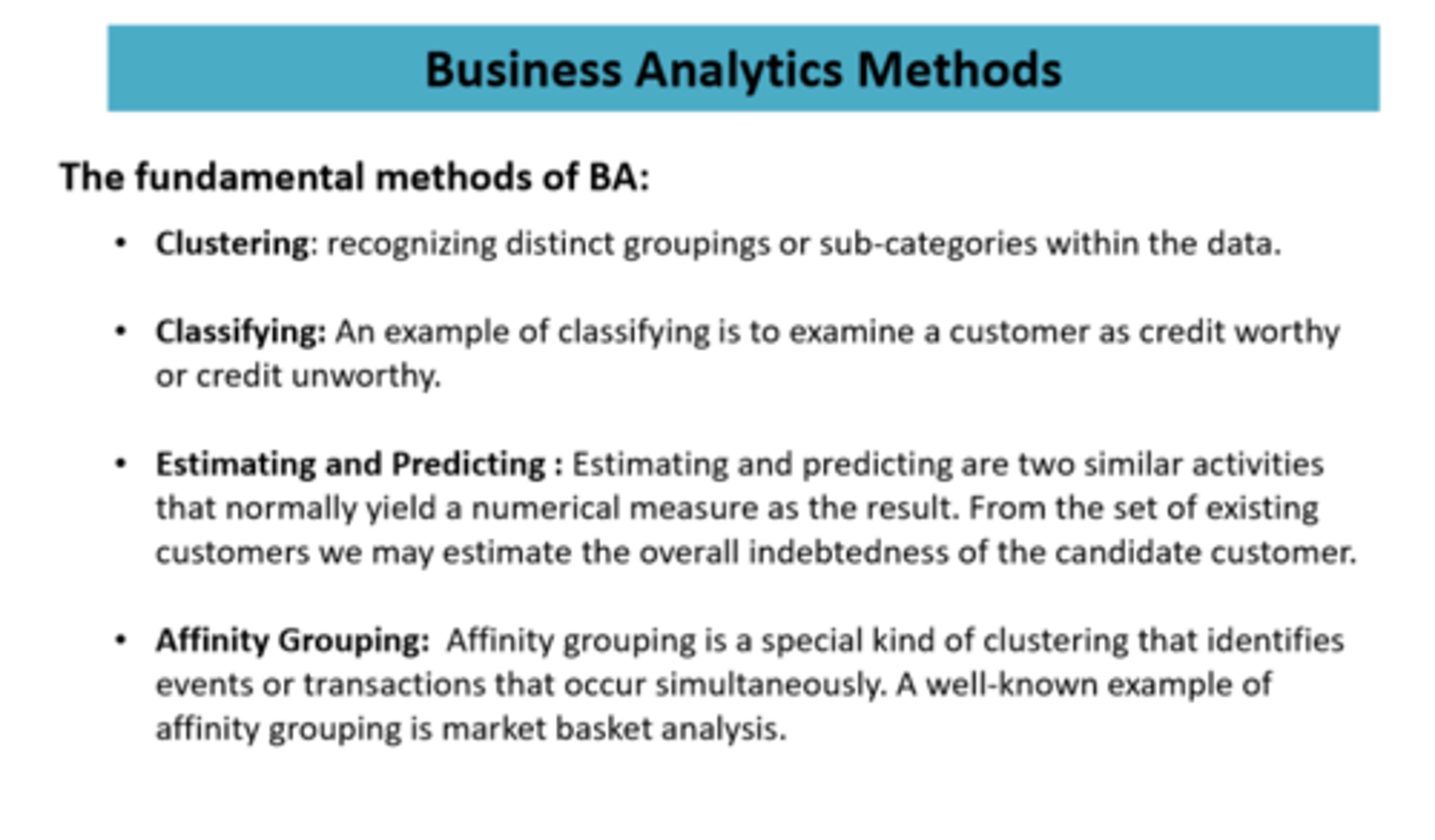
Clustering
Recognizing distinct groupings or sub-categories within the data
Classifying
An example is to examine a customer as credit worthy or credit unworthy
Estimating and predicting
Two similar activities that normally yield a numerical measure as the result. From the set of existing customers we may estimate the overall indebtedness of the candidate customer
Affinity grouping
A special kind of clustering that identifies events or transactions that occur simultaneously. A well-known example of affinity grouping is market basket analysis
1. Know the objective 2. Define criteria for success and failure 3. Select your methodology (know the data and relevant internal/external factors) 4. Validate models using criteria
Best practices for business analytics
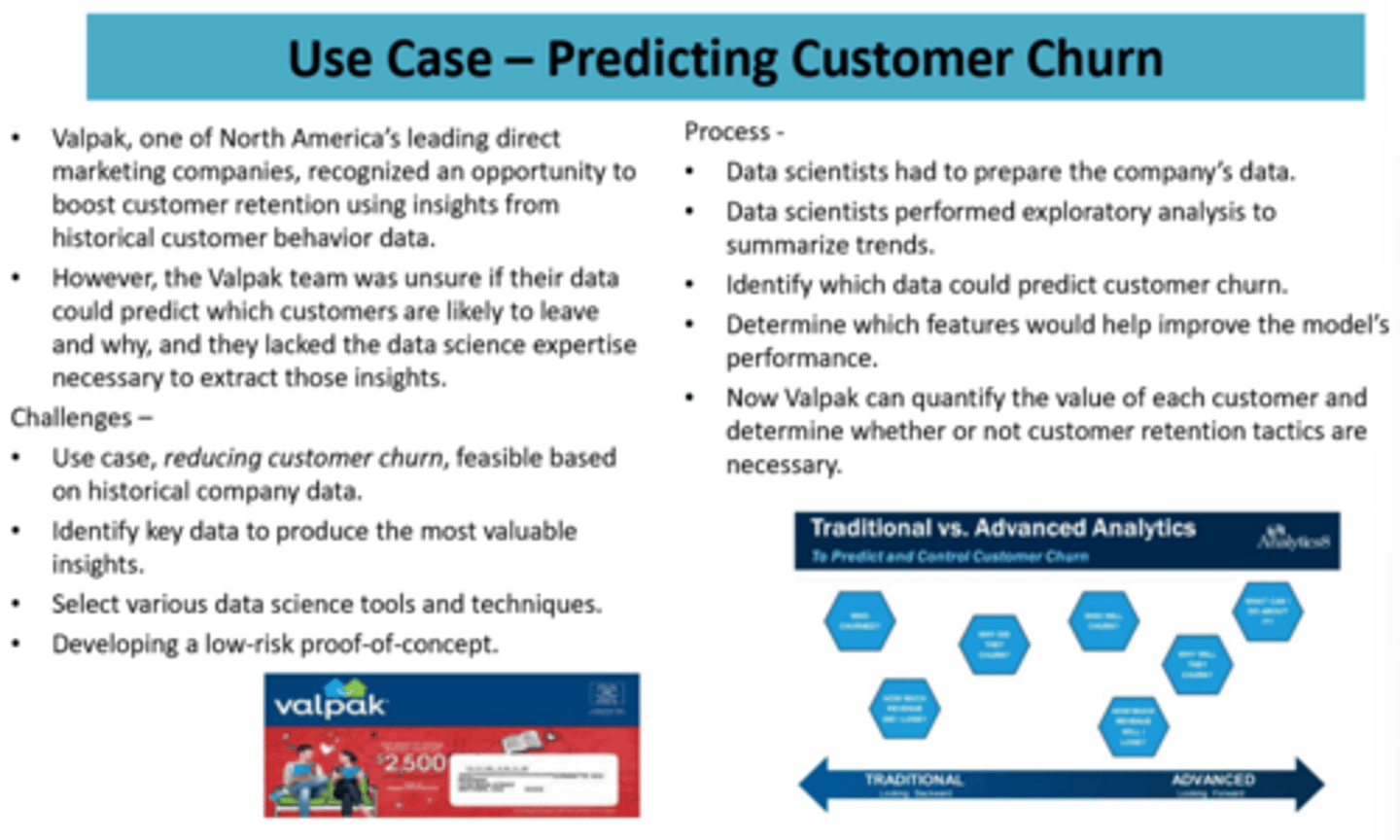
Valkpak use case
Wanted to boost customer retention using insights from historical consumer behavior data, now they can quantify the value of each customer and determine whether or not customer retention tactics are necessary
Data mining
The process of using computers to identify hidden patterns in, and to build models from, large datasets
1. Information technology (understanding how to pull together data and selecting analysis tools) 2. Statistics (building models, interpreting the validity of results) 3. Business knowledge (helping set system goals and requirements)
Skills necessary for data mining (3)
Over-engineering
Build a model with so many variables that the solution arrived at might only work on the subset of data used to create it
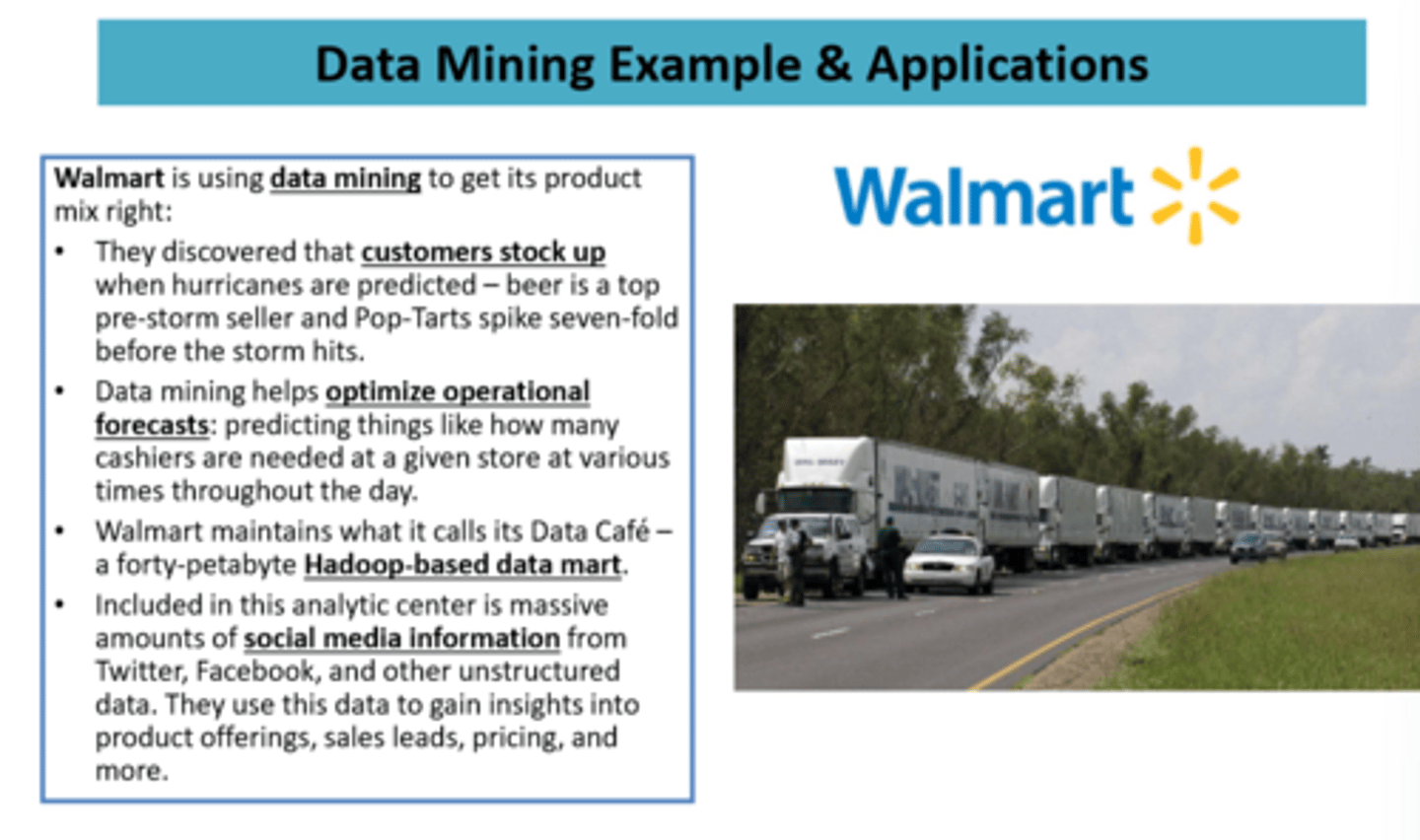
Walmart data mining
Artificial intelligence
Computer software that can mimic or improve upon functions that would otherwise require human intelligence
Machine learning
Software that contains the ability to learn or improve without being explicitly programmed (most AI we use)
Deep learning
A type of machine learning that uses multiple layers of interconnections among data to identify patterns and improve predicted results (better than ML, not explainable)
Supervised learning
A type of machine learning where algorithms are trained by providing explicit examples of results sought, like defective versus error-free, or stock price (trained AI)
Unsupervised learning (self-supervised learning)
Systems build pattern-recognizing algorithms using data that has not been pre-classified (builds its own algorithms)
Semi-supervised learning
A type of machine learning where the data used to build models contains data with explicit classifications, but is also free to develop its own additional classifications that may further enhance result accuracy
Neural networks
Examines data and hunts down and exposes patterns, in order to build models to exploit findings
Expert systems
Leverages rules or examples to perform a task in a way that mimics applied human expertise (NOT AI, what we used before AI)
Genetic algorithms
Model building techniques where computers examine many potential solutions to a problem (they decide which AI is best for the specific problem)
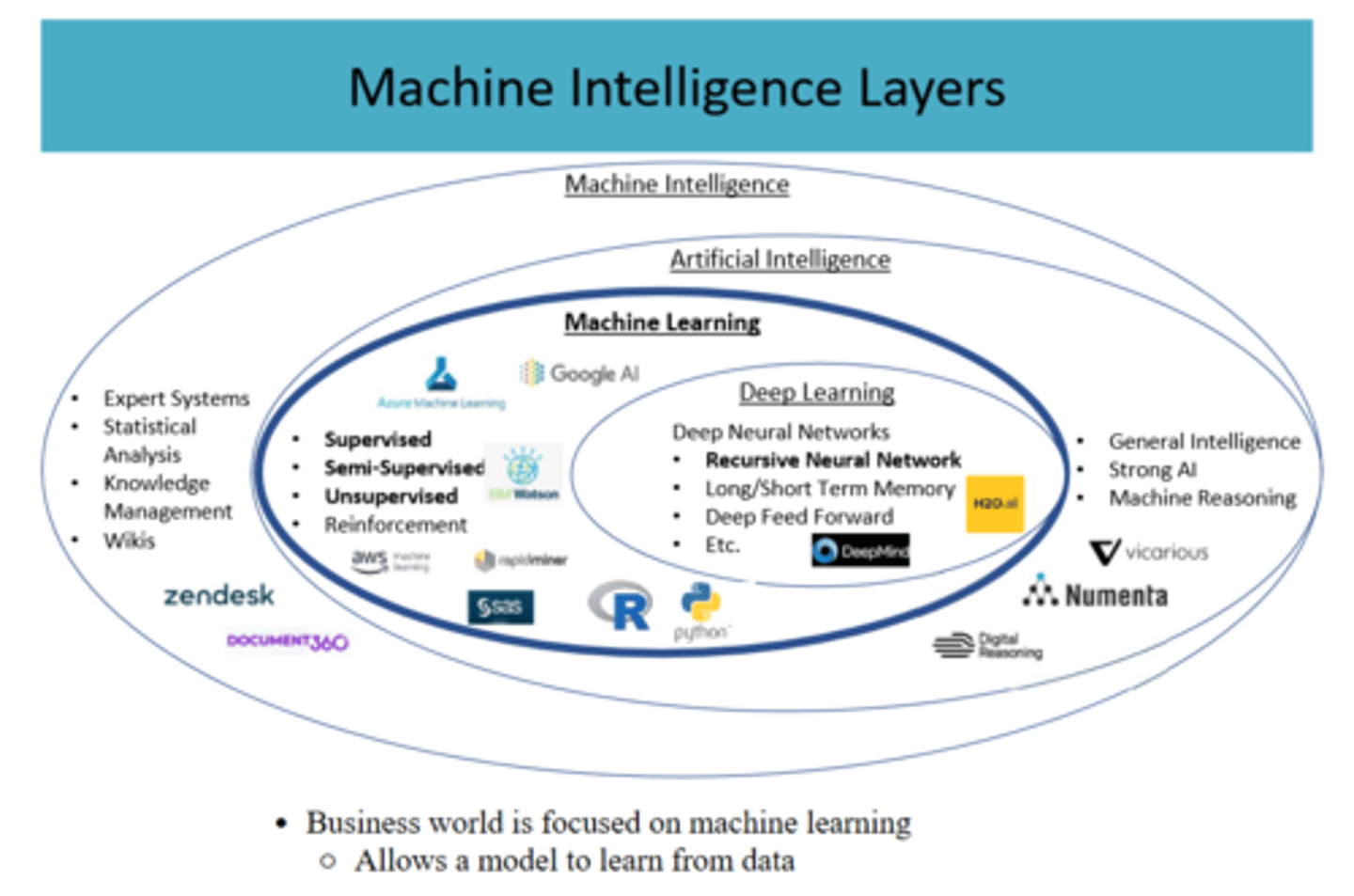
Machine intelligence (just know this visually, know we are focused on machine learning)
CAPTCHA
An acronym standing for completely automated public Turing test to tell computers and humans apart
Turing test
Test of software's ability to exhibit behavior equivalent to, or indistinguishable from, a human being
OCR (optimal character recognition)
Software that can scan images and identify text within them
Generative AI
A combination of machine learning techniques which, when combined in a system, create human-like text, images, or other media in response to a prompt
Parameters
Values that are used to determine text elements and relationships and that are further refined during training
Corpus
In AI, this refers to the data used to train a model before it can be used
Prompt
A request made to a generative AI system, usually in the form of written or spoken text
Prompt engineering
The practice of designing inputs for generative AI tools that will produce optimal outputs
Hallucination
An incorrect answer provided by generative AI that is otherwise presented as correct
Artificial general intelligence (AGI)
Refers to software that's capable of learning and reasoning on any task or subject, including developing reasoning about topics not presented through a training corpus
Agentic Ai
Autonomous systems that can break down complex problems and take actions with minimal human intervention
Vibe coding
Developers guide AI coding tools to generate, revise, and debug applications rather than writing code line-by-line
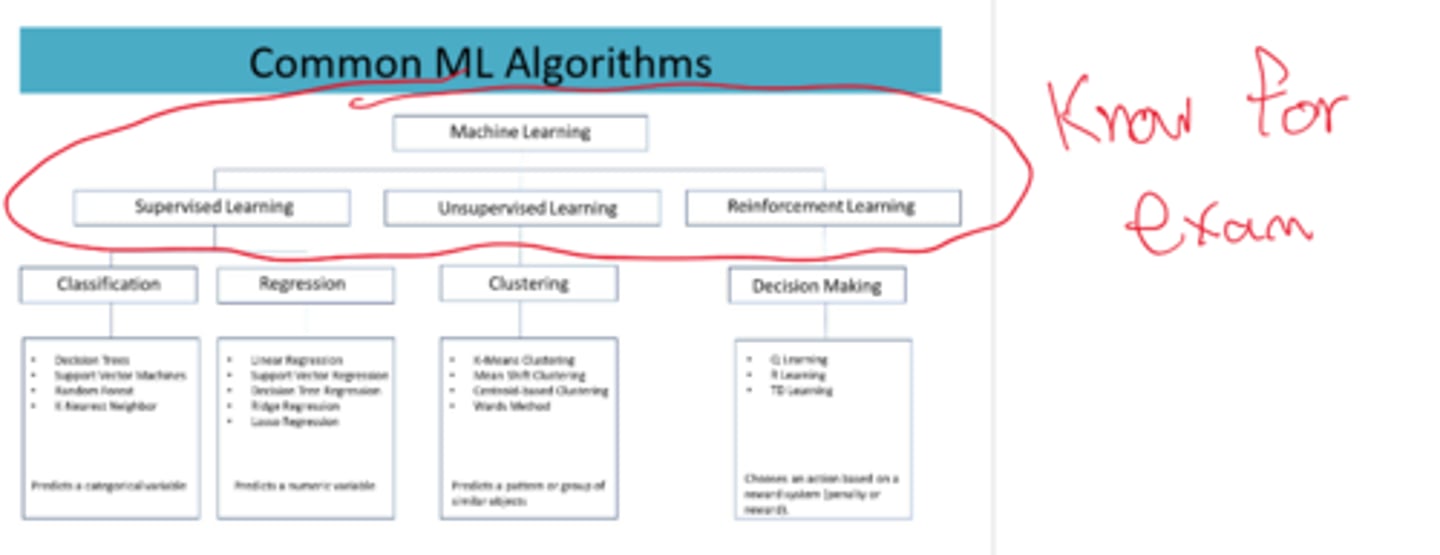
Common ML algorithms (just know this visually)
Reinforcement learning
Training a model by rewarding it for good outputs and penalizing bad ones, learning through trial and error
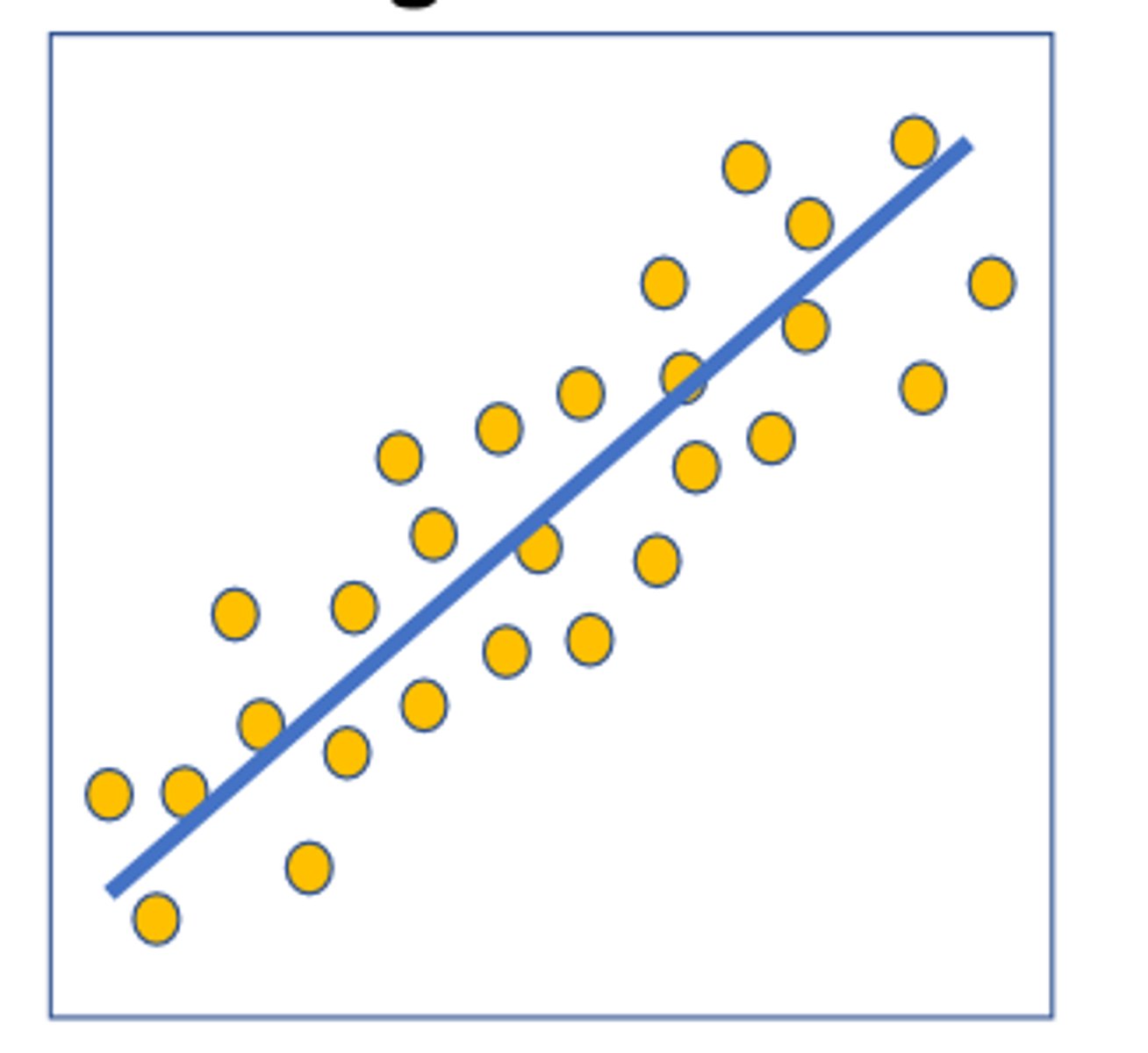
Regression
Predicts continuous values such as age, price, salary, etc, based on a second parameter
Classification
Predicts discrete values such as true/false, spam/not spam, credit worthy/not credit worthy

Correlation
A connection or mutual relationship between two or more variables
Negative correlation
A relationship between two or more variables that moves in opposite directions
Correlation strength (correlation coefficient)
A measure of how strongly variables are related

Challenges of AI
1. Data quality, inconsistency of data, and inability to integrate data into a single dataset for AI 2. Not enough data 3. Technical staff may require training 4. Change management 5. Legal issues (data used or inability to identify how a model works) 6. Misuse of data leading to regulation that limits AI 7. Organization network and firm computers can be monitored 8. Early leaders in AI may scale and collect more data where they have a huge edge over competitors
1. Tasks and occupations 2. Business processes 3. Business models
Three Levels at which AI drives change