Early Embryogenesis Pt.1
 Call Kai
 Learn
Learn Practice Test
 Spaced Repetition
 Match
Match Flashcards
 Knowt Play
1/9

There's no tags or description
Looks like no tags are added yet.
Name | Mastery | Learn | Test | Matching | Spaced | Call with Kai |
|---|
No analytics yet
Send a link to your students to track their progress
10 Terms
Define what an embryo is
Embryo: an organism in early stages of development
Has not acquired anatomical form recognizable for its species
Define what a fetus is
Fetus: potential offspring still residing within uterus
More advanced form of an embryo (usually recognizable)
Define a conceptus and what it includes
Conceptus: “product of conception”; includes:
Embryo during early embryogenesis
Embryo and extraembryonic membranes during preimplantation stage
Fetus and placenta during post-implanation phase
What must the embryo achieve before it can attach to the uterus
Development within confines of the zona pellucida
Blastocyst hatching from zona pellucida
Maternal recognition of pregnancy
Formation of extraembyyonic membranes
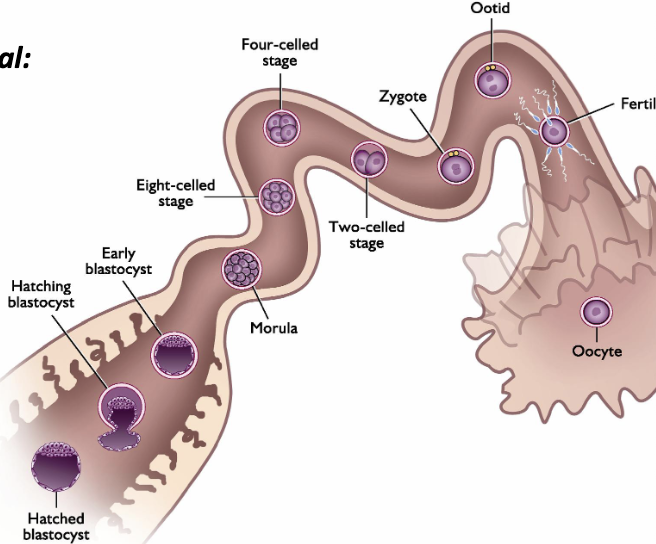
What is an ootid?
Contains female + male pronuclei
Largest single cell
Enormous cytoplasm relative to nucelar volume
What is a zygote?
Single cell, diploid embryo following syngamy
Cleavage - Increase cell number without increasing the cell mass; forms blastomeres
Describe cells between the zygote and 16-cell stage
Cells are totipotent - able to form any'/all cell types in the body
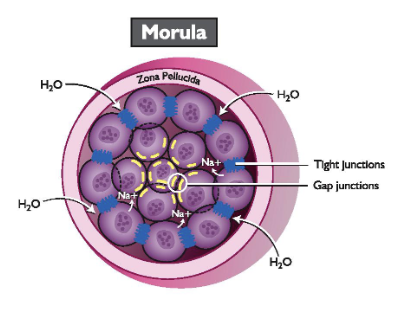
What is the morula?
Solid ball of cells; > 32 individual blastomeres
Two different groups of cells forms:
Inner cells develop gap junctions
Outer cells form cell-cell adhesions (tight junctions)
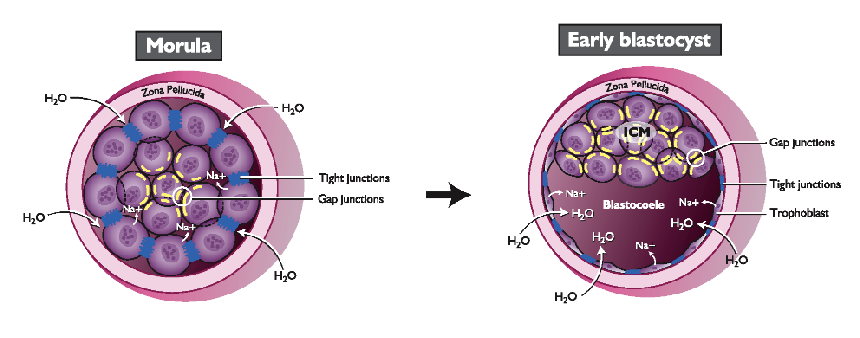
Alters permeability of outer cells → fluid accumulation
What is a blastocyst? What is a blastocoele?
Blastocoele - fluid filled cavity of embryo
Partitioned into 2 distinct cell populations:
Inner cell mass - gives rise to body of embryo
Trophoblast - gives rise to chorion that becomes fetal component of placenta
Hatching - result of several forces:
Growth and fluid accumulation increases pressure
Enzymes produced by trophoblast weaken zona
Blastocyst contraction creates intermitten pressure
When a blastocyst is a free-floating embryo within the uterine lumen what does the uterine environment provide for survival?
Adequate luteal function
Adequare P4 synthesis
Responsiveness of uterus to P4