Models for explaining Memory
 Call Kai
 Learn
Learn Practice Test
 Spaced Repetition
 Match
Match Flashcards
 Knowt Play
1/63

There's no tags or description
Looks like no tags are added yet.
Name | Mastery | Learn | Test | Matching | Spaced | Call with Kai |
|---|
No analytics yet
Send a link to your students to track their progress
64 Terms
What is memory?
The cognitive function through which information and past experiences are actively processed, stored and retrieved
What is encoding?
The process where information is converted into a form that is stored within the memory system
What are the types of encoding?
Visual encoding → information is encoded according to sound
Acoustic encoding → where ifnromation is processed based on sound
Semantic encoding → Information is stored based on meaning
Examples of encoding
Use sensory info and encode it to make sense
feeling hot under the sun → taking off our jumper because it is hot
What is storage?
The retention of information within the memory
Retrieval
The process of moving information from long term memory into conscious awareness
Two types of encoding and what they mean
Automatic encoding → easier to retrieve and requires little effort
Effortful encoding → information recall that requires more effort
What is automatic encoding? What are some examples?
No concious effort made to store
personal experiences
interesting information
basic types of learning (what you ate last or where your family car is usually parked)
What is effortful encoding? What are some examples?
Requires special attention and practice
Interpreting calculus, how to scuba dive, driving
What is the name of the model for memory?
Multi-store Model of Memory (Atkinson + Shiffrin, 1968)
What is the Multi-store Model of Memory (Atkinson + Shiffrin, 1968)?
visualises memory as a system consisting of multiple memory stores, through which a stream of data flows for processing
model emphasises the storage structures and suggests that if info is stored for a long time, it must pass through three memory stores
What are the three memory stores?
Sensory register
Short term memory store
Long term memory store
all operate independently but all operate at the same time and their control processes are interrelated
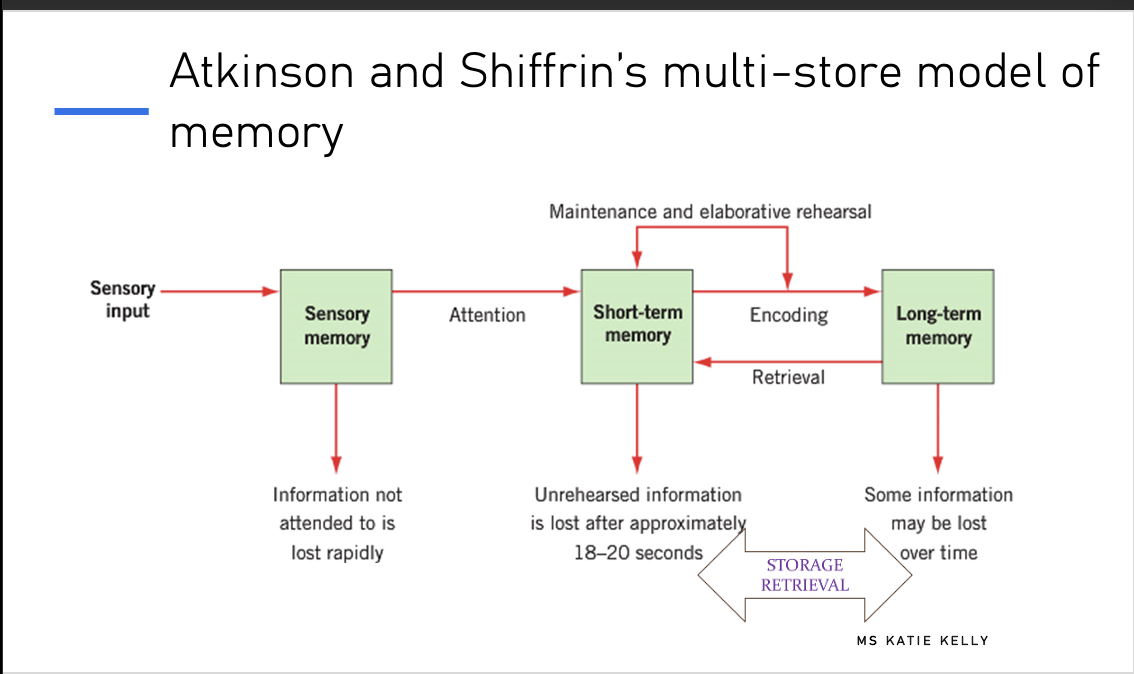
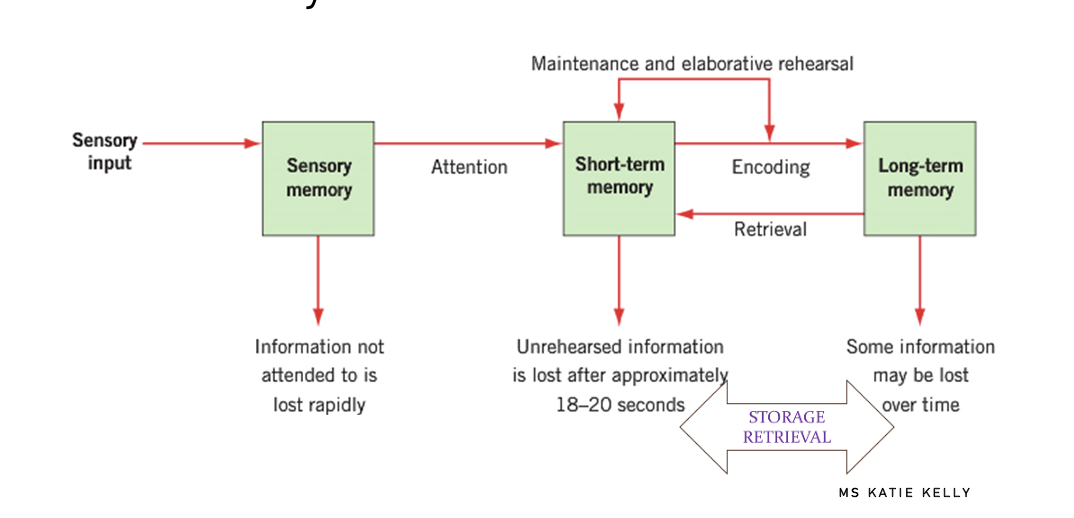
Atkinson and Shiffrin’s multi-store model of memory
flow chart
What are sensory registers?
The memory store where sensory info is briefly held before decaying or being transferring to short term store
What happens when information enters the sensory register?
Individual uses the voluntary control process of selection to determine which information will be attended to
Selected info is transferred to the STM where unattended info rapidly decays and is lost
What is scanning the sensory register?
A search initiated for associated infromation int he long term mmeory store
e.g. individual sees a cat → verbal label cat is retrieved from the LTM and held in the short term store alongside the visual information of the cat selected from the sensory register
What are the types of sensory registers
iconic memory: visual images
echoic memory: sounds
tactile register: touch
olfactory register: smell
gustatory registrer: taste
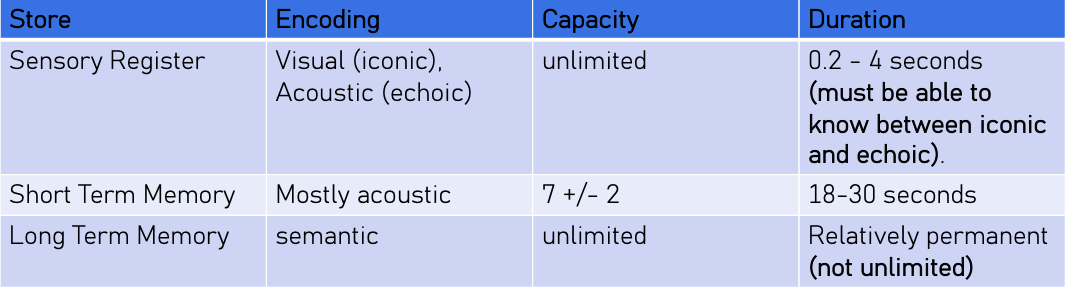
Memory store encoding, capacity and duration

decay: fading of memory over time
capacity: maximum amount of info that can be stored at a given time
duration: amoount of time info can be stored for
What is short term memory?
Temporary memory store that receives limited information from sensory registers and long term store
What happens when info is transferred from sensory register to short term memory
Info is not removed from sensory register and shifted to STM store
copy of info is made for stm while trace remains in sensory register and continues to decay
What is the capacity of short term memory?
Limited capacity, 5-9 pieces of info can be held at one time
info decays and is lost after 15-30 seconds unless control process such as rehearsal and coding procedures can hold it for longer to encode into long term store
What is increasing capacity of STM
Chunking
Maintenence rehearsal
Elaborative rehearsal
What is chunking
grouping information to form a larger simple item
What is Maintenance Rehearsal?
Involves repeating the information remembered over and over again so it can be retained in STM.
does not always lead to long term retention
What is Elaborative Rehearsal ?
process of linking new information in a meaningful way with new information or information already stored in LTYM to aid it’s storage and retrieval in LTM
What are the strengths of maintenance rehearsal
Strength: Effective for storing meaningless information for an extended period of time
What are the limitations of maintenence rehearsal
restricts amount of new information entering sensory memory and LTM
easily interrupted
adds nothing to the understanding of information
not an effective way of transferring information to LTM
What are the strengths of elaborative rehearsal?
increase understanding because it requires deep processing
adds more detail, which increases retrieval
increases possibility of long term retention because it organises new info according to meaning
makes information more accessible because it creates more potential retrieval cues
What are the limitations of elaborative rehearsal?
Takes longer than maintenance
difficult to practice in situations where information entering STM is rapidly changing
relies on ability to retrieve information previously stored in LTM
requires more conscious effort than maintenance rehearsal
What is long term memory?
A relatively permanent memory store for a limitless amount of information that sends and receives information from the short term store
How does long term memory work according to the multi store model?
info processed in STM → transferred to third store for relatively permanent storage of unlimited amount of information: LTM
when required later → info located in LTM and returned to conscious awareness
info encoded semantically, meaning unless thigns people remember are meaningful, they will decay over time.
What is searching?
A process controlled by the individual, Where a search for a memory trace ensues when someone is trying to remember something
For instance, the individual decides when to give up on a search
Once memory trace is found, it is recovered and trasnferred to the STM via retrieval and the stronger the memory trace, the easier it will be located and consequently retreiveed
Why wouldn’t all information be able to be retrived from LTM and transferred to STM?
Decay
Interferance
What is decay?
Gradual fading of memory over time
What is interferance?
Hpapens when information in the long term store is distrupted by similar information and therefore cannot be retrieved
What is implicit memory?
Memory that operates without concious awareness
non-declarative
includes procedural memory
What is explicit memory?
Memory for facts and personally significant events that can be conciously recalled
Declarative memory
Includes semantic and episodic
Types of memory and organisation
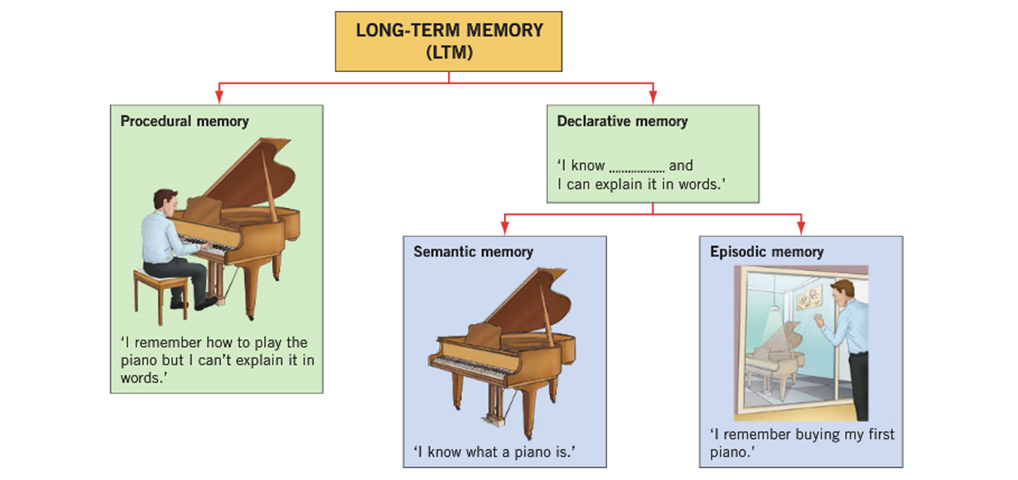
Procedural memory
The memory of learnt actions and skills
walking
talking
juggling
stored in LTM but often involve complicated sequences of mmovements that we are unware of or that we are unable to articulate
only fully express this memory through actions
little to no concious effort or intentional attempt to retrieve, then are knwon as being implicit memories
Where is procedural memory registered?
low brain such as cerebellum
out of conscious control’
more basic, automatic elements of learning and memory related to actions
most resistant to forgetting
Declarative memory
LTM store for factual information such as face, names, words, dates and ideas
words or symbols
can be explained in words
takes concious effort to retrieve
aka explicit memories
What is declarative memory divided into
Semantic and Episodic
What is semantic memory
declarative memory of impersonal factual knowledge
objects, days of the week and months of the year, simple maths
impersonal facts
general factual information about the world that does not involve the memory of personally significant events or episodes that are tied to a specific time and place
What is episodic memory
declarative memory of personally experienced events related to a specific time or place, such as birthday celebrations or a first day of highschool
least resistant to forgetting
Strengths of multistore model
good understanding of the structure and process of memory.
allowed researchers to expand on this model by performing experiments to validqate and support the theory. generated a lot of research int omemory
memory studies provide evidence to support distinction between STM and LTM
case studies such as Henry Molaison, Clive Wearing
provided focus on teh structural basis of memory stores when ability to recall new memories became severely impaired after surgery
Limitations of Multi-store mmodel
Rehearsal is considered too simple an explanation to account for the transfer of information from STM to LTM → ignores factors such as motivation, self-regulation, cognitive strategies (mnemonics, abstract reasoning), which underpin learning
models main emphasis was on structure and tends to neglect the process elements of memory
only focuses on attention and rehearsal but does not explain how LTM is retrieved
describes memory as a passive process while others such as loftus study on false memories shows that it’s active
Draw the multi-store model of memory wrap up
What are the models of working memory
•Alan Baddeley + Graham Hitch, 1974.
•Baddeley then updated this in 2000.
model of STM as a working memory
a view of short term memory as a dynamic storage system capable of simultaneously holding multiple pieces of information
•Simply holding information in STM is not sufficient for it to be transferred to LTM – i.e. the duration that the information is held there is not the only factor that increases probability of transfer.
•Information is not passively held in STM; it is actively manipulated (or ‘worked on’).
• termed it as Working Memory; as they believe it is active, not passive.
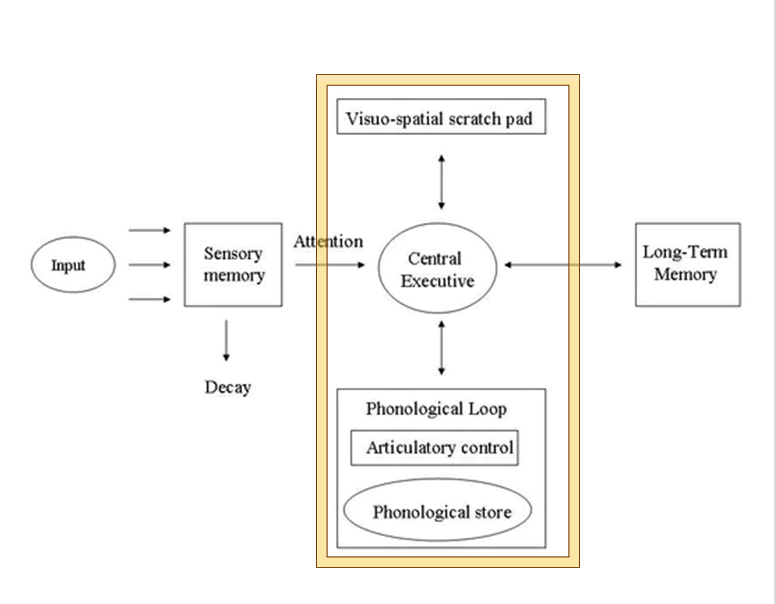
What are the components of the Working Memory Model?
Central executive that integrated information from two subsystems
Phonological loop
Visuospatial sketchpad
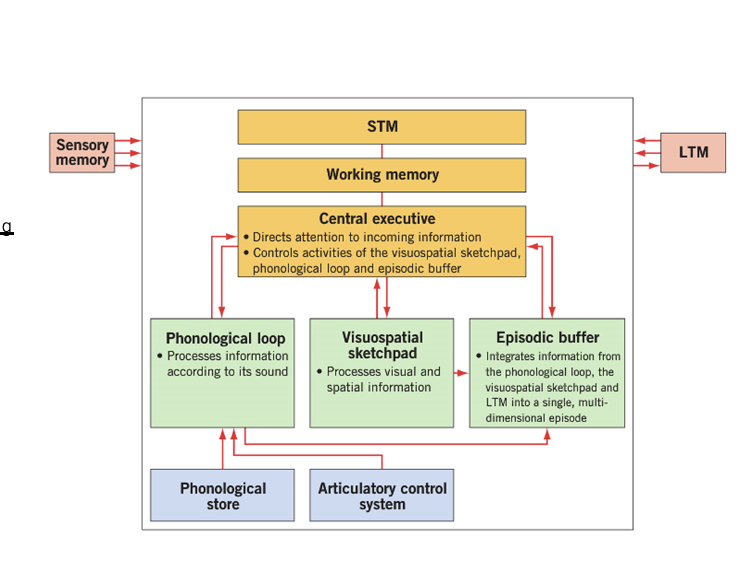
Baddley then added episodic buffer
Draw the working memory model (version 1974)
Draw the working memory model (version 2000), bADDELEY
what is the Phonological loop
area of working memory that temporarily stores and processes auditory information.
Works with auditory info that has been encoded acoustically
further divided into
phonological store: storage for words that are heard (inner ear)
articulatory process: repeats words heard in a loop allowing maintenance rehearsal to occur
lasts up to two seconds unless the information is rehearsed
prevent rapid decay when we are speaking
e.g. reciting phone number, counting how many doors you have
what is the Visuospatial sketchpad
coponenent of working memory model that stores and manipulates visual and spatial information
used when visualising something in the mind
Deals with what ifno looks like and how it is laid out in space by representing info in the form of visual features such as size, shape and colour, location, speed of objects in space
stores info briefly but not long enough to rehearse and manipulate and process it
What is the central executive
Info Enters VSS and PL under control of CE
Decides which system shoudl deal with incoming infromation
Also retrieves information from LTM and consolidates it with information from VSS and PL within episodic buffer
info retrieved from LTM store is controlled by central executive
controls attention given to tasks, allows for selective attention switching between different tasks
only can proces one inpput at a time.
integrates info from phonological loop, visuospatial sketchpad and episodic buffer
What activities does the CE do?
•executive plays a major role in planning and controlling behaviour as it switches attention between tasks and selects strategies to tackle the problem being worked on.
•coordinates activities needed to carry out more than one task at a time, so it is in control when we multi-task.
e.g , you mentally weigh up pros and cons before making a decision.
•executive can not multi-task, so it helps to work out which decisions need to be made first.
What was added?
Episodic buffer (added in version 2000 – in syllabus)
What is the episodic buffer
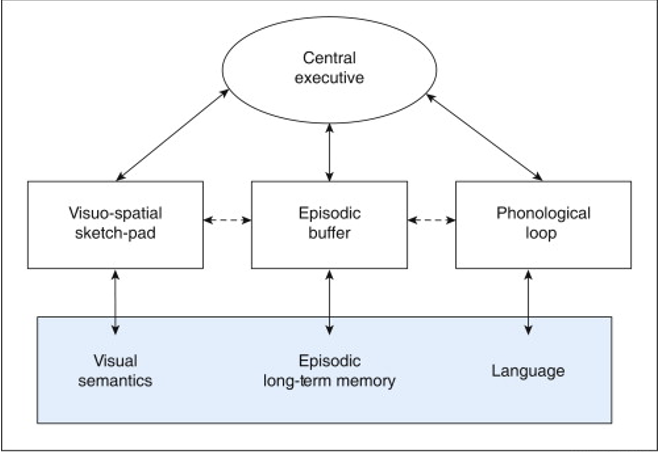
A component of working memory model that temporarily stores consolidated information from CE, VSSP, PL and LTM
limited capacity and is accessible by conciousness
semantic memories held in the long term store of memory are intergrated with j info retrieved from vssp and pl within buffer to produce segments termed “episodes”
can make sense of information entering different parts of the working memory.
was added to the working memory model to help explain how working memory actually links with LTM.
2000 working memory model
Strengths of working memory model
•Explains a lot more than the multistore model. It makes sense of a range of tasks - verbal reasoning, comprehension, reading, problem-solving and visual and spatial processing. And the model is supported by considerable experimental evidence (KM case study).
•Applies to real-life tasks such as reading (phonological loop), problem solving and multi tasking (central executive), navigation (visuo-spatial sketchpad)
•does not over emphasize the importance of rehearsal for STM retention, in contrast to the multi-store model
Limitations of working memory model
•There is little direct evidence for how the central executive works and what it does. The capacity of the central executive has not been measured.
•Working memory only involves STM, so it is not a comprehensive model of memory (as it does not include SM or LTM).
•The working memory model does not explain changes in processing ability that occur as the result of practice or time.
Storage
The retention of information within stores of emmeory
Retrieval
The movement of info from long term store of emmeory to concious awareness
Encoding
the form in which memory is stored