APHG Unit 2 Unit review
 Multiple Choice & FRQ
 Call Kai
1/82

Earn XP
Description and Tags
Name | Mastery | Learn | Test | Matching | Spaced | Call with Kai | Chat |
|---|
No analytics yet
Send a link to your students to track their progress
83 Terms
Agricultural Density
This measures how many farmers there are for each unit of farmable land. It's used by geographers to see how developed a place is, as fewer farmers per area usually means more advanced technology and urbanization.
Anti-natalist Policies
These are rules made by governments to encourage people to have fewer children.
What is an example of a Anti-natalist policies
China's One Child Policy is a famous example. Other countries with such policies include India, Singapore, and Iran.
Arithmetic Density
This is the total number of people divided by the total land area. It's used to compare population densities, but it can be misleading because it doesn't consider variations in land usability, uneven population distribution, or urban-rural divides.
Asylum Seekers
People who leave their home country and ask for protection in another country. They're different from refugees because they haven't been officially accepted yet.
Carrying Capacity
This is the maximum number of people an environment can support with its available resources like food and water. It's hard to estimate and depends on things like technology and resource management.
What is the estimated carrying capacity for the world
10-11 billion
Chain Migration
When immigrants move to a place because their family or people from their home country already live there. It helps new immigrants by providing support and connections in the new country.
Cohort
A group of people who share a common experience, like being born in the same time period. Millennials are one example, born roughly between the early 1980s and the mid-1990s to early 2000s.
Crude Birth Rate (CBR)
The number of live births per 1,000 people in a year. High CBR can lead to challenges like overpopulation and strain on resources.
Crude Death Rate (CDR)
The number of deaths per 1,000 people in a year. High CDR can indicate issues like poor healthcare or aging populations.
Demography
The study of population characteristics, like total population, age, gender, density, and growth rate. It helps us understand how populations change over time.
demographic transition
A process where a society's population changes from high birth and death rates to low ones, leading to a larger overall population.
Natural Increase Rate (NIR)
Population growth rate calculated by subtracting the natural death rate from the crude birth rate.
Demographic Transition Model (DTM):
A model that shows how a country's population changes over time through different stages, based on birth and death rates.
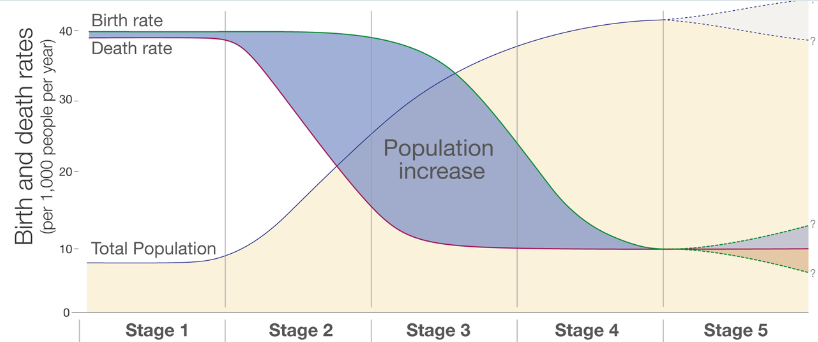
what are the pros and cons of The DTM model
Pros:
It can be applied to all countries.
It provides a starting point for demographic change over time.
The timescales are flexible.
It’s easy to understand.
It enables comparisons between countries.
Cons:
The DTM assumes that all countries go through the same 5 stages, which may not apply to regions like Africa and many other Less Economically Developed Countries (LEDCs).
The model attributes the decline in death rates during stage 2 to industrialization, but in some cases, like the UK, poor industrial conditions led to increased death rates.
The model's timescale may not fit countries developing rapidly, like some in South-East Asia.
The model doesn't consider the effects of migration, such as countries like USA, Canada, and Australia, which grew due to European emigration.
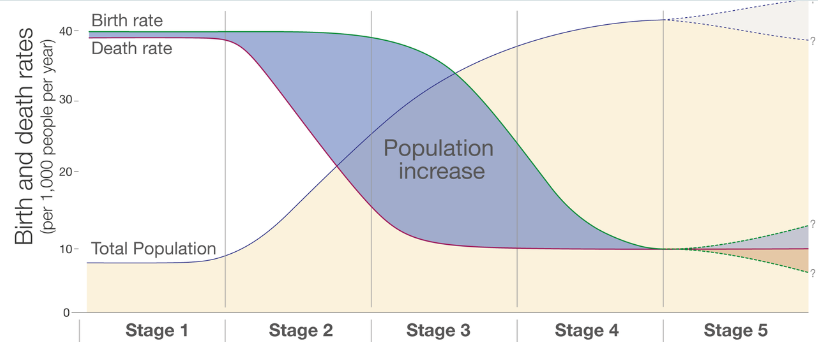
Stage 1 of DTM
High birth and death rates, and little population growth; High stationary stage (Historical England, few isolated civilizations).
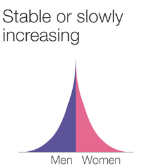
Stage 2 DTM
High birth rates, decreasing rapid death rates, and rapid population growth; Expanding stage (Subsharan Africa, South Asia).
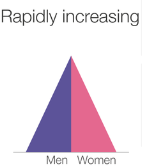
Stage 3 of DTM
Declining birth rates slowly declining death rates, and stable population growth; Expanding stage (Latin America)
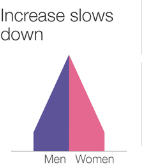
Stage 4 of DTM
Low birth and death rates, stable; Western world
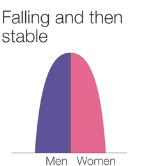
Stage 5 of the DTM
Birth rates are decreasing while death rates are increasing, population growth is decreasing; Declining stage (Japan, Italy, Spain)
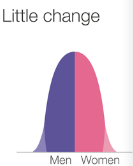
Dependency Ratio
The comparison between the working and nonworking force
Diaspora
A scattered population originating from a particular geographic location;The Jewish diaspora.
Doubling Time
The time it takes for a population to double in size, assuming a constant growth rate.(rule of 70; 70 dived by the rate of growth to find out how many years it takes for the population to double.)
Ecumene
the areas occupied by permanent human habitation
land that would not be considered part of the ecumene
Polar Regions, Deserts, Mountainous Terrain, Deep Oceans and Seas, Protected Natural Reserves, Barren and Inhospitable Lands, and Inland Lakes and Ponds
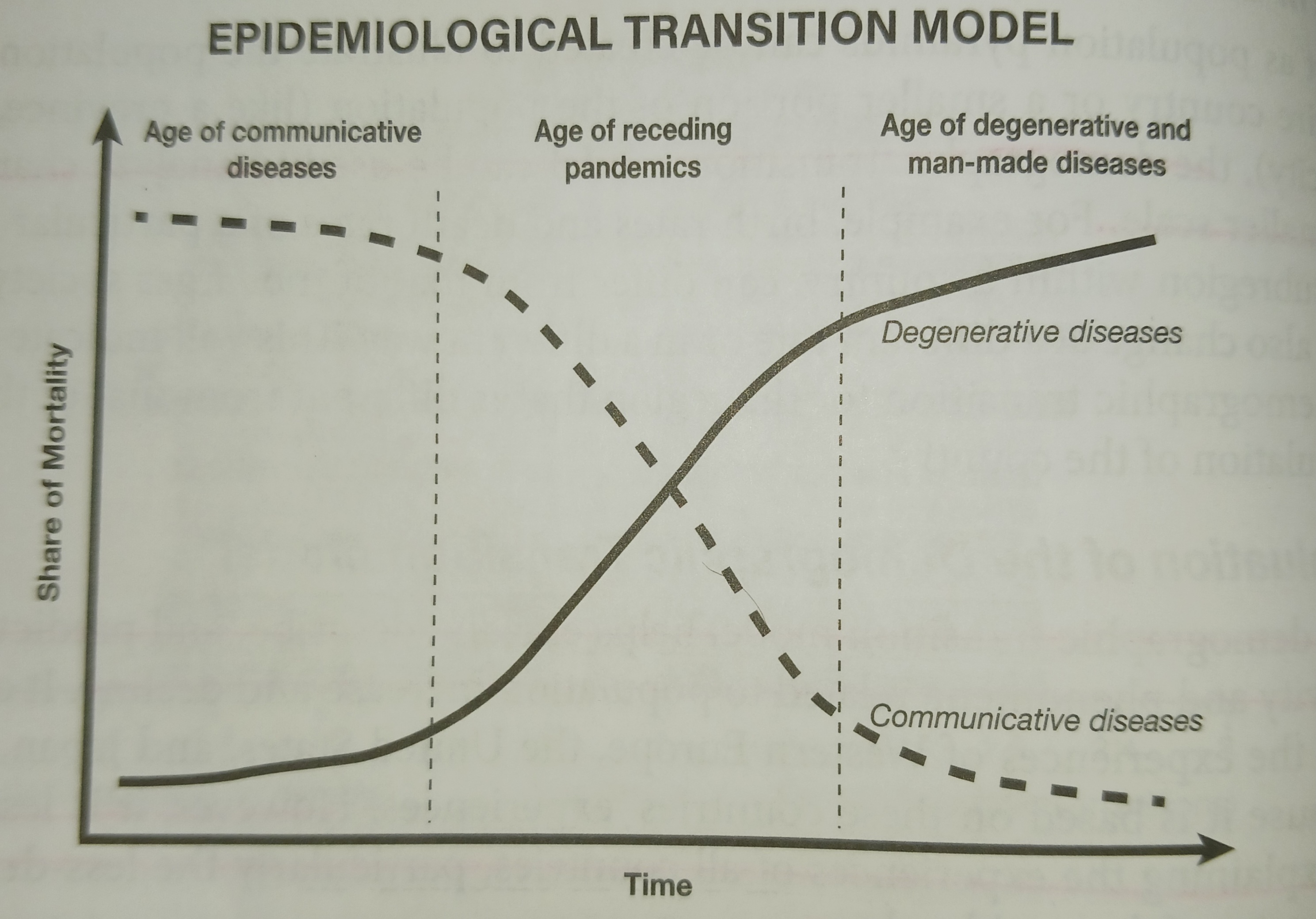
Epidemiological Transition Model (ETM):
Describes how patterns of health and disease change as a country develops economically.
Pros and cons of the ETM model
Pros:
its focus on disease, health, and sanitation as leading variables in determining who lives and who dies and at what age.
Cons:
it is too generalized, it is now understood that demographic models need to look at factors of race, sex, ethnicity, socioeconomic status, and so forth to interpret patterns of mortality and disease
it does not take into account the impact of lifestyle choices or local environmental factors in extending or shortening life expectancy
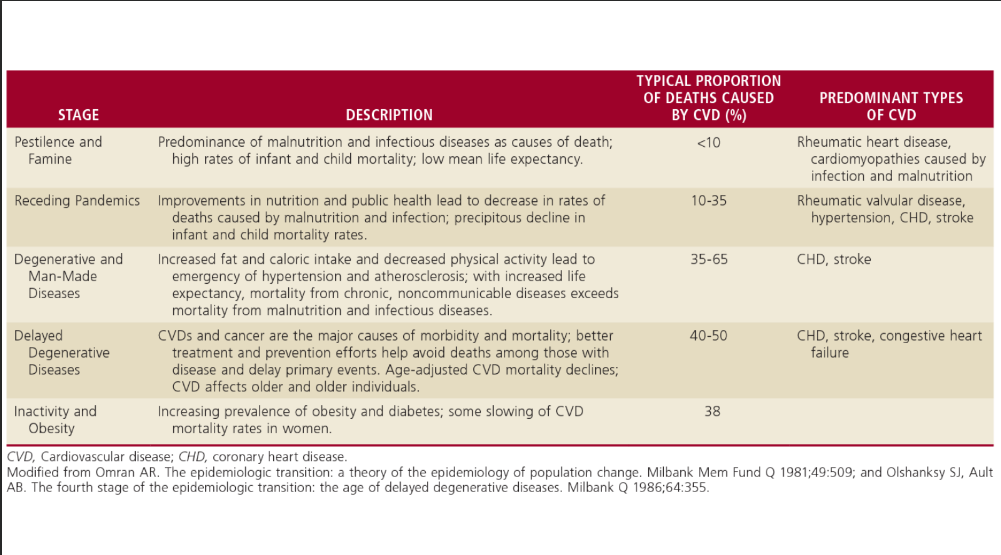
Stage 1 of ETM
Disease and Famine; Parasitic or infectious diseases, accidents, animal attacks, or human conflicts cause most deaths. Food insecurity makes famine more common and more devastating; A high death rate and low life expectancy.
Stage 2 of ETM
Receding Pandemics; The number of pandemics (widespread diseases that affect large populations) declines as a result of improved sanitation, nutrition, and medicine; A decreasing death rate, and increasing life expectancy.
Stage 3 of ETM
Degenerative and Human-Created Diseases; Infectious and parasitic diseases continue to decrease, but diseases associated with aging-such as heart disease and types of cancer-increase as people live longer; Death rate stabilizes at a low level and life expectancy increases
Stage 4 of ETM
Delayed Degenerative Diseases; Stage 4 is an extension of Stage 3, but the age-related diseases are put off as medical procedures delay the onset of these diseases through advanced procedures. Diseases such as Alzheimer's and dementia increase; Death rate reaches its lowest level and life expectancy reaches a peak
Stage 5 of ETM
Reemergence of Infectious and Parasitic Diseases; Infectious and parasitic diseases increase as some bacteria and parasites become resistant to antibiotics and vaccines; Life expectancy decreases.
fertility
the natural capability to produce offspring.
replacement level fertility
Fertility rate at which population exactly replaces itself from one generation to the next (around 2.1 children per woman).
Total fertility rate (TFR)
in simple terms refers to total number of children born or likely to be born to a woman in her life
Forced Migration
Permanent movement compelled by cultural or environmental factors; Syrian refugees during the 2011 civil war.
Guest worker
A person with temporary permission to work in another country.
Internally Displaced Persons (IDP)
People forced to leave their homes within their own country due to conflict or disasters
Internal migration
permanent movement within a particular country; rural to urban migration (not forsed like IDP)
intervening obstacles
Environmental or cultural features that hinder migration, like geographic barriers or immigration policies.
Intervening Opportunities
Factors causing migrants to stop at an intermediate place en route to their intended destination, like finding better job opportunities.
Life expectancy
Average number of years an individual can expect to live, influenced by social, economic, and medical conditions.
Infant mortality
Number of infant deaths per 1,000 live births in a society, influenced by healthcare, socioeconomic factors, and maternal health.
Thomas Malthus
English economist who predicted that population growth would outpace food production, leading to famine, disease, and war.
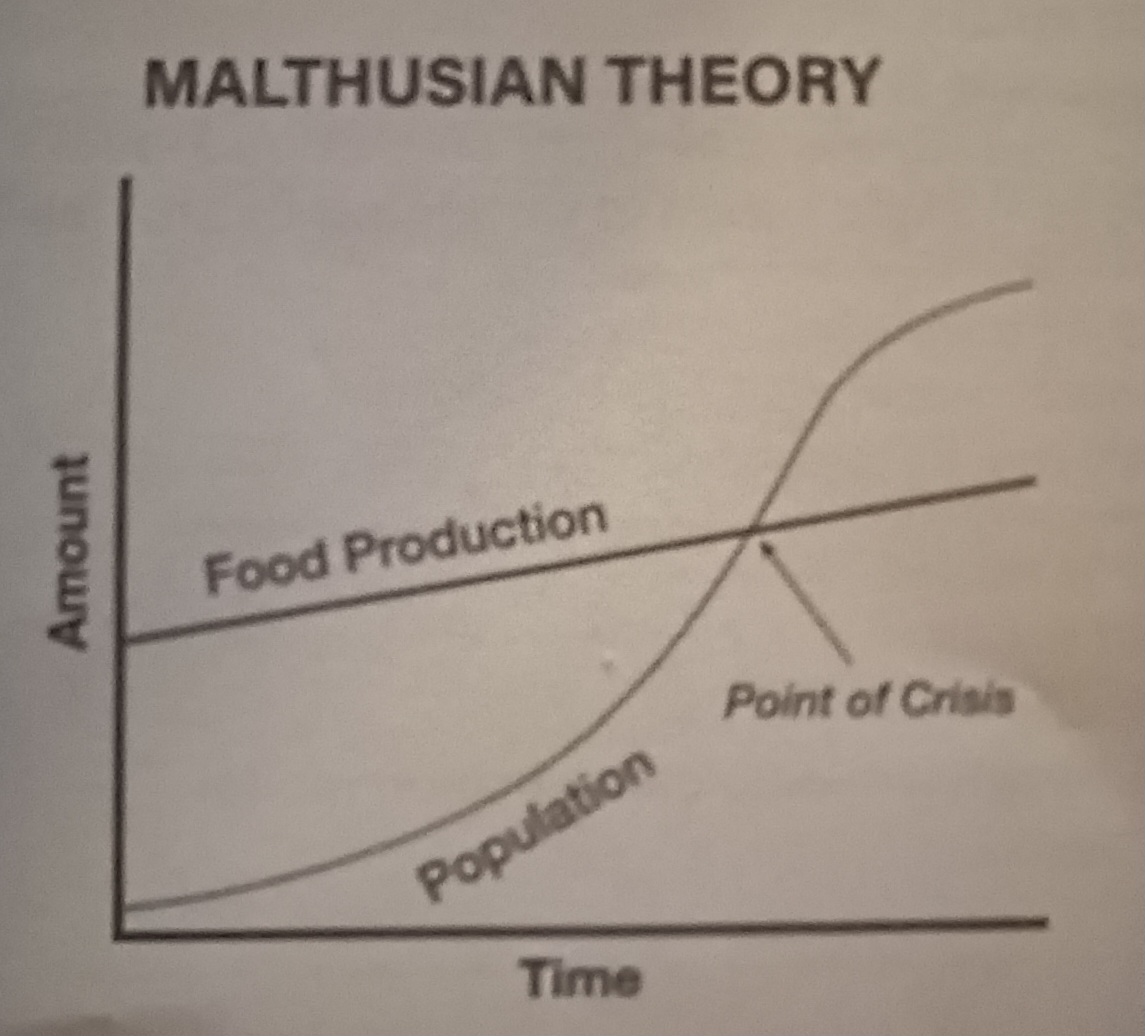
Why were Malthus prediction wrong
Malthus' theories were based on the idea that food supply grew arithmetically while population grew geometrically. He never anticipated that technological improvement would dramatically increase food supply and lead to overall better standards of living.
Migration
Permanent relocation to a new location within or across countries.
Difference Between Immigrate and Emigrate:
"Immigrate" refers to moving into a new country, while "emigrate" refers to leaving one's current country.
Pandemic
Epidemic affecting a wide geographic area and a high proportion of the population simultaneously.
Epidemic
A sudden increase in the number of cases of a disease above what is normally expected in a specific population or region.
Physiological Density
Number of people supported by a unit area of arable land, providing insights into agricultural sustainability.
Examples of countries with a high or low physiological density
Russia (low physiological density), Bangladesh (high physiological density).
Pull factors
Factors that attract people to move to a new location.
Example: Job opportunities, better living standards, political stability.
Push factors
Factors that make people want to leave their old location.
Examples: Economic hardship, political instability, conflict.
Consequences of Fertility Rate Below Replacement Level:
Population decline, aging society, labor shortages, economic slowdown, pension and healthcare challenges, and family structure changes.
Step migration
Migration occurring in stages to a distant destination.
Transnational Migration:
Movement across international borders while maintaining connections to home country.
Voluntary Migration
Permanent movement undertaken by choice.
Zero Population Growth (ZPG)
a decline of the total fertility rate to the point where the natural increase rate equals zero.
Consequences of Zero Population Growth (ZPG)
Aging population, labor shortages, economic effects, challenges in pensions and healthcare.
Where do most people live
midlatitudes
midlatitudes
The regiona between the tropics and polar regions, known for variable weather patterns and distinct seasons. Home to most of the world's population and major cities.
Social Stratification
The division of society into different layers based on factors like wealth, power, and social status. It can impact opportunities and privileges.
why do Baby booms occur
Once hostilities end and peace resumes, the birth rate spikes; another reason is economic abundance
why baby busts happen
Baby busts occur when birth rates fall below replacement level due to reasons such as economic uncertainty, shifting societal norms, and delayed childbearing; happen for a few years after a baby boom
baby echo
when the baby bust ends and the cohort can have children, there is a significant increase in the fertility rate.
What is the order of the generations
Silent Gen
Baby boomers
Gen X
Millenials/Gen Y
Gen Z
Gen Alpha
why would the bars be longer for people ages 18 to 25 than for people younger or older on a population pyramid?
A small city with a large university causes an increase of this age group
A shortage of school funding causes families to move away when they have children.
why would the bars be longer for people ages 25 to 50 than for children on a population pyramid?
An economic crisis causes people to decide to have fewer children.
A government policy to slow population growth discourages births.
An epidemic causes many infants to die
why would the bars be longer for people over the age of 65 on a population pyramid?
A community in a warm climate attracts retirees
A lack of jobs causes young people to move away
Why would the bars be longer for males than females on a population pyramid?
An oil boom or fishing industry attracts people for jobs that are traditionally done by men.
A region contains a military base or prison that may have a larger percentage of men.
Guest workers
Why would the bars be longer for females than males on a population pyramid?
A neighborhood contains a large assisted living home with a high percentage of females who typically outlive males.
Dependent population
under or over 15-64
potential workforce
ages 15-64
Boserup theory
A Danish economist, Ester Boserup. suggests the suggests that more people there are, the more hands are to work, rather than more mouths to feed; opposite of Malthusian theory
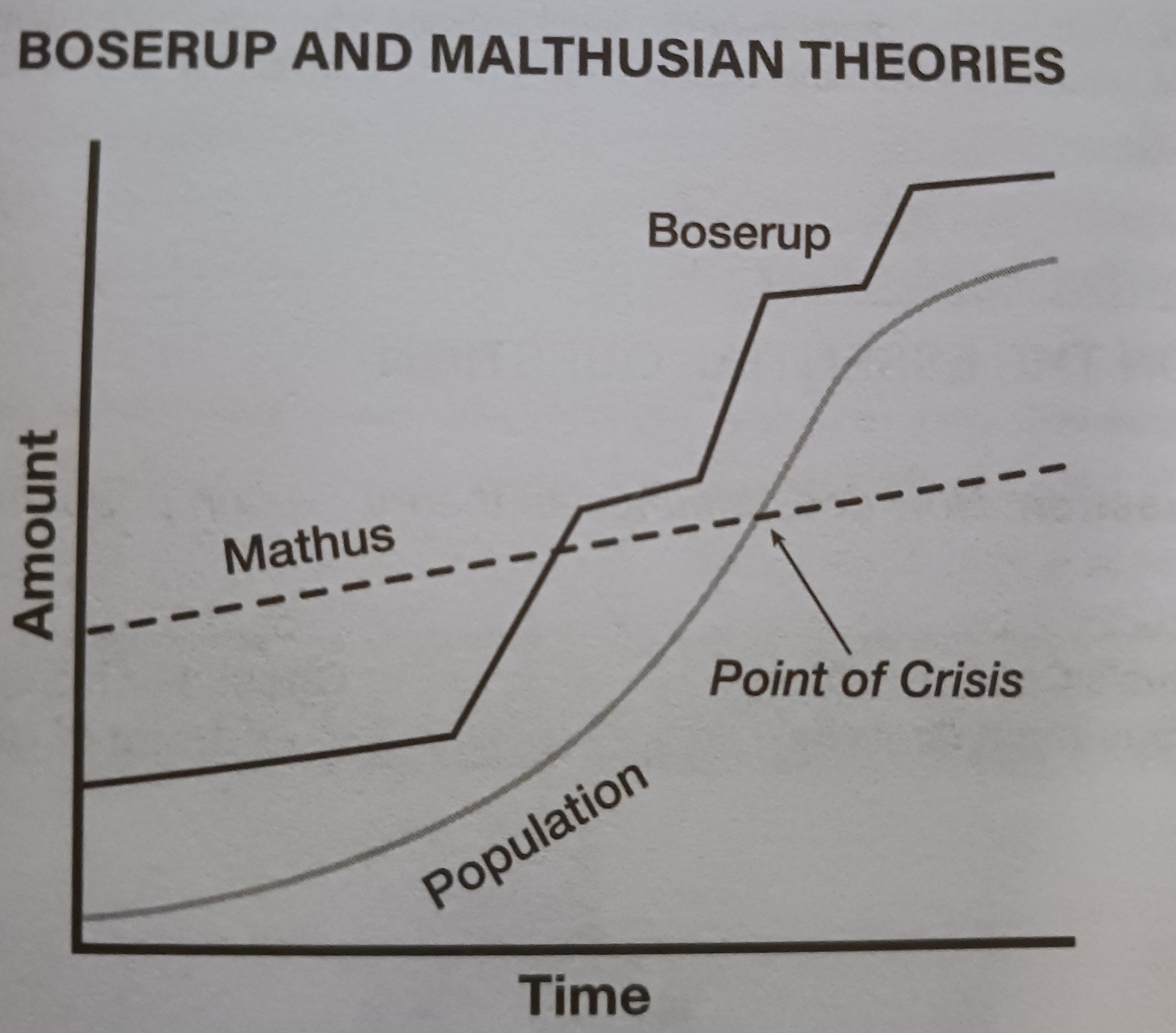
Neo-Malthusians
People who who still accept Malthus's fundamental premise as correct today. They argue that population growth is a serious problem currently and an even greater threat for the future. They also point out continued population growth will lead to the depletion of nonrenewable resources such as petroleum and metals, pollution of air and water, and shortages of food
Counter Migration
Each migration flow produces a movement in the opposite direction
Return migration
The opposite reaction in a counter migration; the return of migrants to their own country
Ravenstein’s laws of migration
Every migration flow generates a return or counter-migration.
The majority of migrants move a short distance.
Migrants who move longer distances tend to choose major sources of economic activity.
Urban residents are often less migratory than inhabitants of rural areas.
Families are less likely to make international moves than young adults.
Most migrants are adults.
Large towns grow by migration rather than natural population growth.
More long-distance migrants are male.
More long-distance migrants are adult individuals rather than families with children.
Females are more migratory than males. (relatively new to the list)
Transhumance
The process of herders moving with their animals to a different pastures during different seasons
REMEMBER THIS
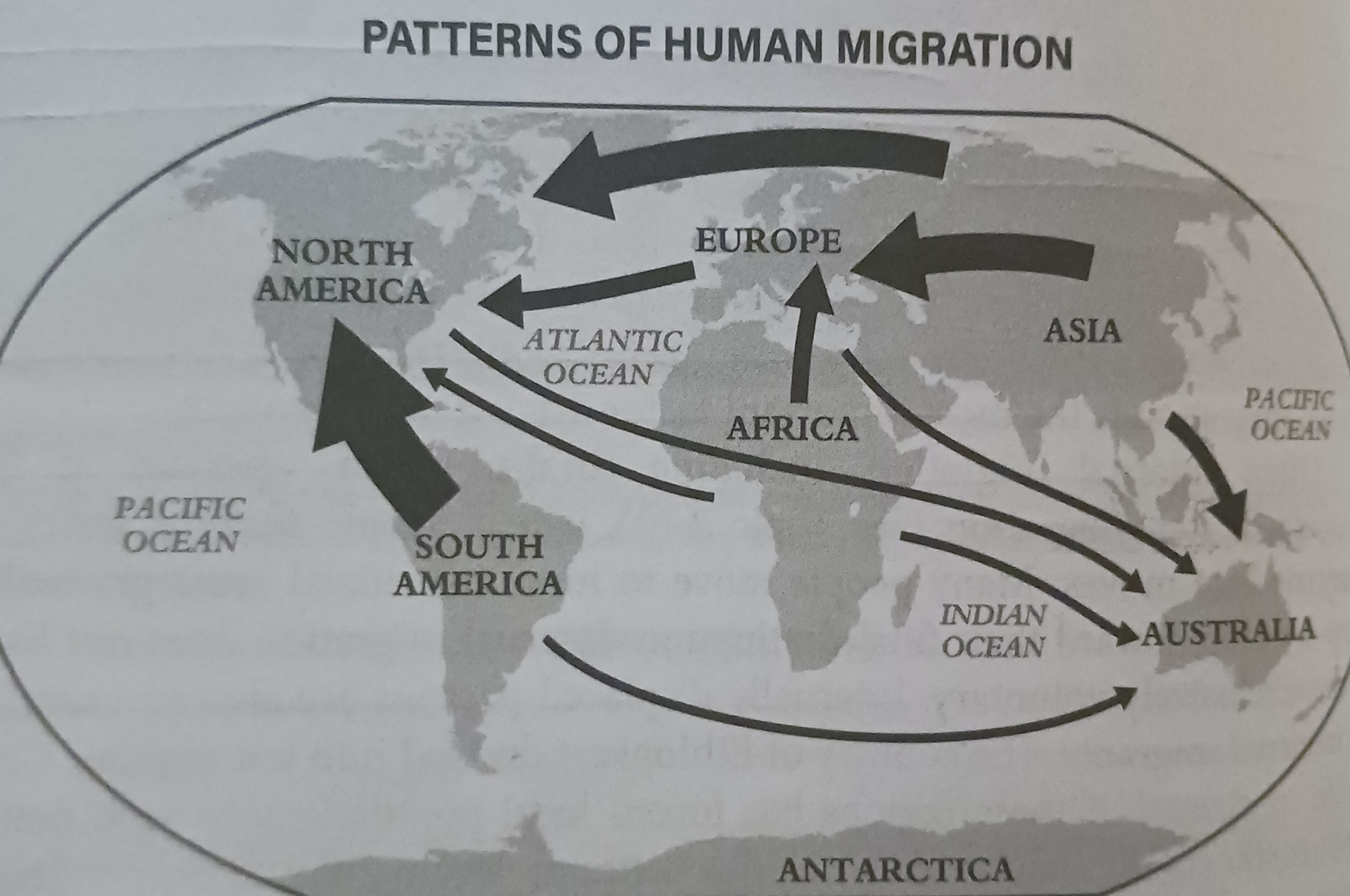
Brain drain
When a migration out of an area is made up of many highly skilled people it is called a brain drain
Ethnic enclave
A neighborhood or area in a city where a particular ethnic group resides maintains its cultural identity through businesses, institutions, and social networks; Chinatown in New York City