Receptive Fields Activity
 Call Kai
 Learn
Learn Practice Test
 Spaced Repetition
 Match
Match Flashcards
 Knowt Play
1/15

There's no tags or description
Looks like no tags are added yet.
Name | Mastery | Learn | Test | Matching | Spaced | Call with Kai |
|---|
No analytics yet
Send a link to your students to track their progress
16 Terms
senses list
Vision (really two senses: our conscious vision (color and intensity) and a subconscious one for regulating sleep) Vestibular (balance), as your ear also senses for gravity In the skin there are thermo (hot cold), pain (chemical, thermo, and mechanical), itch, and pressure sensors Olfactory (chemical smell) Tongue (chemical taste) Muscles and joints have sensors for info regarding motion and tension of muscles Bladder senses when it's time to urinate Large intestine tells you when it's full Senses for thirst and hunger (multiple ones probably come into play here) Humankind has also "augmented" its senses through tools like Radar, Radio, and Sonar. Even a simple microscope is an example of an augmented "additional" sense, allowing us to see with our engineering expertise what was previously unknown The skin (cutaneous system) is a very important part of the somatosensory system; it keeps bacteria out, fluids in, and helps maintain your body's structural integrit
Examples of how it provides your nervous system and brain with important information gathered from the receptors embedded in your skin
1. As you touch a hot stove, pain receptors in your skin fire signals forcing you to immediately pull your hand away from danger. Note that this movement occurs before you are ever conscious of the pain. 2. When you play a violin or guitar, as you become better at playing the instrument, you can play it without looking at the strings (remember the first time you tried and you had to look at the neck of the guitar to play it). Without looking at your arm and fingers, you always know where they are anyway. For example, close your eyes and touch your nose, ear and eye.
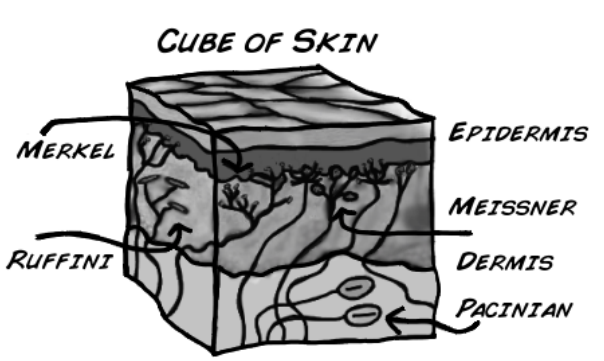
Cube of Skin
Your skin is composed of several layers, an epidermis, dermis, and hypodermis. The epidermis is the outermost layer and is really just layers of dead skin cells that are constantly being shed off and replaced. Most of the tactile feel we receive is gathered by 4 types of mechanoreceptors which are found in both layers of skin. The two receptors located near the top of the dermis, are called Merkel receptors and Meissner corpuscles. These are German.
Thermoreceptors
Give your skin the feeling of hot and cold
Nocicpetors
How you feel pain
Mechanoreceptors
Respond to various pressure, vibrations, and stretching of the skin.
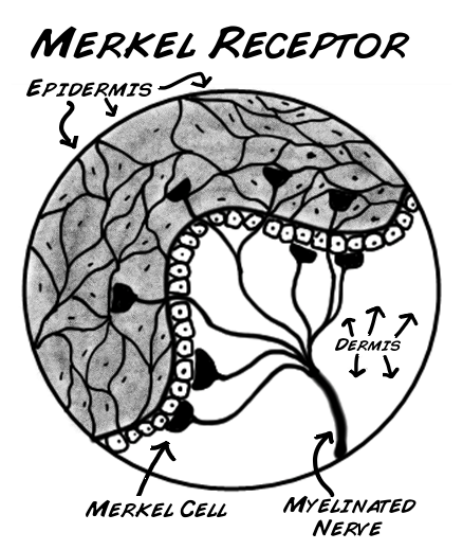
First discovered in 1875 by German anatomist, Friedrich Merkel
these mechanoreceptors constantly fire action potentials, that is, they constantly send signals to the brain as long as the stimulus is touching skin. This receptor is specifically tuned to sense fine detail; for example, the details of Lincoln's face on a penny. This receptor is located in between the dermis and epidermis.
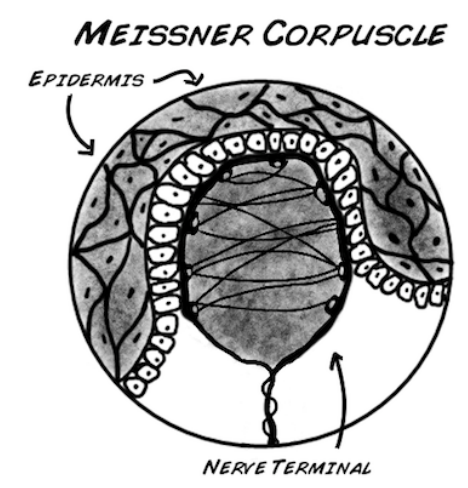
Anatomist Georg Meissner, another German scientist, first described the "Meissner" receptors in 1852
Meissner corpuscles are specialized for controlling hand grip; These are found in the upper dermis. They also fire only when a stimulus is first applied and then when it is removed. For example, when you grab a glass of water they fire, and once again when you let go of the glass. Notice that this type of coding is very different from the cockroach and cricket "rate coding" responses we have observed in Getting Started with your SpikerBox (spikerbox), Rate Coding (ratecoding), Neural Adaptation (somatotopy) and Spike Referencing (referencing), but slightly similar to the earthworm touch coding experiments we see in Introduction to Conduction Velocity (Neural Speed) (speed).
The other two mechanoreceptors
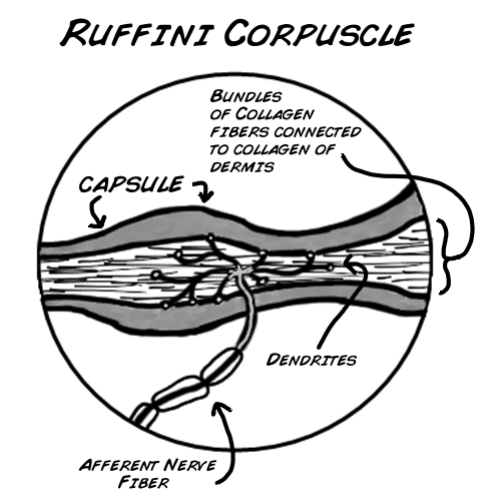
located deep in the dermis and hypodermis layer and are the Ruffini and Pacinian corpuscle. These are Italian
Italian embryologist Angelo Ruffini
Discovered the "Ruffini" corpuscle in the early 1900s. It is sensitive to stretching of the skin and much like Merkel receptors, it fires continuously to stimuli. It is located in both the deep dermis and hypodermis.
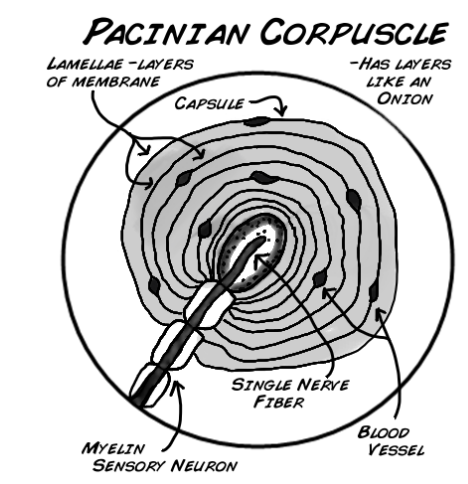
The Pacinian corpuscle was named after a famous Italian anatomist, Filippo Pacini, who discovered it in the 1830s.
These receptors respond to very fine detail by moving fingers, such as reading Braille. They are also selective to vibrations. They are similar to Meissner receptors in the way they fire and send signals. They act like an on/off switch that responds when a stimulus is applied and again when it is removed. It is located deep in the dermis region.
This part of your brain integrates sensory information.
All these receptors send signals to the spinal cord and eventually a part of the brain called the somatosensory cortex in the parietal lobe. This specific flow of information follows the principle of "somatotopy", which we also discussed in the experiment in Neural Adaptation (somatotopy)
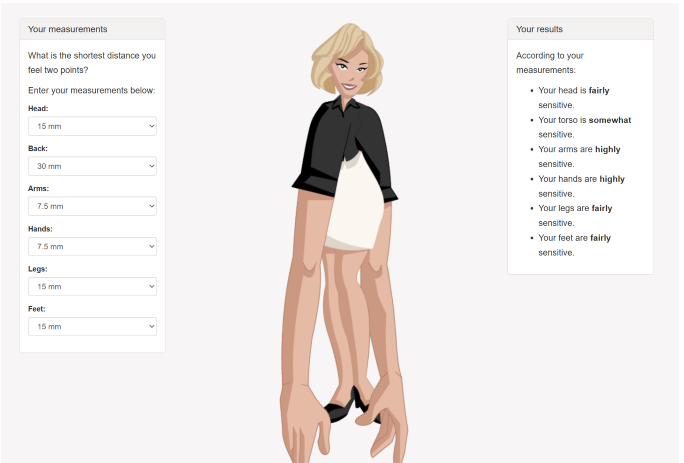
Why can your fingertip detect such small distances between points while your arms and legs cannot?
Fingertips are more sensitive than other parts of the body because that is where we get most of our sensory information from. More receptors and receptor fields in your hands and they get used the most for tasks.
Would you expect to see a difference in males vs females for the recorded areas? What about children vs adults?
I think there might be a minor gender difference with the amount of space allocated to different things. Children I think might be more sensitive because they are developing still and can allocate space in the homunculus differently depending on the sensitivity they have. Skin surface area matters. More difference between indviduals.
Why doesn’t your brain have the sensitivity of your fingertips all over your body?
The brain doesn’t have the sensitivity of your fingertips all over your body because it isn’t needed to have that high level of sensitivity all over and most of the sensory information goes through your hands usually. There is only so much space in the homunculus so it gets allocated accordingly.
My homunculus