Chapter 12: Solids
 Call Kai
 Learn
Learn Practice Test
 Spaced Repetition
 Match
Match Flashcards
 Knowt Play
1/51

There's no tags or description
Looks like no tags are added yet.
Name | Mastery | Learn | Test | Matching | Spaced | Call with Kai |
|---|
No analytics yet
Send a link to your students to track their progress
52 Terms
Density DEFINITION
measure of the compactness of matter
Density SIMPLE
how packed together something is
Density FORMULA
Density = mass ÷ volume
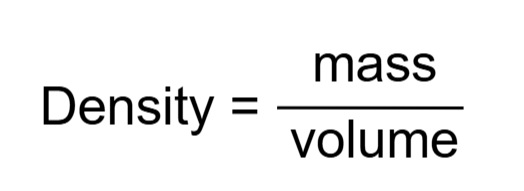
Density EQUATION FORM
see picture
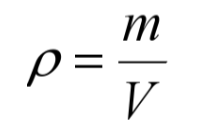
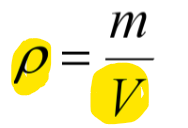
p=
density
Density SI UNIT
kg/m^3
Volume =
how much space it takes up
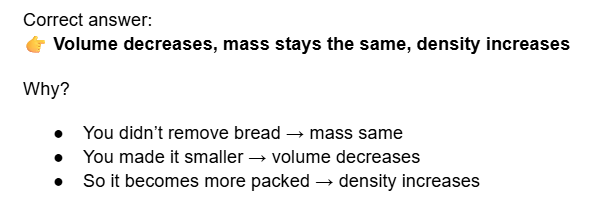
What happens to the volume of a loaf of bread that is squeezed? The mass? The density?
A. Increases, decreases, stays the same.
B. Stays the same, increases, decreases.
C. Increases, stays the same, decreases.
D. Decreases, stays the same, increases
Decreases, stays the same, increases
Density and volume are _____
inverse
Which of the following has a greater density?
A. 3 kg aluminum.
B. 10 kg aluminum.
C. The same.
D. It depends on the volume.
C. The same

t’s the SAME material →
density doesn’t change
Is iron heavier than wood?
It depends on how much you have!
A tiny piece of iron could be lighter than a huge piece of wood
BUT iron is more dense, so same size → iron is heavier
Elasticity DEFINITION
the property of a material by which it changes shape when a deforming force acts on it and returns to its original shape when the force is removed.
Elasticity SIMPLE
Ability to change shape and go back
Materials that return to their original shape are ____
elastic
Materials that do not return to their original shape are ____
inelastic
Under the same force, the ____a material changes shape, the more elastic it is.
less
Steel spring → barely stretches →
very elastic
Rubber band → stretches a lot →
less elastic (even though it’s flexible!)
Is rubber more elastic than steel?
NO, steel is actually more elastic!
Elastic = returns to original shape perfectly
Steel does this better than rubber
Hooke's law:
The stretch of a spring is directly proportional to the force applied to it
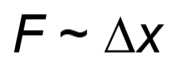
F
stretch
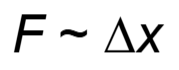
x=
length of spring
Elastic limit:
If stretched beyond certain amount, it will not return to its original shape.
Stretch is _____proportional to weight (or force) as long as the spring is elastic.
directly
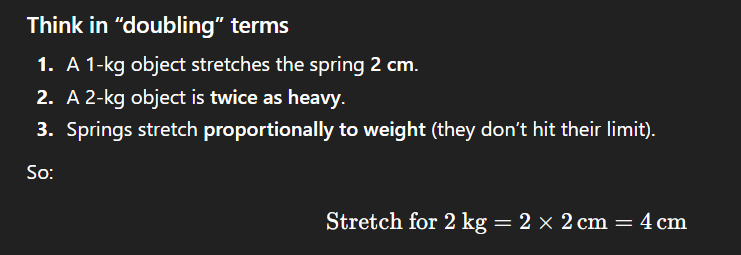
Doubling the mass doubles the force →
doubles the stretch.
If a 1-kg object stretches a spring by 2 cm, then how much will the spring be stretched when it supports a 2-kg object? (Assume the spring does not reach its elastic limit.)
A. 1 cm
B. 3 cm
C. 4 cm
D. 6 cm
C. 4 cm
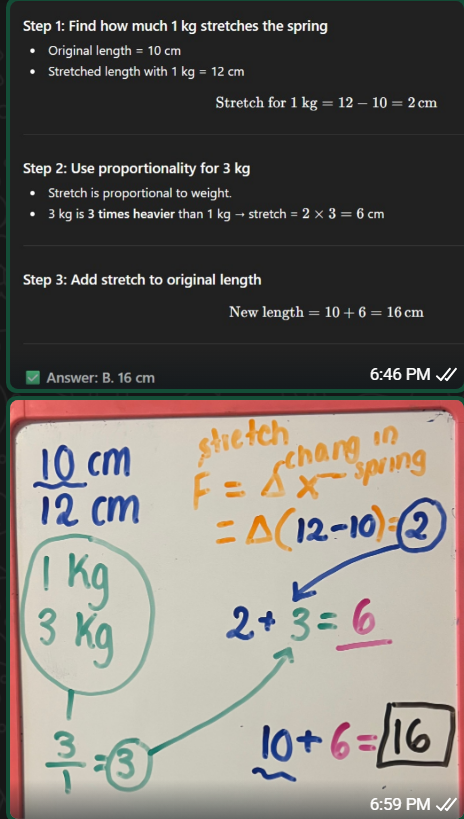
A 10-cm-long spring extends to 12 cm when a 1-kg load is suspended from it. What would be its length if a 3-kg load were suspended from it?
A. 14 cm
B. 16 cm
C. 20 cm
D. 24 cm
B. 16 cm
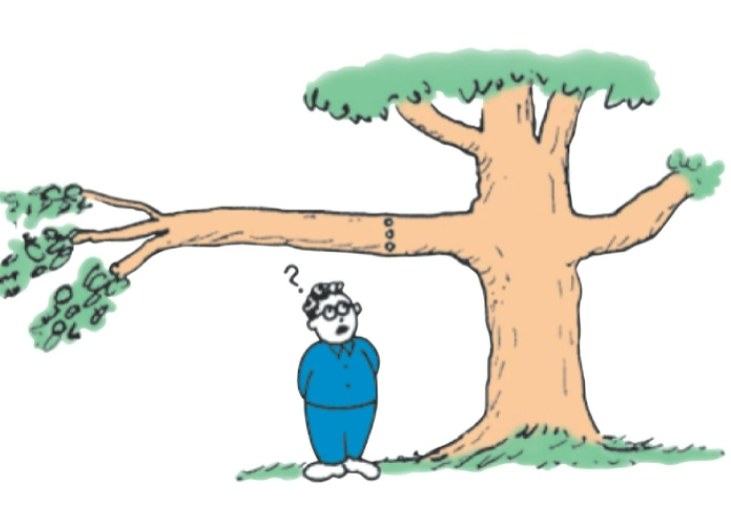
Suppose you drill a hole horizontally through a tree branch as shown. Where will the hole weaken the branch the LEAST?
A. Near the top
B. Near the bottom
C. Near the middle
D. It does not matter
C. Near the middle
Tension = pulling/stretching →
gets longer and thinner
Compression = pushing/squishing →
gets shorter and wider
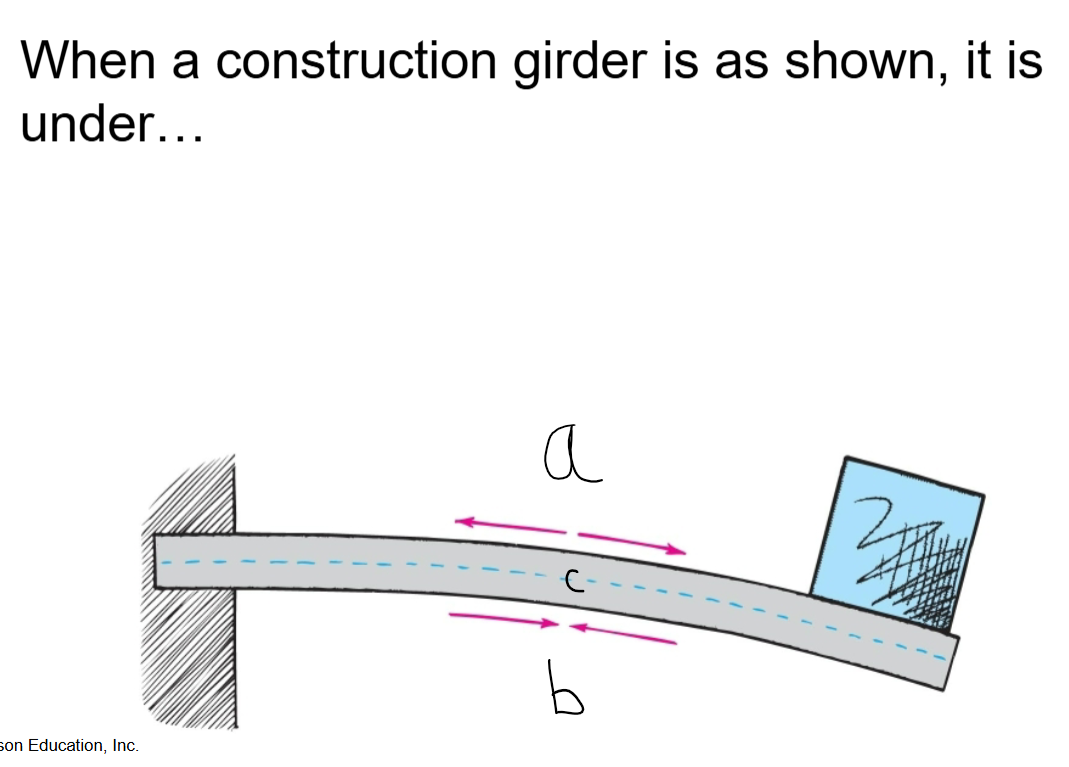
a
Tension (pulling/stretching)
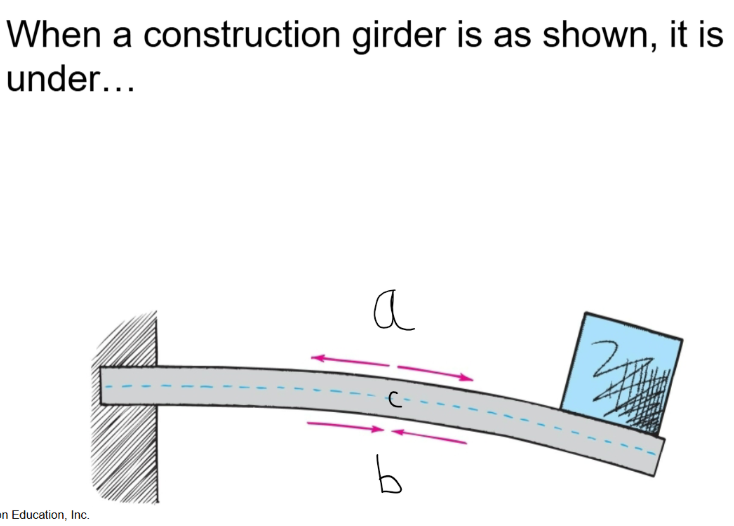
b
Compression (pushing/squishing)
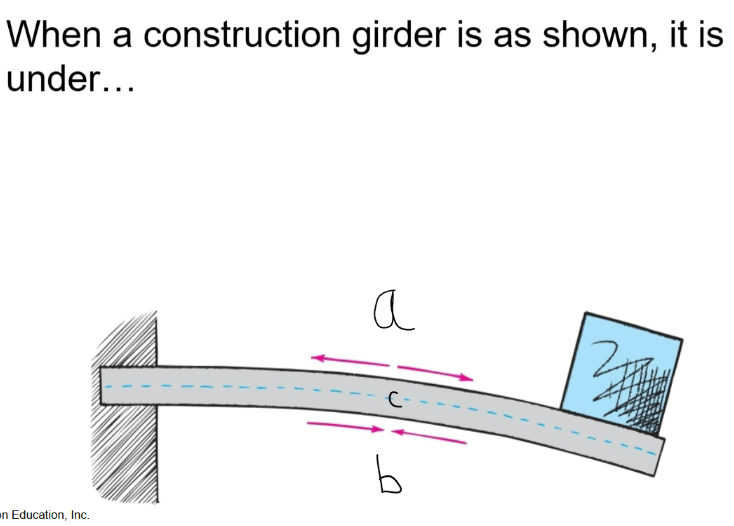
c
neutral layer
Scaling DEFINITION
the study of how size of any object affects the relationships among its strength, weight, and surface area
Scaling SIMPLE
Study of how size affects:
Strength
Weight
Surface area
Strength ~
cross sectional area.
Weight ~
volume
Strength ~ area
(square) ²
Weight ~ volume
(cube) ³
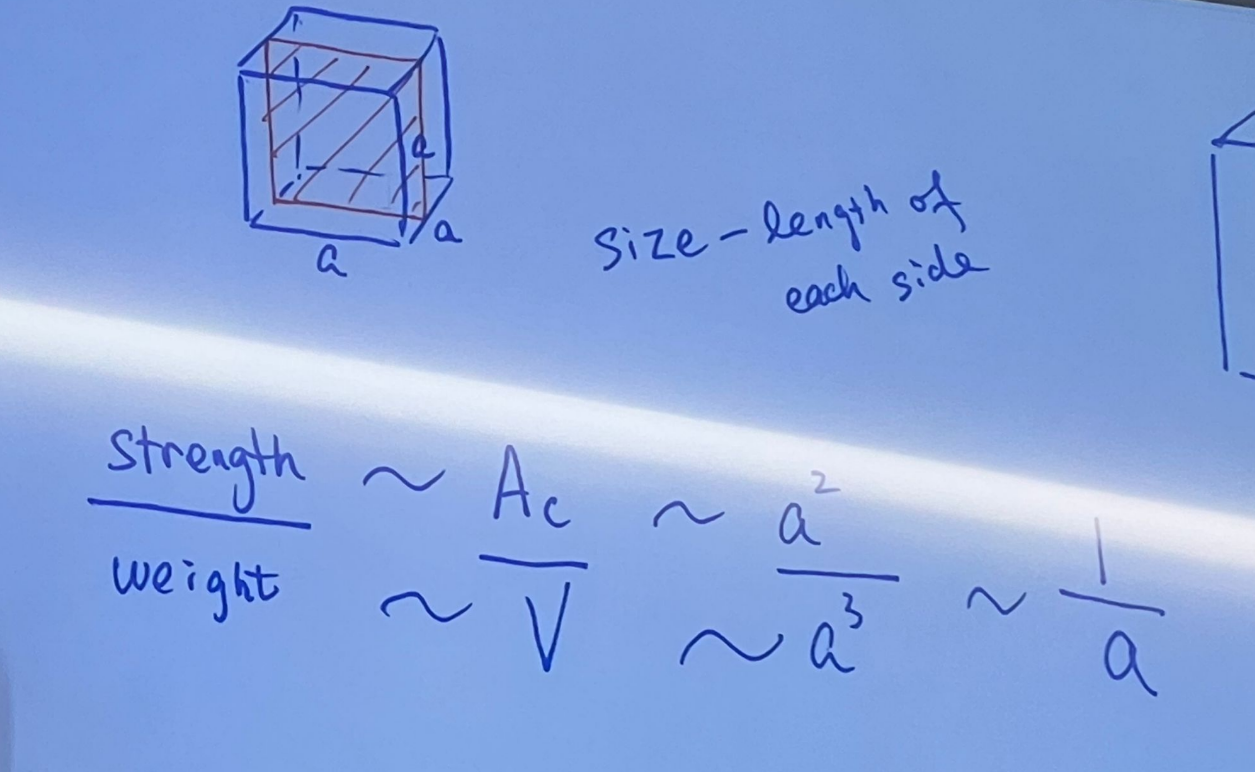
When something gets bigger:
Weight increases ________ than strength
FASTER
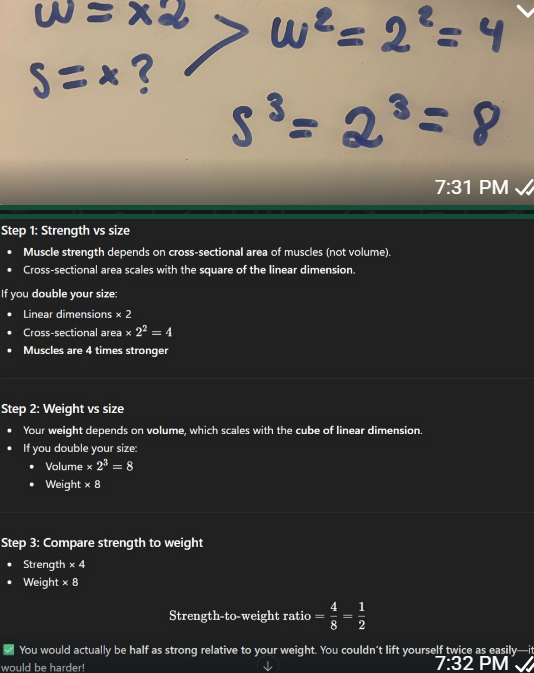
Suppose you could somehow be scaled up to twice your size-that is, every linear dimension increased by a factor of 2. Would you be twice as strong and be able to lift yourself twice as easily?
No
Who is stronger, an ant or an elephant?
Ants win here!
Some ants can lift 20–50 times their own body weight.
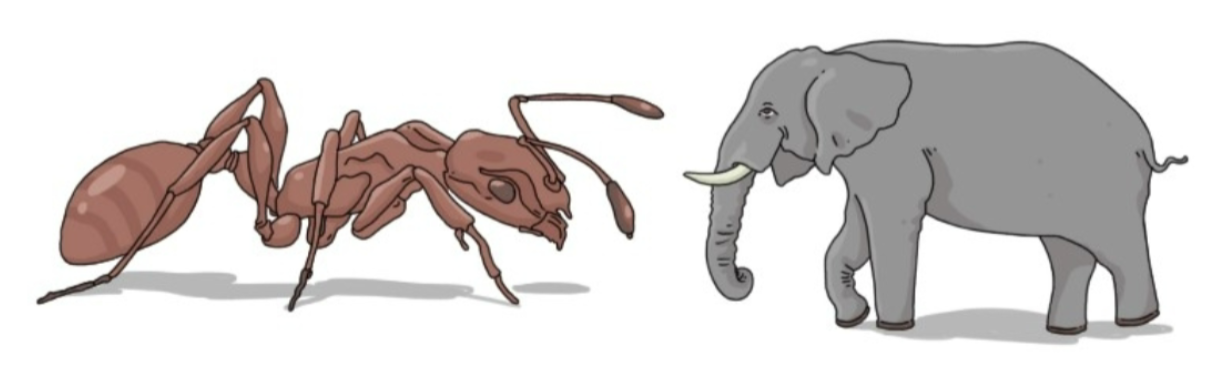
How strong would an ant be if it were scaled up to the size of an elephant?
The ant would be weaker relative to its own weight.
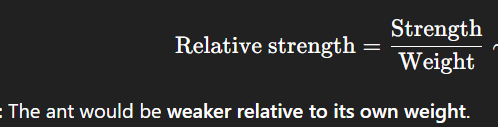
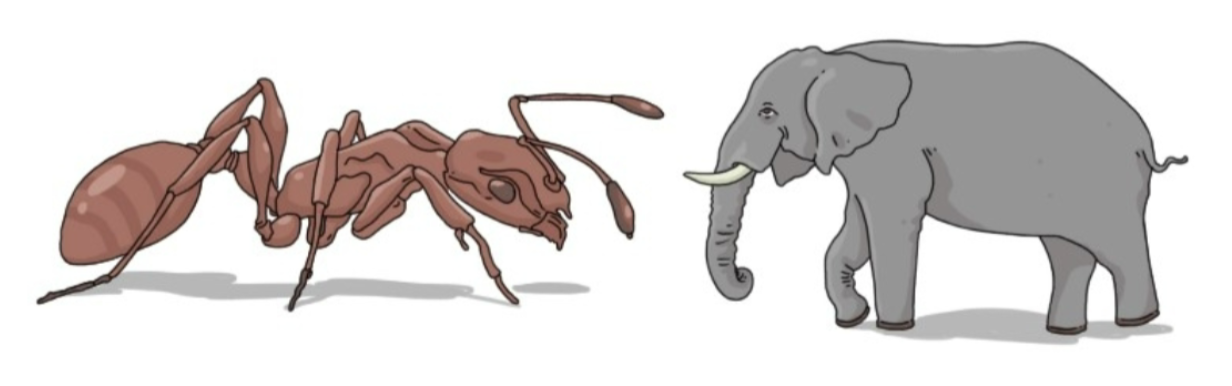
Could the super giant ant carry the weight of several elephants?
NO, When an ant is scaled up to elephant size, its weight increases faster than its muscle strength, so it cannot lift nearly as much relative to its body
surface area grows as»»»
(square) ²
volume grows as»»»
(cube) ³
When a shape gets bigger, the _____ grows faster than the surface, so the surface area compared to volume gets _____.
volume;smaller
If a 1-cm3 cube is scaled up to a cube that is 10 cm long on each side, how does the surface area to volume ratio change?
A. 1/100 of original
B. 1/10 of original
C. 10 times original
D. 100 times original
1/10 of original
Surface area =
total “skin” or “covering” of an object
Volume = how much space is inside the cube.
Volume = 1 × 1 × 1 = 1 cm³ ✅
scale up an object
make it bigger in all directions