Biology - Response and Regulation
 Call Kai
 Learn
Learn Practice Test
 Spaced Repetition
 Match
Match Flashcards
 Knowt Play
1/41

There's no tags or description
Looks like no tags are added yet.
Name | Mastery | Learn | Test | Matching | Spaced | Call with Kai |
|---|
No analytics yet
Send a link to your students to track their progress
42 Terms
Nervous system
Made up of the brain and spinal cord (CNS), and nerves
How does the nervous system control movement?
By sending electrical signals (nerve impulses) along a network of specialised nerve cells known as neurones.
What are the 3 types of neurons?
Sensory - Impulses from receptors to the CNS
Relay - Impulses from sensory to motor neurons
Motor - Impulses from CNS to effectors (muscles and glands)
What is a synapse?
A small gap between neurones across which a nerve impulse is transmitted through neurotransmitters
What are sense organs?
A group of receptor cells that detect specific stimuli (environmental and internal changes) and send info to the CNS.
An example of a sense organ
The eye responds to light
What is a reflex?
An automatic response to a stimulus by the body.
Reflexes are…
Fast, Automatic, Protective
Types of reflexes:
Withdrawal - Pulling away
Pupil - Pupils constrict to prevent damage to the eye from bright light
Blink - Protects the eyes from foreign bodies
What is a reflex arc?
The nerve pathway involved in a reflex action
What is the Reflex arc pathway?
Stimulus → Receptor → Sensory neurone → Relay neurone → Motor neurone → Effector → Response
Structure of the eye
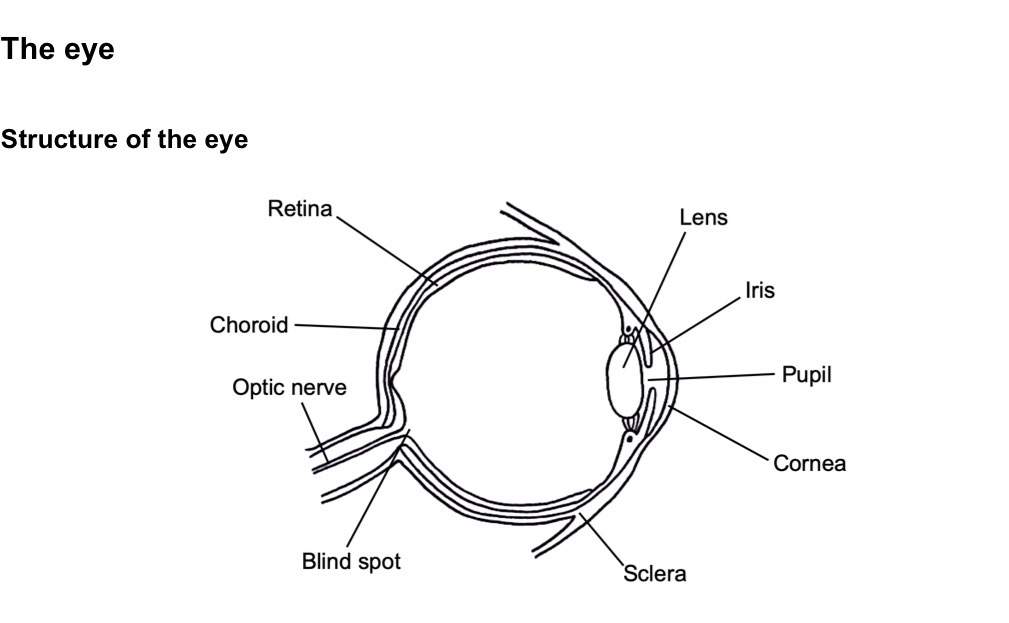
Function of the Lens
Refracts light, focusing it on the retina
Function of Pupil
Allows light to enter the eye
Function of Iris
Controls the size of the pupil to alter how much light enters the eye
Function of Cornea
Refracts light entering the eye
Function of Retina
Converts light energy into neural signals which are sent to the brain via optic nerve
Function of Choroid
Absorbs light, preventing internal reflection
Function of Sclera
Maintains eyeball shape
Function of Optic nerve
Transmits nerve impulses to the brain from the retina
What’s the blind spot?
When the optic nerve leaves the eye
What is Homeostasis?
Maintaining a stable internal environment
Why is homeostasis important?
To ensure optimum conditions for enzymes and cellular processes in the body. Temperature, blood glucose concentration and water levels must be maintained.
What is a Hormone?
A chemical messenger
What happens if blood glucose concentration rises too high?
The body becomes dehydrated
What happens if blood glucose concentration becomes too low?
The rate of cellular respiration decreases
What hormones control blood glucose concentration?
Insulin and Glucagon which are secreted by the pancreas
What is the effect of Insulin?
Causes liver and muscle cells to increase their uptake of glucose
Glucose is converted into glycogen, a storage molecule
What is the effect of Glucagon?
Causes the breakdown of glycogen to glucose in the liver
Glucose is released into the blood
What is Negative Feedback?
Any change from the balance in internal conditions results in the body’s hormonal and nervous systems compensating for the change and restoring the balance.
What happens when Blood Glucose concentration increases too high?
Pancreas secretes Insulin and stops producing Glucagon
Liver converts Glucose to Glycogen which is stored
Blood glucose decreases and returns to normal level
What happens when Blood Glucose concentration decreases too much?
Pancreas secretes Glucagon and stops producing insulin
Liver converts Glycogen into Glucose which is released into the blood
Blood glucose increases returning to normal level
What is Diabetes?
When the control of blood glucose levels stops working
What is the cause of Type 1 Diabetes and how do you treat it?
When the Pancreas doesn’t produce enough insulin
Insulin injections, manage diet, regular testing glucose levels
What is the cause of Type 2 Diabetes and how do you treat it?
When you become insulin resistant
Manage diet, Regular exercise
What happens when your body is too hot
Vasodilation: Blood vessels dilate near the surface of the skin, blood flows closer. More heat is lost.
Sweating: Heat energy is used to evaporate sweat, body temp decreases
The erector muscles relax, hair lies flat
What happens when your body is too cold?
Vasoconstriction: Blood vessels constrict, so less blood flows closer to the skin surface. Less heat is lost.
Little sweat
Erector muscles contract, hairs stand and pockets of air are created as a layer of insulation
Shivering, muscles contract and heat energy is generated
Lifestyle factors
Obesity - Increases risk of Type 2 diabetes
Drugs - Affects chemical processes in the body and has damaging side effects
Alcohol - Decreases reaction time and causes liver damage, cardiovascular disease
What are Plant tropisms?
Growth responses of a plant to stimuli
What is Phototropism
A plant’s growth response to light
Positive - Plant shoots grow towards light
Negative - Roots grow away from the light
What is Gravitropism?
A plant’s growth response to gravity
Negative - Plant shoots as they grow away from gravity
Positive - Plant roots as they grow towards gravity
What is the importance of plant tropisms?
Increase a plant’s chance of survival
Enable them to respond to their environment