4.3-4.4- diversity and mutation or meiosis/genetic diversity and adaptation
 Call Kai
 Learn
Learn Practice Test
 Spaced Repetition
 Match
Match Flashcards
 Knowt Play
1/16

There's no tags or description
Looks like no tags are added yet.
Name | Mastery | Learn | Test | Matching | Spaced | Call with Kai |
|---|
No analytics yet
Send a link to your students to track their progress
17 Terms
what is genetic diversity?
what is a gene?
what is an allele?
what is a gene pool?
the number of different alleles in a population
section of DNA that codes for the production of a polypeptide chain and functional RNA
different versions of a gene
all the alleles in a population
what does a bigger gene pool mean?
what does greater genetic diversity mean?
greater variation within that species, and the greater the genetic diversity
the better the survival chances of that species as they are more likely to be able to adapt to a change in the environment
what are the three causes of genetic diversity?
of these causes, which is the only way asexually reproducing organisms show variation?
mutations, meiosis and random fusion of gametes
mutations
what are mutations and what can they cause?
how do they lead to the production of non-functioning proteins?
why would this prevent an enzyme functioning?
1) change in the base sequence of DNA- causes change in characteristics
2) sequence of bases altered- changes sequence of amino acids
change in primary structure of protein causes change in tertiary structure- bonds form in different places
loss or reduction in function of protein
3) active site of enzyme changes- no longer complementary to substrate- less ES complexes forms
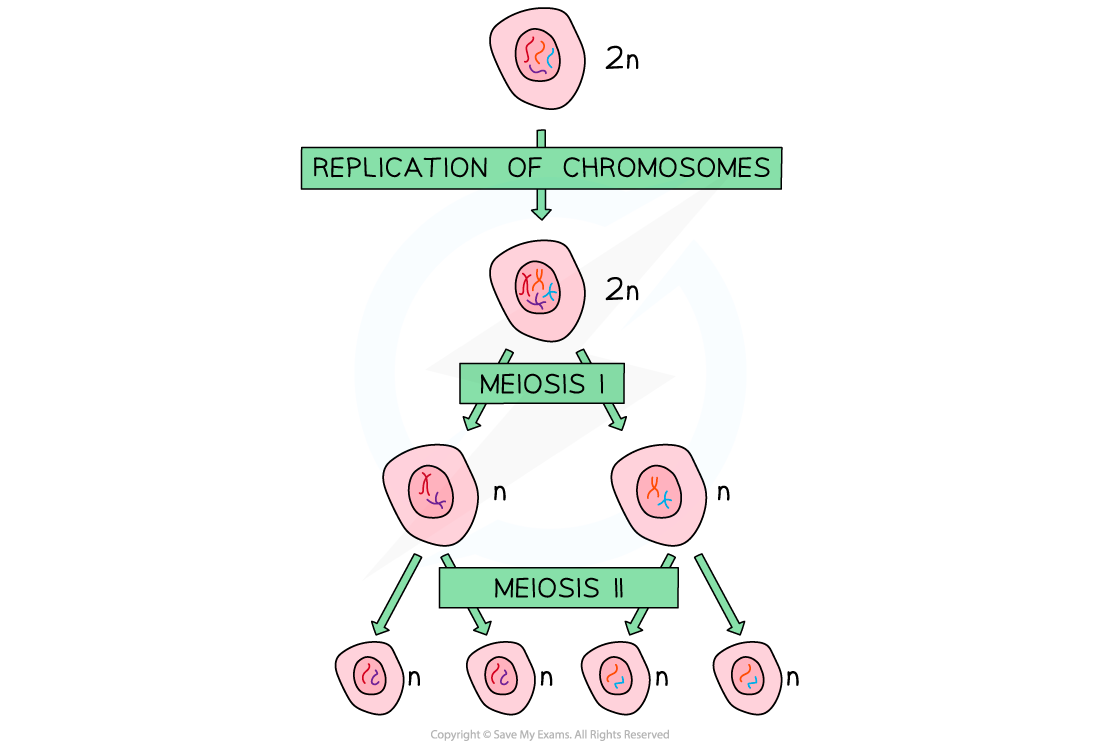
what happens in meiosis?
how many nuclear divisions?
what is formed?
what is haploid and diploid?
what does meiosis ensure?
1) formation of gametes
2) 2 nuclear divisions
3) 4 genetically different daughter cells
4) daughter cells have half the number of chromosomes in a normal body cell (23)- haploid
normal number of chromosomes found in a body cell- (46)- diploid
5) when male and female gametes join together at fertilisation, the diploid number is restored
therefore, meiosis ensures that the chromosome number is kept constant from one generation to the next
what happens in meiosis 1?
what happens in meiosis 2?
homologous pairs separate, and the cells become haploid
centromere breaks and chromatids separate
what is chromosome non-disjunction?
what happens to the zygote as a consequence?
homologous chromosomes don’t separate properly during meiosis and both chromosomes of a pair go into the same cell
the zygote can end up with an extra copy of a particular chromosome
how does meiosis lead to variation in the offspring produced by fertilisation of the gametes?
do these two processes occur during meiosis 1 or meiosis 2?
independent segregation- random shuffling between maternal and paternal chromosomes
crossing over- parts of chromatids are exchanged between homologous chromosomes
alleles are exchanged between the maternal and paternal chromosmes- genetic recombination occurs
both during meiosis 1
What happens in crossing over? (3)
Homologous pairs of chromosomes associate to form a bivalent
Non sister chromatids entangle and chiasmata form
Non sister chromatids are exchanged
(Results in new combination of alleles)
during which two stages, is the chromosome number 2n i.e. diploid and n i.e. haploid
draw what the cells look like in meiosis?
diploid = interphase + meiosis 1
haploid = meiosis 2 + at the end
How to calculate possible combinations of chromosomes in daughter cells?
2 to the power of n
N = number of homologous pairs
Why may mutations still produce a functional protein?
Substitution- one nucleotide changed
Same amino acid coded for- genetic code is degenerate
So tertiary structure not changed
Change could be in an interim
Removed during splicing
what is natural selection and what are some factors that are involved in it?
What does variation in the population do?
process by which frequency of ‘advantageous’ alleles gradually increase in a population’s gene pool over time
predation, disease and competition, e.g. for food and breeding sites in animals, and for water, space and light in plants.
variation- some organisms possess phenotypes that give them a selective advantage in their environment
what is directional selection and give an example?
one extreme of organism’s phenotype selected, and the other extreme is acted against
antibiotic resistance in bacteria:
random mutations some bacteria have allele which gives them resistance to antibiotics
In the presence of antibiotics only those bacteria that have the allele for resistance will be able to survive and reproduce
The next generation of bacteria inherit this allele as they divide (vertical gene transmission)
Over time, the frequency of the allele for antibiotic resistance will increase in the population.
Bacteria can also transfer this allele to different species of bacteria in a process (horizontal gene transmission)
what is stabilising selection and give an example (what are the two extremes selected against and why?)
acts against both the extremes in a range of phenotypes i.e. it selects and favours the intermediate phenotype and so acts to prevent change
e.g. human birth weight- two extremes that are selected against e.g. high birth weight- damage to mother;s body + low birth weight- lose heat faster- ill from infectious diseases
what is disruptive selection?
both extremes of a phenotype have a selective advantage over those in the middle
intermediate phenotypes are selected against
what are the three types of adaptations?
physiological e.g. having haemoglobin with different oxygen affinity
anatomical- visible changes to organism’s body
behavioural e.g. better food search strategy more elaborate songs in whales