L7 Limb Development
 Call Kai
 Learn
Learn Practice Test
 Spaced Repetition
 Match
Match Flashcards
 Knowt Play
1/50

There's no tags or description
Looks like no tags are added yet.
Name | Mastery | Learn | Test | Matching | Spaced | Call with Kai |
|---|
No analytics yet
Send a link to your students to track their progress
51 Terms
What can easily be done to chicken embryos
The chicken embryo and in particular the developing limbs can be easily manipulated
One of the most common birth defects
Malformations. They do not interfere with an embryos life.
Why is understanding developmental processes important
It provides a framework for understanding anatomical malformations in the adult
Morphological features of the vertebrate limb
The vertebrate limb shows an enormous morphological variety. Limb development serves as a paradigm to understand morphogenesis and the underlying cellular and molecular mechanisms.
Correlation between limb development and evolution - main structure is the same but there is a high level of variation between species
FLIP
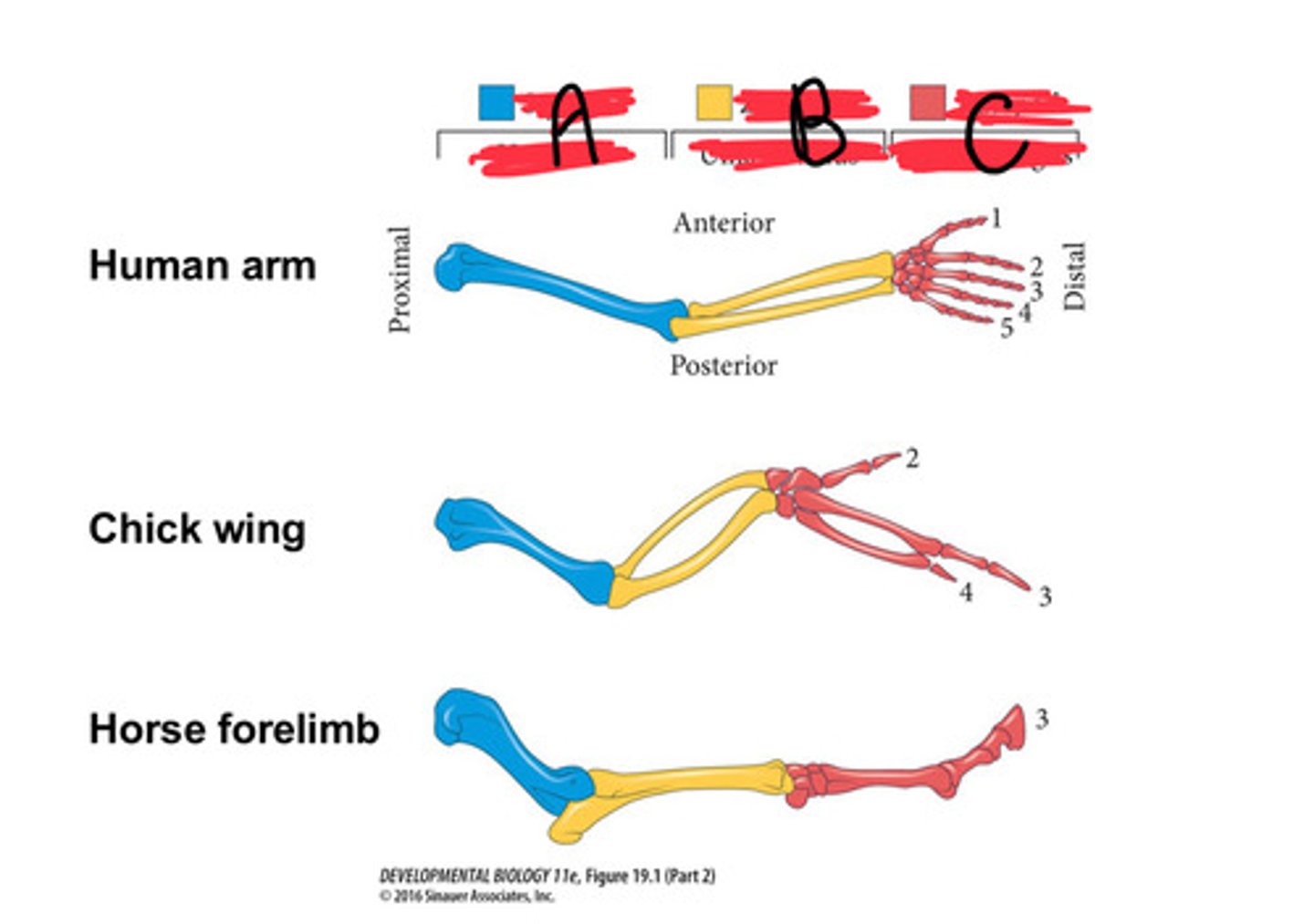
A: stylopod (close to body axis), Humerus
B: Zeugopod, Ulna radius
C: Autopod, Carpals digits
Label the Skeletal patterns of the tetrapod limb
How is axis orientation in development different to an anatomist
Proximal at shoulder, distal at fingertips
Posterior and anterior CONFUSED FIX THIS SLIDE 6
Where do the vertebrate limbs develop from
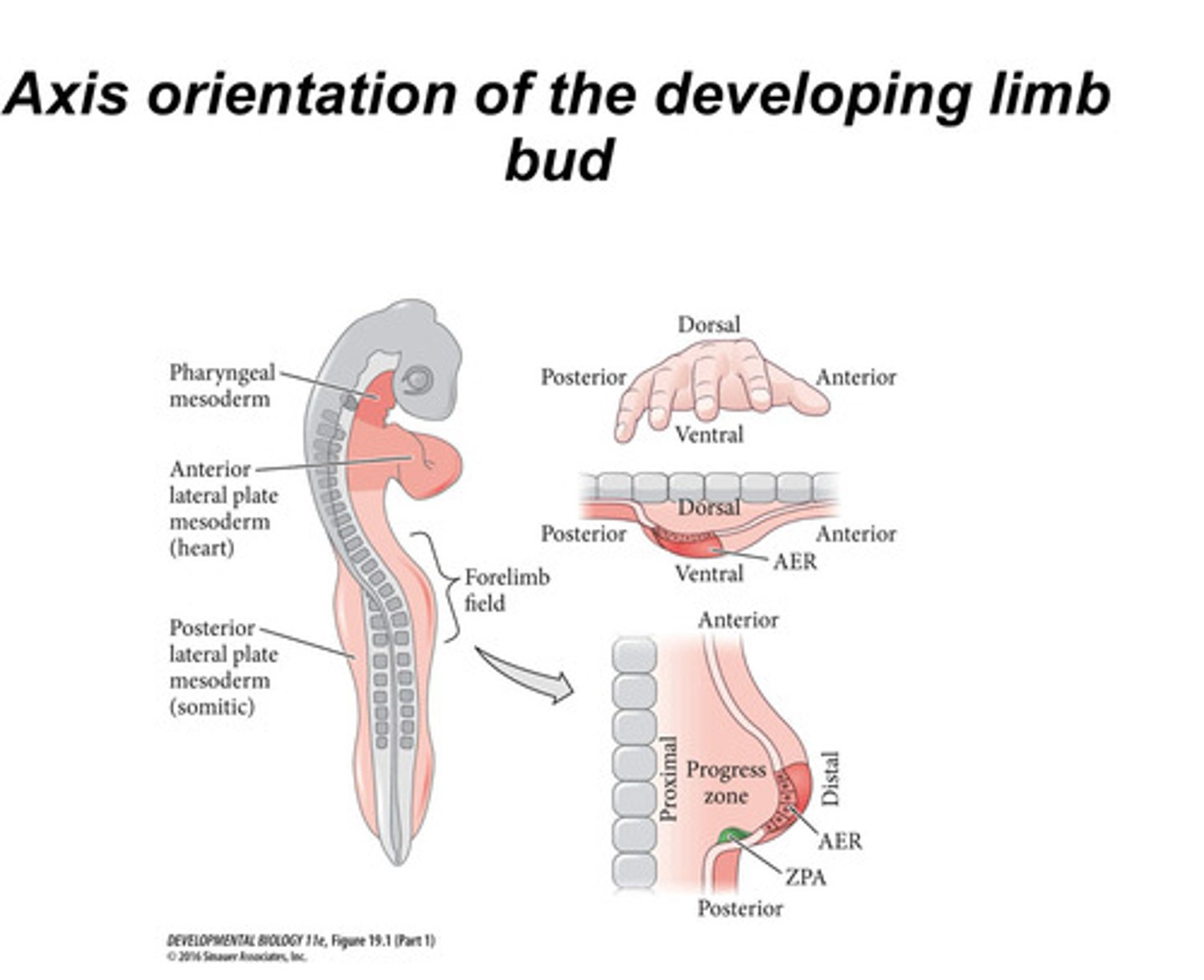
From the limb bud - sac of cells with ectoderm on the outside and mesonchyl cells on the side
Mouse developmental limb stages
At E12.5 the mouse embryo has prominent structures which will form the digits. Digits are not yet separated yet but will via apoptosis
E18.5 (1 day before birth) it is properly developed
Three axes of the limb bud
Proximal - distal
Anterior - posterior
Dorsal - ventral
What controls limb growth along the proximal-distal axis
Apical Ectodermal ridge (AER)
- thickened ectoderm at most distal tip
- secretes Fgf8
What is the function of Fgf8 from the AER
- keeps mesenchyme proliferating
- prevents premature differentiation
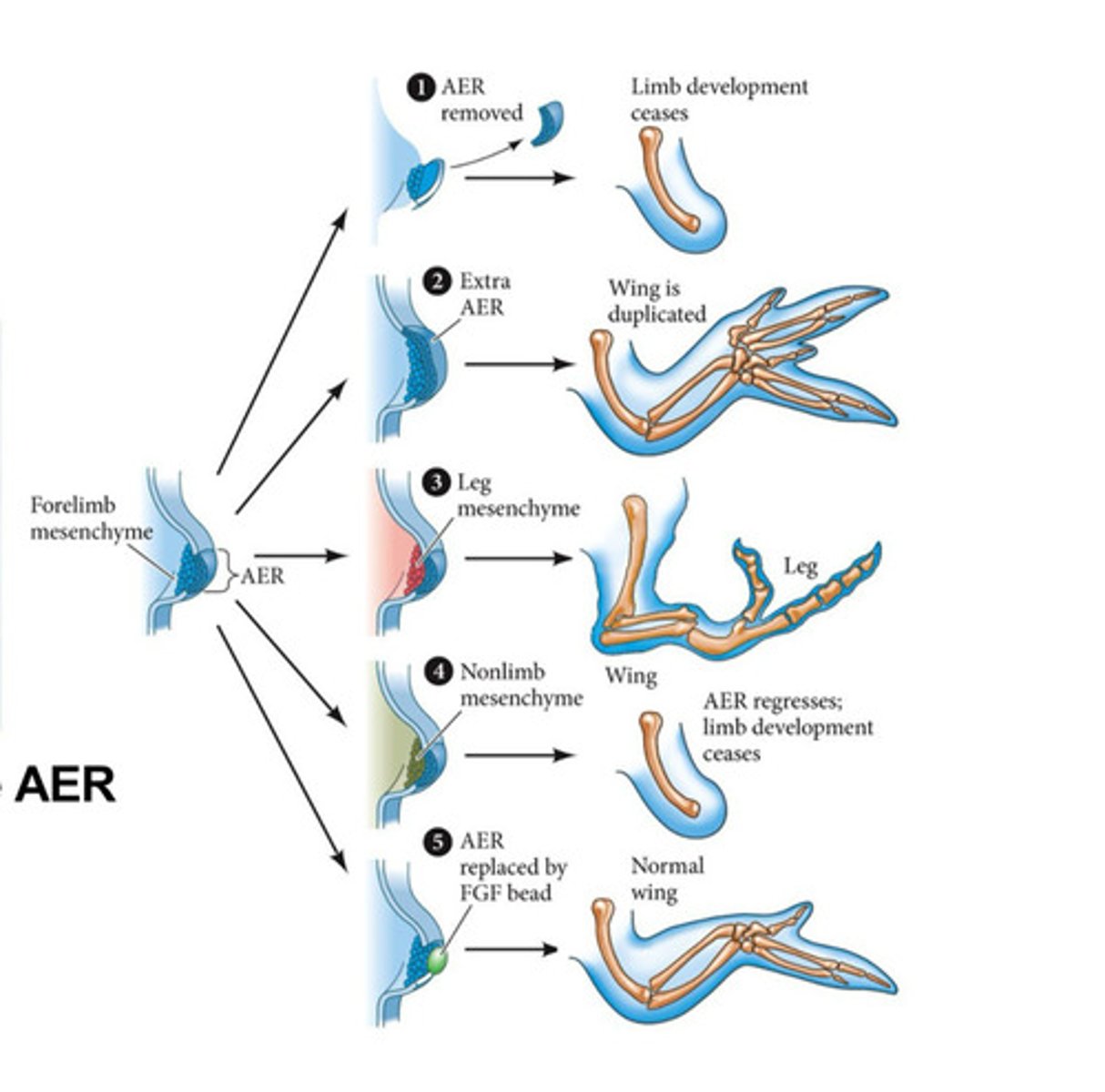
What does the AER do
Expression of fgf8 in the AER diagram experiments
What specifies the anterior-posterior axis
Zone of Polarising Activity (ZPA)
Which signaling molecule is produced by the ZPA
Sonic hedgehog (Shh)
What is the effect of ectopic ZPA/Shh
Mirror-image polydactyl
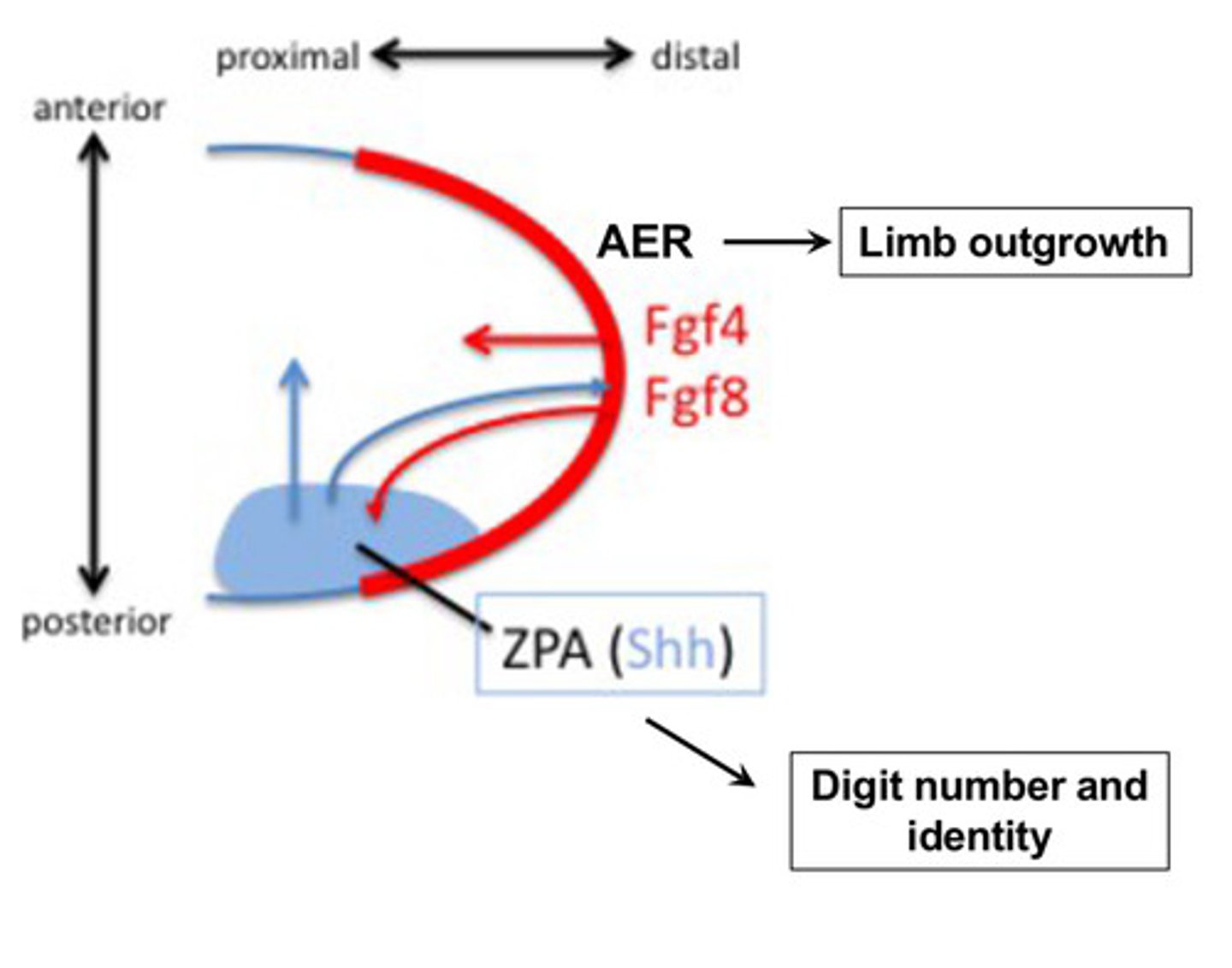
What is the relationship between AER and ZPA
Form a positive feedback loop controlling limb outgrowth
- AER (Fgf8) maintains Shh
- Shh maintains Fgf expression
AER and ZPA feedback diagram
How many steps in limb initiation
Initiation of limb bud formation: a process of 4 steps
What are somites
segmented blocks of tissue that later differentiate into vertebrae, ribs, and skeletal muscles (predecessors of the vertebrae used to stage embryos) .
Necessary and sufficient to determine the size of the limb bud and where it forms
What is Retinoic Acid
RA is a vitamin A derivative which diffuses through cell membranes and binds to TR or retinoic acid receptor (RARs) to directly regulate gene transcription.
Promotes forelimb identity by activating genes such as Tbx5 in the lateral plate mesoderm
Role of Fgf8 before limb bud formation x
Before limb, bud formation, Fgf8 is expressed in the primitive streak and acts to suppress RA activity. This prevents premature limb initiation and restricts where the forelimb can form. Later in development, it is reused in the AER
Explain the antagonism between Fgf8 and RA
Makes mesoderm permissive for forelimb formation through their mutual inhibitory relationship.
RA promotes forelimb formation by inducing Tbx5 expression while Fgf8 suppresses RA signaling. This establishes a boundary that defines the forelimb field.
What happens if RA signaling is lost
If RA synthesis is lost, Tbx5 cannot be properly activated in the lateral plate mesoderm and forelimb buds fail to form
Step 2 What is the primary inducer of limb bud formation
Fgf10 (in mesoderm) in both forelimb and hindlimb
(ALSO transcription factors control its outgrowth Tbx4 and Tbx5)
What transcription factors specify hindlimb identity
Tbx4 (also Islet1 and Pitx1)
What transcription factors specifies forelimb identity in the chicken embryo
Tbx5 specifies forelimb identity. It is expressed in the anterior half
- controls Fgf8 expression
- Works in feedback loop with Wnt2b
What feedback loop controls forelimb
A positive feedback loop involving Tbx5, Wnt2b and Fgf10 controls forelimb bud initiation
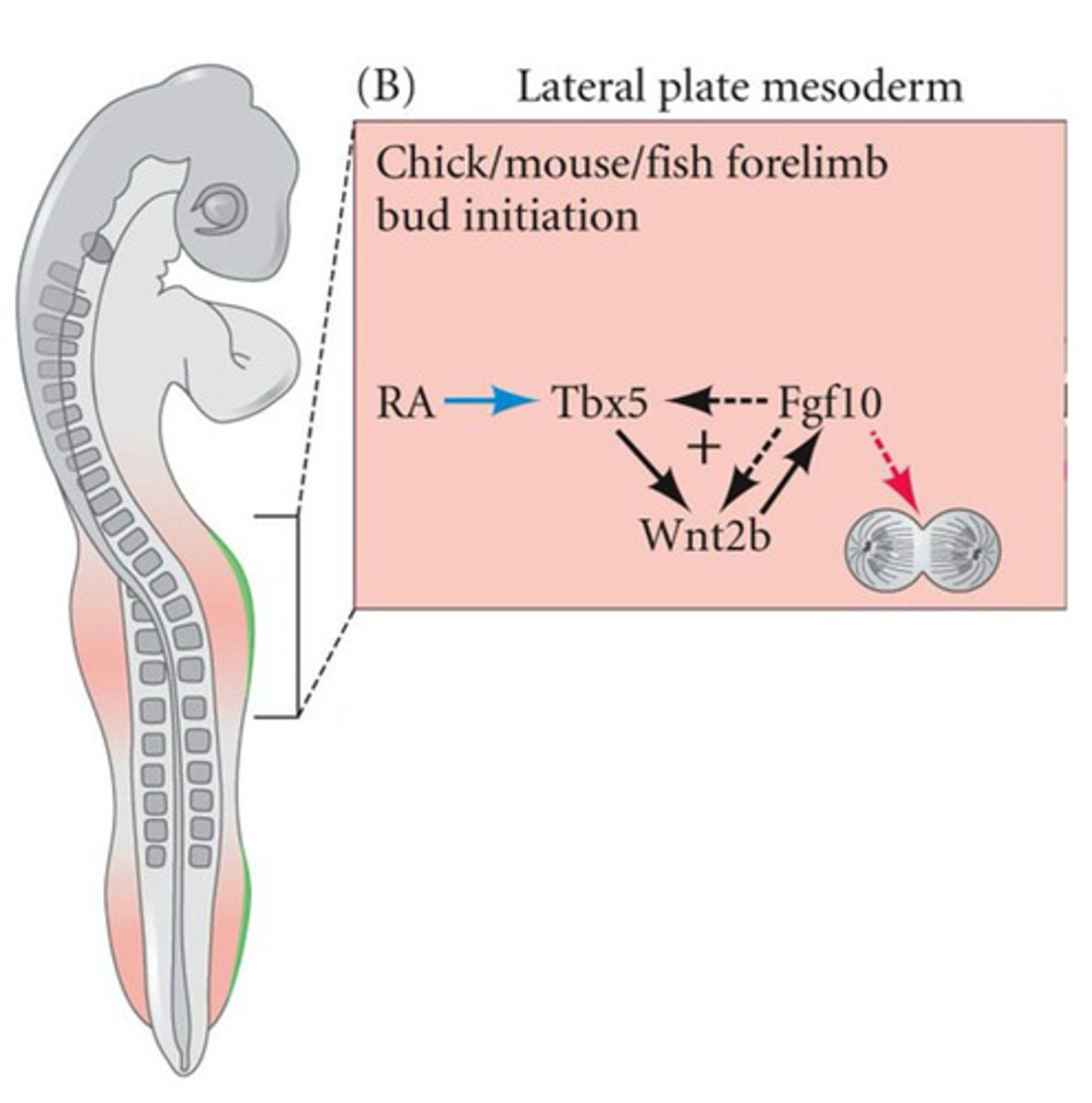
Step 3 - what cellular process does Tnx5 induce
Epithelial-to-mesenchyme transition (EMT)
- also has an effect on cellular structures
What is this transition important for
Development but also the development of cancers and homeostasis
Step 4 - What establishes the AER
A second feedback loop:
Fgf10 (mesoderm) ↔ Wnt3a + Fgf8 (ectoderm)
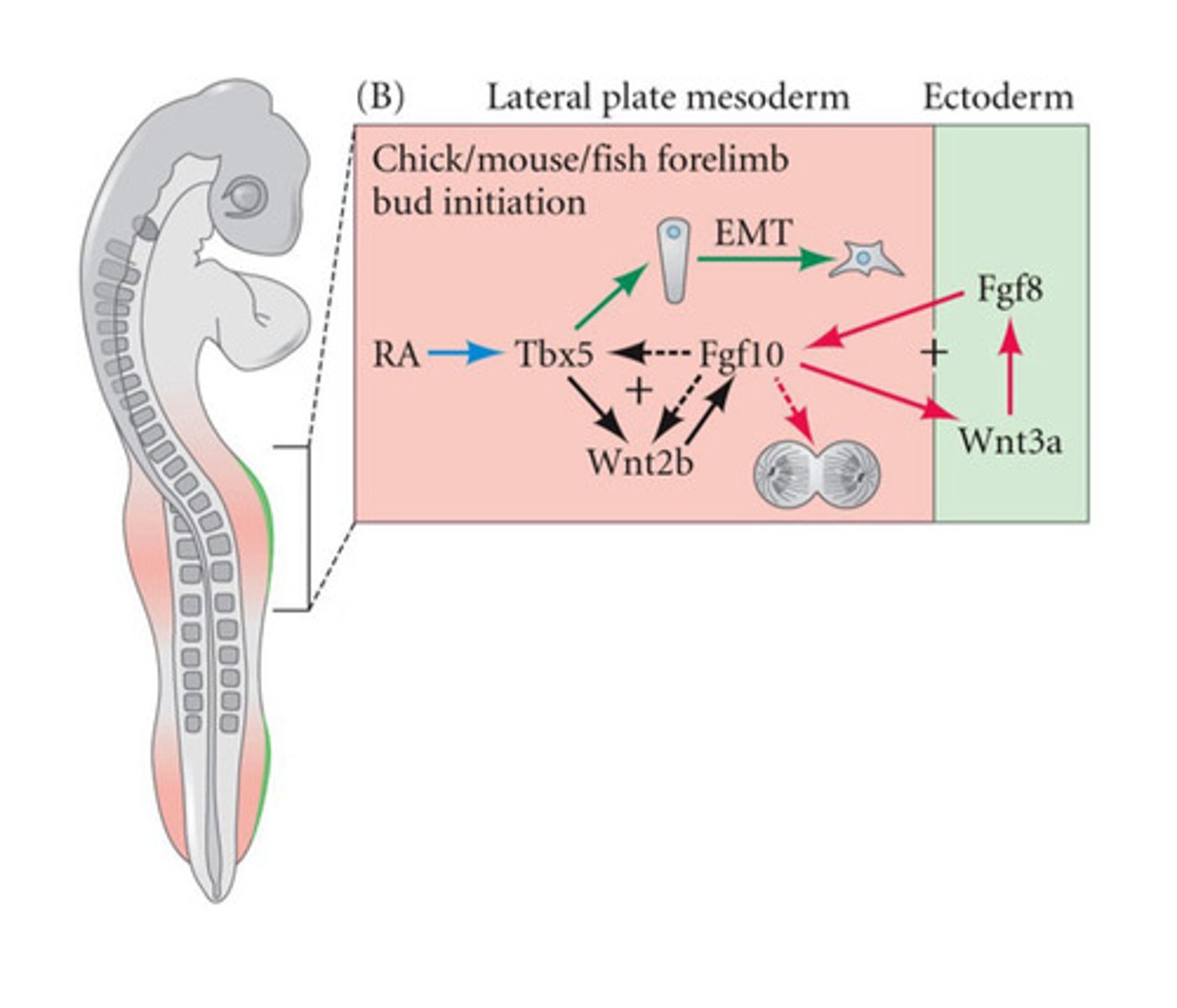
What are the 4 steps of limb initiation
1. Limb field positioning and size
2. Primary inducer
3. Cellular transition
4. Establishing the AER (second feedback loop)
Model for hindlimb field initiation
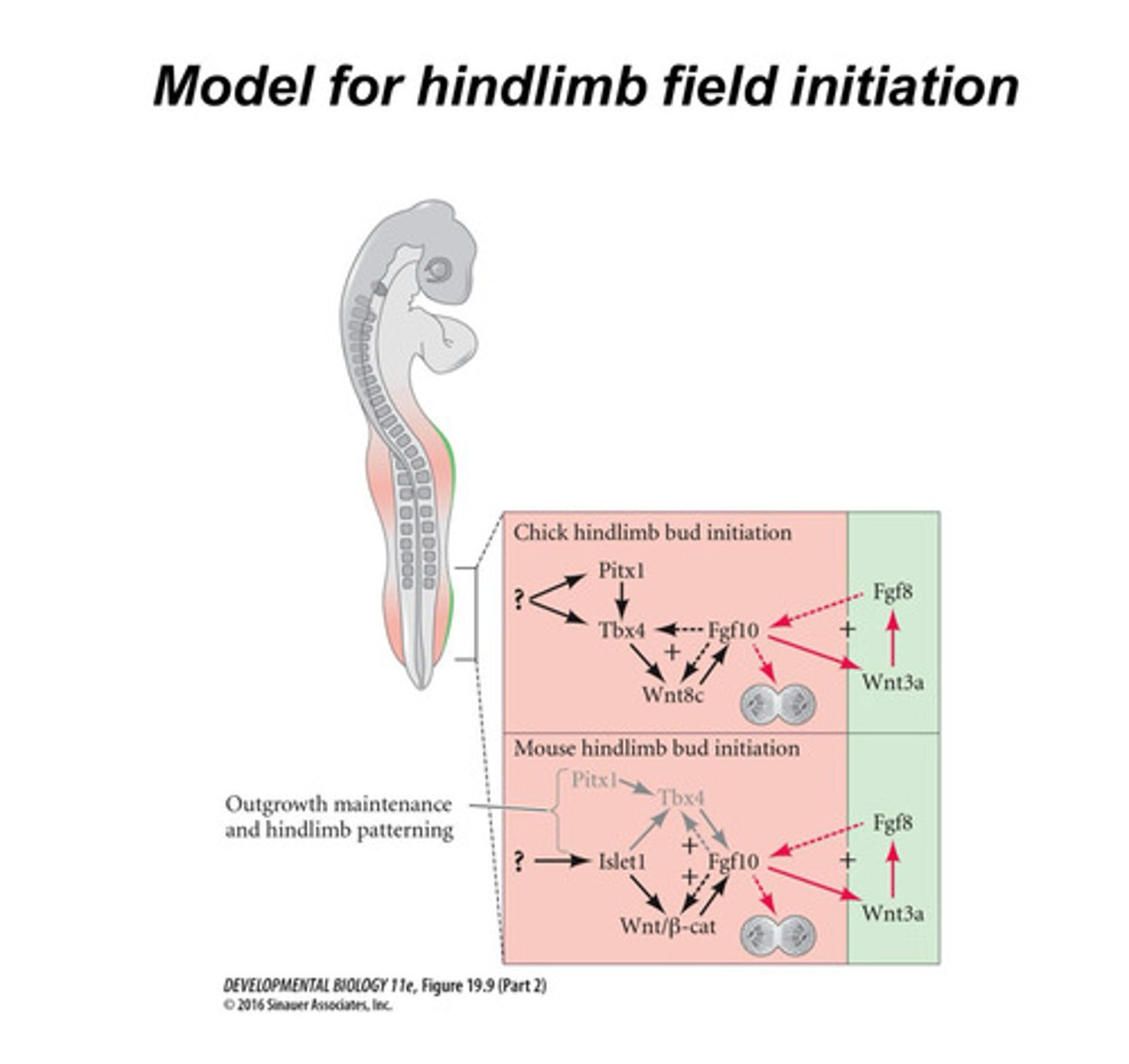
What specifies hindlimb identity
Transcription factors: Tbx4, Islet1 and Pitx1
(If you replace them the forelimb cam tale the identity of a hind limb )
Step 1 - what determines limb field position
- Somite specify the position and size of the limb field
- Antagonism between Fgf8 and Retinoic acid (RA) control forelimb field
Loss of RA —> failure of forelimb formation
Summary limb development along the proximal distal-axis
Limb bud development begins with the specification of the limb field, which determines the position and size of the limb. This is regulated by opposing signals such as Retinoic acid and FGF8.
Next, FGF10 acts as the primary inducer of limb bud formation in the mesenchyme. This is followed by an epithelial-to-mesenchymal transition (EMT), allowing cells to become migratory and form the early limb bud.
FGF10 signalling then induces Wnt signalling in the ectoderm, leading to the formation of the apical ectodermal ridge (AER).
Once established, the AER secretes FGF8, which maintains the underlying mesenchyme in a proliferative and undifferentiated state, driving limb outgrowth along the proximal-distal axis. The AER also forms a positive feedback loop with the zone of polarising activity (ZPA) to sustain growth and patterning.
Which gene is mutated in small patella syndrome
TBX4
- affects hindlimb development
Why are feedback loops important
Initiate limb development, establish AER, maintain limb outgrowth, stabilize patterning
How is the ZPA formed
The ZPA forms in the posterior mesenchyme of the limb bud. Posterior identity signals restrict this region to one side of the limb bud, allowing a group of cells there to become the Zone of Polarising Activity.
How is Shh expression established
Shh is switched on in the posterior mesenchyme where the ZPA forms. Once expressed, Shh helps maintain its own activity through interaction with Fgf8 from the apical ectodermal ridge.
How is limb outgrowth stopped
Limb outgrowth stops when the AER begins to regress and Fgf8 expression decreases. Without Fgf8, Shh can no longer be maintained, and the limb stops growing.
What stops the Fgf8/Shh positive feedback loop
The loop stops when Fgf8 expression declines in the AER. This leads to loss of Shh expression in the ZPA, reduced cell proliferation, and the end of limb elongation.
Transplantation of an extra Apical Ectodermal Ridge to a chicken forelimb bud results in?
Duplication of the wing. Induces ectopic Shh
The position of a chicken forelimb is determined by..
Antagonism between Fgf8 and RA
What controls the formation of AER
Positive feedback loops in forfeliomb development of the mouse
What is the significance of feedback loops during limb development.
Inititiate limb development, initiate AER and maintain the...
Why are many developmental processes controlled by a combination of transcription factors and signalling molecules?
TF are very powerful and can change cell type. Signalling molecules induce changes in gene transcription by controlling TF. TF activity need to be regulated
Despite a common pattern of bone formation, mammals exhibit a particularly wide array of limb morphologies. For example, whales have extremely long fingers in the forelimb but only rudimentary hindlimbs. Using your knowledge on the role of signalling molecules in limb development, explain the limb morphologies of the whale
All tetrapod limbs develop using the same basic signalling pathways, including Fgf8 from the apical ectodermal ridge (AER) and Shh from the Zone of Polarising Activity (ZPA). Differences in limb morphology arise from changes in how long and where these signals are active.
In whales, the AER is maintained for a longer period in the forelimb. Prolonged Fgf8 signalling keeps the mesenchyme proliferative for longer, resulting in extended growth of the digits and therefore very long fingers. In contrast, hindlimb development is reduced because signalling required for limb outgrowth, such as Fgf10, Fgf8, and Shh, is downregulated early. This leads to reduced limb bud growth and rudimentary hindlimbs.
Thus, changes in the duration and strength of signalling pathways, rather than new genes, explain the specialised whale limb morphology.
As an expert in limb development, you are contacted by a clinician who takes care of a patient with Small Patella syndrome, a skeletal dysplasia characterized by patellar aplasia or hypoplasia and by anomalies of the pelvis and feet, including disrupted ossification of the ischia. What can you tell him about potential genetic causes of this syndrome? What are potential candidate genes
Small Patella syndrome primarily affects the hindlimb, including the patella, pelvis, and feet. Since hindlimb identity and development are controlled by specific transcription factors, the most likely candidate gene is TBX4, which plays a key role in hindlimb specification. Other hindlimb-associated transcription factors such as PITX1 could also be considered candidates, but TBX4 is the strongest candidate because of its central role in hindlimb development.
In patients with Small Patella syndrome mutations affect the TBX4 gene. Which type of mutation would you expect (heterozygous vs homozygous; nonsense mutations, missense mutations etc.)?
Since the limb is still present but malformed, the mutation is likely heterozygous rather than homozygous. A complete loss of TBX4 would likely cause more severe defects or embryonic lethality. Small Patella syndrome is autosomal dominant and is typically caused by heterozygous missense mutations. These mutations alter protein function without completely eliminating it.
The genetic changes involved in Small Patella syndrome are heterozygous missense mutations in TBX4. Can you explain how these mutations cause malformations of the lower limb?
TBX4 is a transcription factor that specifies hindlimb identity and regulates genes required for proper hindlimb development, including those involved in limb bud initiation and patterning. Missense mutations change the structure of the TBX4 protein, reducing its ability to regulate target genes correctly.
As a result, hindlimb identity and patterning are disrupted. This leads to defects in structures that depend strongly on proper TBX4 function, such as the patella, pelvis, and parts of the foot. Because one normal copy of the gene remains, limb formation still occurs, but development is incomplete or abnormal