last bio eco exam
 Call Kai
 Learn
Learn Practice Test
 Spaced Repetition
 Match
Match Flashcards
 Knowt Play
1/104

There's no tags or description
Looks like no tags are added yet.
Name | Mastery | Learn | Test | Matching | Spaced | Call with Kai |
|---|
No analytics yet
Send a link to your students to track their progress
105 Terms
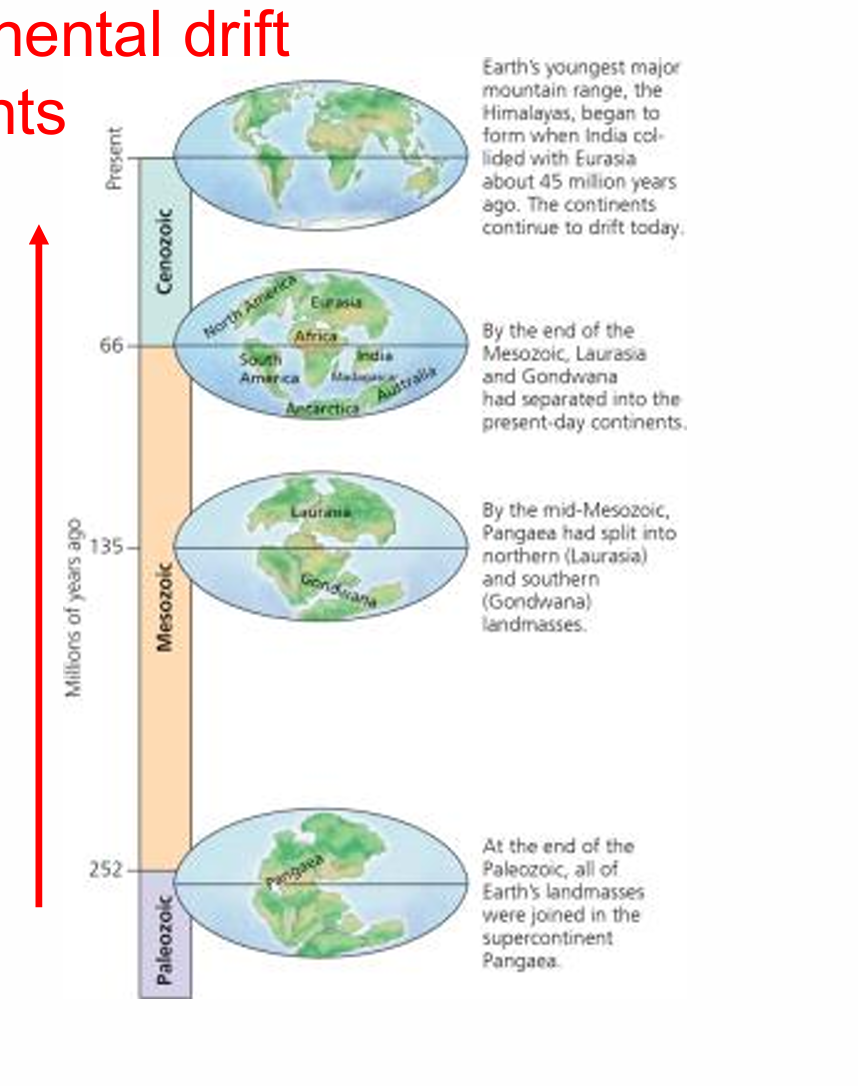
what is continental drift?
Plate tectonics with continental drift ‘reorganized’ the continents
The movement of tectonic plates on the surface of the earth reconfigurated the landmasses throughout geological history
lead to biogeographic regions
what is biogeography
The study of patterns of species composition and richness across geographic locations
species richness and composition vary with latitude
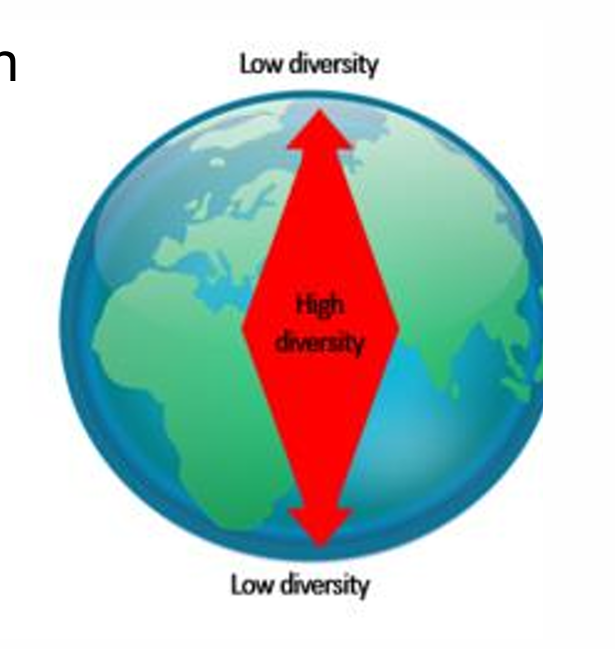
global biogeography
global patterns of species richness and composition are influenced by geographic area and isolation, evolutionary history, and global climate
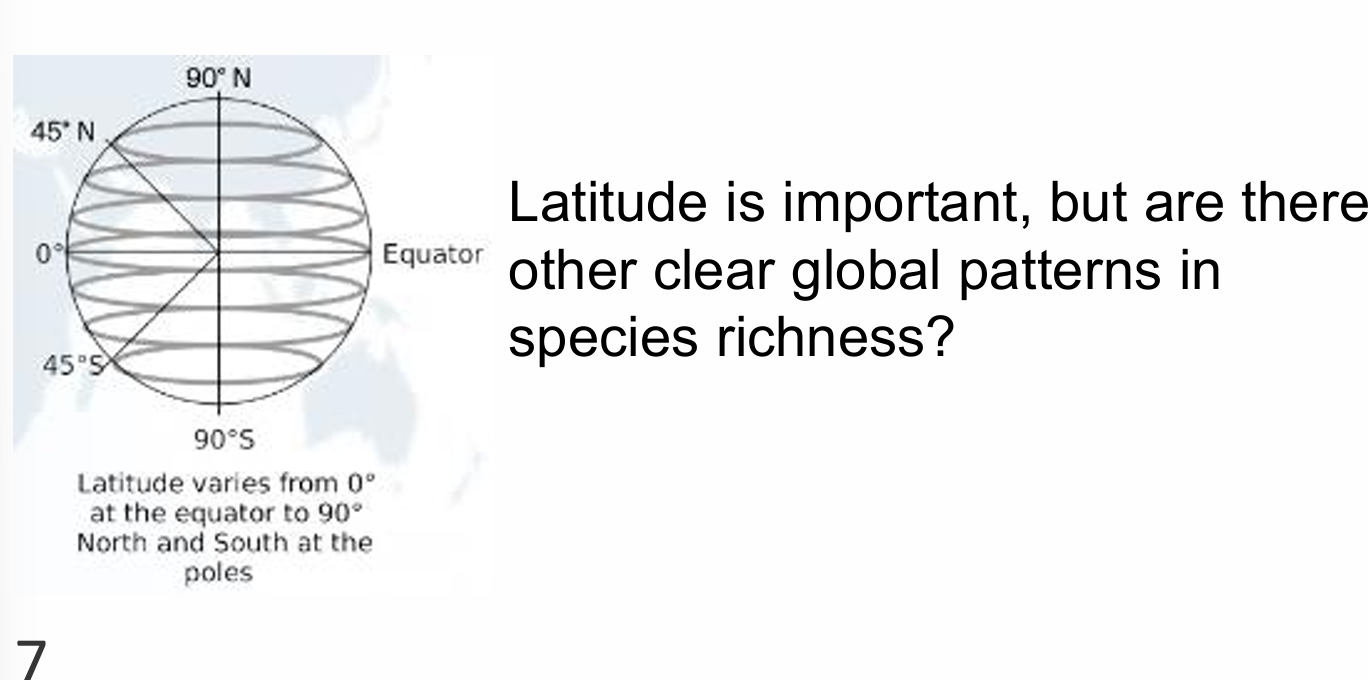
latitude and species richness relationshsip
The Core Pattern
Equator: Species richness peaks in tropical regions.
Poles: Species richness declines steadily toward both poles
Primary Drivers
Solar Energy: More sunlight fuels higher plant productivity.
Climate Stability: Predictable tropical climates lower extinction rates.
Geographical Area: Large, continuous tropical zones support bigger populations.
Evolutionary Time: Tropical ecosystems are older and had more time to diversify. [1, 2, 3, 4, 5]
![<p>The Core Pattern</p><ul><li><p><span><strong>Equator</strong>: Species richness peaks in tropical regions.</span></p></li><li><p><span><strong>Poles</strong>: Species richness declines steadily toward both poles</span></p></li></ul><p></p><p>Primary Drivers</p><ul><li><p><span><strong>Solar Energy</strong>: More sunlight fuels higher plant productivity.</span></p></li><li><p><span><strong>Climate Stability</strong>: Predictable tropical climates lower extinction rates.</span></p></li><li><p><span><strong>Geographical Area</strong>: Large, continuous tropical zones support bigger populations.</span></p></li><li><p><span><strong>Evolutionary Time</strong>: Tropical ecosystems are older and had more time to diversify.</span> [1, 2, 3, 4, 5]</p></li></ul><p></p>](https://assets.knowt.com/user-attachments/418e1068-362c-41a7-a012-b82e8fda9dce.png)
dispersal rates in the poles
If we assume dispersal rates are similar everywhere, then species Richness should reflect a balance between Extinction and Speciation.
Species diversification rate = Speciation rate – Extinction rate
Speciation rate is the speed at which new, distinct biological species evolve from existing populations over a given period of time.
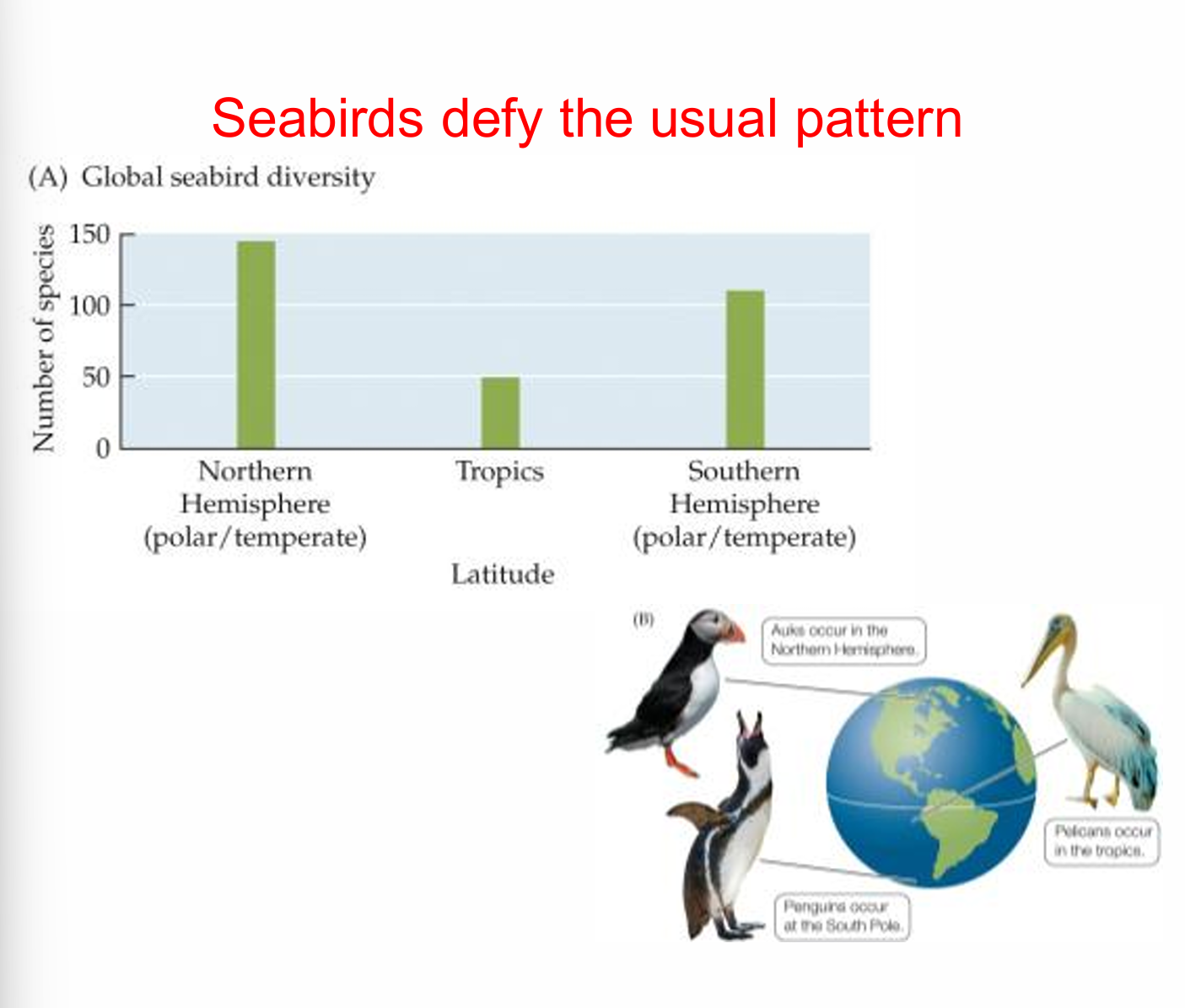
why are seabirds an exception to the usual pattern of latitude and species richness trend
Some groups, like penguins, seabirds, and certain conifers, thrive in colder regions.
seabird species richness peaks at high latitudes (the poles) rather than the equator (the tropics).
when is speciation most likely to occur?
Large, thermally stable areas → Lower extinction rates + Larger population sizes and geographic ranges → Speciation is more likely to occur
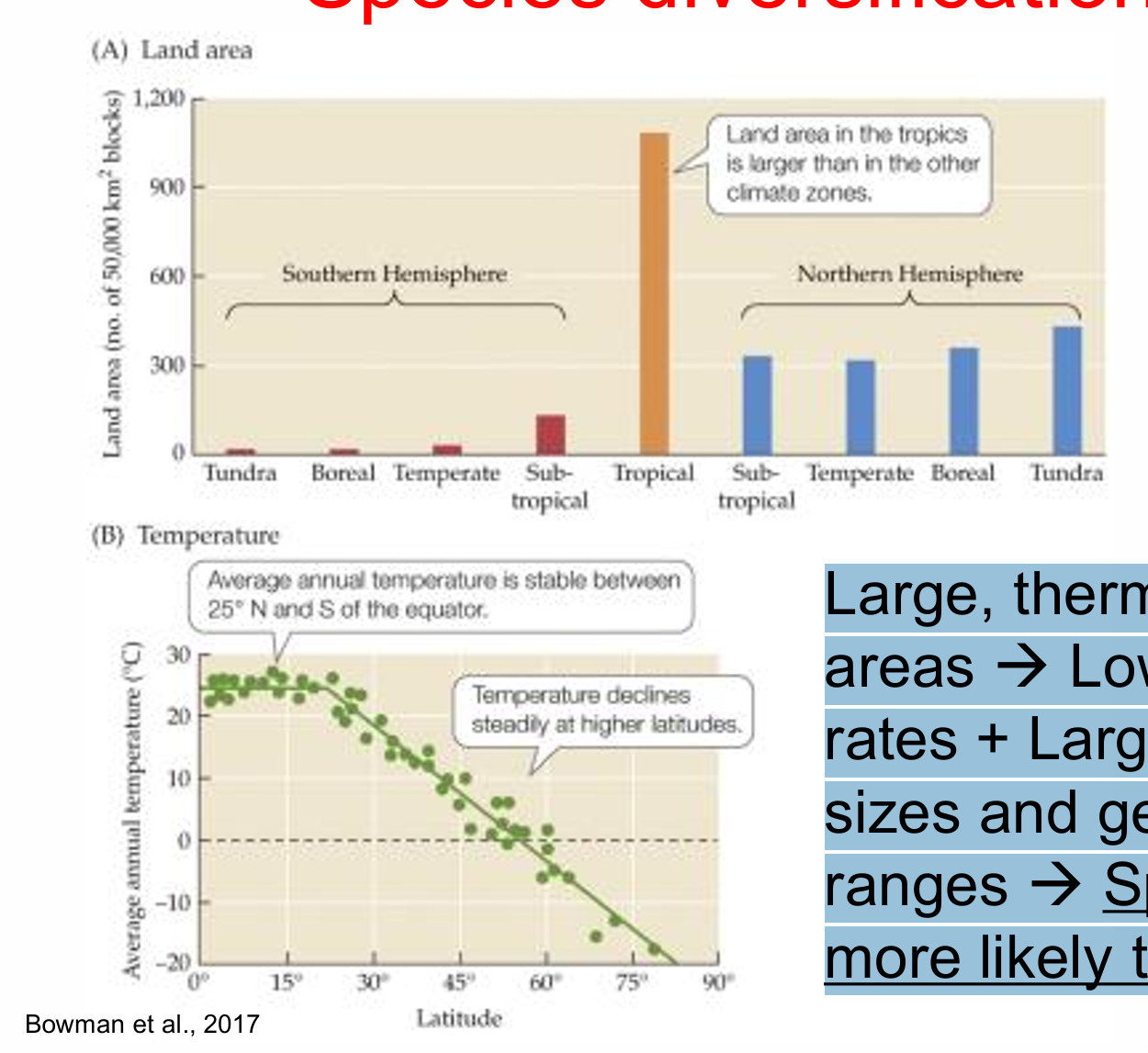
where is terrestrial productivity the highest
High productivity → Larger carrying capacities → Larger population sizes → Lower extinction rates Productivity could also explain the reverse pattern seen in sea birds:
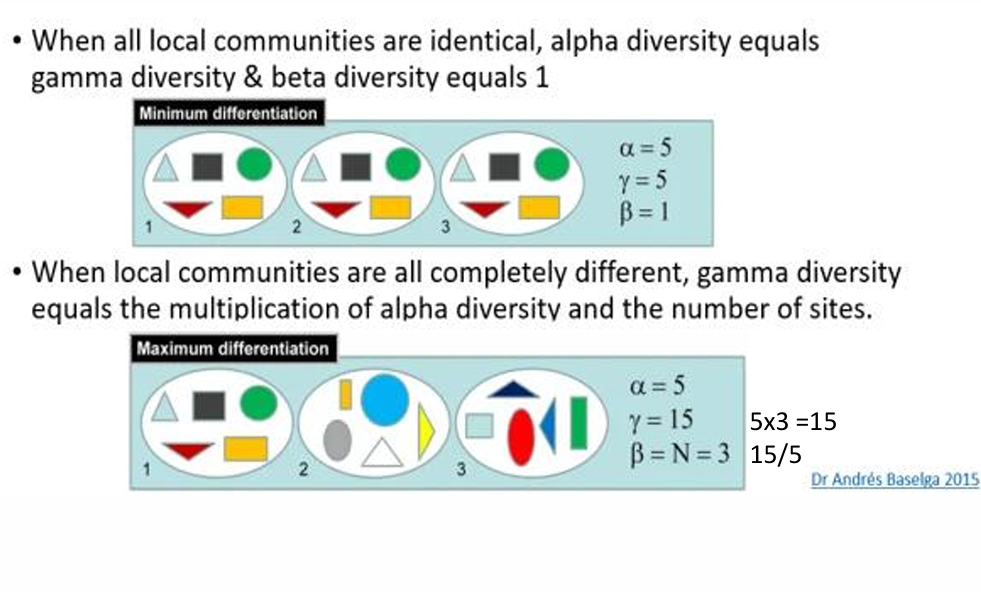
what is alpha diversity
The number of species in a commnity define in an area
ex:
number of fish species in a lake in California
what is gamma diversity
Richness over a larger geographic area.
ex:
Number of fish species in all lakes in California.
Can compare the number of fish species in Californian lakes versus the number of fish species in the lakes in Oregon
what is beta diversity
Relates alpha to gamma diversity. Represents the rate of change of species composition among an environment or geographic gradient.
= gamma / average alph
what are biodiversity indexes
for three regions, each consisting of three separate mountains.
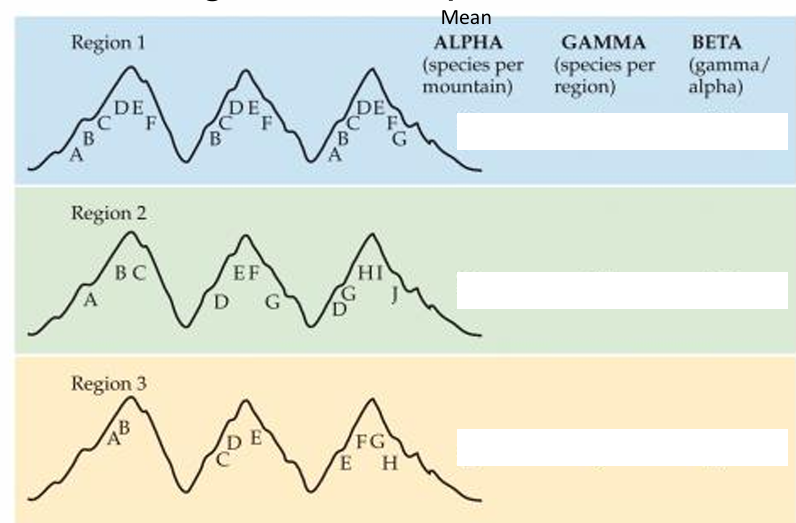
what are the levels in composition =
what is island biogeography
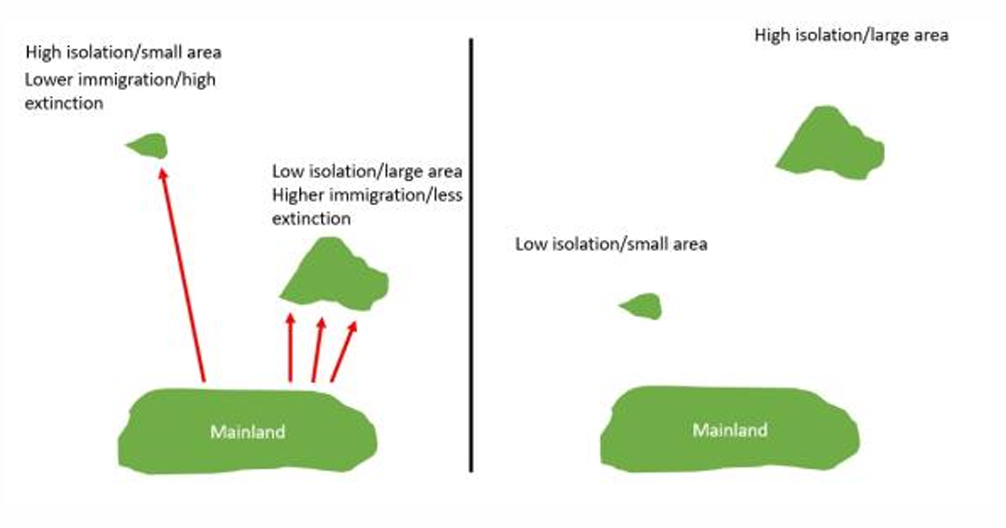
a field in ecology that explains how the size of an island and its distance from a mainland determine its total species richness.
The Two Driving Forces
Immigration Rate: Controlled by Isolation (Distance).
Low Isolation (Near): Islands close to the mainland receive many colonizing species.
High Isolation (Far): Remote islands are hard to reach, resulting in lower immigration rates.
Extinction Rate: Controlled by Island Area (Size).
Large Area: Bigger islands offer more resources and diverse habitats. They support larger populations, leading to less extinction.
Small Area: Tiny islands have limited resources. They support small populations that are highly vulnerable to high extinction.
what is the biosphere
All the ecosystems on Earth
what is the ecosystem?
1. Biotic and abiotic components of an ecological system that influence the flow of energy and elements.
2. A biological community plus all the abiotic factors influencing that community
Primary producers or autotrophs.
Can use sun energy, CO2, H2O and other inorganic substances to produce glucose, other organic materials and ATP
Consumers or heterotrophs.
Obtain energy from producers or from other consumers.
Decomposers
Secrete enzymes that digest remaining organic molecules. Return nutrients to the environment
How do nutrients enter through ecosystems ?
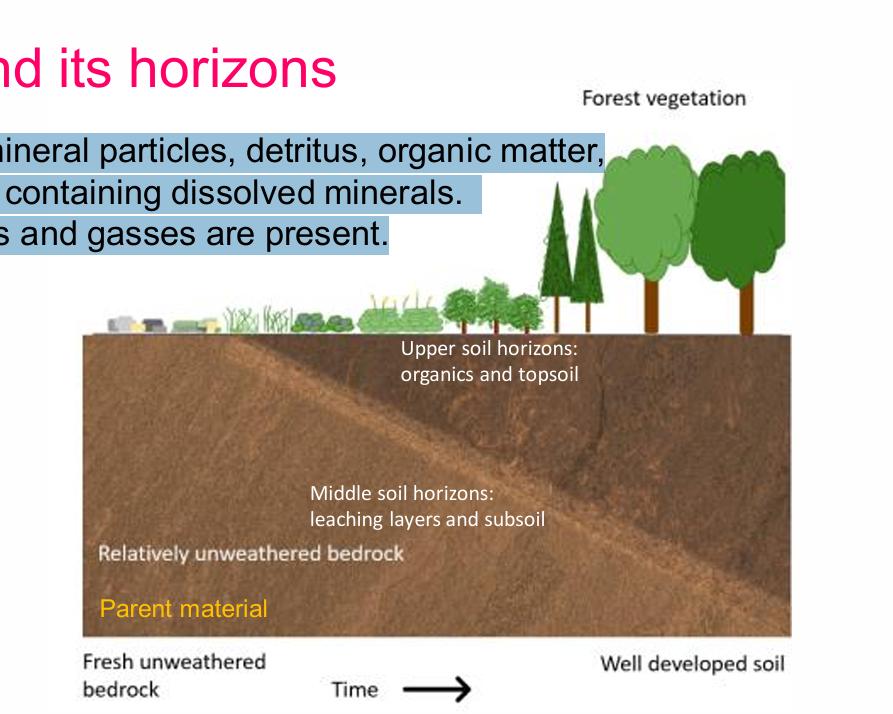
1. Chemical breakdown of minerals in rocks.
Mechanical weathering.
Chemical weathering.
2. Fixation of gases in the atmosphere.
what is Biogeochemistry
Study of the physical, chemical, and biological factors that influence movement and transformation of elements.
Understanding biogeochemistry is important in determining the availability of nutrients for life.
what does the soil consist of?
A mix of mineral particles, detritus, organic matter, and water containing dissolved minerals. Organisms and gasses are present.
what is Nutrient cycling
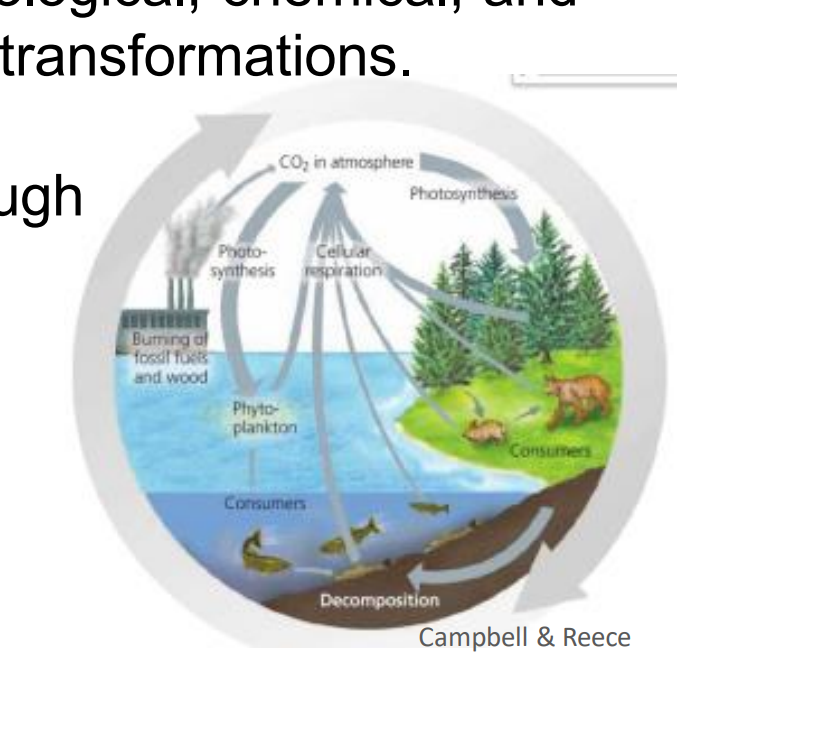
The movement of nutrients within ecosystems, as they undergo biological, chemical, and physical transformations.
what is biogeochemical cycles
Complex global-scale recycling of molecules on Earth, involving biological, chemical, and geological steps and transformations.
Molecules move through biotic and abiotic "compartments" of Earth.
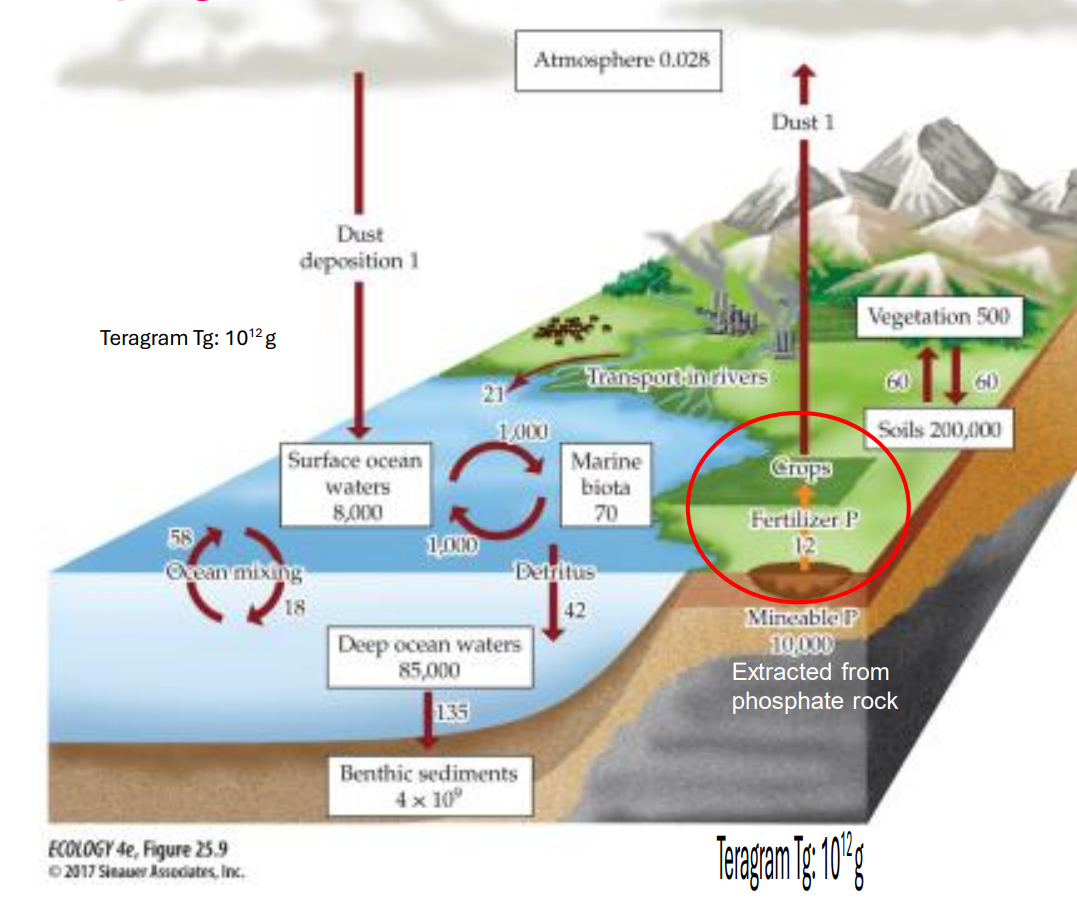
what is the phosphoric cycle?
The anthropogenic flux of the phosphorus cycle refers to the rate at which human activities mobilize phosphorus from stable geological reserves and accelerate its movement through the environment
ex: phosphate rock mining
consequences:
triggers explosive algal blooms, creating aquatic dead zones
what is the carbon cycle:
Autotrophs absorb atmospheric CO2 and use it in photosynthesis to produce organic compounds.
what is photosynthesis
6 CO2 + 6 H2O→ C6H12O6 + 6 O2
what is cellular respiration
releases CO2 back to the atmosphere
C6H12O6 + 6 O2 6 CO2 + 6 H2O + ATP
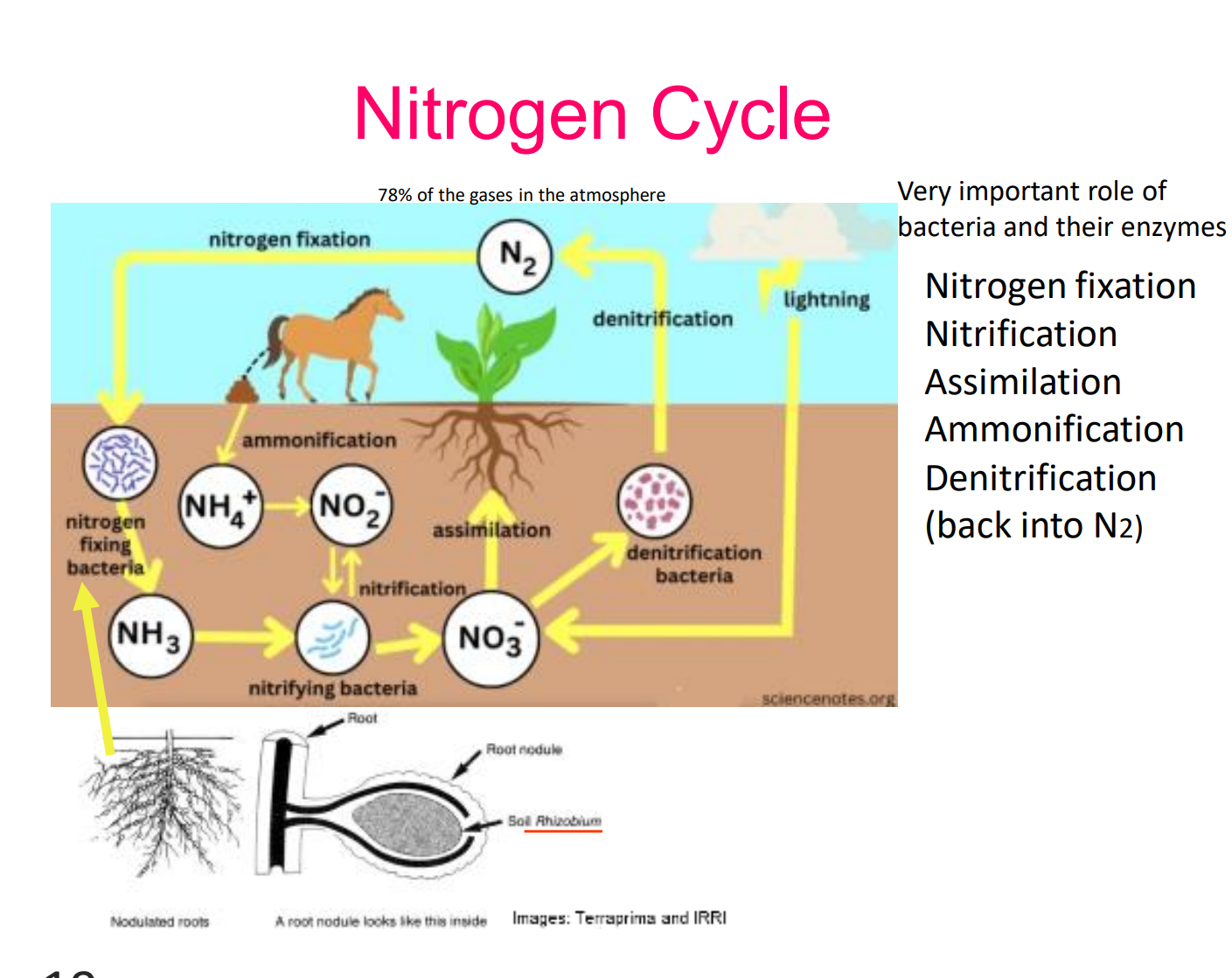
what is the nitrogen cycle?
nitrogen fixation: Specialized nitrogen-fixing bacteria (shown interacting with root nodules at the bottom, labeled Soil Rhizobium) convert atmospheric N2 gas into ammonia NH3
nitrification: NH3 is converted by nitrifying bacteria into ammonium(NH4+), the nitrite (NO2-) the nitrate (NO3-)
assimilation: plants use nitrogen through roots, create building molecules through it, and then it is acquired by animals that eat roots
denitrification: roots takes remaining nitrate in the soil and converts back into nitrogen gas and into the air
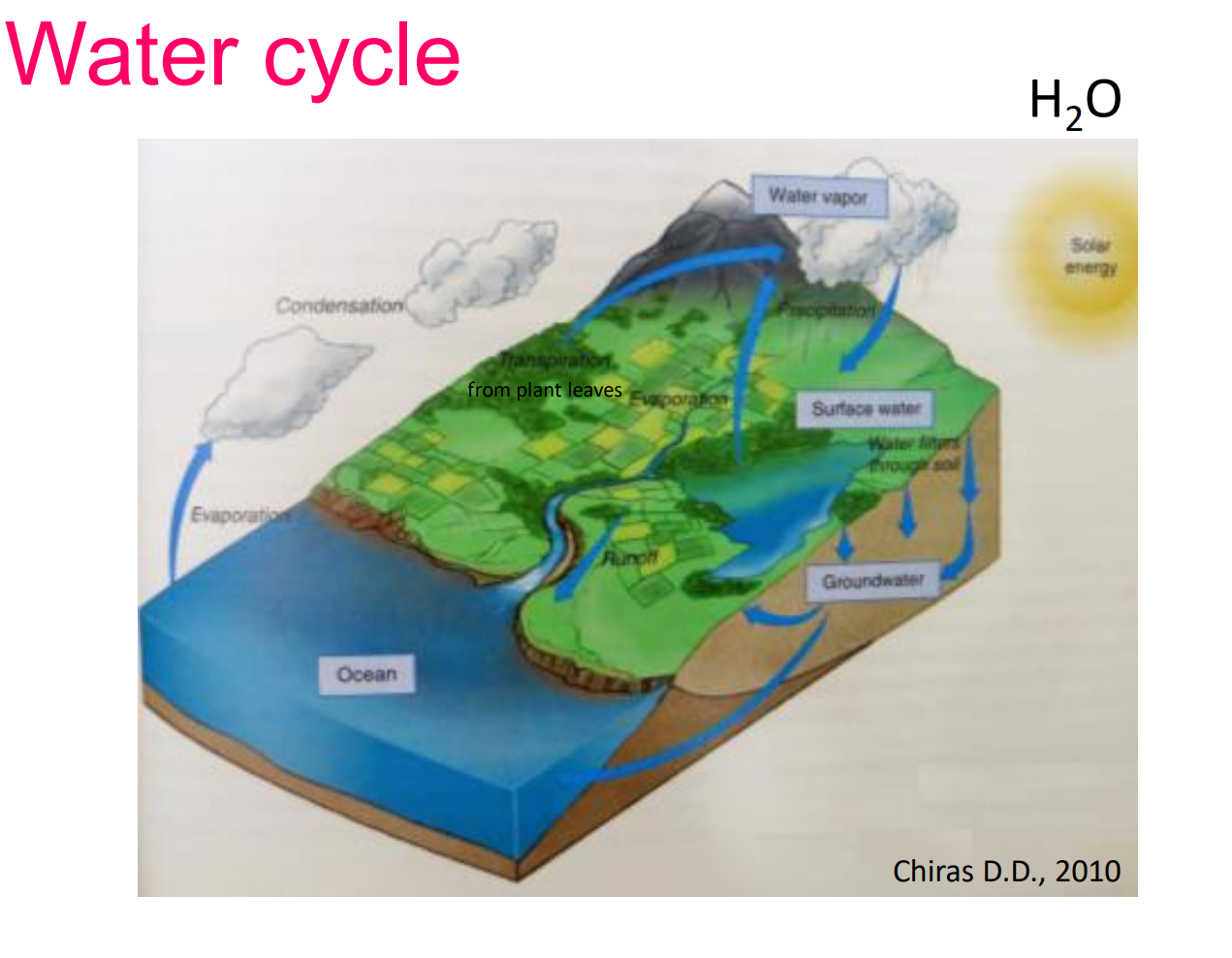
the water cycle
driving force solar energy heats the earth
evaporation, water turns into gas, rises from the ocean and through transpiration, where water evaporates from plant leaves
condensation: water vapor cools down, forming clouds, then accumulates near mountains (water vapor)
precipitation: rain or snow falls
water collects on landscapes
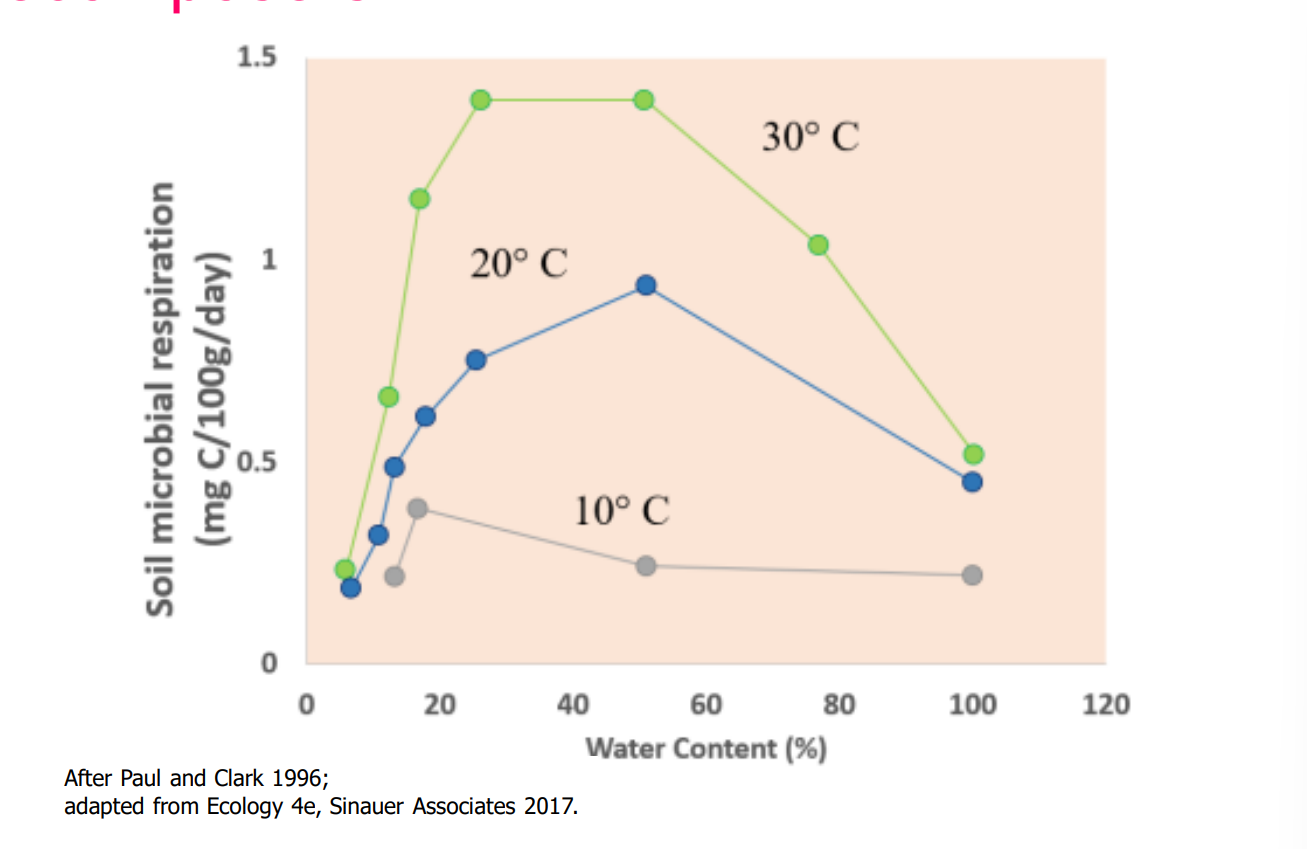
how do Abiotic factors control the activity of decomposers
temperature and water content (soil microbial respiration) work together to determine the rate of decomposition
High heat increases decomposer respiration, microbial activity is suppressed at cold temps
when optimal moisture is reached respiration peaks
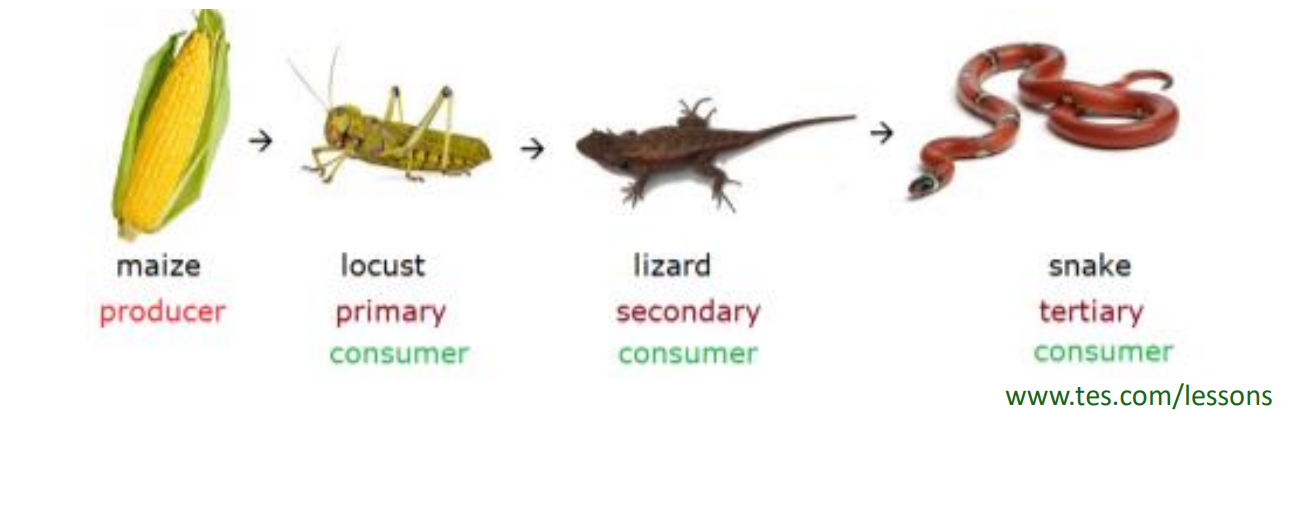
are food chains realistic?
no!!!! Linear transference of matter and energy from a trophic level to the next one(s) with no other trophic interactions.
wood webs are more realistic for how complex they can be!!
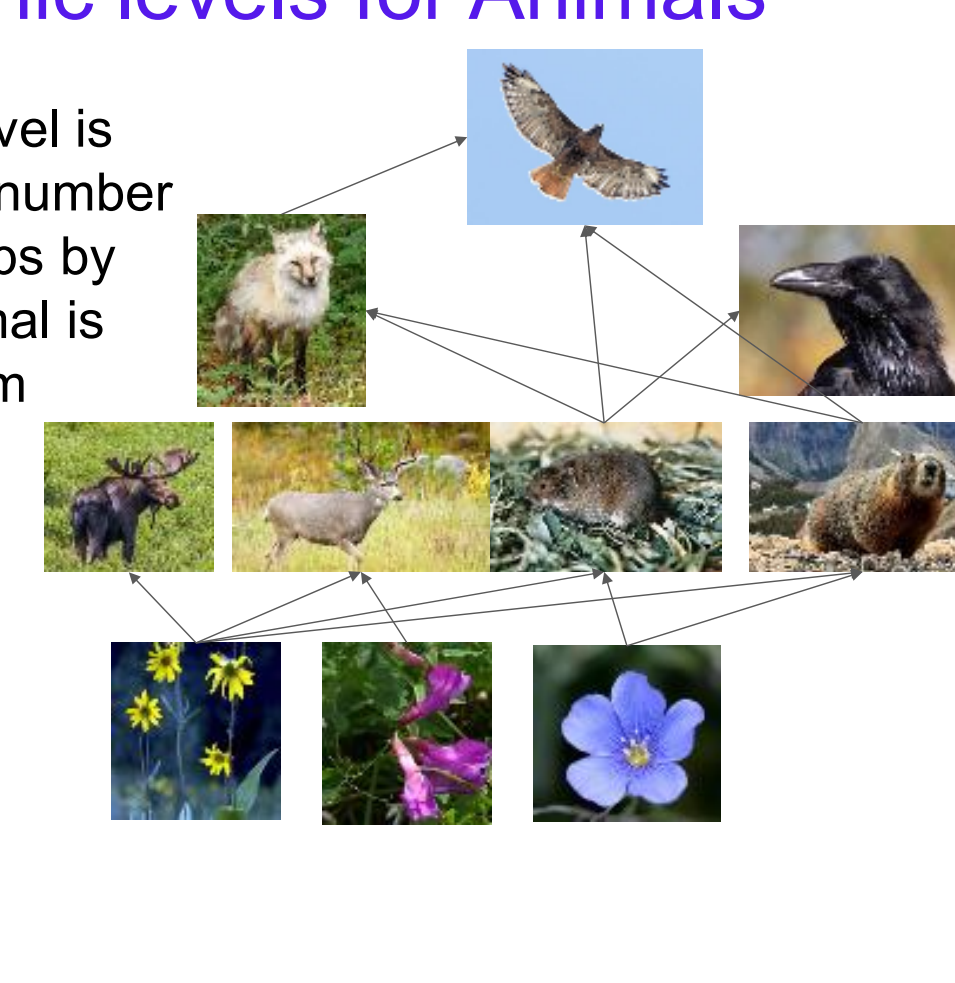
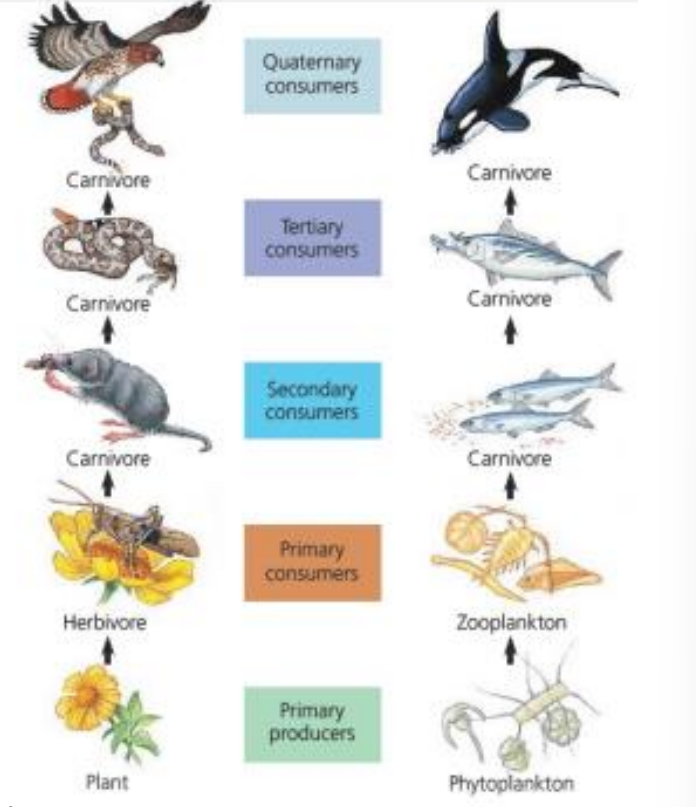
what are trophic levels for animals
The trophic level is based on the number of feeding steps by which an animal is separated from autotrophs.
what is trophic efficiency?
The amount of energy transferred from one trophic level to the next one.
Amount of energy at one trophic level divided by amount of energy at the trophic level immediately below it. Typically 10% or 0.1 = 10% Rule
Available energy decreases with each trophic level. Units: Kilocalories, calories, kilojoules, or even biomass
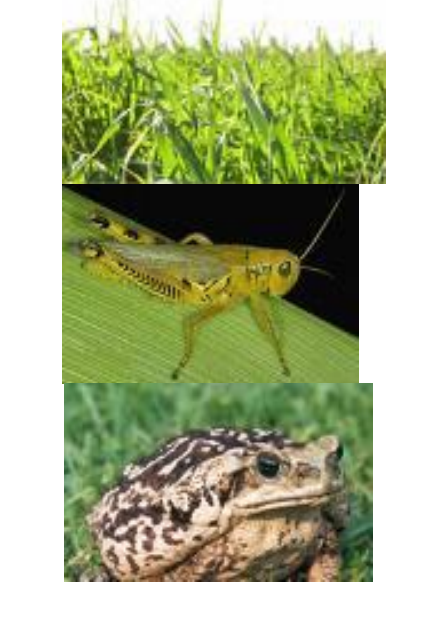
In a simple food chain, grass is consumed by grasshoppers, and grasshoppers are consumed by toads. If you have 100 kg of grass, predict what mass of toads would be supported?
a) 10 Kg b) 100 Kg c) 1,000 g d) 1 Kg e) Both c and d
10% of 100kg = 10kg
10% of 10kg= 1kg
therefore both c and d, because 1kg=100g
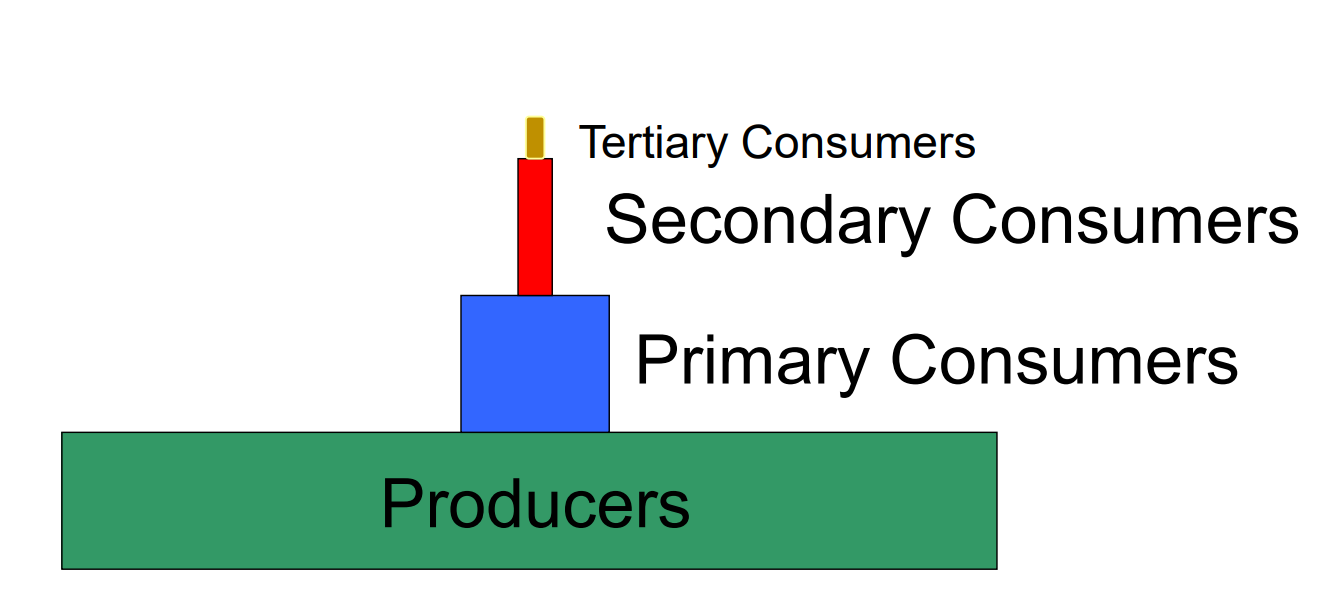
what is the trophic pyramid
Only about 10% of the energy or biomass from one level is successfully transferred up to the next.
The remaining 90% is lost as metabolic heat, used for daily survival, or left behind as undigested waste.
Biomass: If we follow the 10% rule, producing 1 g of primary consumer biomass requires 10 g of producers.
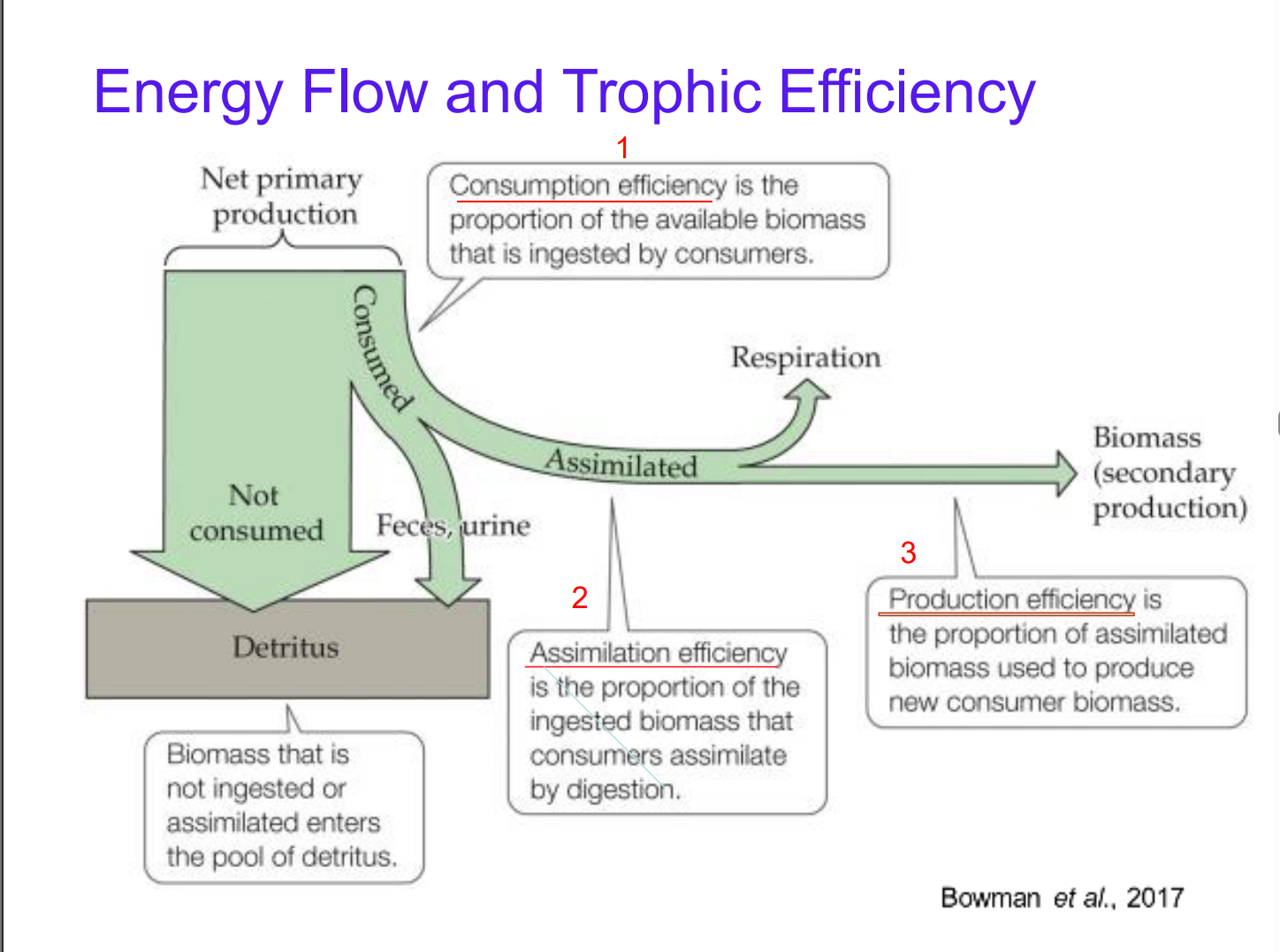
What is energy flow and trophic efficiency
1.Consumption Efficiency
Definition: The proportion of available biomass that consumers actually ingest or eat.
Assimilation Efficiency
Definition: The proportion of ingested food that the consumer's digestive system successfully absorbs.
Production Efficiency
Definition: The proportion of assimilated energy
how energy moves through a food chain and how efficiently organisms at one level convert food into their own biomass.
what is trophic cascade
Changes in the abundances of organisms or rate of consumption at one trophic level can influence energy flow, composition, and abundance at lower trophic levels
what is trophic efficiency
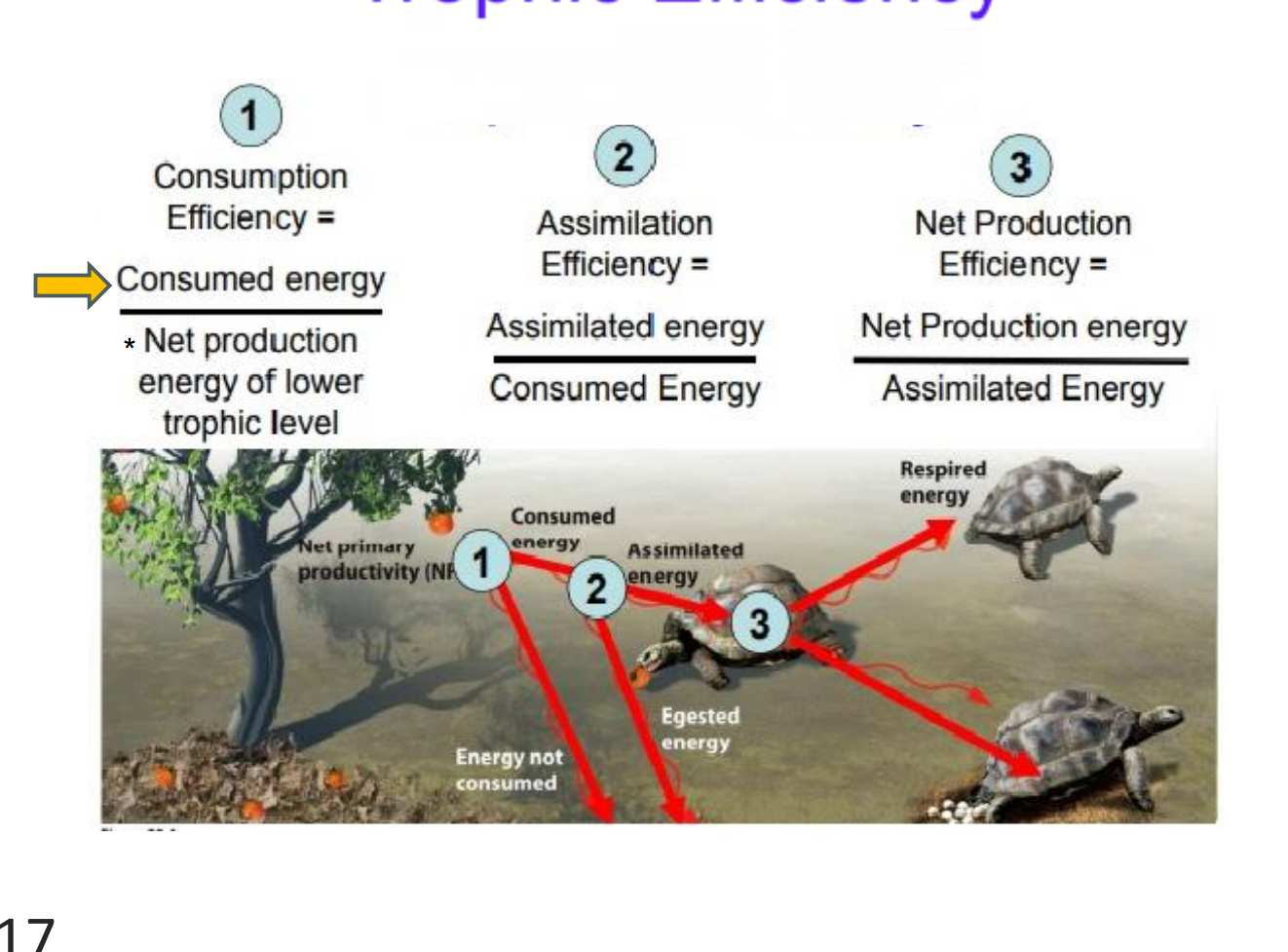
Consumption Efficiency: (consumed energy/ net production of lower trophic level)
Measures the percentage of available food from the previous level (e.g., the tree's fruit) that the consumer actually eats. The rest is energy not consumed.
Assimilation Efficiency: (assimilated/ consumed energy)→ Measures how efficiently the consumer digests what it ate. Food that cannot be digested is lost as waste (egested energy).
net production efficiency: (net production energy/ assimilated energy)
Measures how much of the digested food is turned into new body growth (biomass). A significant portion of assimilated energy is lost to metabolic processes (respired energy).
Humans as a species in ecosystems are known as what?
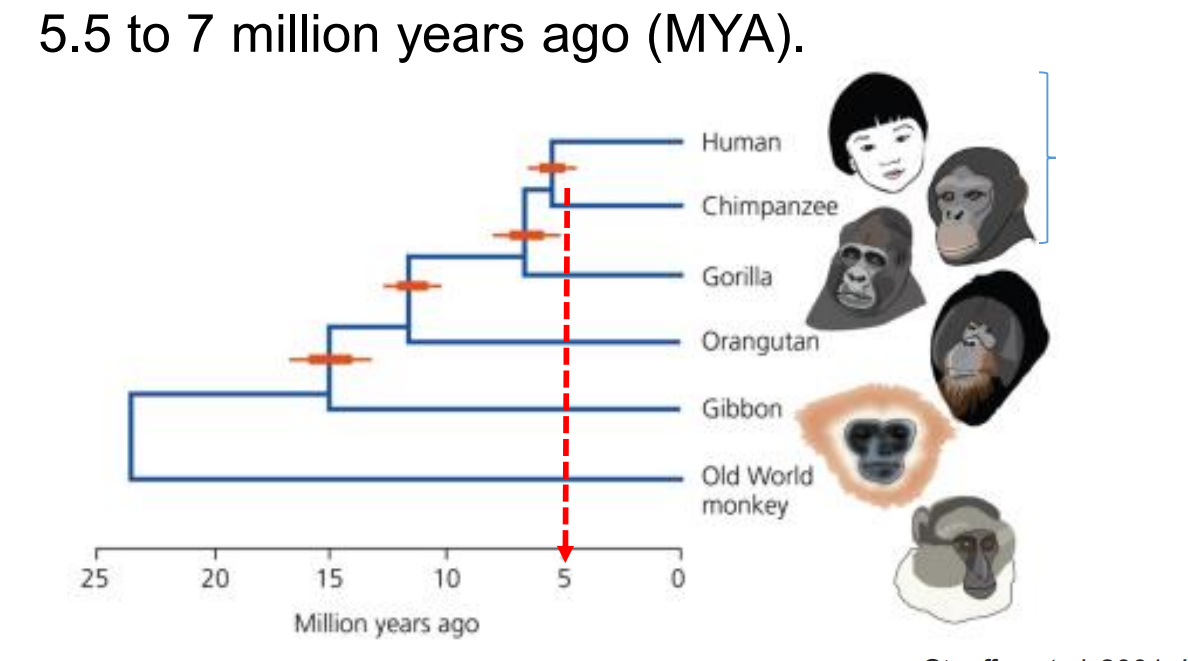
Hominins, the clade that includes Homo sapiens and extinct 'humans', arose around 5.5 MYA.
what is bottom-up vs top-down control?
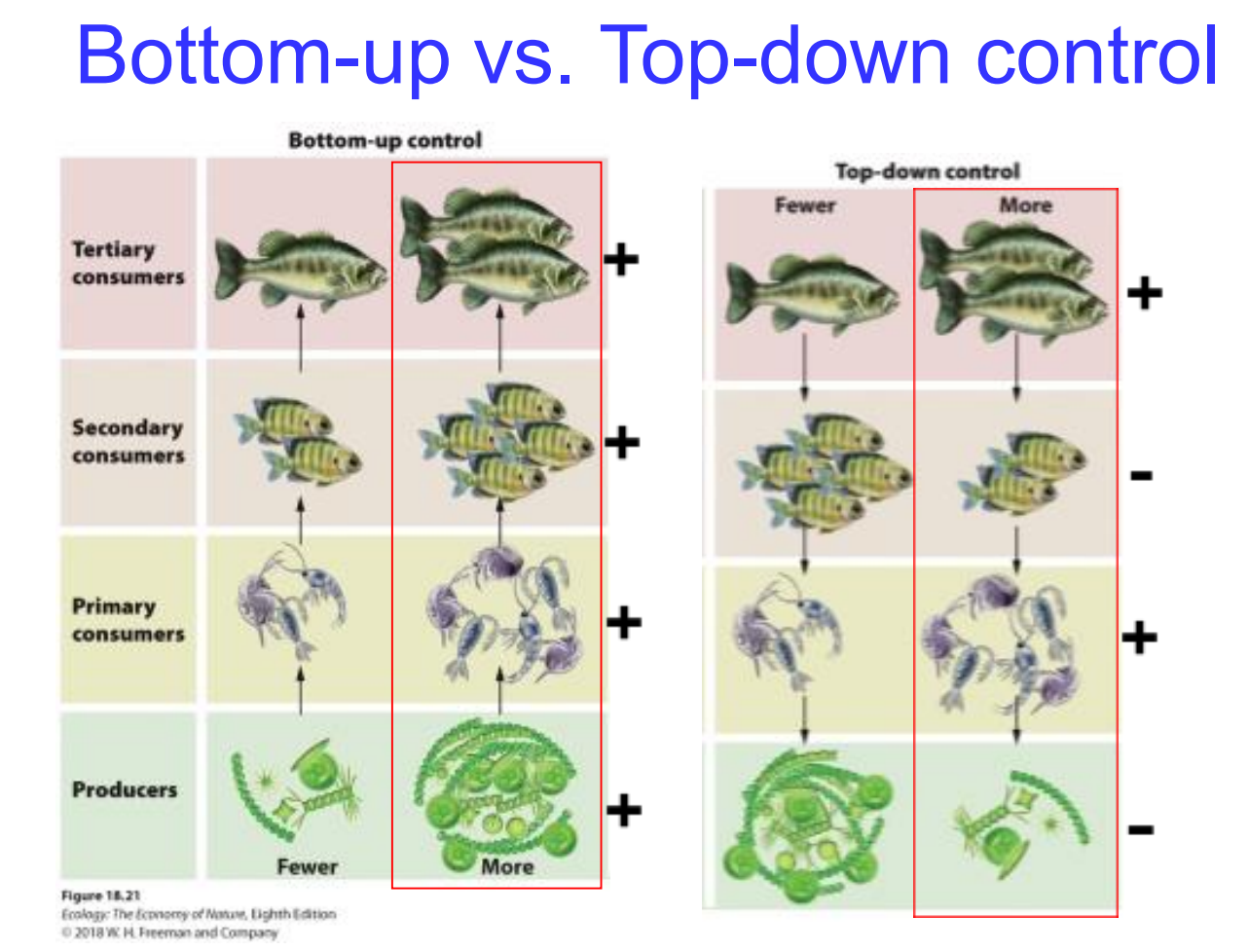
In bottom-up control, the ecosystem is regulated by the availability of resources at the base of the food chain (Producers/Nutrients)
If you add "More" producers (+), it creates a positive ripple effect:
More primary consumers can feed
More secondary consumers can feed
More tertiary consumers can feed
In top-down control, the ecosystem is regulated by predation from the top predators (Tertiary consumers).
what does age phylogeny suggest?
Fossil-calibrated molecular clock data suggest that the human and chimpanzee lineages split 5.5 to 7 million years ago (MYA)
what are Homo sapiens
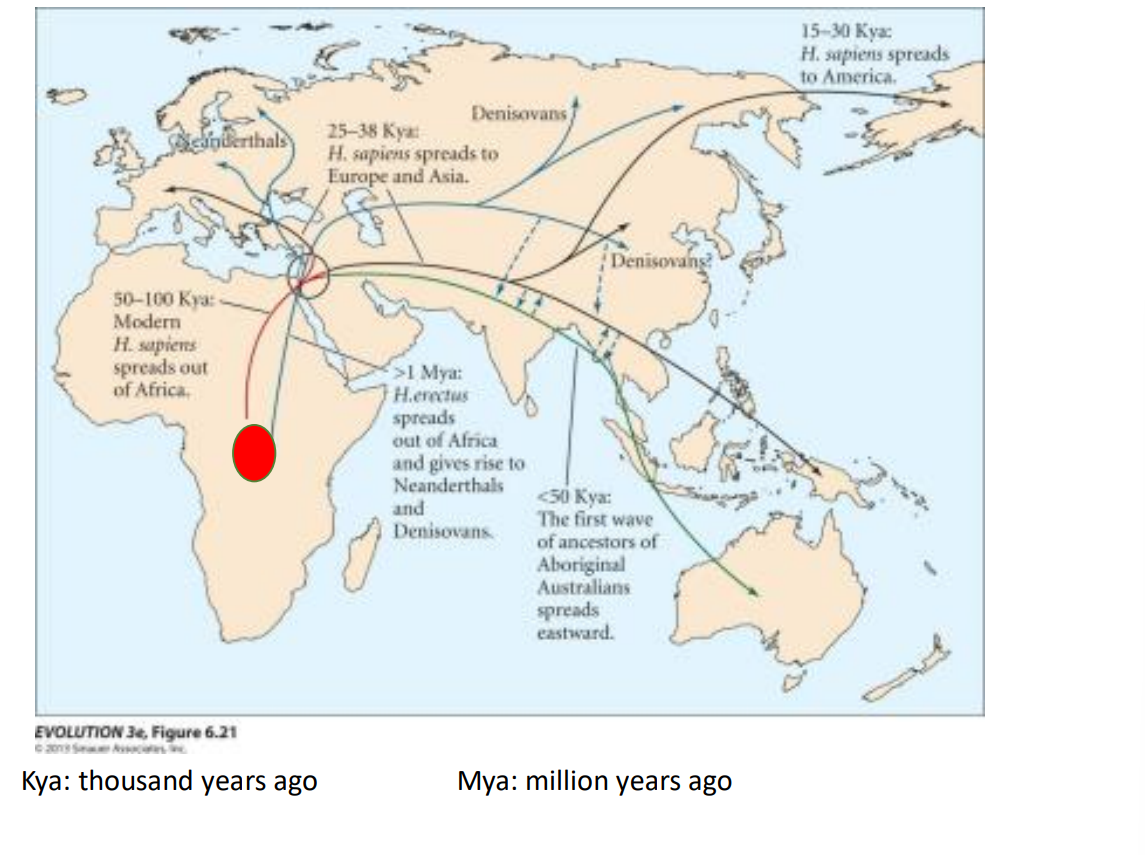
By ~ 0.2 million years ago (200,000 years), anatomically modern humans existed.
Spread of humans from Africa to other parts of the world
what resources do humans need?
O2, freshwater, and nutrients.
Main crops in the world
• Corn (maize)
Wheat • Rice •
Potato • Soybean •
Oat • Cotton •
Sugar cane • Canola
Main animal species consumed by humans
• Pig • Caw (beef, veal) • Chicken (poultry) • Sheep •
Goat • Fish • Buffalo • Tuna, tilapia, salmon
Europeans
A general anthropocentric (human-centered) view of nature led to the exploitation and degradation of vast resources in the regions colonized by European countries from the sixteenth century onward.
The needs and traditional uses of non-European native peoples were largely disregarded.
European origins
However, an important element of the conservation movement did develop in Europe (18th and 19th centuries), based on experiences of scientific officers trained to make observations on biology, natural history, geography and anthropology of the colonial regions.
what are the roles american presidents in Conservation
ex: Yellowstone National Park
First national park in the US. Established in 1872 by Ulysses S. Gran
Theodore Roosevelt (1901-1909) established the first national wildlife refuge and expanded federal lands for conservation
what is conservation biology
Integrated, multidisciplinary scientific field that has developed in response to the challenge of preserving species and ecosystems.
what are the important goals of conservation biology
1. To document the full range of biological diversity on Earth.
2. To investigate human impacts on species, genetic variation, communities and ecosystems.
3. To develop practical approaches to prevent the extinction of species, maintain genetic diversity within species, and protect and restore biological communities and their associated ecosystem functions.
what are the ethical principles of conservation biology
The diversity of species and ecosystems should be preserved.
The untimely extinction of populations and species should be prevented.
Ecological complexity should be maintained.
Evolution should continue.
*Biodiversity has intrinsic value.
what are the major threats to biodiversity are the result of human activities?
1.Habitat Alternation
Habitat loss: Complete destruction of natural environments.
Habitat fragmentation: Breaking large habitats into smaller, isolated patches.
Habitat degradation: Lowering habitat quality, which explicitly includes pollution.
2.Overexploitation
The unsustainable harvesting or over-hunting/fishing of species.
3.Climate Change
Global shifts driven heavily by industrial activities and fossil fuel use.
Invasive Species and Disease
The introduction of non-native species and pathogens into new ecosystems.
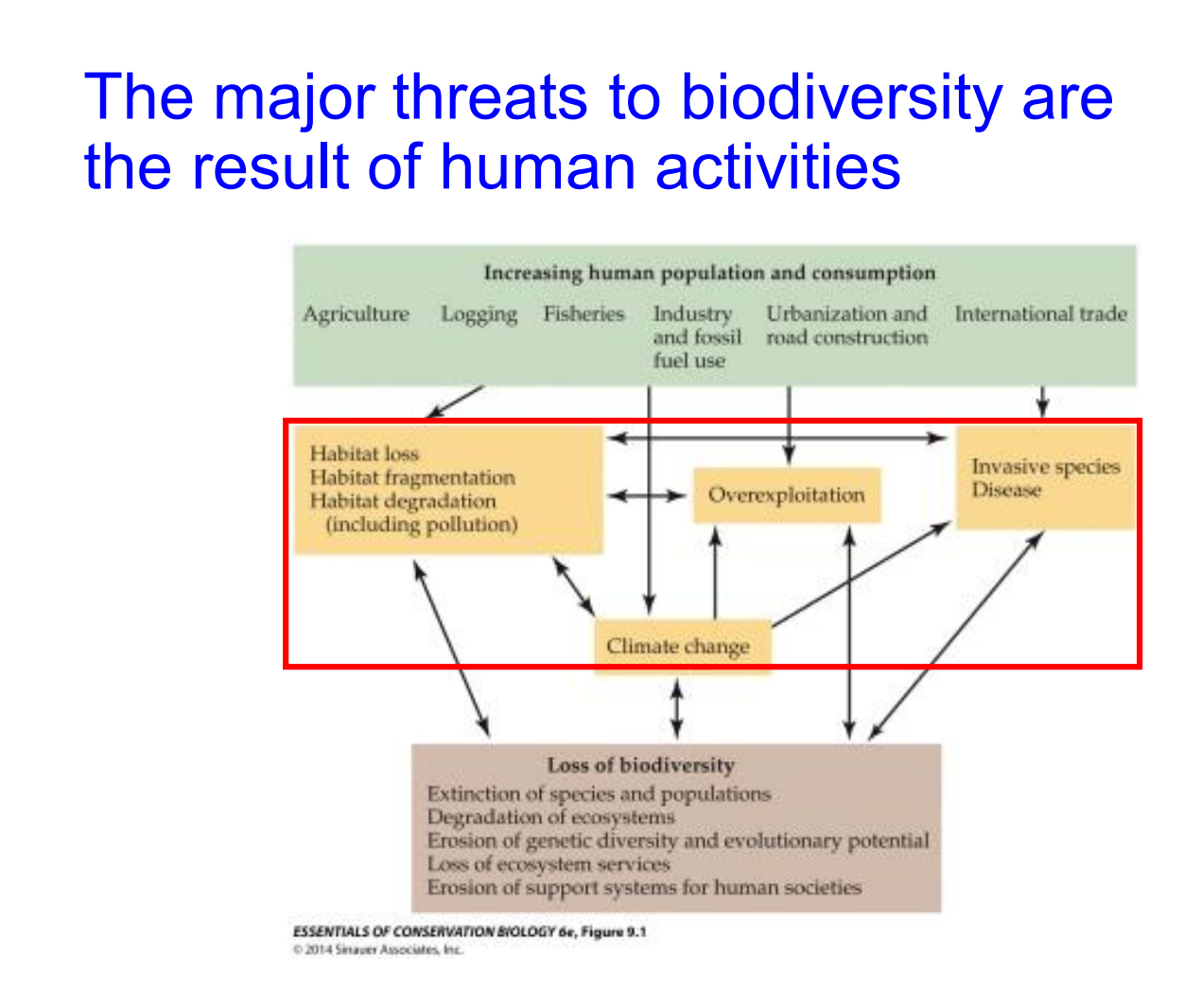
Multiple anthropogenic stressors
Habitat destruction, fragmentation, modification, degradation Change in nutrients and resource availability Chemicals (pollution) Eutrophication Pathogens Overexploitation Invasive species Climate change
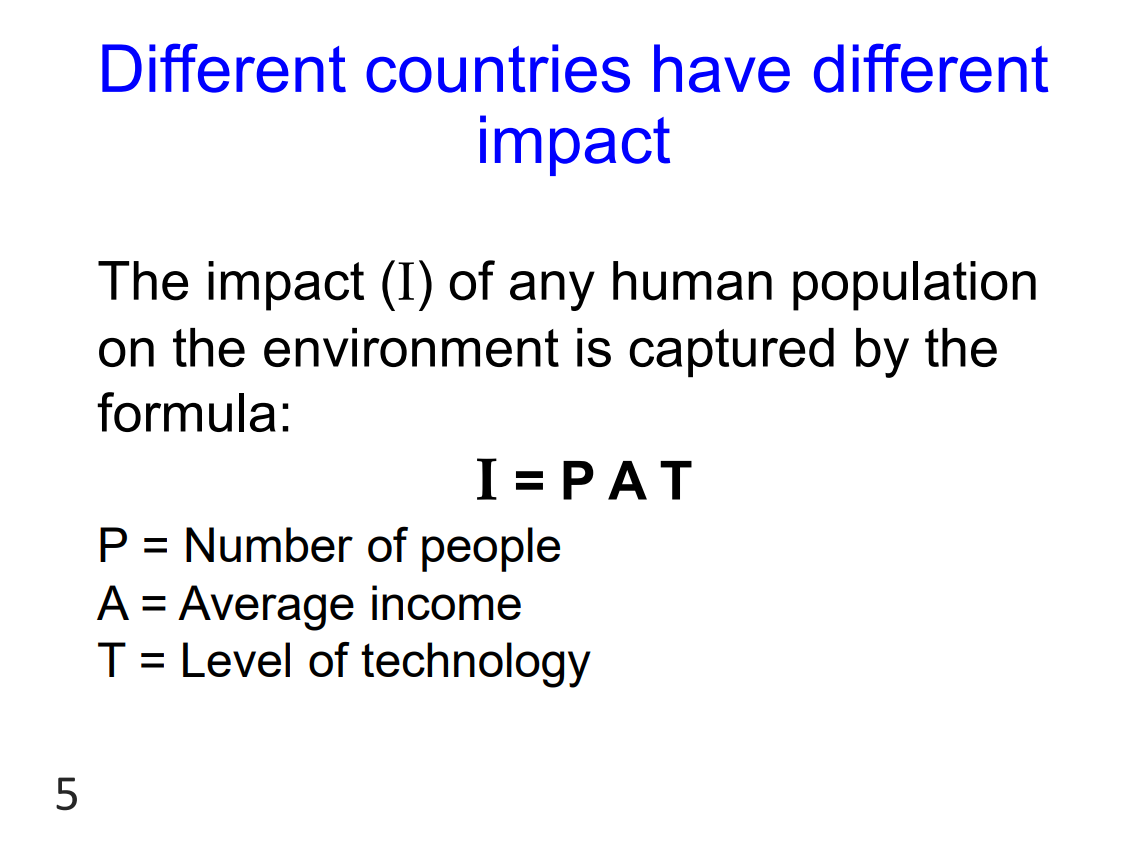
The impact (I) of any human population on the environment is captured by the formula:
I=PAT
P = Number of people
A = Average income
T = Level of technology
human ecological footprint
Measures the amount of land area (global hectares) and energy needed to support an average citizen of a nation.
what is the ecological footprint per country?
Ranks for total footprint can change: 1. China, 2. USA, 3. India, 4. Russia, 5. Japan (Global Footprint Network, 2025). Qatar and other Middle East countries can have large footprints per person.
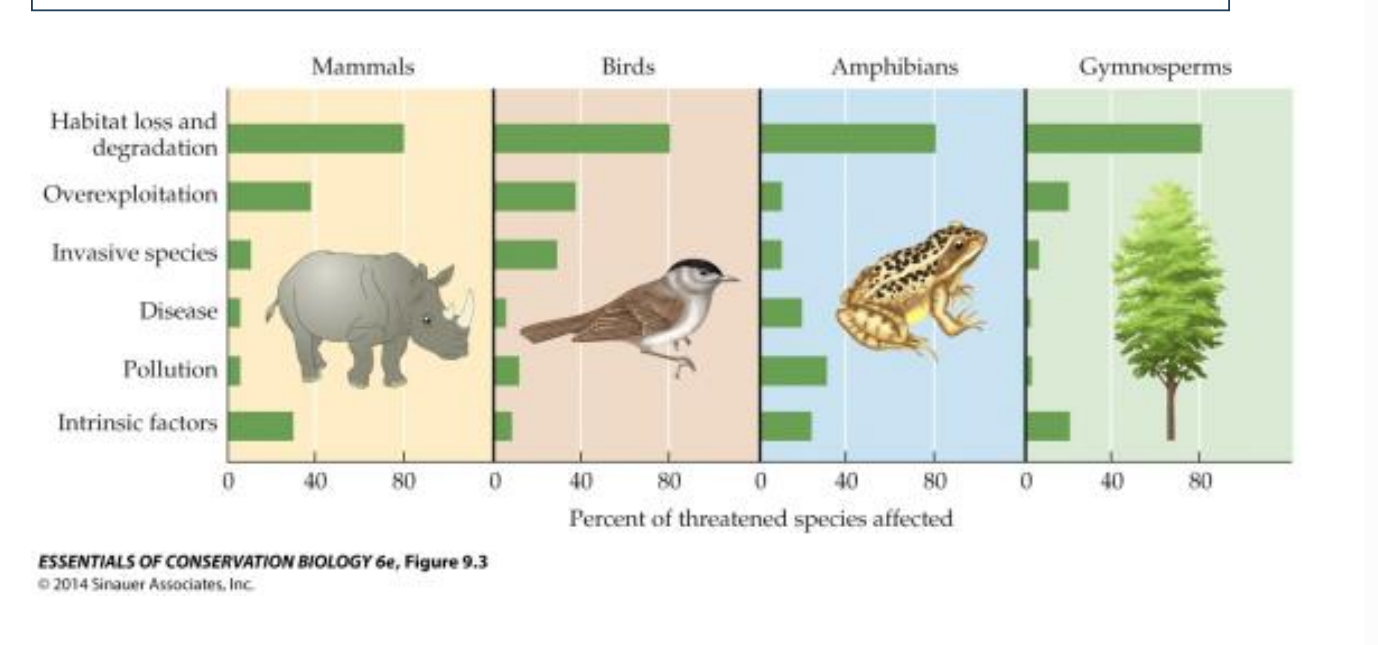
what is habitat destruction
Habitat destruction generally happens in three ways, driven by the human activities from your previous slide:
Habitat Loss: The outright elimination of an ecosystem (e.g., clear-cutting a forest for agriculture or paving over wetlands for urbanization). The organisms lose their shelter, food sources, and breeding grounds entirely.
Habitat Fragmentation: Breaking a large, continuous ecosystem into tiny, isolated patches (e.g., building a highway through a forest). This traps small populations, cuts off migration routes, and limits genetic diversity.
Habitat Degradation: The ecosystem remains physically intact, but its quality is ruined by pollution, acid rain, or introduced species, making it unlivable for the native wildlife.
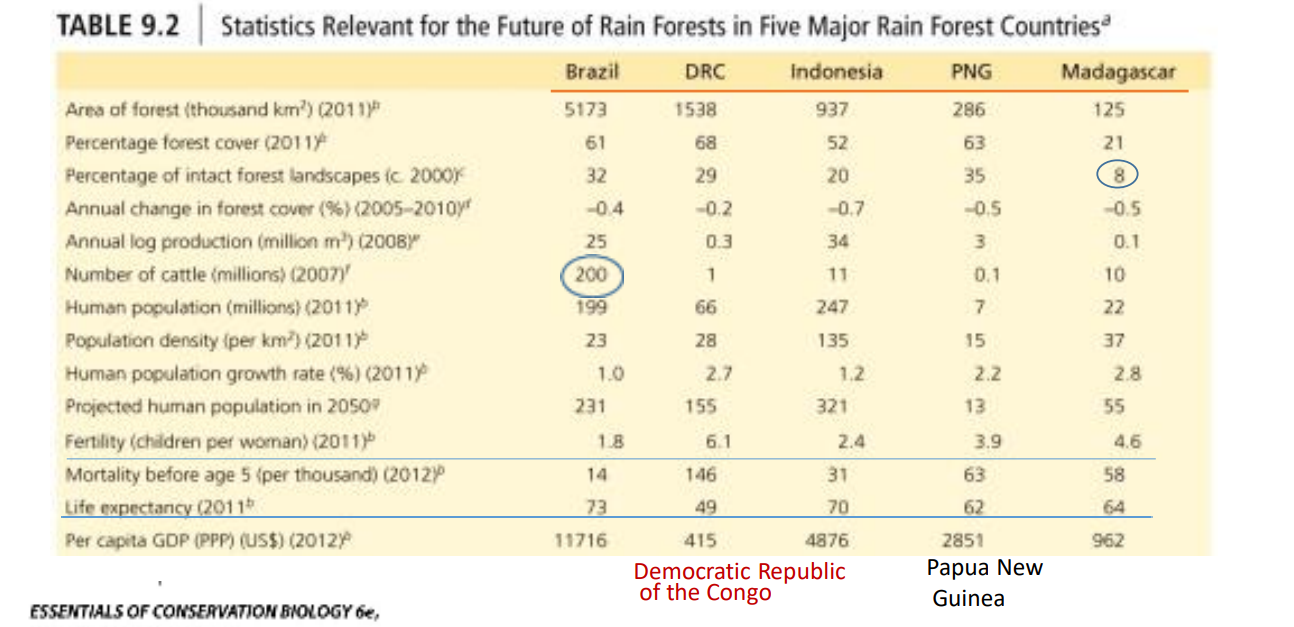
Threatened tropical rain forests
Very high species richness and global importance absorbing some of the excess CO2 produced by burning of fossil fuels.
what is Habitat fragmentation
The process whereby a large continuous area of habitat is both reduced in area and divided into two or more fragments
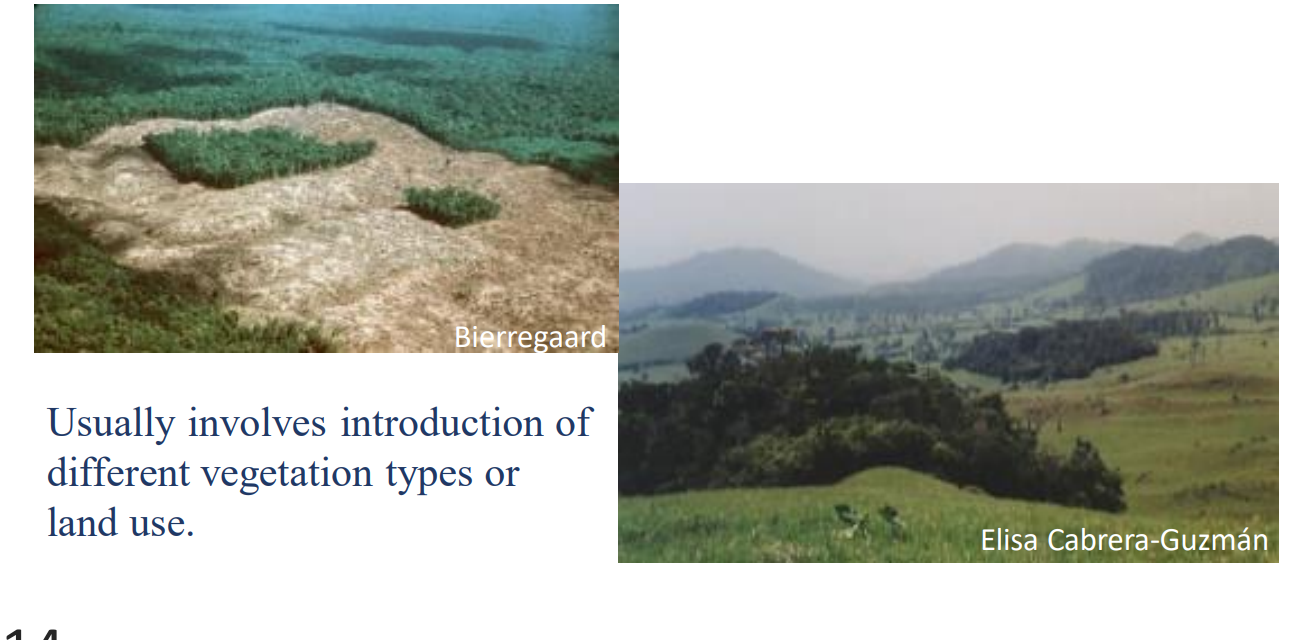
Overall, impact of fragmentation will depend on:
•Number of isolated patches
•Size of the patches
•Connectivity of patches
•Nature of matrix between patches
•Ecology of individual species
what is effethe ctive population size Ne
The size of the population estimated by the number of its breeding individuals. It is usually lower than the total population size (N):
More individuals of a species are better for conservation, much better if they are reproductive individuals.
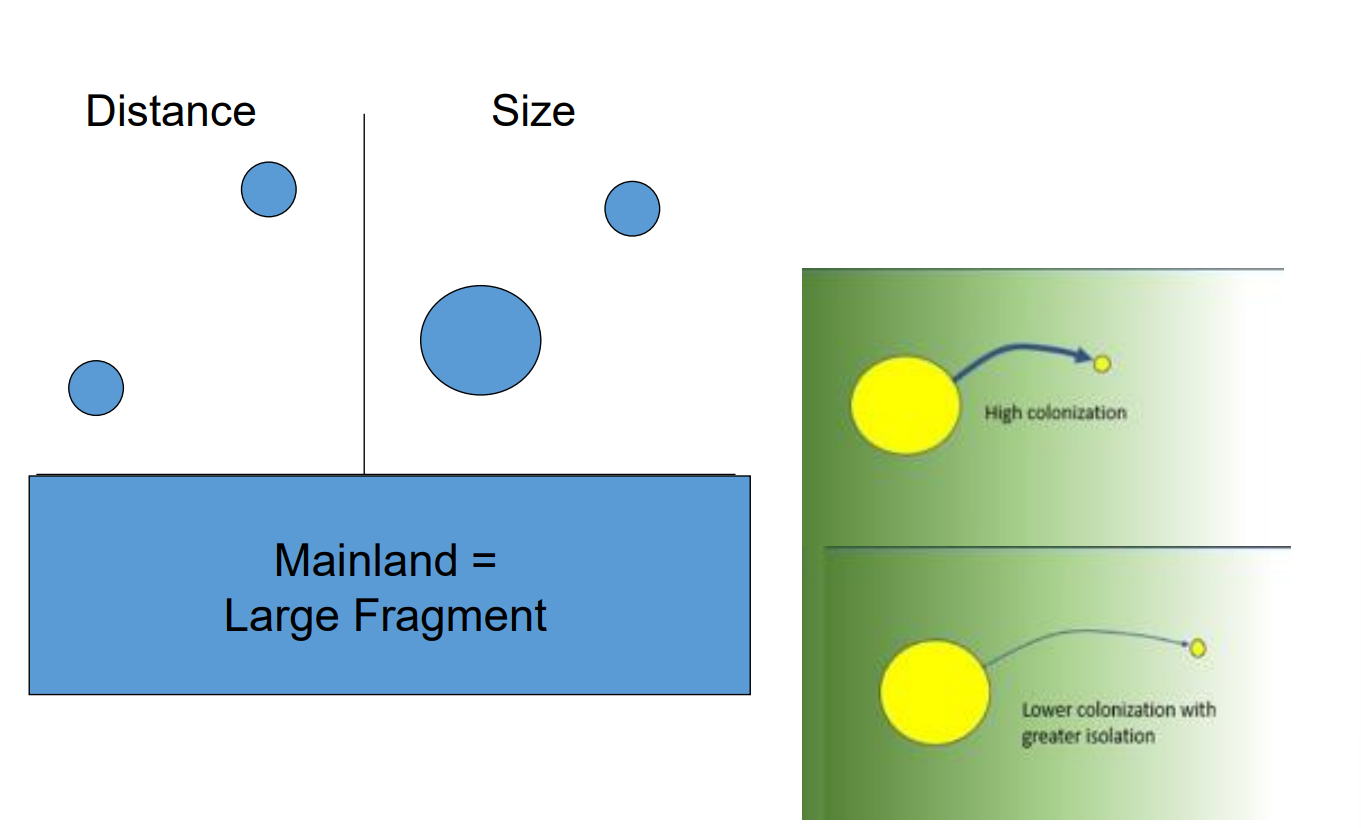
Can fragments function like islands?
Yes, habitat fragments function exactly like islands
1.Distance (Isolation Effect)
Near Fragments: Patches close to the mainland have high colonization rates. Species can easily migrate or disperse to them.
Far Fragments: Patches deep in isolation have lower colonization rates. Species struggle to cross the hostile gap.
2. Size (Area Effect)
Large Fragments: Act like large islands. They hold larger populations, offer more resources, and have lower extinction rates.
Small Fragments: Act like tiny islands. They hold fewer resources and experience higher extinction rates due to random environmental shocks
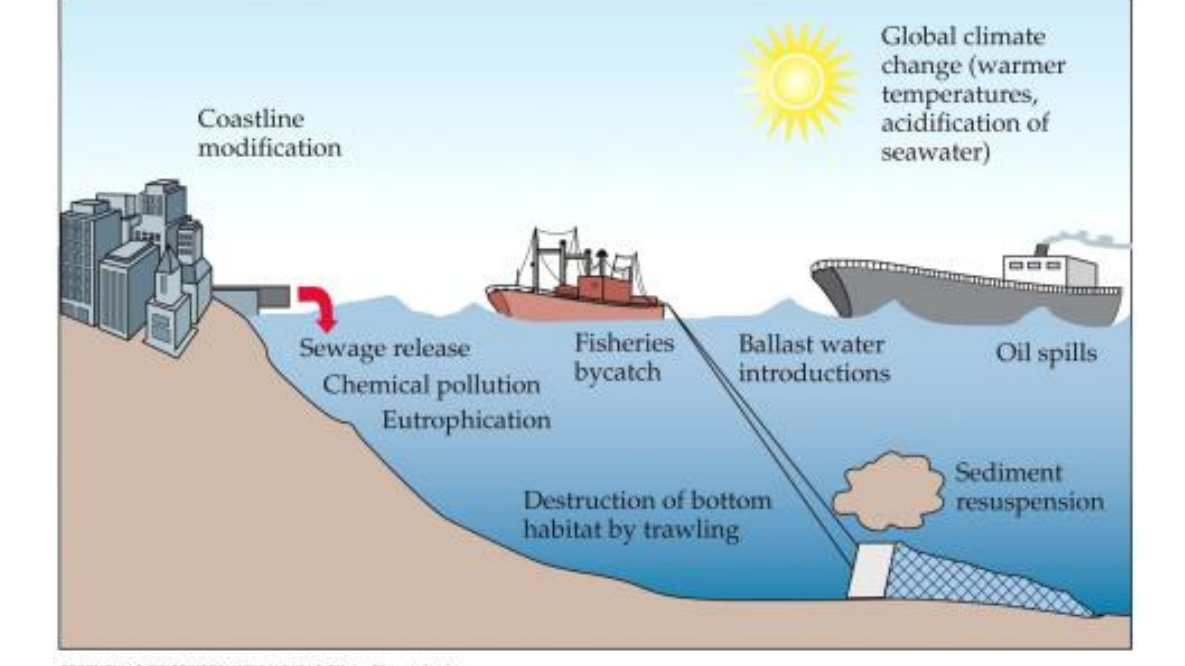
Marine environments face multiple threats, why?
lotss of pollution, oils spills, ect.
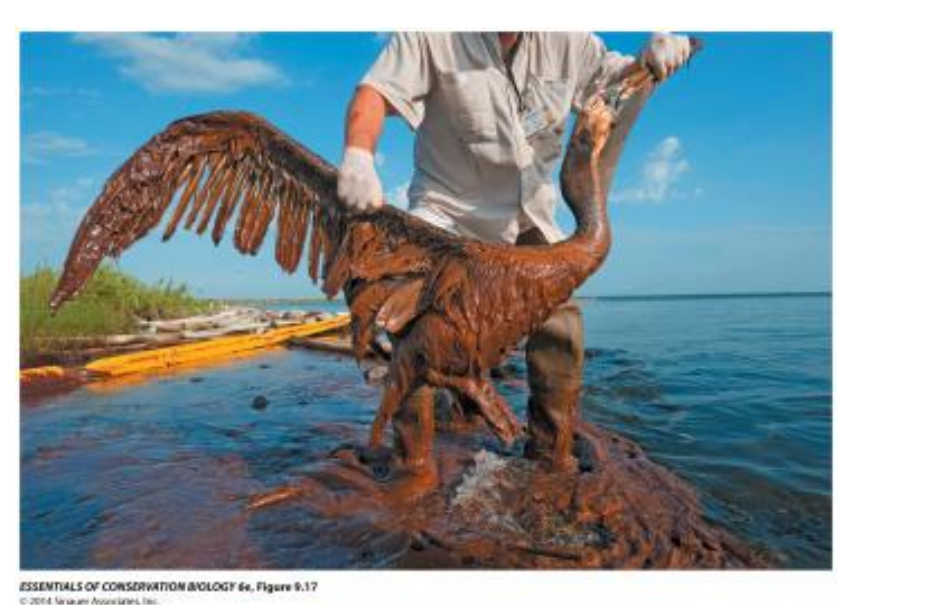
Habitat degradation and pollution
Birds, marine mammals, and many other ocean animals sicken and die when they are covered by crude oil following spills.
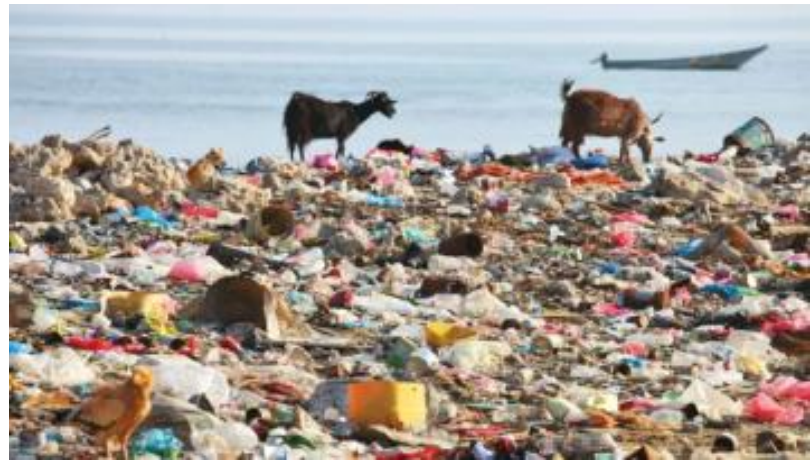
Plastics and microplastics
Aquatic and terrestrial environments
Large and tiny fragments of plastic.
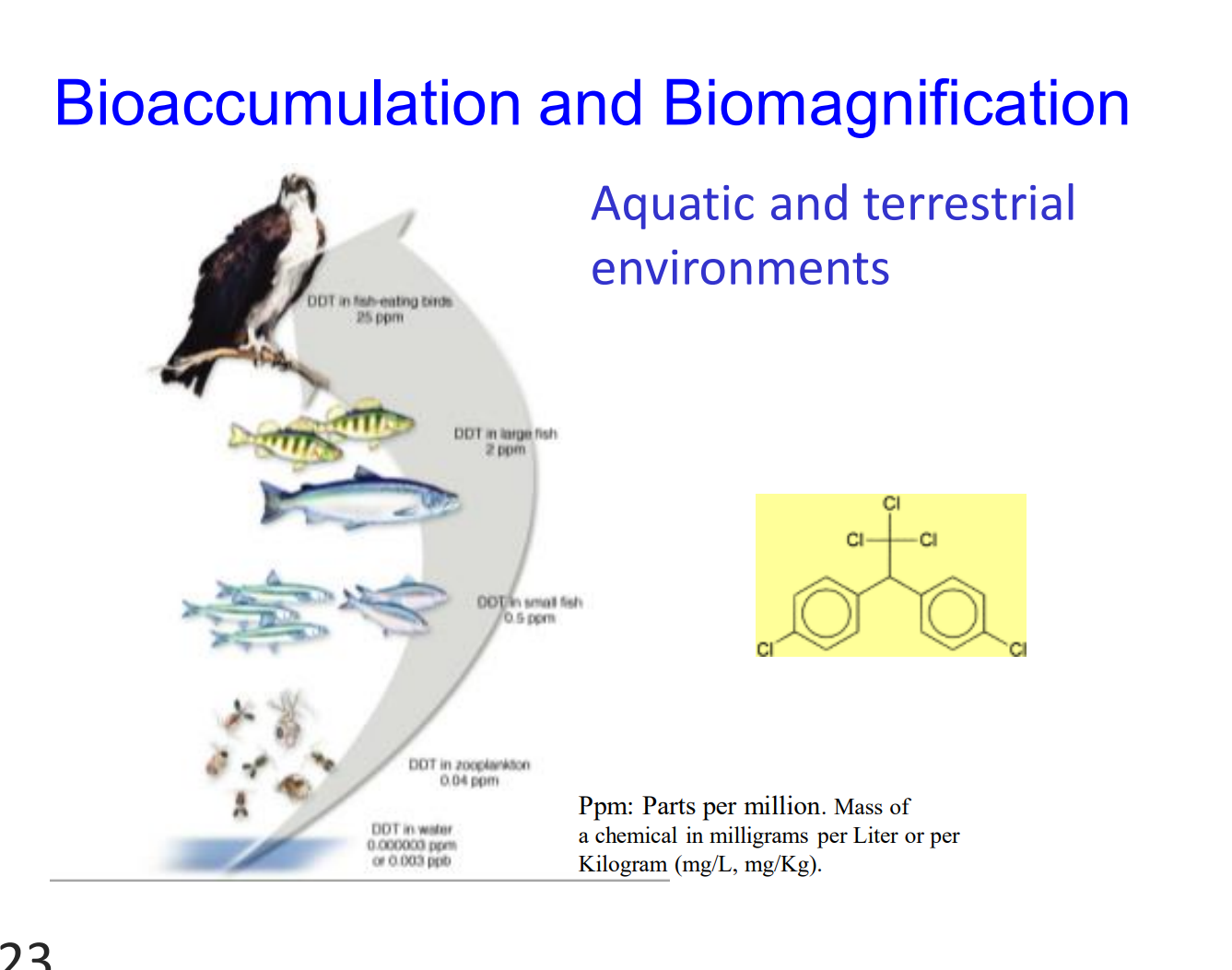
Bioaccumulation and Biomagnification
Bioaccumulation
occurs when an individual organism absorbs a toxic substance at a rate faster than it can break it down or excrete it.
Over time, the chemical builds up inside the organism's body tissues.
This is why even trace amounts of DDT in the water accumulate to higher levels in microscopic zooplankton
Biomagnification (Food Chain Level)
Biomagnification is the process where the concentration of a toxin increases dramatically as it moves up to higher trophic levels in a food chain.
what is eutrophication in freshwater habitats
Increase in nutrient levels in a water body with important effects on the aquatic communities.
Abundance of phytoplankton: (cyanobacteria and algae) increases. These photosynthesizing organisms cover the upper sunlit layer of the water bodies.
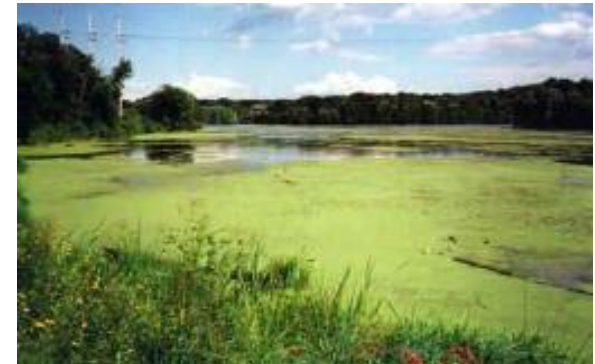
what is eutrophication
Algal blooms: High growth and biomass of various types of photosynthetic organisms.
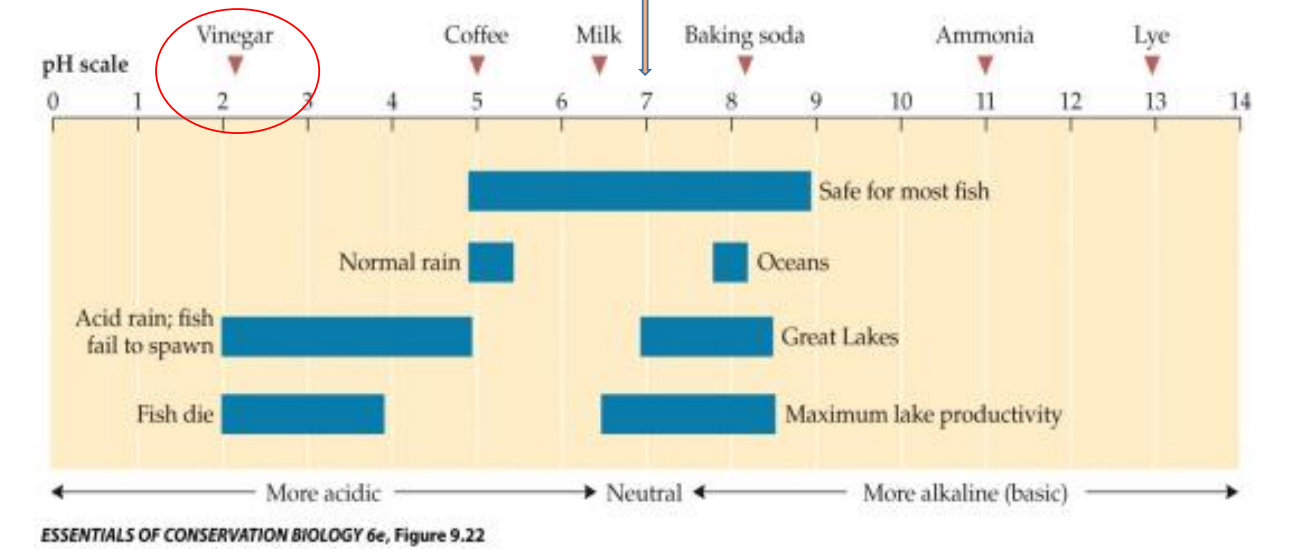
what is the pH scale
Strength of the hydrogen ions
The lower the pH the more acidic it is a substance.
Less than 7 = acidic
More than 7 = alkaline
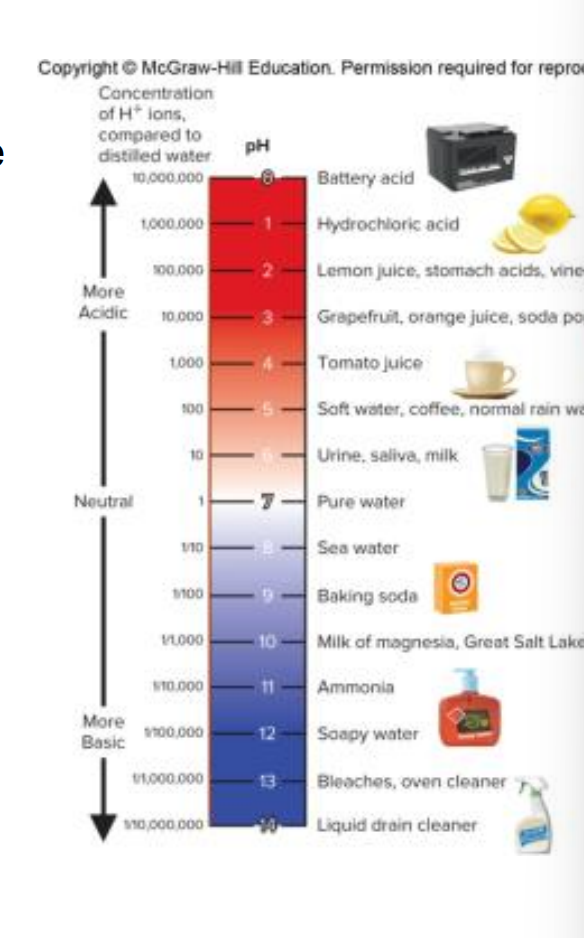
pH in aquatic environments
As the acidity in water bodies increases there are lethal effects on fish, tadpoles, etc.
Atmospheric CO2 also affects ocean pH by diffusing in and forming carbonic acid.
what is air pollution
Contaminants in air can damage and weaken tree species and make them more susceptible to attacks by insects, fungi, and disease
what is acid rain
Produced when industries release huge quantities of nitrogen and sulfur oxides into the air, where these chemicals combine with moisture in the atmosphere to produce nitric and sulfuric acids
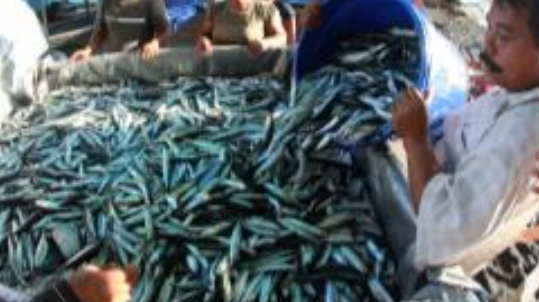
Overexploitation & Overharvesting
Exploitation in the modern world
Harvest that exceeds the productive capacity of a species and causes populations, and consequently the yield, to decline over time. The terms can also be applied to ecosystems and resources (e.g. water, aquifers).
what is logging
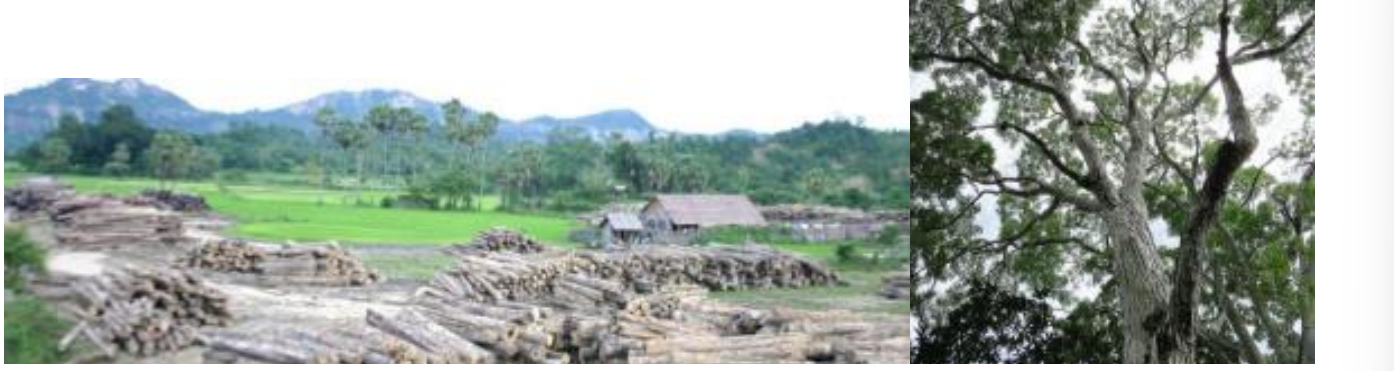
A net forest loss of 7 million hectares per year takes place in tropical countries, particularly in low income countries. Usually consumer demand is the reason:
Broad leaf mahogany (Swietenia macrohylla) also called caoba. Latin American species.
African cherry (Prunus africana).
how does fishing affect conservation
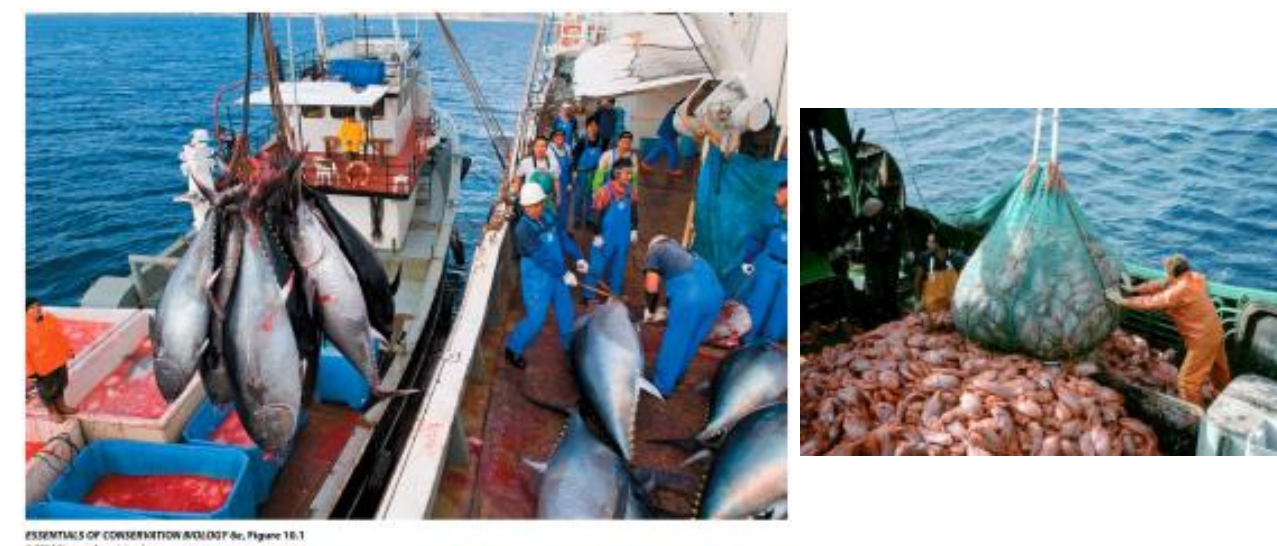
Intensive harvesting has reached crisis levels in many of the world’s fisheries.
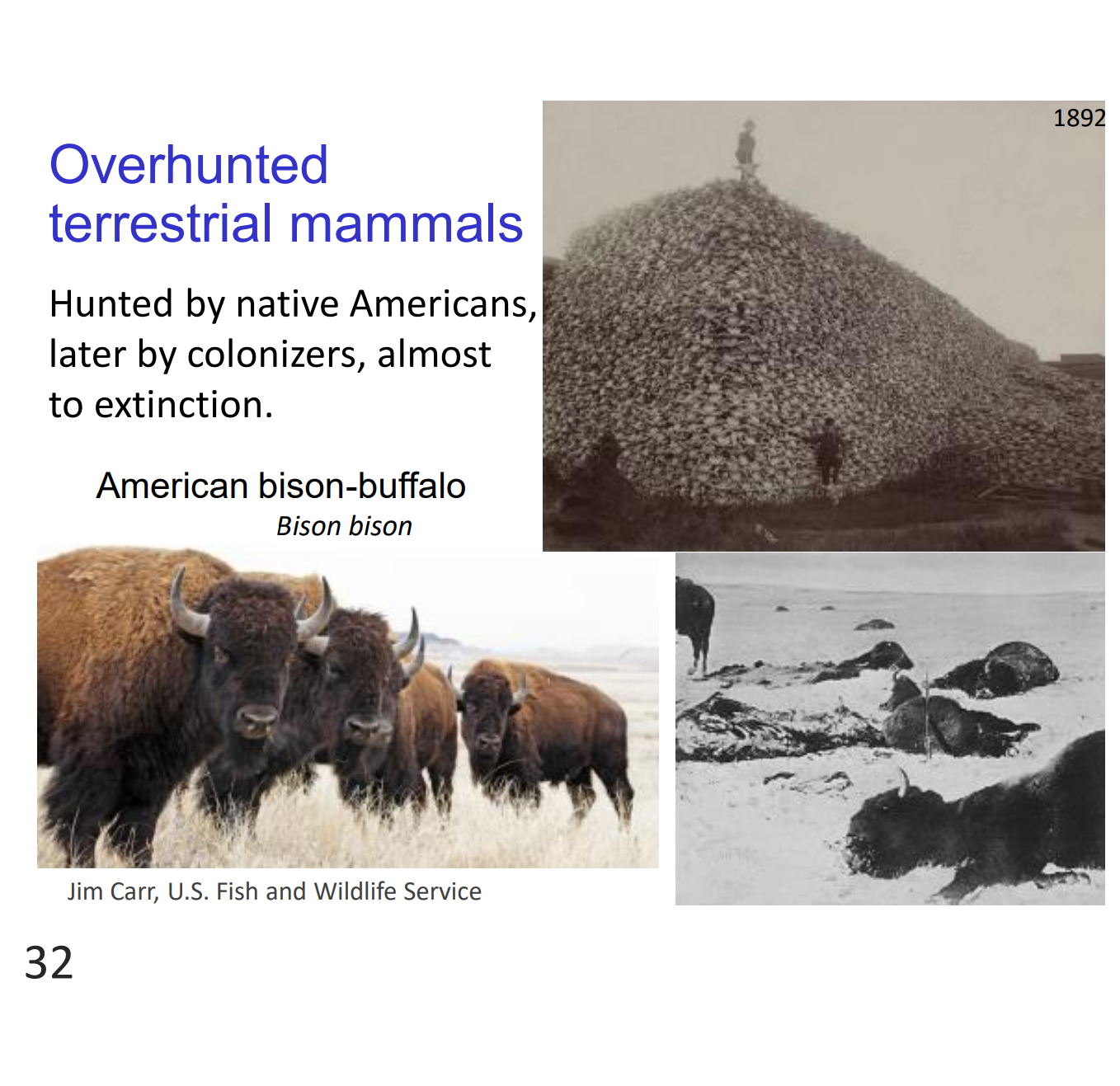
Overhunted terrestrial mammals
Hunted by native Americans, later by colonizers, almost to extinction.
American bison-buffalo Bison bison
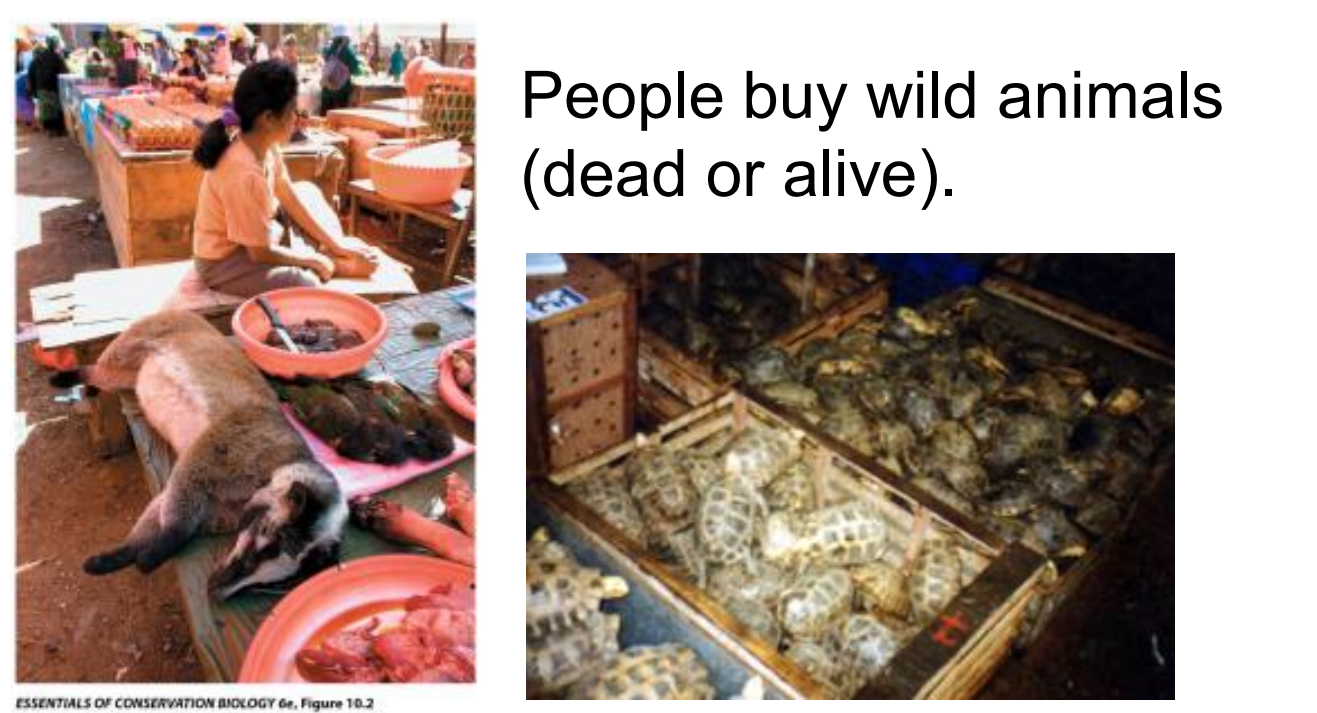
Bushmeat crisis and Illegal wildlife trade
People buy wild animals (dead or alive).
what are GMO crops
High crop demand in the world → hope to achieve higher yields
Is applying biotechnology to artificially increase yields overexploitation?
Around 25 years since GMO crops have been commercialized.
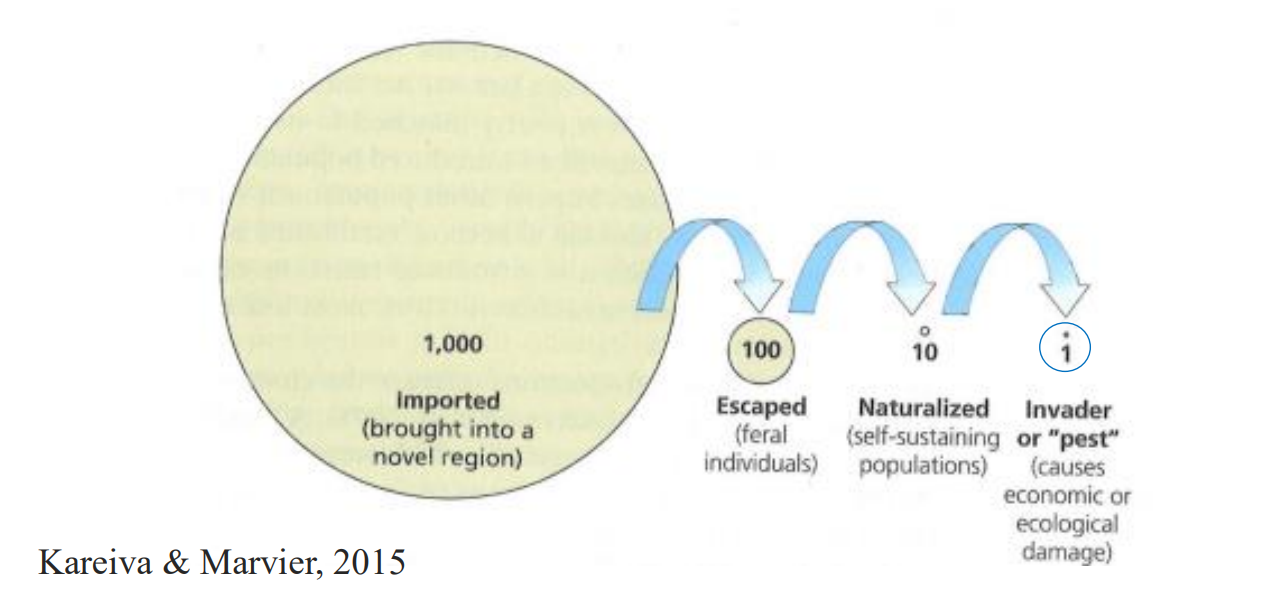
what si the tens rule
Roughly 10% of imported species escape control or cultivation, 10% of escaped species establish selfsustaining populations, and 10% of established species become problematic or damaging
why are invasive species bad?
Not native
Established
Abundant
Spreading
With effects on local species or impacts on ecological procesess in the ecosystem
How an introduced species becomes a successful invasive sp?
High reproductive rate
High dispersal rate
Generalist diet
Lack predators and pathogens
ex: cane toad in Australia (Rhinella marina)
Pandemics
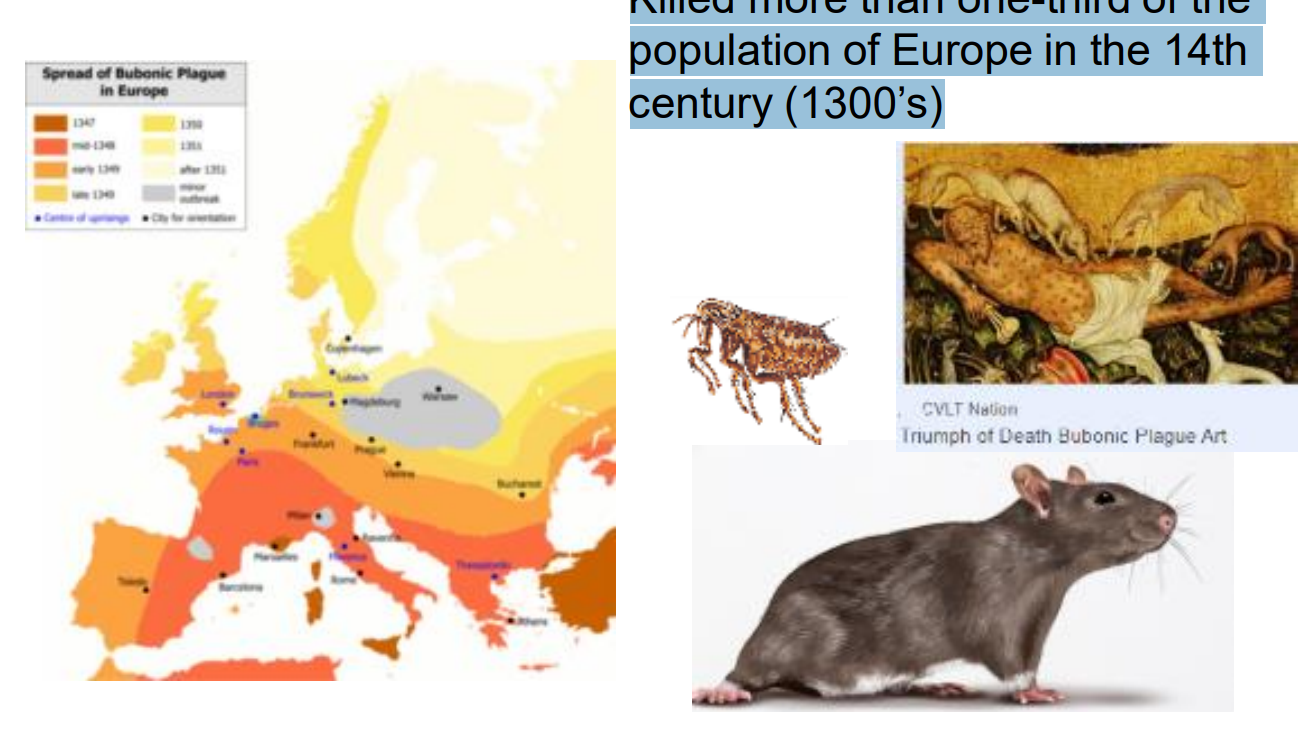
Plague or ‘black death’. Bacteria Yersenia pestis
Killed more than one-third of the population of Europe in the 14th century (1300’s)
ex: COVID-19 virus, SARS-CoV-2
Zoonosis and emerging diseases
Disease producing pathogens that move from an animal species to humans.
Of the emerging pathogens, 75% are zoonotic.
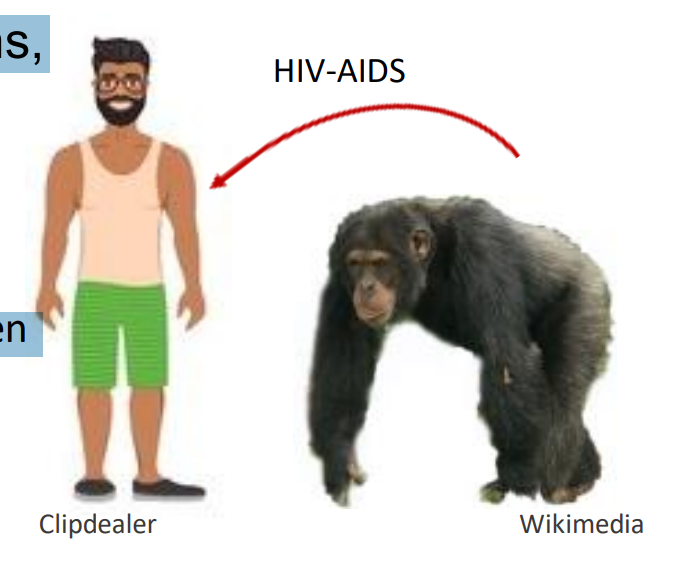
AIDS. Pathogen that jumped host From nonhuman primates and then evolved into a new virus.
does COVID-19 virus, SARS-CoV-2 has had environmental impact?
es, the SARS-CoV-2 virus and the resulting COVID-19 pandemic have had a profound, dual-sided impact on the global environment. [1]
Because human behavior shifted drastically during lockdowns—a period scientists call the "anthropause"—ecosystems experienced temporary relief alongside new, severe pollution challenge
Land use change and vectors
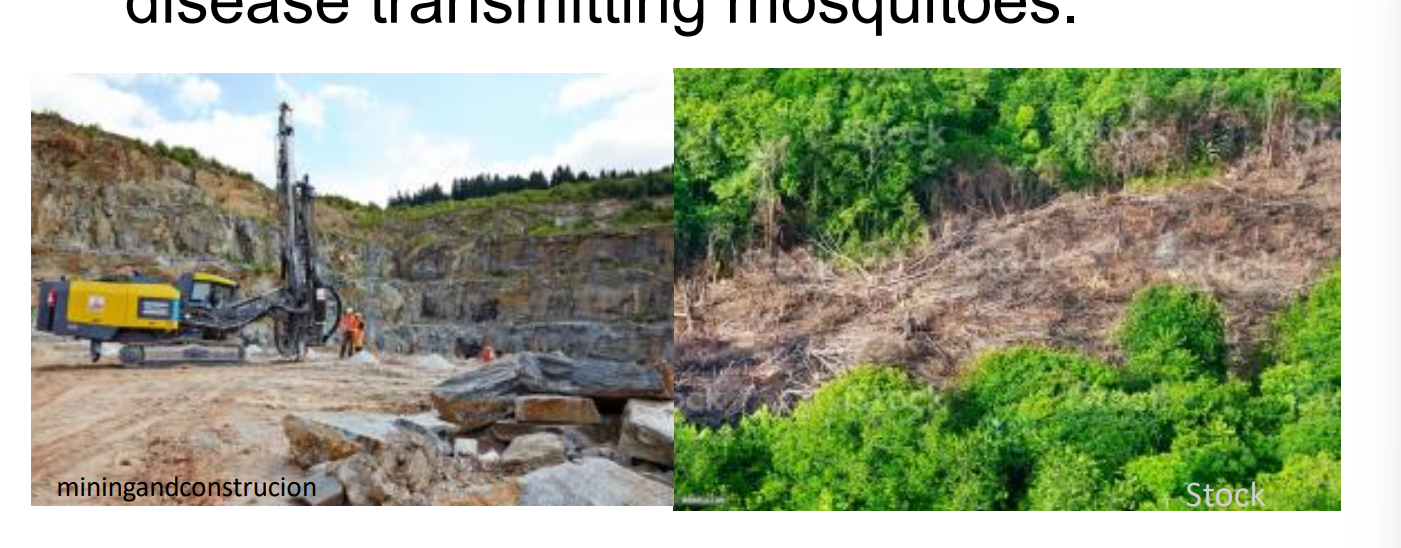
Deforestation and mining create more spots that collect rainwater offering environments suitable for larvae of disease transmitting mosquitoes.
Movement of pathogens and hosts
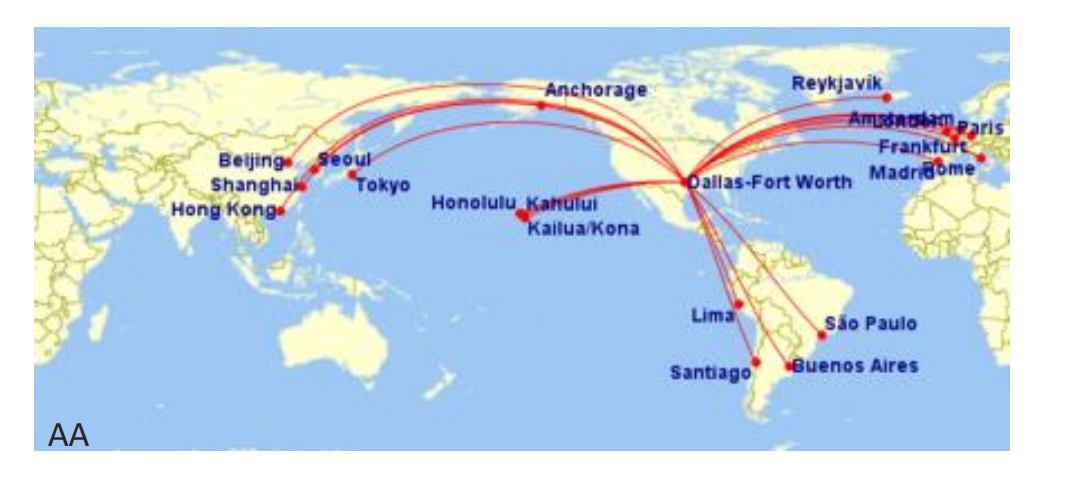
“Pathogen pollution": Human introduction of pathogens or hosts into new areas.
Humans affect populations of vultures which can impact human health
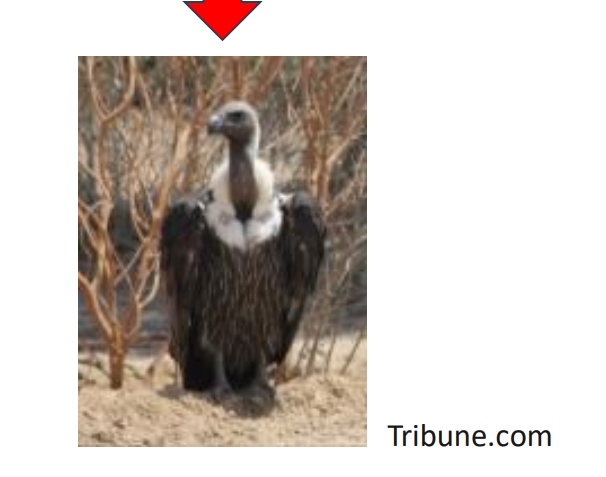
Vultures play a critical role in the disposal of cattle carcasses which reduces disease transmission among domestic and wild ungulates.
Declining populations of vultures (Gyps spp.) in India, Pakistan, and Nepal
what is landscape ecology
have fairer grading not just have tests determine our worth
Ecosystem management:
A collaborative process with the maintenance of long-term
ecological integrity as its core value
how can biodiversity be sustained?
Biodiversity can best be sustained by large reserves connected across the landscape and buffered from areas of intense human use
Design of nature reserves focuses on core
natural areas, where conservation of
biodiversity and ecological integrity take
precedence over other uses
what do conservation biologists often do to start reserve design
Representation: Biodiversity.
Resiliency: Large enough to keep characteristics even if climate changes.
Redundancy: Enough examples of each aspect of biodiversity.
Reality: Sufficient resources to regulate and manage the are
what is the SLOSS debate for reserve design
Best shape…
Individuals of endangered species…
Connected by corridors…
Ways to spend the available amount of funding
what are the primary objectives of reserve confirguation
maintain the largest possible populations
provide habitat for a species throughout their area of distribution
have enough area to maintain natural disturbance regimes
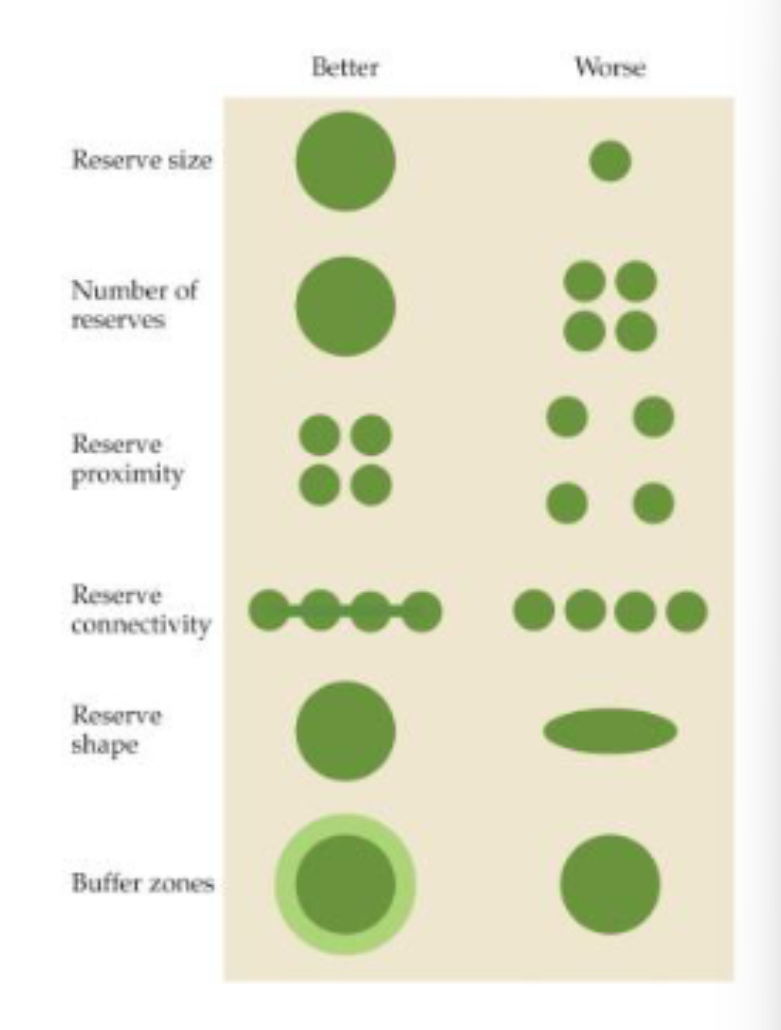
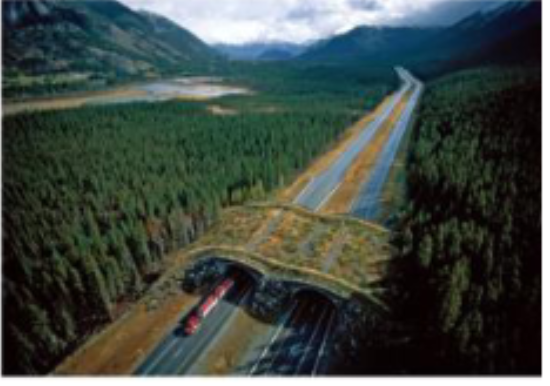
what are habitat corridors
Linear patches that connect blocks of habitat.
Connectivity can reduce the effects of fragmentation by
preventing the isolation of populations
-Increase immigration and prevent local extinctions
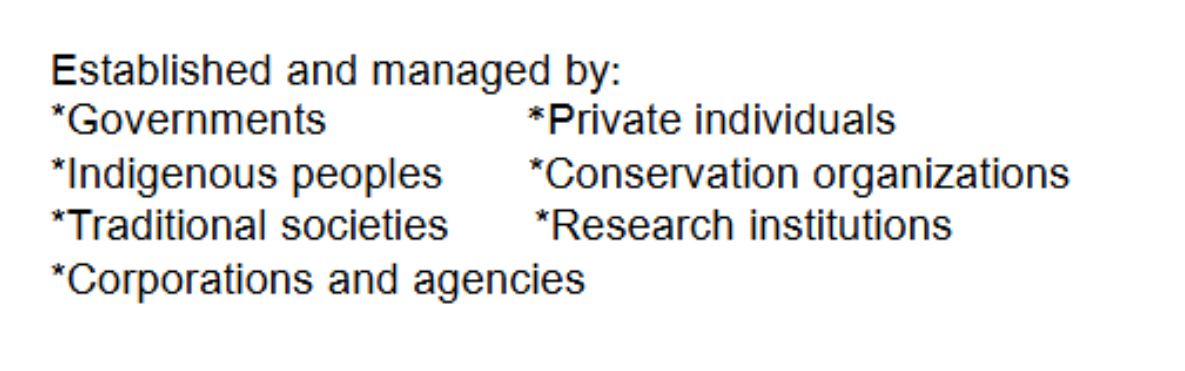
what is a protected area (IUCN)
A clearly defined geographical space, recognized, dedicated, and managed, through legal or other effective means to achieve the long-term
conservation of nature with associated ecosystem services and cultural values.
What are the seven categories of protected areas under the IUCN(International Union for Conservation of Nature) with various protections and restrictions of human activities
• Ia. Strict nature reserves
• Ib. Wilderness areas
• II. National parks
• III. Natural monuments or features
• IV. Habitat/species management areas
• V. Protected landscapes/seascapes
• VI. Protected areas with sustainable use of natural
resources
what is the effectiveness of protected areas
About half of the protected areas have been reasonably effective at protecting biodiversity but the other half are experiencing species
declines.
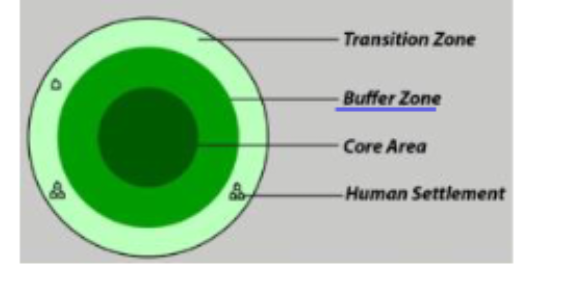
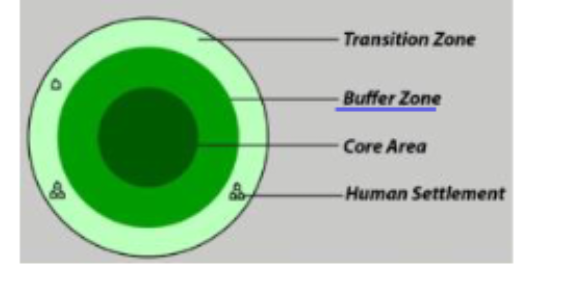
what are buffer zones
Buffer zones around protected areas, in which
only lower-impact land uses are allowed
what does a new protected area require
1. Establishing priorities for conservation
Identifying high priority areas that should be
protected.
Selecting new protected areas by filling gaps
and developing conservation networks.