Chapter 16: Mechanisms of Genetic Variation
 Call Kai
 Learn
Learn Practice Test
 Spaced Repetition
 Match
Match Flashcards
 Knowt Play
1/40

There's no tags or description
Looks like no tags are added yet.
Name | Mastery | Learn | Test | Matching | Spaced | Call with Kai |
|---|
No analytics yet
Send a link to your students to track their progress
41 Terms
types of mutations
spontaneous
induced
transition
transversion
mutation
a stable, heritable change in the genomic nucleotide sequence
this can be a single base change → point mutation
spontaneous or induced mutations
changes of several bases or larger → insertions, deletions, inversions, duplications, and translocations
can be spontaneous or induced (physical and chemical mutagens)
base pair substitutions, deletion or insertion
spontaneous mutation
arise occasionally in the absence of any added agent
without exposure to external agents → they are often the result of errors in replications or lesions to the DNA
tautomerization: due to DNA replication, there are errors in replication can be due to tautomeric shifts = base substitutions
transitions and transversion mutations
lesions in the structure of DNA
loss of a nitrogenous base creating an apurinic or apyrimidinic site can cause spontanous mutations
induced mutations
result of exposure to a mutagen (physical or chemical agent) that damage DNA, alter its chemistry or interfere with its functioning
base analogs
specific mispairing
intercalating agents
transition mutation
substitution of one purine for another or of one pyrimidine for another
transversion mutation
substitution of a purine for a pyrimidine or vice versa
base analogs
structurally similar to normal nitrogenous bases and can be incorporated into DNA during replication → exhibit base-pairing properties different from the bases they replace
specific mispairing
occurs when mutagen is a DNA modifying agents that changes a base’s structure and thereby alters its pairing characteristics
intercalating agents
become inserted between the stacked bases of the helix, distort the DNA and thus induce single nucleotide pair insertions or deletions
detection and isolation of mutants (mutagens and carcinogens)
carcinogens are cancer causing agents = mutagens
therefore tests for mutagenicity can be used as a screen for carcinogenic potential
ames test
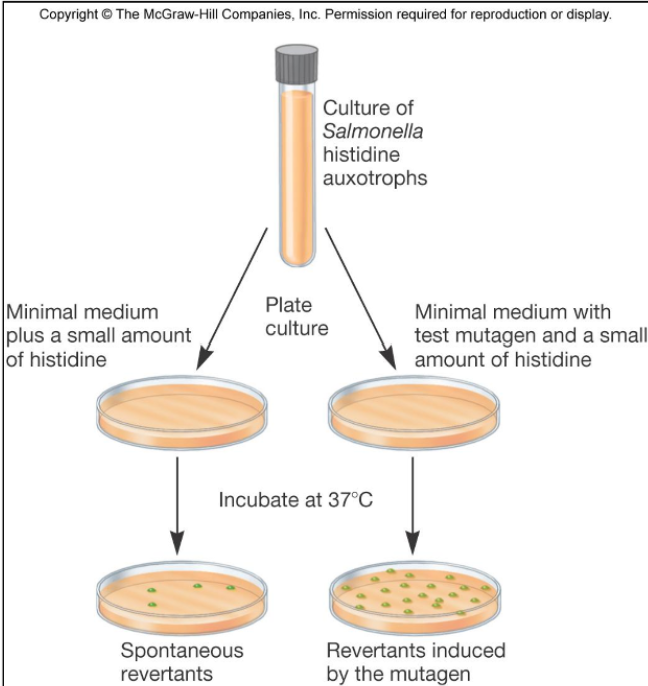
ames test
widely used mutagenicity test
detects an increase in reversion of special strains of salmonella typhimurium from histidine auxotrophy to prototrophy after exposure to carcinogen
DNA repair
attempt to correct mistakes or damages in the DNA → cells have the ability to repair damaged DNA by:
proofreading by DNA polymerases
excision repair
direct repair of thymine dimers
mismatch repair
recombinational repair
SOS response
proofreading by DNA polymerases
immediately repairs many replication errors
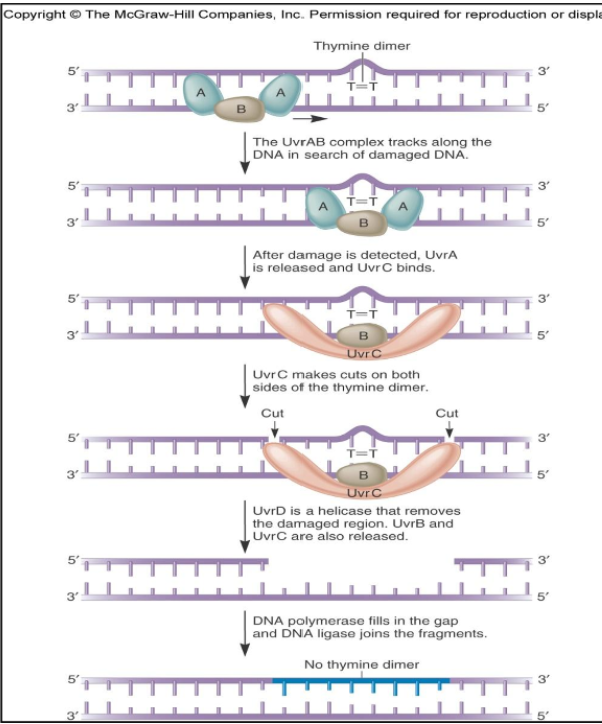
nucleotide excision repair
damaged area is excised, producing a single stranded gap → the gap is filled in by DNA polymerase I and DNA ligase joins the new fragment into the existing DNA strand
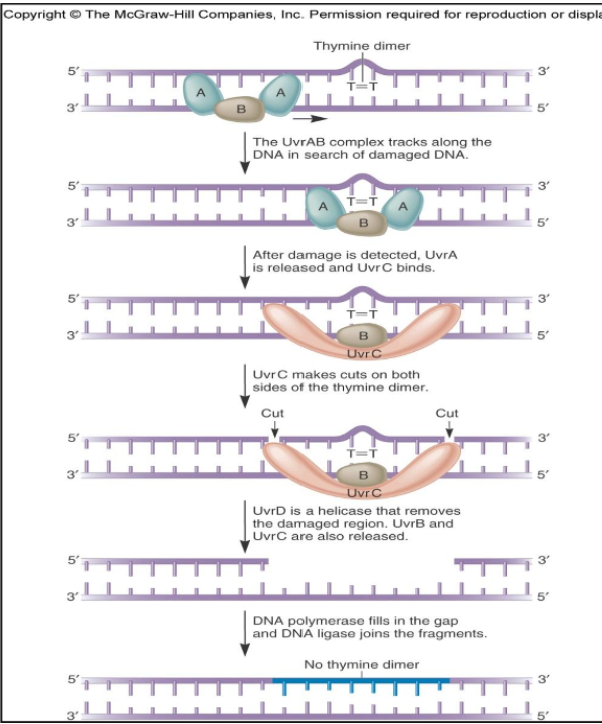
base excison repair
DNA glycosylases remove the damged base and signals AP nucleases to mark the damaged DNA, which is then excised and repaired by DNA polymerase I and ligase
direct repair of thymine dimers
alkylated bases occurs through photoreactivation or the action of alkyl or methyltransferases
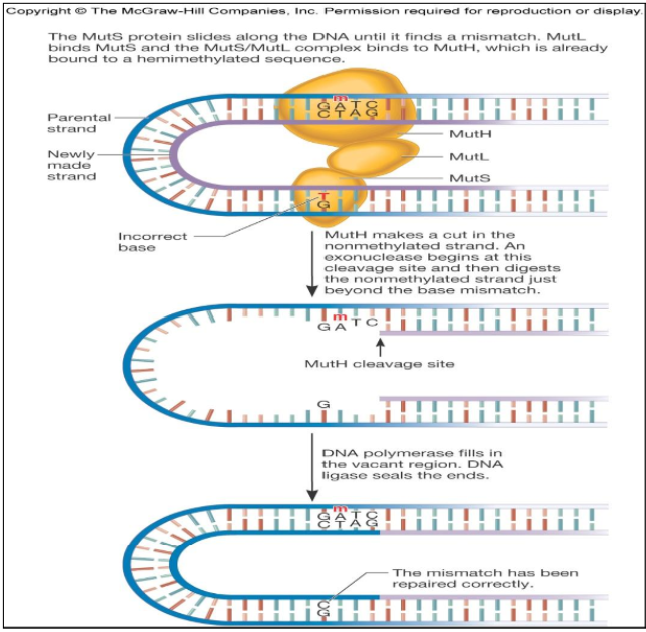
mismatch repair
system corrects replication errors that result in mismatched base pairs
detected by MutS and repaired through excision by MutH
recombinational repair
recombination with an undamaged molecule, is used to restore DNA that has damage in both strands through the action of RecA protein
SOS response
repair is a type of recombination repair that depends on the RecA protein
used to repair excessive damage that halts replicaiton → error prone process that results in many mutations
RecA derepresses the synthetic of a variety of DNA repair genes
very serious damage is treated by translesion DNA synthesis that is highly error prone
transposable elements
transposons
insertion sequences
transposition
movement of pieces of DNA around the genome
transposons
segments of DNA that can move about chromosomes → jumping genes
carry other genes in addition to those needed for transposition
insertion sequences
contain genes only for those enzymes required for transportation
are bound on both ends by inverted terminal repeat sequences
creating genetic variability
recombination
horizontal gene transfer in bacteria or archaea
vertical gene transfer
exogenote
conjugation, transformation, transduction
recombination
process by which one or more nucleic acid molecules are rearranged or combined to produce a new nucleotide sequence
mutant or wild type alleles can be exchanged
horizontal gene transfer
moves genes from one mature, independent organism to another
vertical gene transfer
transmission of genes from parents to offspring
exogenote
donor DNA that enters the bacterium by one of several mechanisms
conjugation
direct transfer from donor bacterium to recipient while the two are temporarily in physical contact
transformation
transfer of a naked DNA molecule
transduction
transfer mediated by a bacteriophage
bacterial conjuation
the transfer of genetic information via direct cell contact → mediated by fertility factors (F plasmids)
F+ F- mating
Hfr conjuation
F+ F- mating
in E. coli and other gram negative bacteria, an F plasmid moves from the donor (F+) to a recipient (F-) while being replicated
replication is by the rolling circle mechanism where the 3’ end is extended from a nick in one DNA strand, following around the circular genome and displacing the 5’ end
the displaced strand is transferred via a sex pilus and then copied to produce double stranded DNA
donor retains the other parental DNA strand and its complement → recipient becomes F+ and the donor remains F-
chromosomal genes are not transferred
high frequency of recombination (Hfr) conjugation
F plasmid integration into the host chromosome results in an Hfr strain of bacteria
mechanics of conjugation of Hfr strains are similar to those of F+ strains
initial break for rolling circle replication is at the integrated plasmid’s origin of transfer site
part of the plasmid is transferred first
chromosomal genes are transferred next
the rest of the plasmid is transferred last
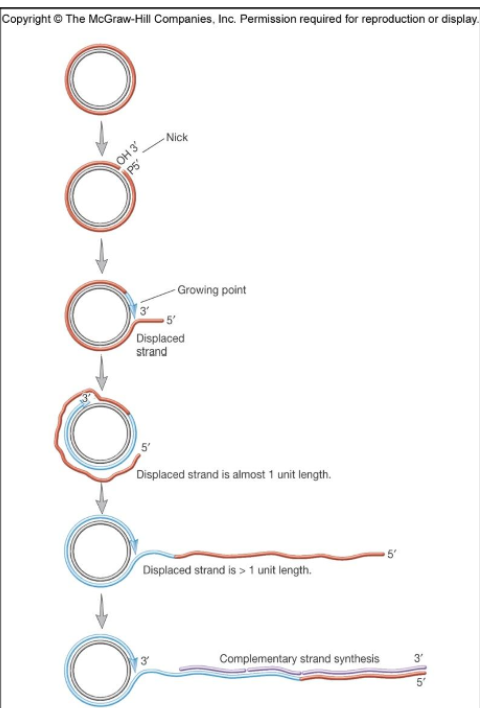
rolling circle replication
enzyme cuts one strand of plasmid DNA while the other strand is in tacked
the cut strand rolls off and passes through the conjugation pilus to the other bacteria
DNA synthesis then produced a new complementary strand to replace the strand that left
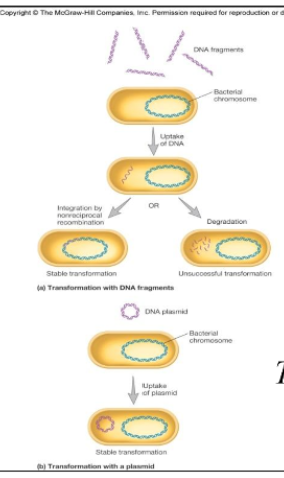
bacterial transformation
a naked DNA molecule from the envrionment is taken up by the cell and incorporated into its chromosome in some heritable form
competent cell→ one that is capable of taking up DNA and therefore acting as a recipient
only a limited number of species are naturally competent
mechanics of the natural transformation process differ from species to species
species that are not normally competent can be made competent by calcium chloride treatment and other methods that make the cells more permeable to DNA
bacterial transduction
transfer of bacterial genes by viruses → occurs as the result of the reproductive cycle of the virus
lytic cycle
lysogeny
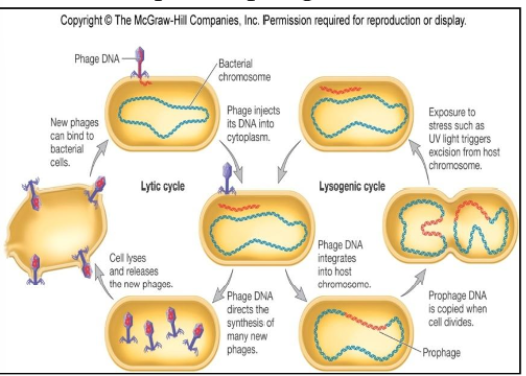
lytic cycle
viral reproductive cycle that ends in lysis of the host cell → viruses that use this cycle are called virulent bacteriophages
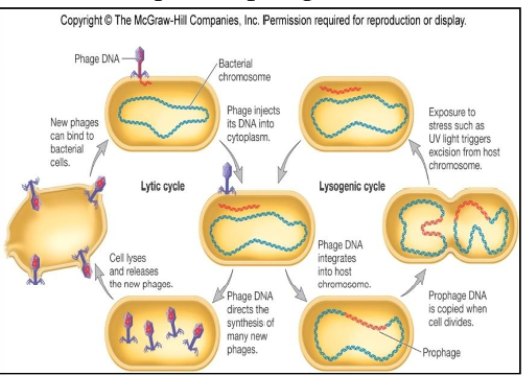
lysogeny
reproductive cycle that involves maintenance of the viral genome within the host cell without immediate lysis of the hostg
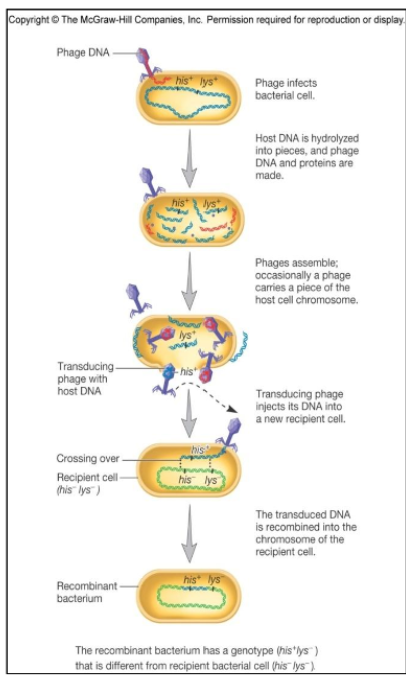
generalized transduction
transfer of any portion of the bacterial genome → occurs during the lytic cycle of virulent and temperate bacteriophage
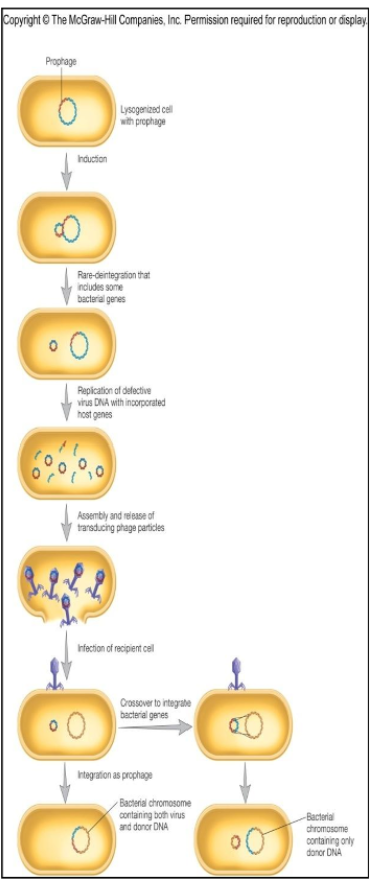
specialized transduction
transfer of only specific portions of the bacterial genome → carried out only by temperate phages that have integrated their DNA into the host chromosome at a specific site in the chromosome