BIOL274 food webs
 Call Kai
 Learn
Learn Practice Test
 Spaced Repetition
 Match
Match Flashcards
 Knowt Play
1/121

There's no tags or description
Looks like no tags are added yet.
Name | Mastery | Learn | Test | Matching | Spaced | Call with Kai |
|---|
No analytics yet
Send a link to your students to track their progress
122 Terms
Predation
The consumption of one living organism by another
What are four different types of predations?
‘True’ predators, Grazers, Parasites, and Parasitoids
True predators
Kill prey straight after attacking it
Grazers
Remove only part of an individual, with rarely lethal effect. They attack a large number of individuals throughout their lifetime
Parasitism
Effect is rarely lethal or takes a long time to kill as only part of an individual is removed. Usually only one individual is attacked
Parasitoids
Intimately associated with one host, do not cause immediate death, but eventually death is inevitable
Ambush (‘sit and wait’) predators
Select profitable locations, waiting for prey to come along e.g. spiders
What determines encounter rate for ambush predators?
Location
Active predators
Move to search for prey, but still wait for certain conditions e.g. Wrybill bird waiting for correct tide to forage in mud
What determines encounter rate for active predators?
Predator movement/behaviour
What are the two different types of active predators?
Stalking and pursuit predators
What defines stalking predators? (with example)
Stalking predators such as cats spend more time and energy encountering prey
What defines pursuit predators? (with example)
Pursuit predators like lions and wolves spend more time and energy capturing and handling prey
The grazing mayfly moves over rocks to find algae. What kind of predator is it?
Active predator
Between true predators and grazers, which has a greater impact on their prey’s population dynamics?
True predators, since they kill their prey immediately
Why aren’t predators always fully aggregated around their prey?
1) To avoid competition with other predators; and
2) To avoid forming too large an aggregation to be at risk of predation themselves
Case study of predation risk influencing foraging activity
Tit birds restricting their activity when bank vole populations are low due to risk from Eurasian Pygmy Owls
Assumption guiding optimal foraging theory
Predators seek to maximise their net energy intake and thereby maximise their evolutionary fitness
Handling time
The time it takes to capture, take down and subdue prey items without consuming it
Based on the optimal foraging model, when should a predator specialise on one prey only?
If the average search time for that prey is relatively low
Should predators with short handling times be generalists or specialists?
Generalists
What is an issue with the optimal foraging model?
Animals are not ‘all-knowing’
Mayfly drift case study
Mayflies tend to be smaller when their predators (trout and stonefly) are present compared to when they are absent
Allometric scaling
Prey with larger body size have larger predators
Bergmann’s rule
For endotherms, body size for a species tends to increase with decreasing mean annual temperature, and vice versa
Example of Bergmann’s rule
Mean body mass of red-billed gulls has decreased from 1958-2004 in conjunction with rising mean ambient temperature
Caribou case study
Changing environmental cues bring earlier onset of plant growing season, creating a mismatch with caribou breeding season
Case study of the consequences of absence of coevolution
‘Tibbles the cat’ - cats causing extinction of Stephens Island Wren in 1894
Prey isocline
Determines the number of predators where there is no change in the prey population, setting dN/dt = 0
Case study of predator-prey cycles
Lynx, snowshoe hares, and woody browse
Rabbits and mustelids in the Wairarapa
T/F: Tendency for lagging cycles as described by Lotka-Volterra is quite rare in nature
True
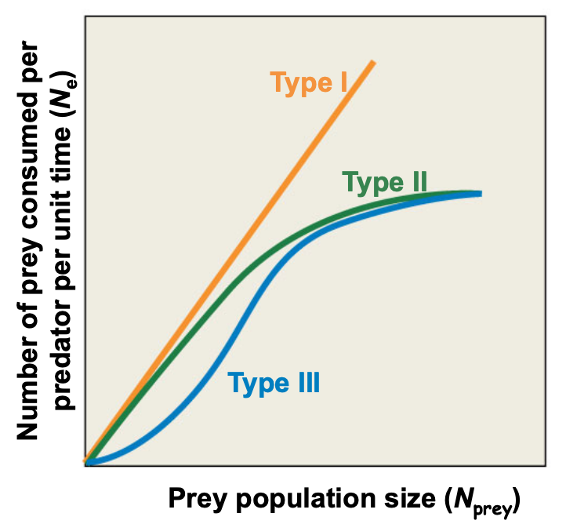
Which of these predator-prey curves is most common in nature and why?
Type 2 - because predators are constrained by their unchangeable handling time
How does dispersal stabilise predator-prey population dynamics?
Leads to metapopulations, meaning that predators have less pervasive influences
Three factors leading to variable predatory-prey population dynamics
Metapopulations
Predators targeting demographically unimportant individuals
Co-evolution
HSS theory
Takes a top-down view, stating that predators reducing herbivore populations allows plants to dominate and produce green habitats. Plants more dominant in odd-numbered food chains.
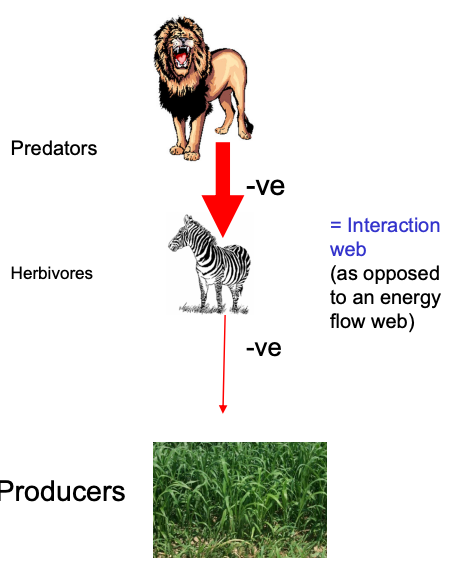
Bottom-up view
Abundance of energy at lower trophic levels determines those that can live above
Example of bottom-up trophic cascade
Lake Washington daphnia control
Example of top-down trophic cascade
Wolves in Yellowstone
What is a limitation of the HSS theory?
In many places plants have developed anti-herbivory adaptations and compensations for damage e.g. kawakawa being estringent
What are some plant compensations for damage?
Reduced death rate of plant parts, self-thinning, changed allocation of photosynthate
What chemical defences does rimu exhibit?
24% of their weight is tannins and >12% of their weight is terpenes, making them very estringent
What is an example of a plant physical defence?
Matagouri and harakeke being spiky
What is the tradeoff of chemical defence in plants?
More energy invested in chemical defence = slower growth rate
Deer impact on vegetation in NZ
Little diversity in lower canopy with lots of shrub removal, and inedible crown ferns now make up a high proportion of forest composition
Intraguild predation
One species predates upon (kills and eats) another species which competes for similar resources
Why are trophic cascades likely greater in aquatic than terrestrial systems?
Because phyto/zooplankton don’t have defence mechanisms the way terrestrial plants do
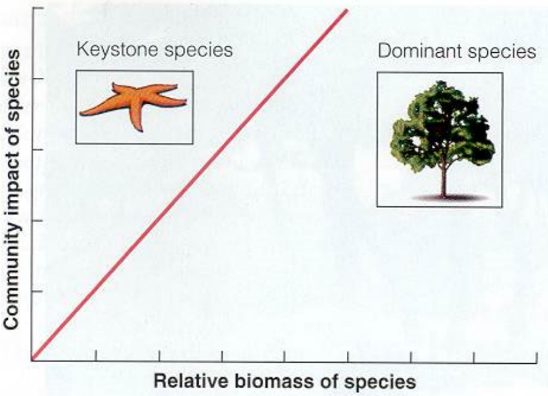
Keystone species
Species that function in a unique and significant manner, with an outsized ecological impact compared to their numeric abundance e.g. beavers and cassowaries
Why are cassowaries regarded as a keystone species?
Because many plant species rely on them for seed dispersal and germination. Cassowaries are the only species large enough to swallow some species’ seeds, and others rely on the cassowary’s digestive process to germinate.
Evenness
The abundances of different species in a system in relation to one another
Why was the intermediate disturbance hypothesis observed with Littorina snail predation in closed tide pools but not on exposed platforms?
On exposed platforms species richness peaks at lower snail density because the harsher environment is subject to greater environmental stressors, thereby alleviating competition
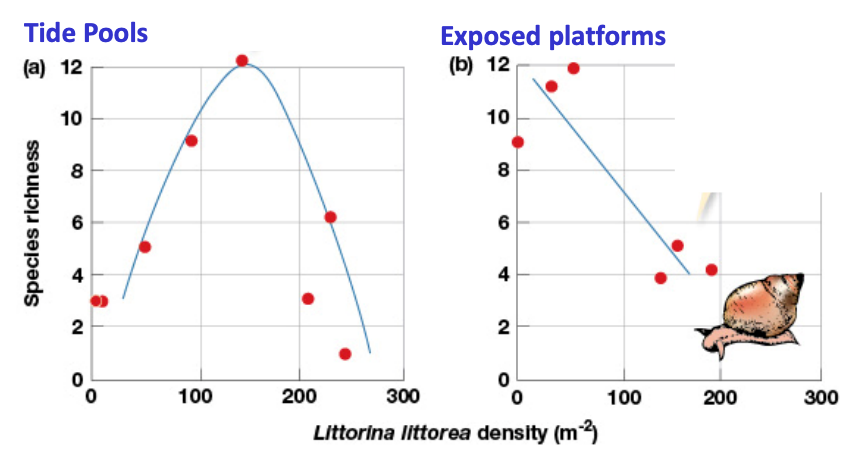
If a preferred prey is competitively dominant, when does prey species richness peak? (think Littorina snails in tide pool)
At intermediate predation densities
What effect does predation intensity have on prey richness if there is no competitive dominance among prey?
Increasing predation intensity reduces prey richness
Predator-mediated coexistence
A keystone predator prevents its preferred prey from outcompeting every other species and achieving complete system domination
Example of predator-mediated coexistence
Pisaster starfish preferentially feeding on competitively dominant Mytilus mussel
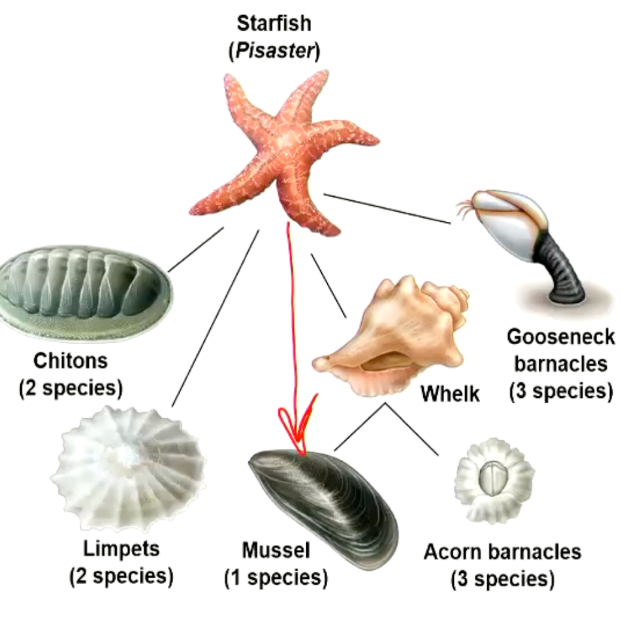
Main difference between community dominant and keystone species
Dominants are more numerically abundant
Direct interactions
When two species interact e.g. predation, mutualism, or interference competition
Interference competition
Where one species out-competes another, restricting its access to food
Indirect interaction
Where one species affects another via their effect on a third species. May arise throughout an entire community because of a single direct interaction between two component species
Exploitation competition
Consumer 1 decreases consumer 2 by eating their shared resource e.g. wasps competing with geckos for honeydew
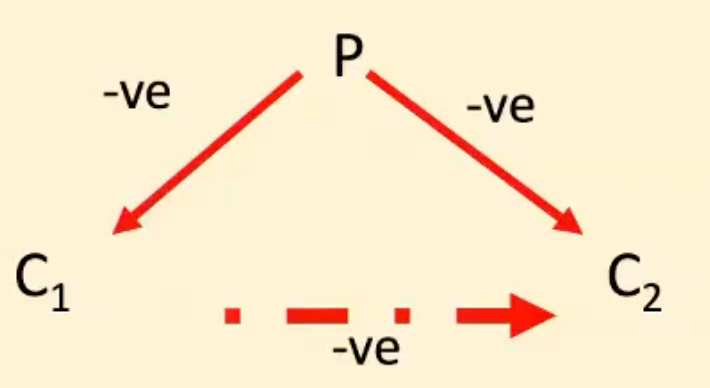
Apparent competition
Two different prey species indirectly effect one another by their impact on the population size of their shared predator
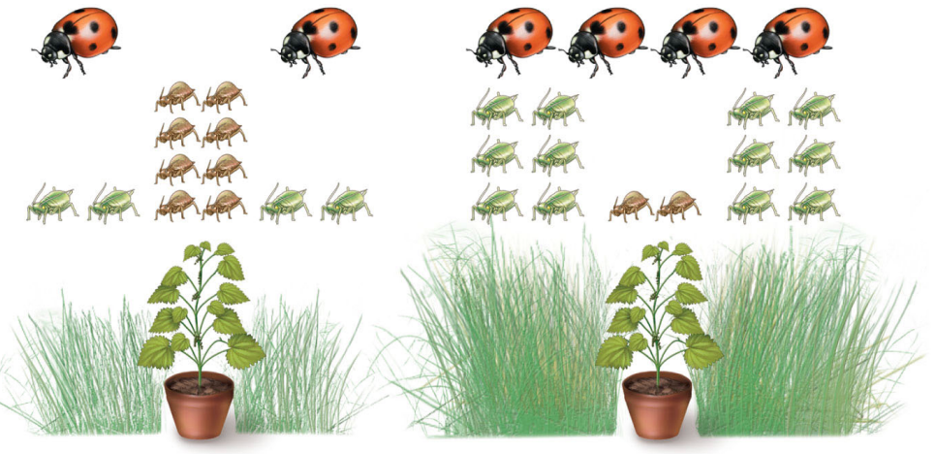
Example of apparent competition
In fertilised plot, grass aphid showed up in greater numbers, therefore bringing more predatory ladybugs, which then decreased the population of nettle aphids. Negative interaction between grass aphids and nettle aphids
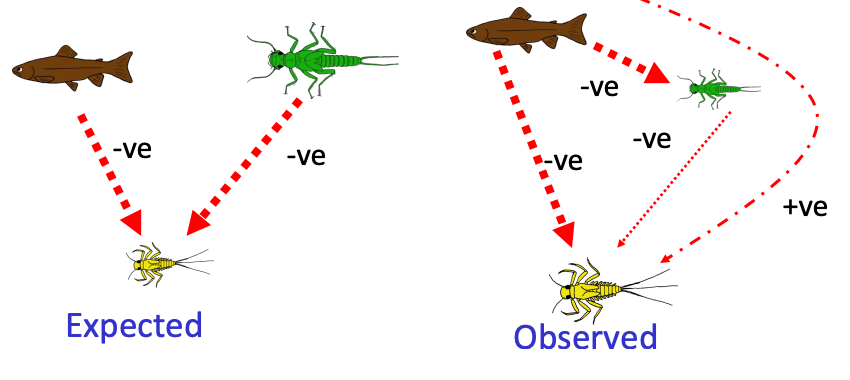
Interaction modification
Where one species modifies the effect of another, influencing a third interaction
Example of interaction modification
Trout feeding on stoneflies, having an indirect positive effect on mayflies
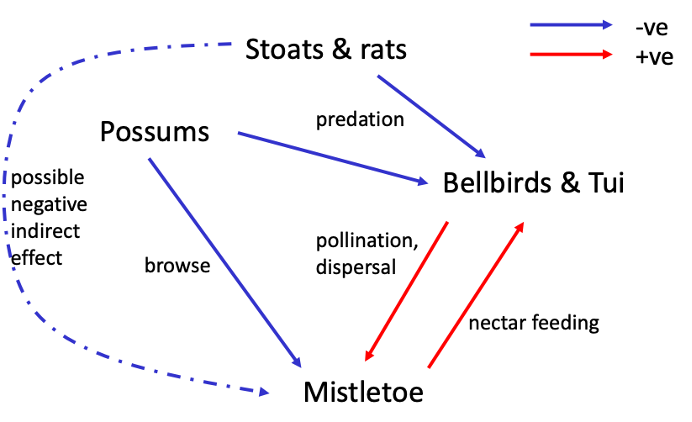
Conservation example of complex indirect interactions
Stoats and rats negatively indirectly affect mistletoe by decreasing pollinator bird populations
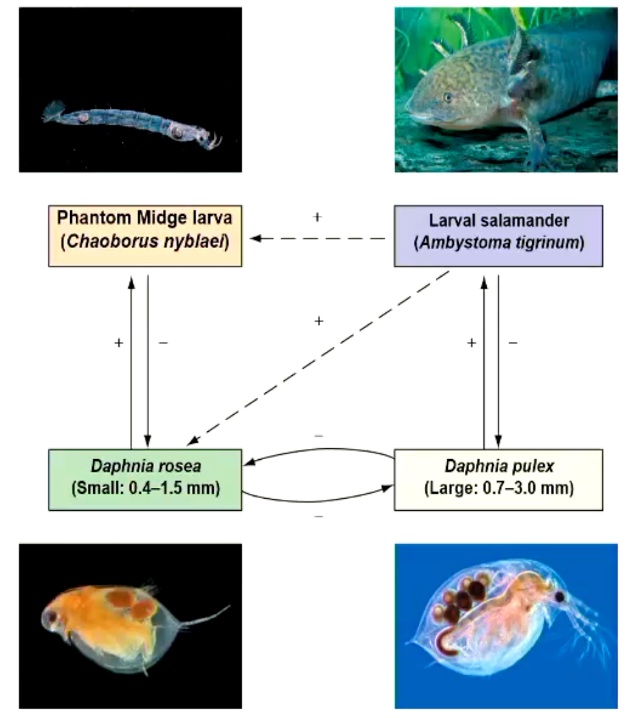
Example of indirect commensalism
When salamander was removed from a pond, Daphnia pulex out-competed Daphnia rosea so it went extinct, and the Phantom Midge larva now had nothing to eat and also went extinct. Beneficial to midge, neutral to salamander
Network theory
Number of species, links, and maximum number of links in a food web.
Connectance
Proportion of possible links that are realised
Linkage density
Average number of links for each species in the web
How can omnivory be thought of?
A species’ ability to adapt to the loss of a species that they rely on
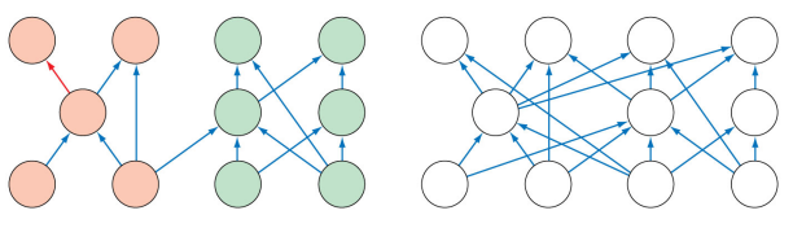
Compartmentalisation
Tendency for species to interact more strongly and more frequently among themselves than with other species in community. Often organised around body size
When is a community said to have stability?
When it remains in or returns to the original structure and function after some disturbance
Disturbance
Any relatively discrete event that disrupts community structure and function
Variability
How much the community changes in time or space
Resistance
A community’s ability to not change from disturbances
Resilience
The time it takes for a community to return to its normal state after a disturbance
Findings of McIntosh’s stream stability experiment
Resistance to disturbance consistently increased with stream size, but resilience was significantly higher in smaller streams for some response variables. However, smaller streams were overall more variable
Alternative stable state
The state which a community can be put into following a sufficiently large disturbance
Hysteresis
The energy/resources required to return the system to its natural state
Causes of Lake Ellesmere’s alternative stable state
Big storm ripped up the macrophytes (water plants) which would have shielded from waves. Waves could now disturb more, suspending the sediments, leading to a constant turbid state
Factors improving food web stability
Species richness, presence of highly connected species, and compartmentalisation
Energetic hypothesis
Length of food chain is limited by basal energy supply, and most chains are short because energy is lost between trophic levels
Dynamic stability hypothesis
Food chains will be shorter in more variable environments, as long food chains take longer to recover
Ecosystem size hypothesis
Larger systems should have longer food chains because of their greater habitat heterogeneity and ability to support compartmentalized food webs
Limitation of ecosystem size hypothesis
It has gone largely untested in wetland and stream ecosystems
Findings in Lake Cayuga, upstate NY
Consumers at higher trophic levels had higher concentrations of heavier nitrogen isotopes. Stable isotopes were used to calculate the maximum food chain length in each ecosystem
What does the instability of long food chains mean for top predators?
Fluctuations cause extinctions of top predators
Despite its high productivity, why does Lake Ellesmere support a relatively short food chain?
Its inhabitants have invested lots of energy in defence mechanisms, so there is little energy available - so its tuna are relatively small
Redundancy
When different species share the same traits
Interaction facilitation
Where species within and between the groups are contributing to the success of the others
Complementarity effect
Species have different niches, so use resources in a different way. More resources are used, so ecosystems has a higher ‘function’
Sampling effect
Finding an ecosystem that is species-rich has a higher probability of containing species with high ‘functioning’. Difficult to distinguish from complementarity
Redundancy effect
Once species richness reaches some threshold, additional species are redundant
Facilitation effect
Species have a positive effect on other species functioning
Case study of high redundancy: Amazon headwaters in Venezuela
Areas of river without a certain fish species had very high sedimentation, as they are critical in cycling carbon with their migration
Case study of why ecosystem functioning is important
Nutrient enrichment leading to algal blooms in Mississippi and Missouri rivers, creating anoxic conditions
‘Chicken or egg’ question around diversity/function
Does diversity cause function, or function cause diversity?
Lake Victoria nile perch case study - why such a severe extinction?
Nile Perch is a large, omnivorous generalist predator. They hadn’t co-evolved with the local cichlids, leading to more than half of the 200 local species going extinct
Big South Cape island invasion case study
1963 rat invasion led to extinction of Stewart Island snipe, Stead’s bush wren, and the greater short-tailed bat
Traits displaying lack of native bird co-evolution with predators
Nesting on ground, and competing with one another for resources
Example of how invaders impact ecosystem functions and services
Rats kill Titi, who line their burrows with leaf litter. Therefore leaf litter is not cleared away and accumulates on the forest floor