dpt anatomy - back 2
 Call Kai
 Learn
Learn Practice Test
 Spaced Repetition
 Match
Match Flashcards
 Knowt Play
1/32

There's no tags or description
Looks like no tags are added yet.
Name | Mastery | Learn | Test | Matching | Spaced | Call with Kai |
|---|
No analytics yet
Send a link to your students to track their progress
33 Terms
suboccipital triangle is located
deep to semispinalis capitis
between occipital bone and posterior aspects of C1 and C2
the spinal cord is a continuation of
the medulla oblongata (part of the brainstem) that extends from the foramen magnum at the base of the skull
where does spinal cord extend to and what does it terminate as
extends down to L1/L2 vertebral level
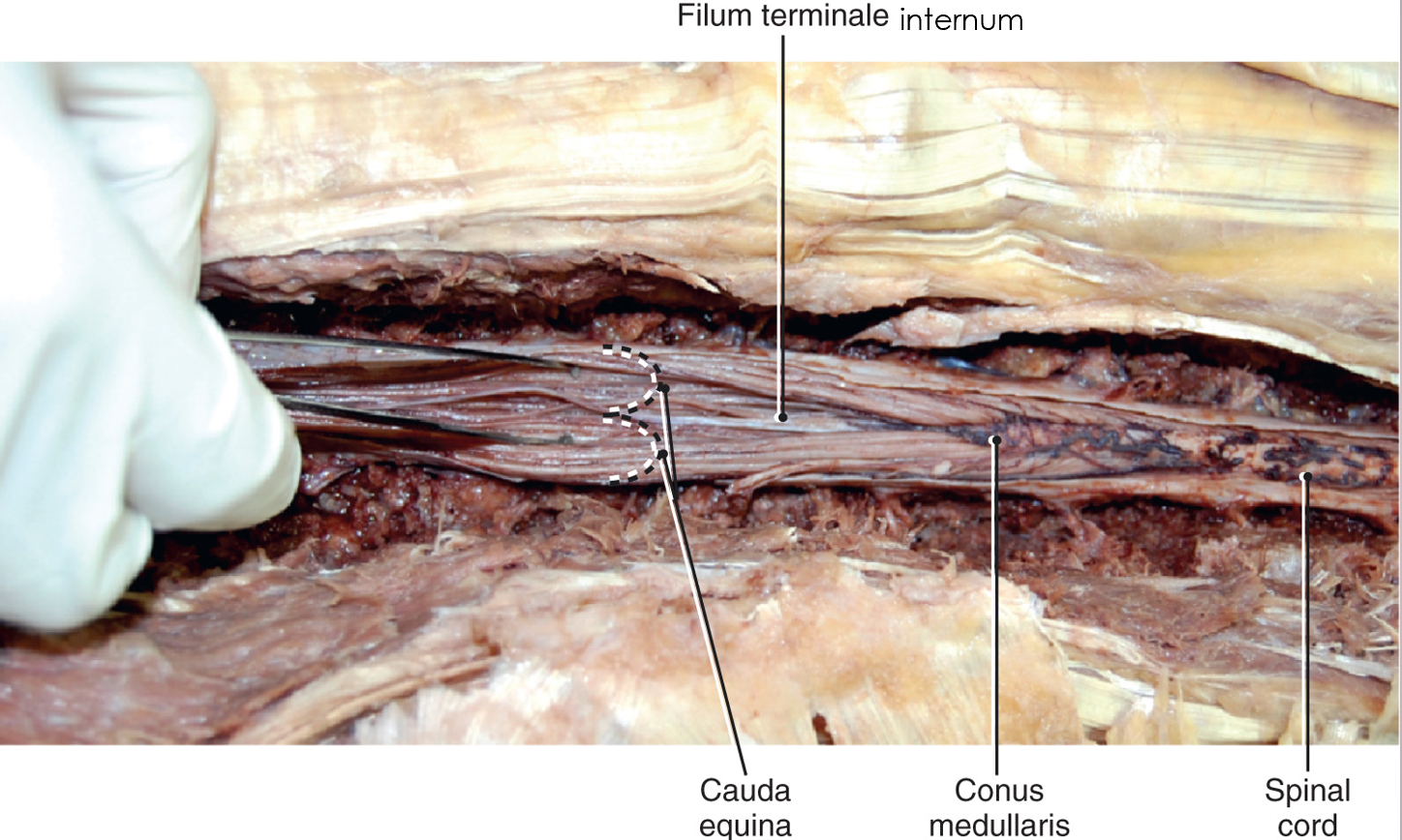
terminates as conus medullaris
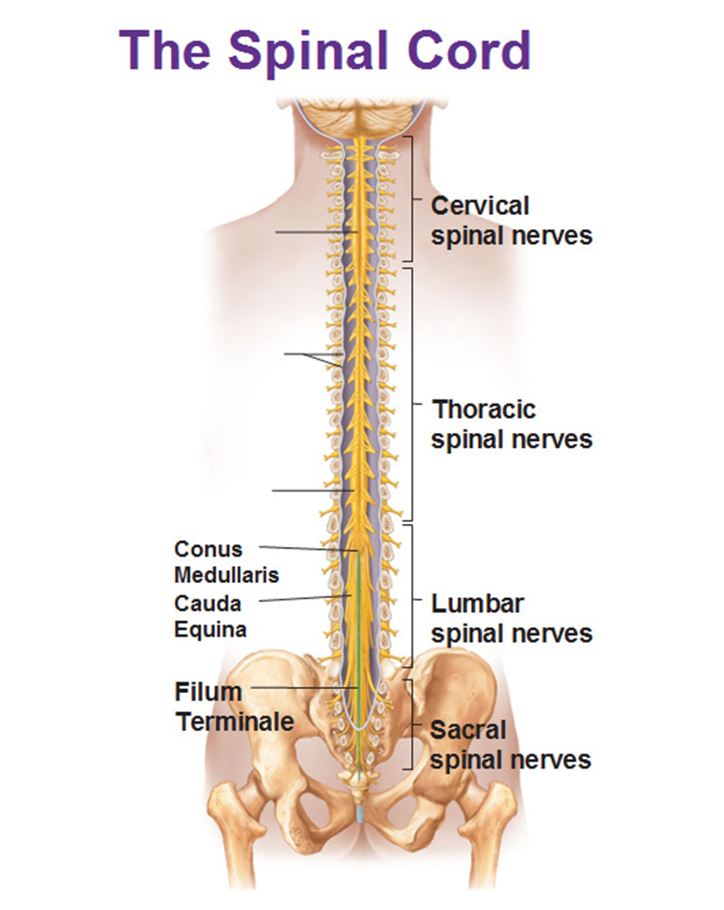
what is cauda equina
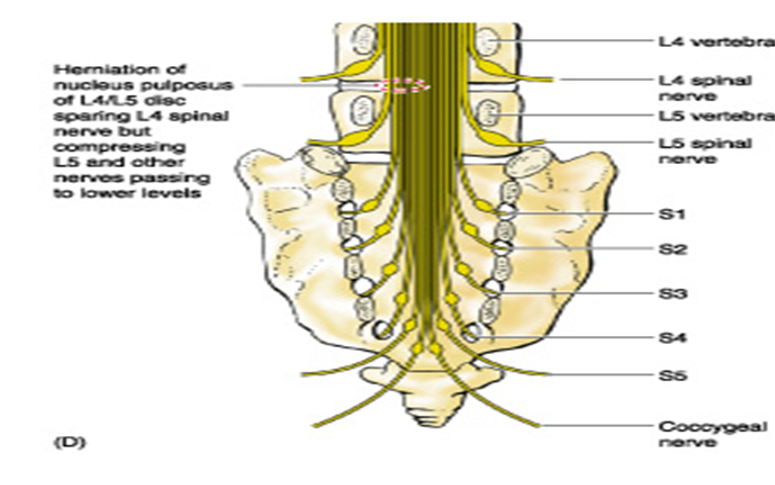
a collection of dorsal and ventral roots that will from spinal nerves but that need to exit through intervertebral foramina that are below the vertebral level of the conus medullaris
how many cervical, thoracic, lumbar, sacral, and coccygeal segments does the spinal cord contain
8 cervical
12 thoracic
5 lumbar
5 sacral
1 coccygeal
each spinal cord segment gives rise
dorsal and ventral roots that join together to form a spinal nerve
what is each spinal nerve responsible for
contributing to the innervation of a specific myotome and dermatome
the spinal cord is covered by
3 layers of meninges
dura mater
arachnoid mater
pia mater
dura mater
outer tough collagenous tissue that encloses the spinal cord and the cauda equina
dura mater is continuous with ___ and extends to ___
continuous with dura of the brain at the foramen magnum and extends as a tube down to S2 (we call this the end of the dural sac)
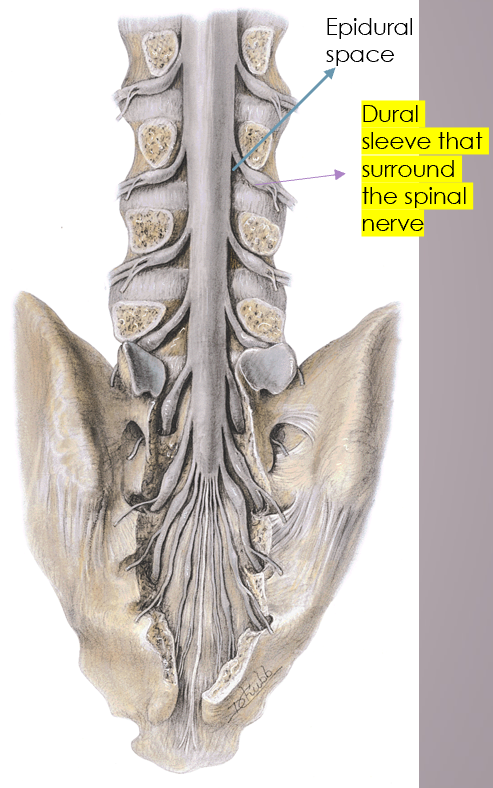
dural sleeves
extends out around spinal nerves as they exit, then dura blends with epineurium of nerve
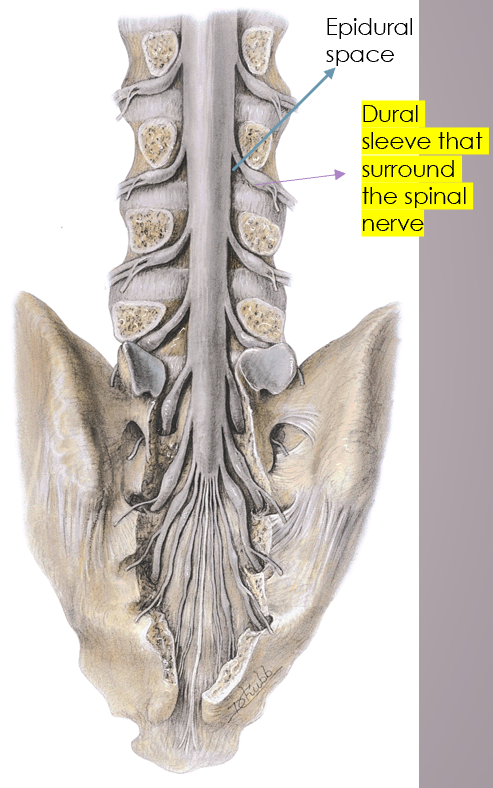
epidural space
space between the dura and the bony interior of the vertebral canal
subdural space
space between the dura mater and the arachnoid layer
where is the arachnoid mater located
lines the inside of the dural sac and extends as a web through subarachnoid space to attach to the pia mater
what is the subarachnoid space and what does it contain
space between arachnoid and pia mater
contains cerebrospinal fluid
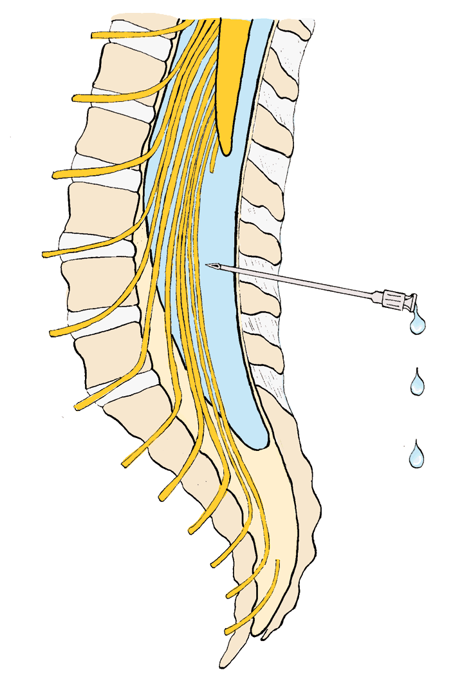
lumbar cistern
subarachnoid space between L2-S2
good place to get fluid samples (safest to get fluid from L4 and below during spinal tap)
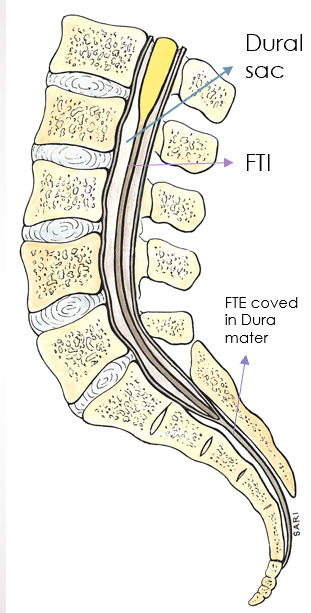
contains cauda equina and filum terminale internum
pia mater
bound to the surface of the spinal cord and nerve roots
pia mater continues as
filum terminale internum (FTI) inferior to the conus medullaris
FTI is surrounded by cauda equina until it reaches the end of dural sac at S2
denticulate ligaments
lateral projections of the pia mater that form triangular shaped ligaments that extend from the spinal cord to the internal surface of the dura mater
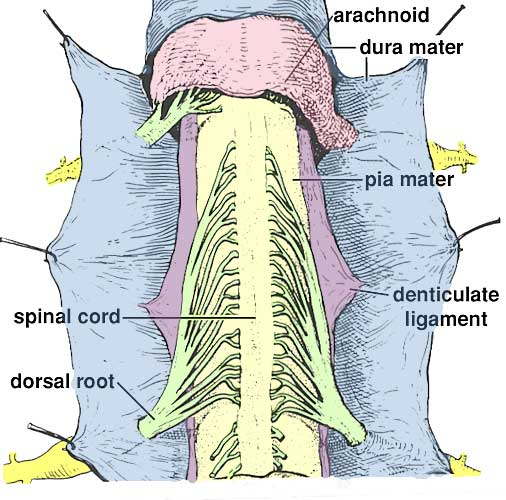
function of denticulate ligaments
stabilizing
how many pairs of denticulate ligaments are there
21
where are dorsal and ventral roots in relation to denticulate ligament
dorsal roots are on posterior sides of denticulate ligaments
ventral roots are on anterior side of denticulate ligaments
what happens to the filum terminale internum at the end of dural sac
FTI passes through (and gains a layer of dura) and continues as filum terminale externum (FTE)
FTE continues inferiorly and attaches to coccyx as the coccygeal ligament
enlargement of spinal cord are in
cervical and lumbar
bc there are so many axons that need to exit in the lower cervical and lumbar region
why is cervical and lumbar enlargement clinically important
the enlargement might be more susceptible to having compression at the spinal nerves
where do cervical nerves exit?
above their corresponding segment
i.e. C2 spinal nerve exits above C2 (through the intervertebral foramen between C1 and C2)
C8 exits BELOW C7 (between C7 and T1)
where do thoracic, lumbar, sacral, and coccygeal spinal nerves exit?
BELOW their corresponding spinal vertebra
i.e. T 1 spinal nerve exits below T1 (through intervertebral foramen between T1 and T2)
why are lumbar and sacral roots the longest
because they are the farthest from the intervertebral foramina where they will exit
how does herniated disc affect the vertebra
when small, an HNP usually affects spinal nerve whose number corresponds to the number of the vertebra below the disc
i.e. HNP at L5/S1 (most common) will usually affect S1
spinal block (anesthesia)
inject into subarachnoid space for child birth
inferior to waist level
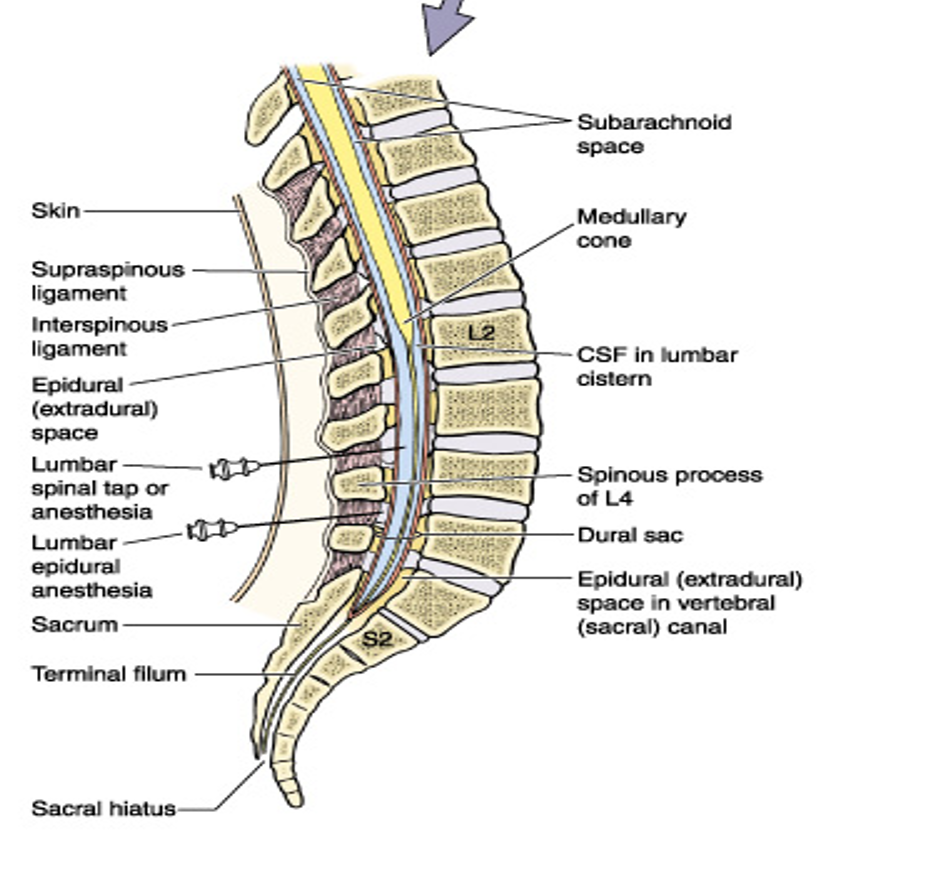
epidural block
inject into epidural space
doesn’t go into SC or CSF
can target a region
common during childbirth as they can target L3/L4 level (anesthesia for uterus and cervix) but doesn’t affect lower limbs as much
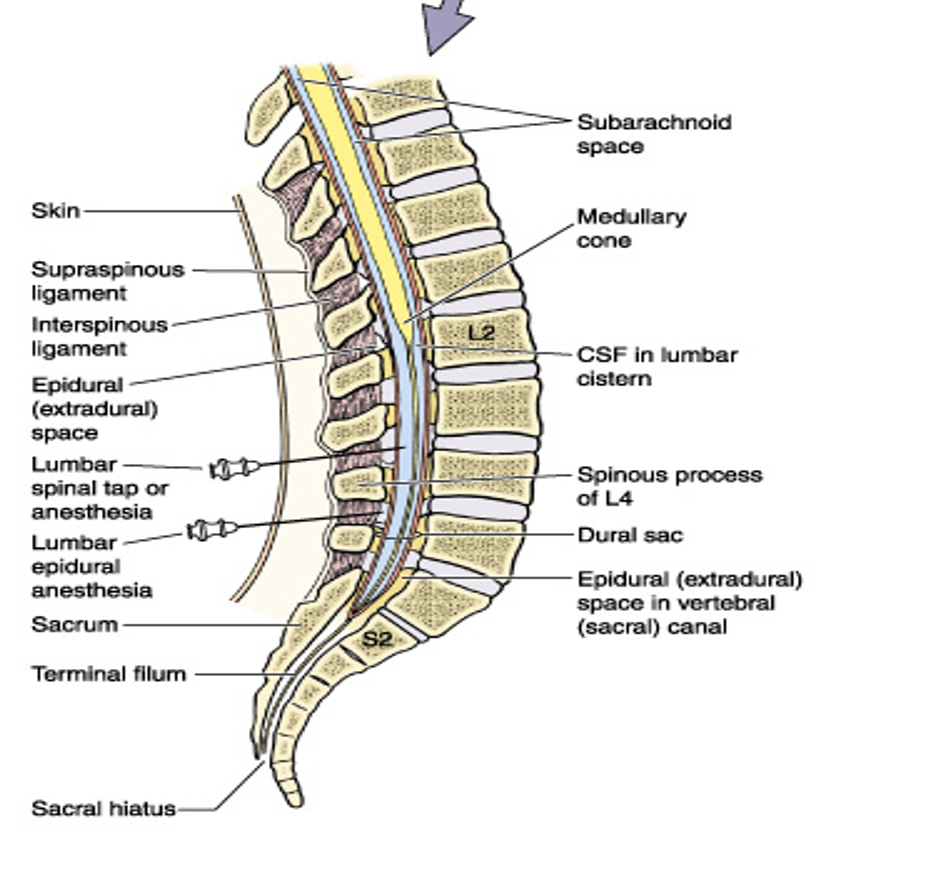
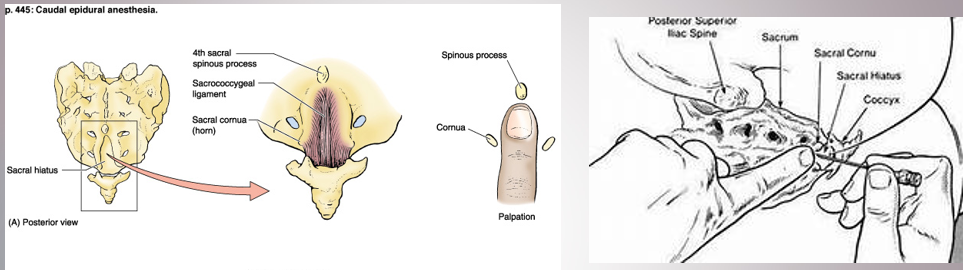
caudal epidural anesthesia
acts on S2-Co1 spinal nerves
injected into sacral canal via sacral hiatus
pudendal nerve block - popular for childbirth - bathes S2-4 spinal nerves so can’t feel birth canal, pelvic floor, but usually doersn’t affect lower limbs so patient can participate