SAM3.2: Optho Eyelid
 Call Kai
 Learn
Learn Practice Test
 Spaced Repetition
 Match
Match Flashcards
 Knowt Play
1/78

There's no tags or description
Looks like no tags are added yet.
Name | Mastery | Learn | Test | Matching | Spaced | Call with Kai |
|---|
No analytics yet
Send a link to your students to track their progress
79 Terms
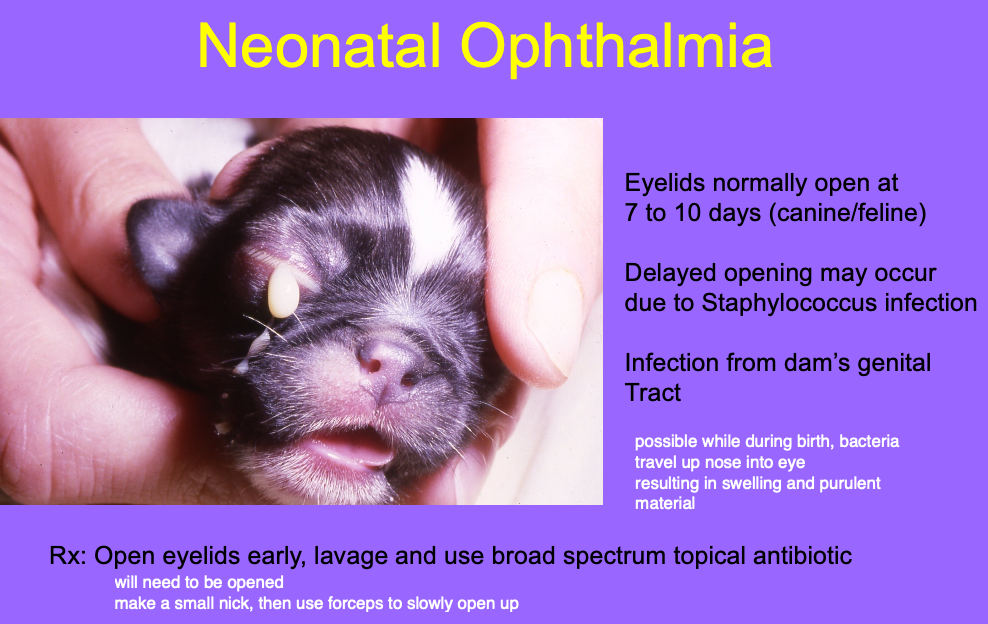
Neonatal Ophthalmia: Opening of the neonatal eyelids
normal: 7-10d (feline, canine).
Delayed opening may occur due to Staphylococcus infections - usually from dams genital tract.
Neonatal Ophthalmia Tx of delayed opening (3)
Open eyelids early.
Lavage.
Use broad spectrum topical ABX.
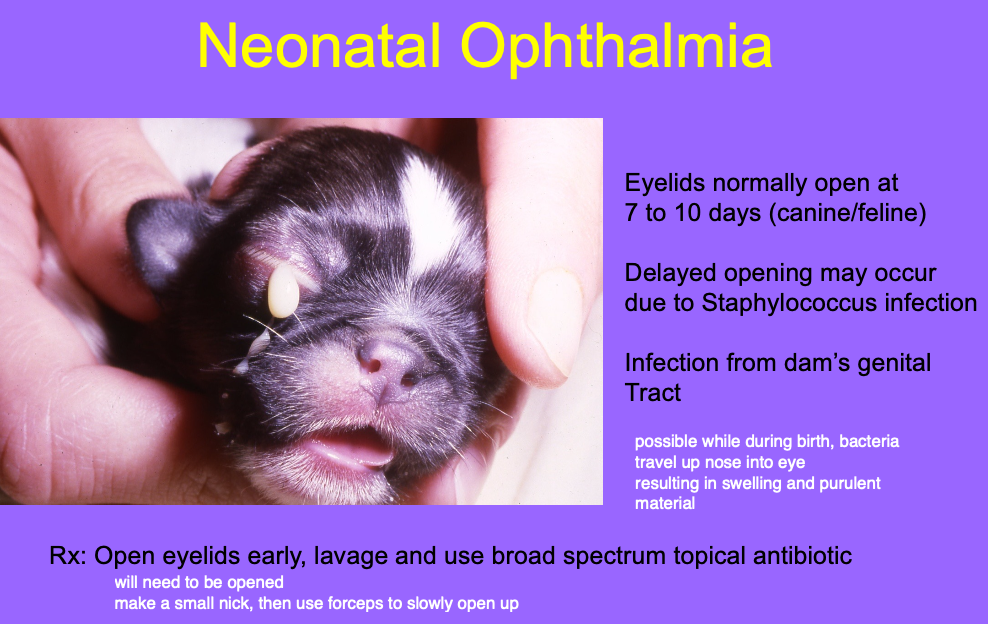
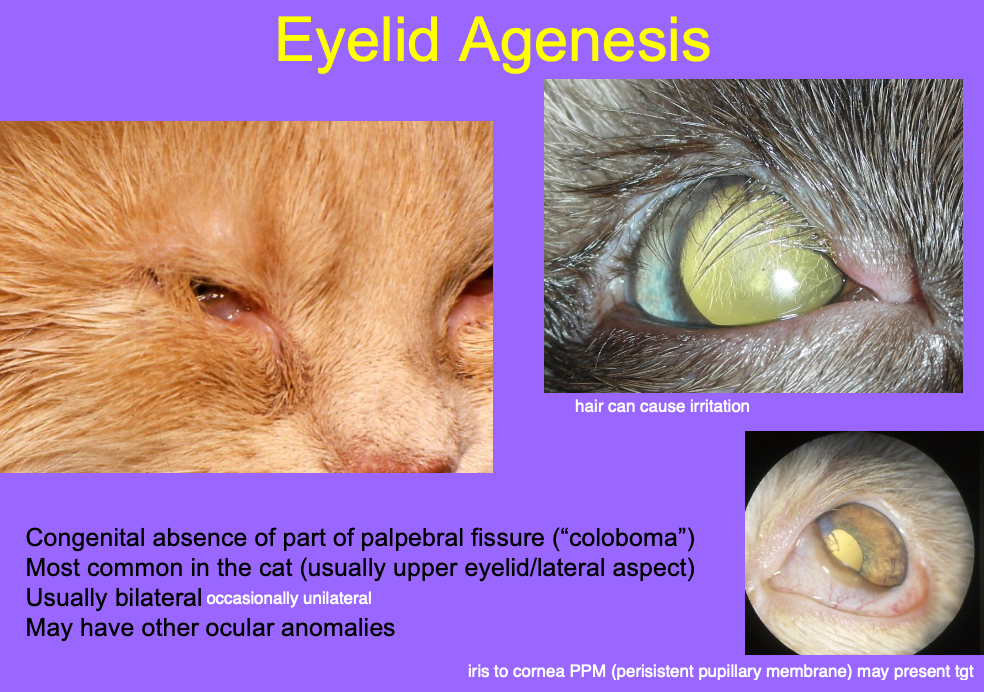
Eyelid agenesis is
congenital absence of part of palpebral fissure
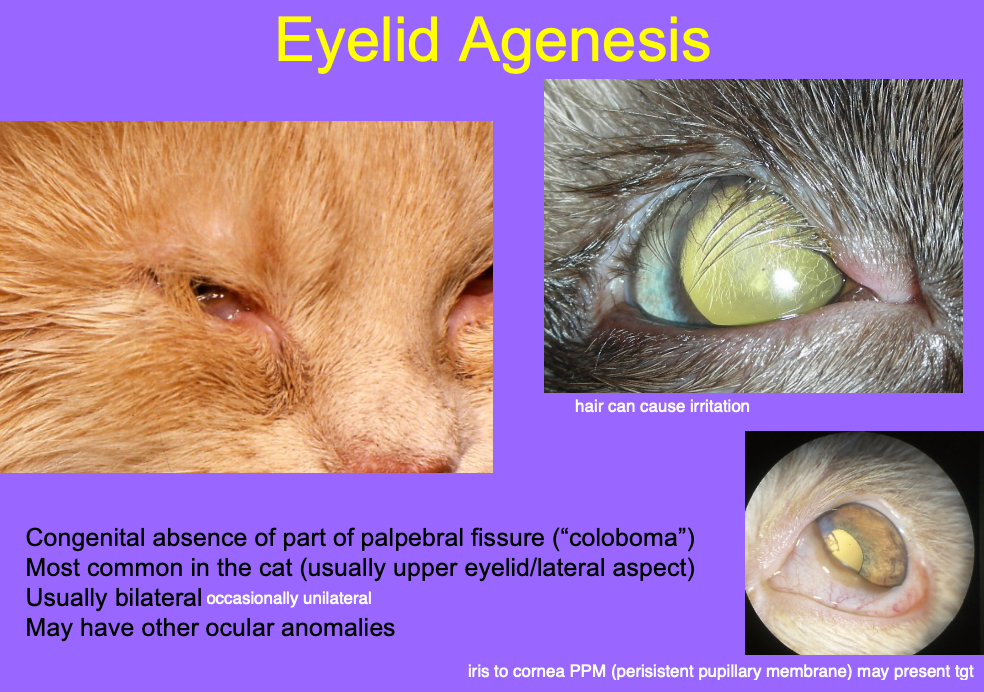
Eyelid agenesis is more common in
cats - usually upper eyelid/lateral aspect.
Eyelid Agenesis details (2)
Usually bilateral
May have other ocular anomalies (e.g. iris to cornea PPM)
Tx for Eyelid Agenesis
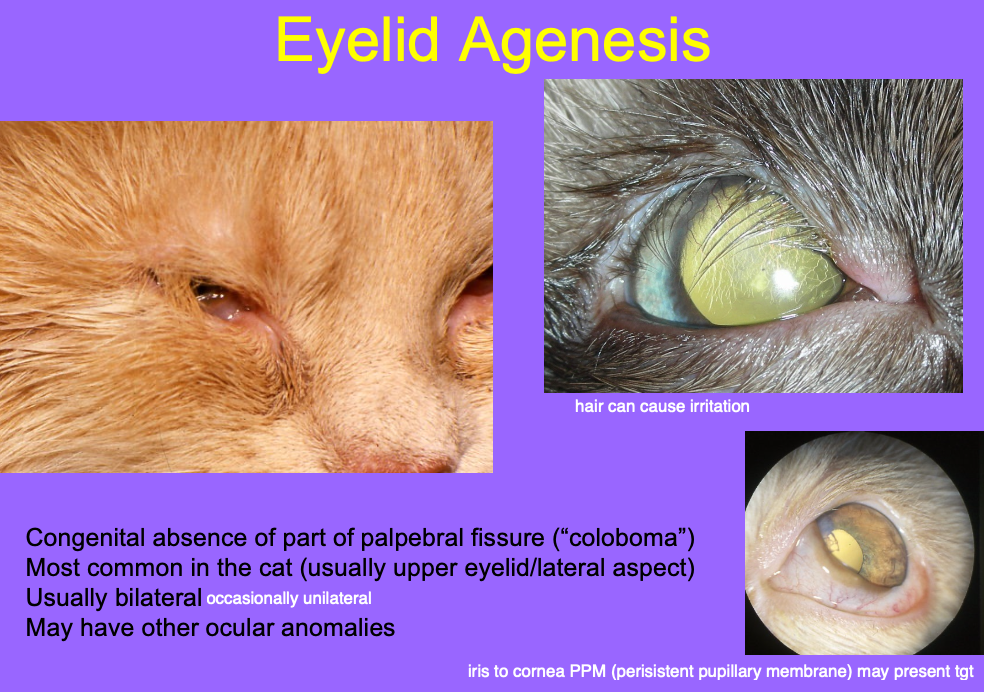
Ophthalmic lubricants.
Surgical repair: cryosurgery of offending hairs, grafts.
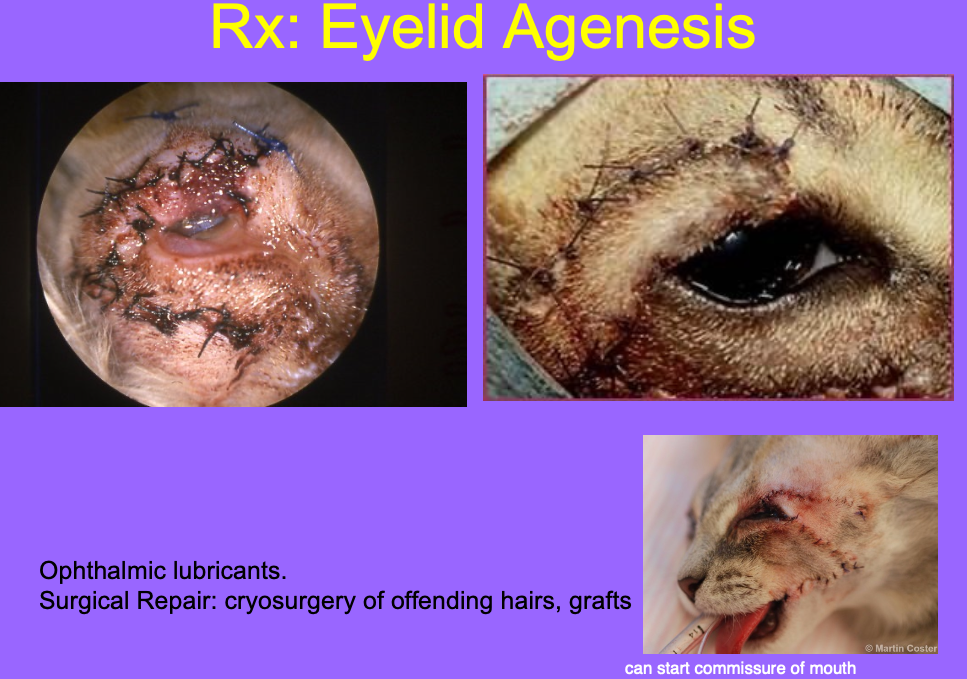
Entropion def
Inward rotation of part, or all of the eyelid margin.
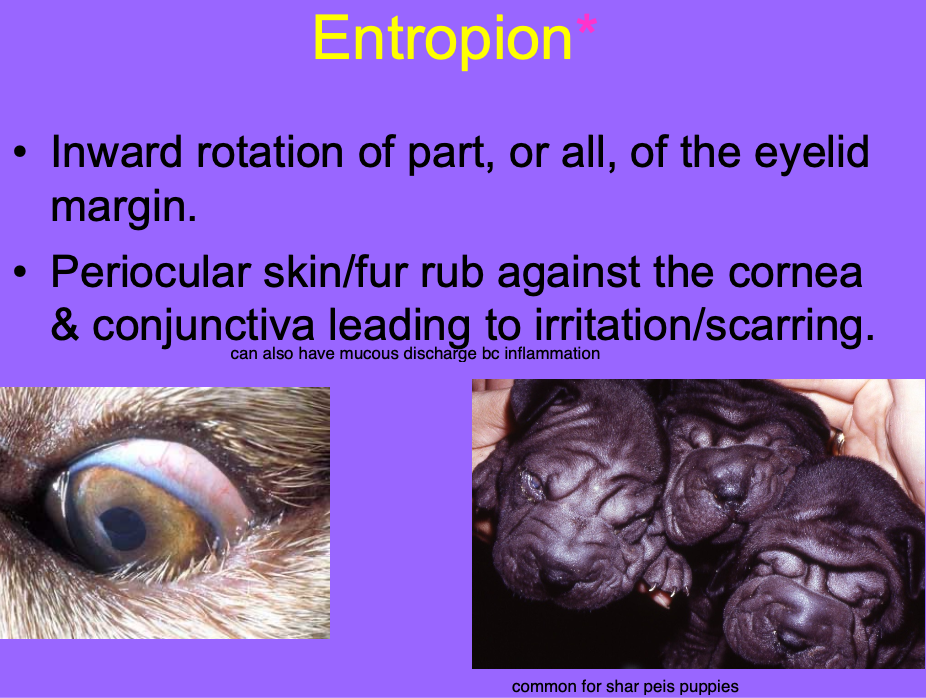
Pathophys of entropion
Periocular skin/fur rub against the cornea and conjunctiva leading to irritation scarring.
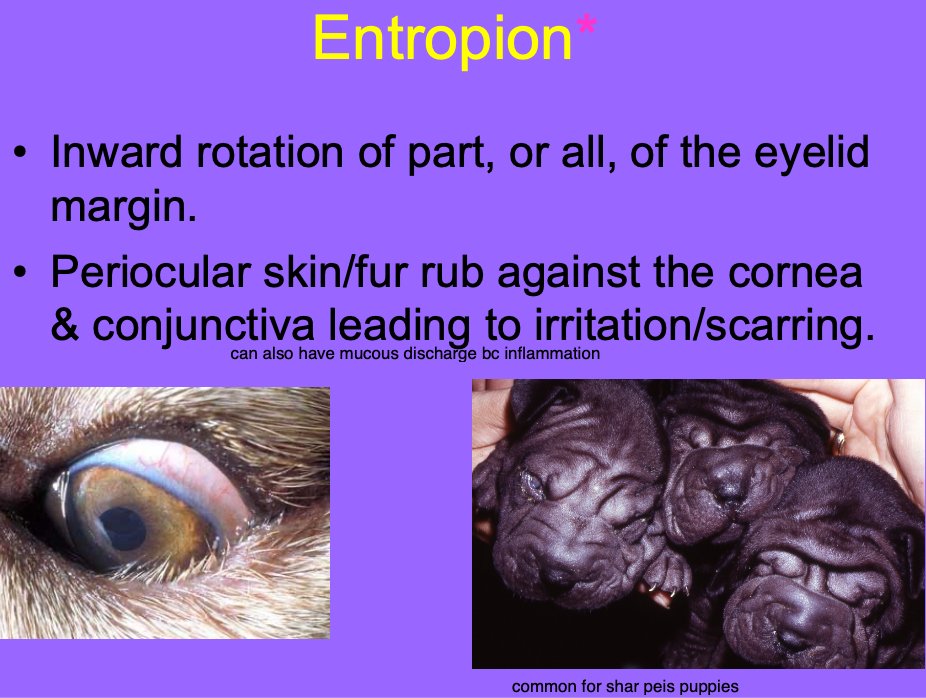
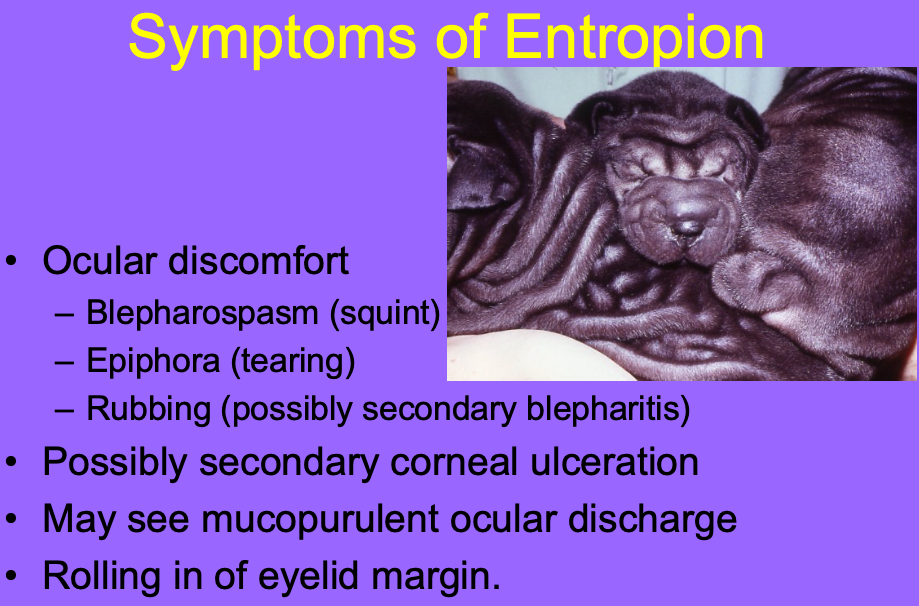
Symptoms of entropion
Ocular discomfort (blepharospasm - squint, epiphora - tearing, rubbing)
Secondary corneal ulceration
Mucopurulent ocular discharge
Rolling in of eyelid margin
Chronicity can lead to pigment loss of eyelid
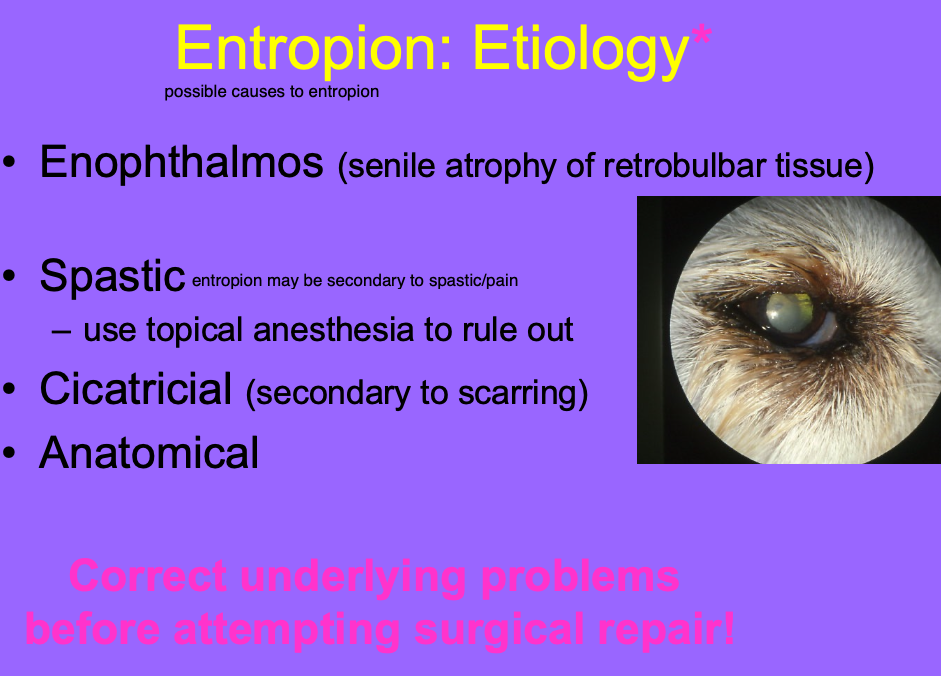
Entropion etiologies (4)
Enophthalmos - senile atrophy of retrobulbar tissue.
Spastic.
Cictrical (secondary to scarring).
Anatomical.
Spastic entropion can be R/O
w/ topical anesthetics.
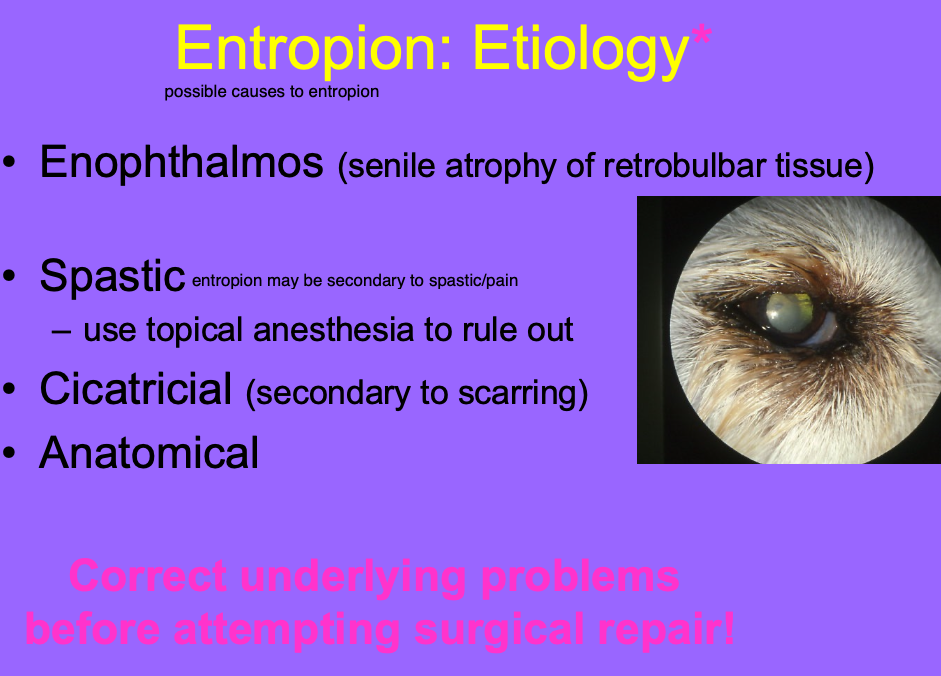
Entropion: before doing sx repair
correct underlying problem
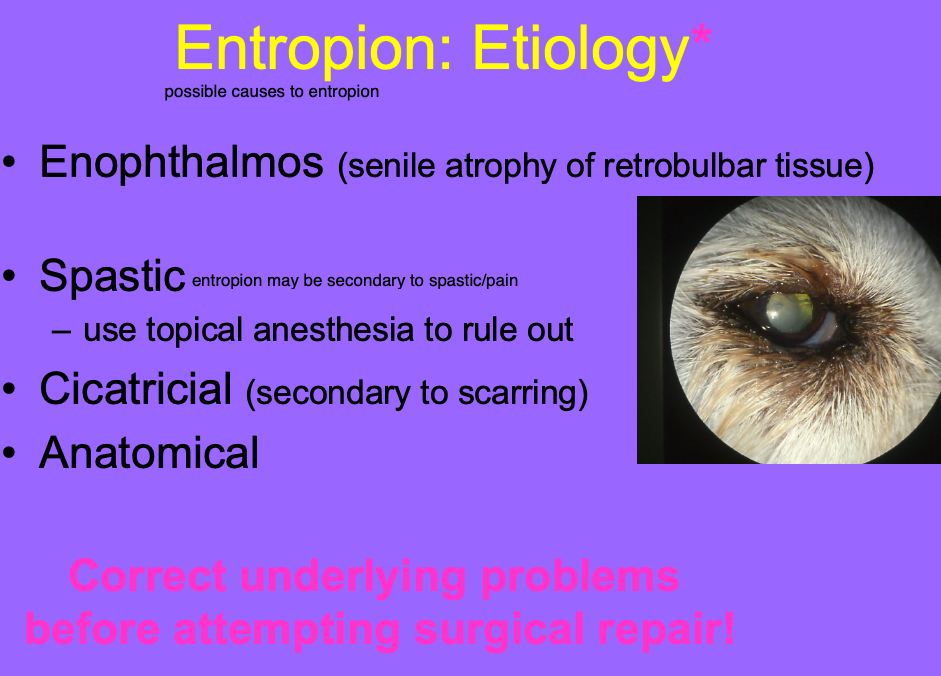
Eyelid tacking procedure for entropion
Surgical staples or suture to every eyelid margin.
Temporary relief or use while growing.
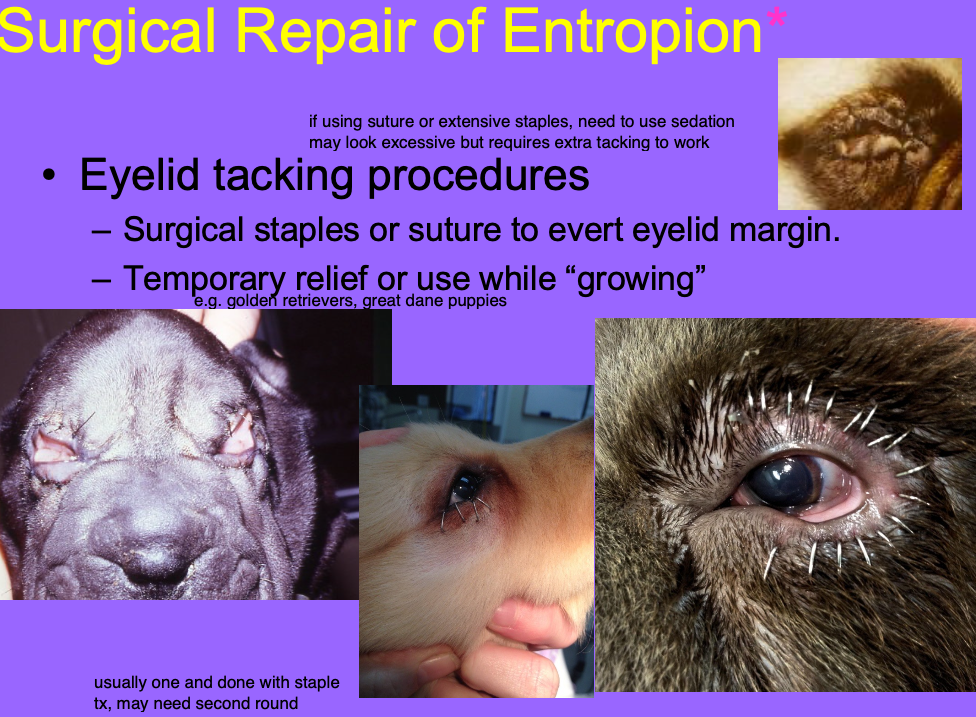
Eyelid tacking procedure: Suturing
Sutures should NOT go through conjunctiva.
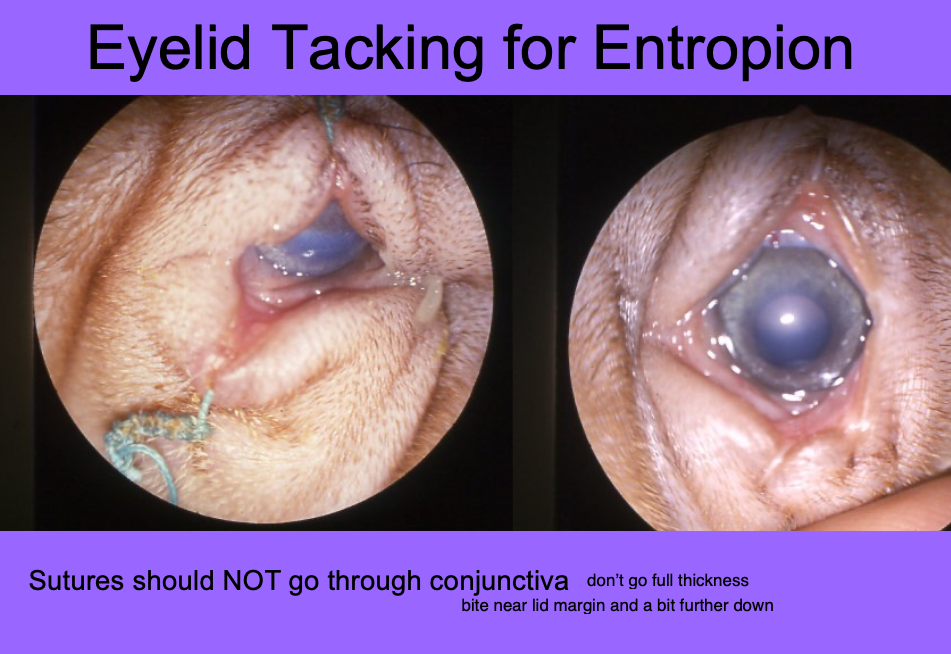
Hotz-Celsus surgical tx
“pinch” technique
use small suture and place closely tgt
avoid overcorrection!
good for older dog when staples cannot be used
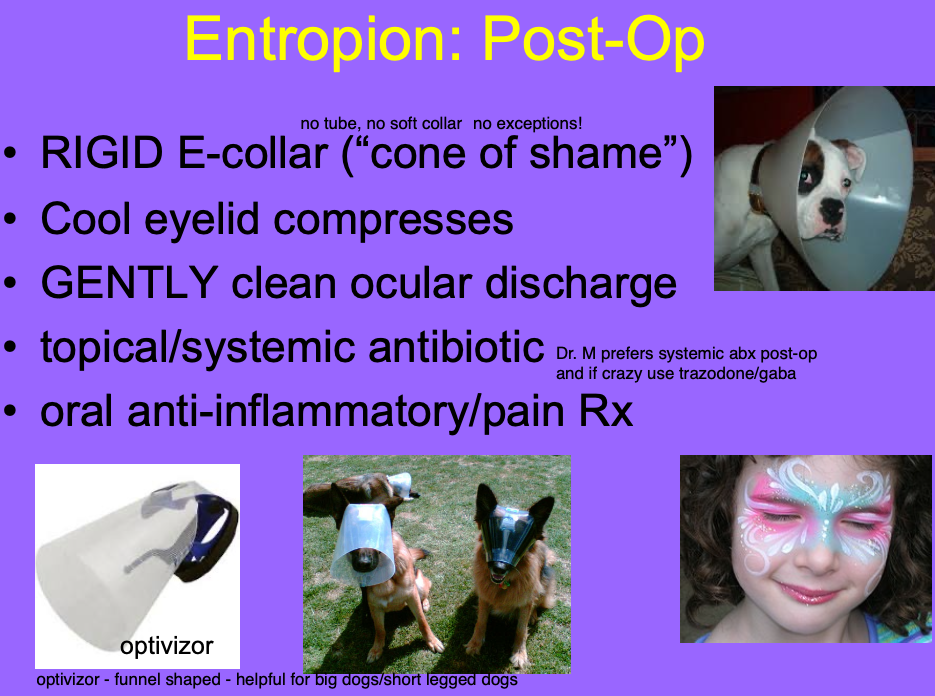
Post-op for Entropion (5)
Rigid E-collar.
Cold eye compresses.
Gently clean ocular discharge.
Topical/systemic ABX.
PO anti-inflammatory and PM.
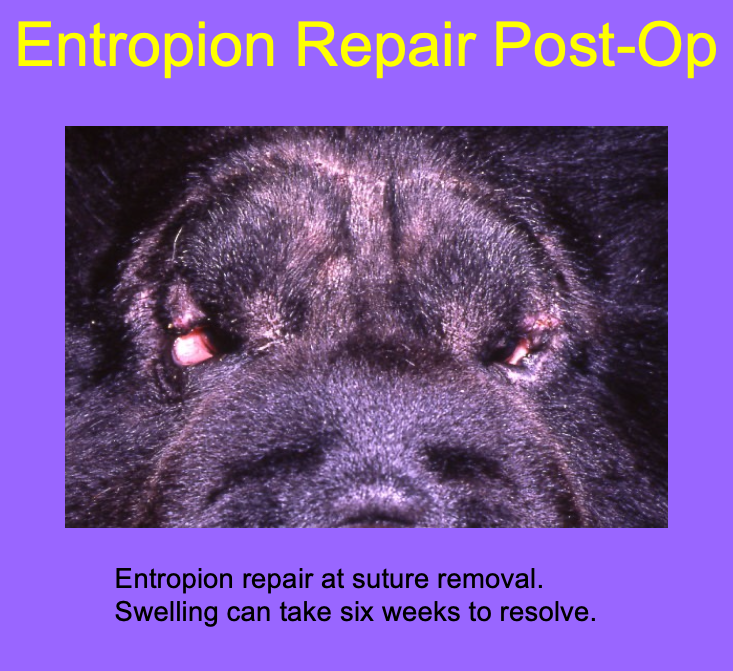
Post-op swelling for entropion
can take up to 6wks to resolve.
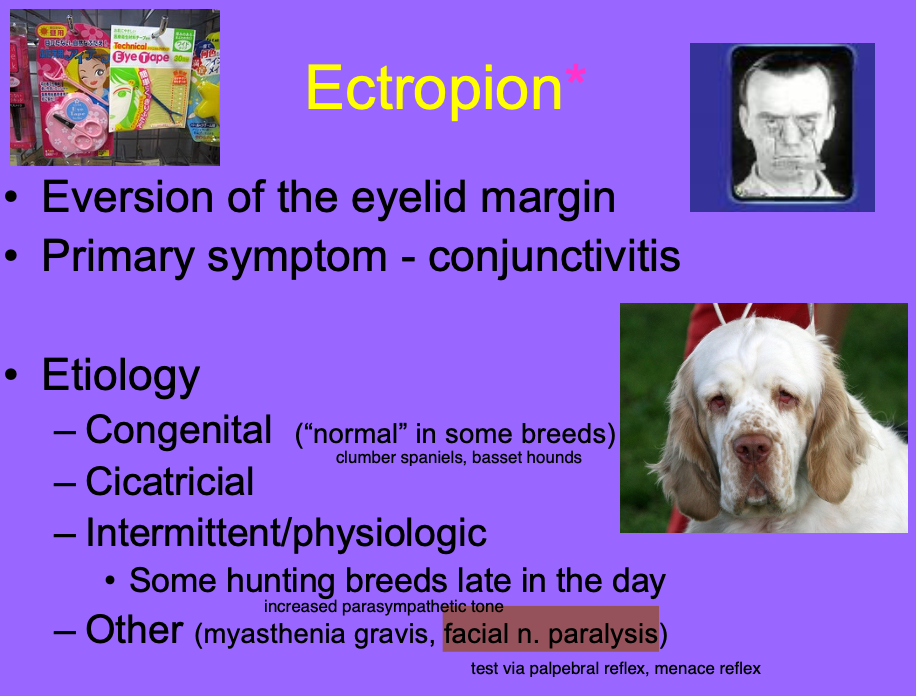
Ectropion is
eversion of the eyelid margin
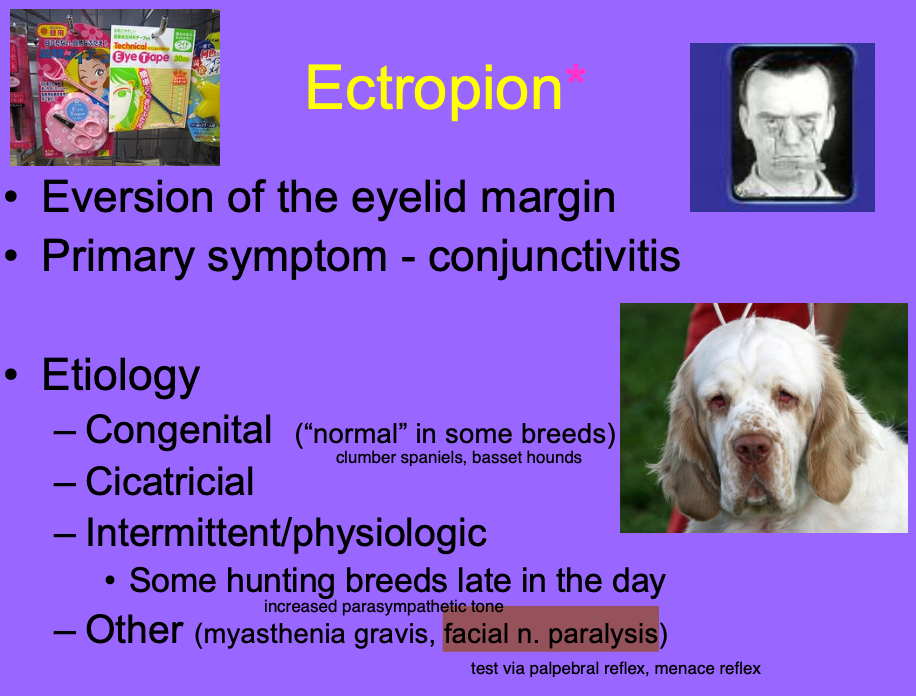
Ectropion primary symptom
conjunctivitis
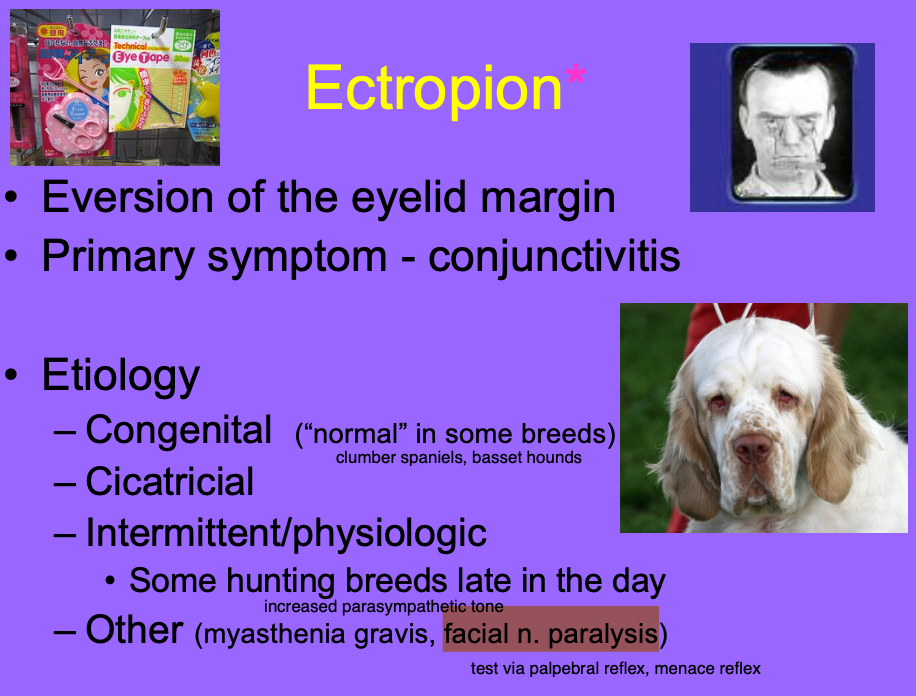
Etiology of Ectropion (4)
Congenital.
Cicatricial.
Intermittent/physiology (some hunting dogs late in the day).
Other - facial n. paralysis.
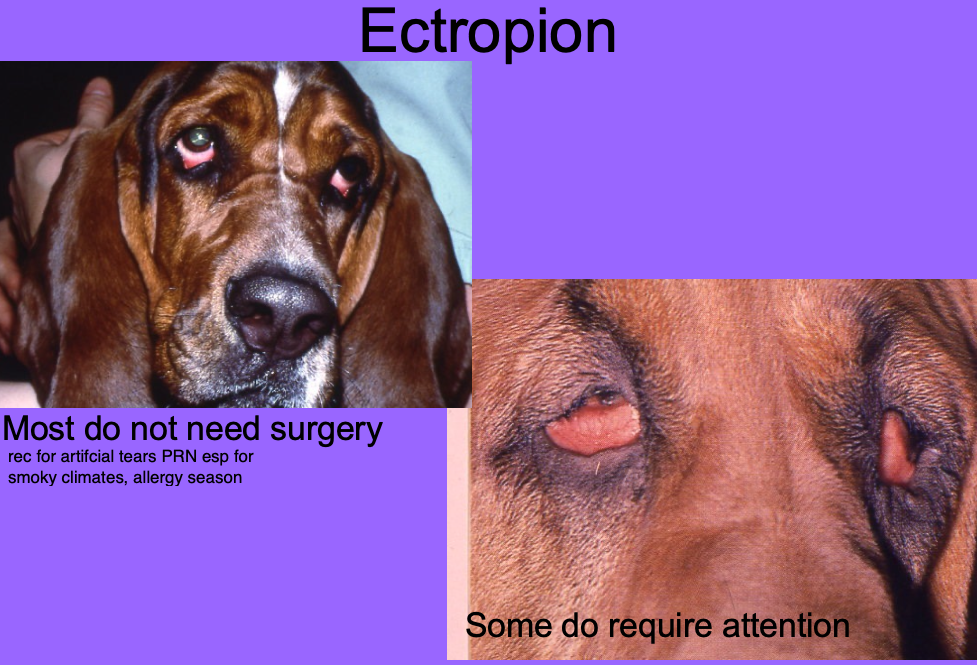
Most Ectropion dogs
do not require Sx.
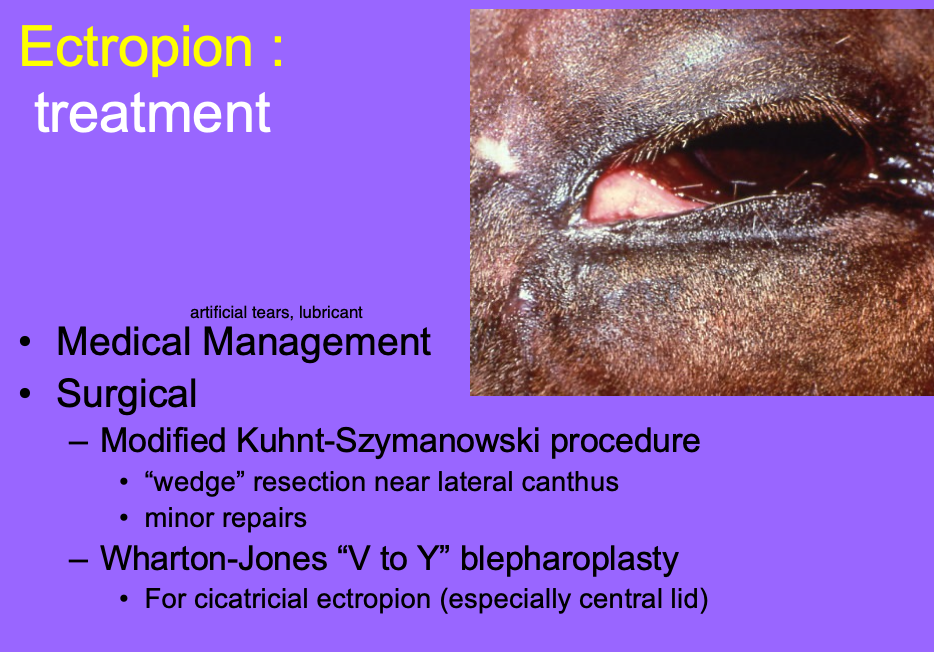
Ectropion Tx - general (2)
Medical management.
Surgical.
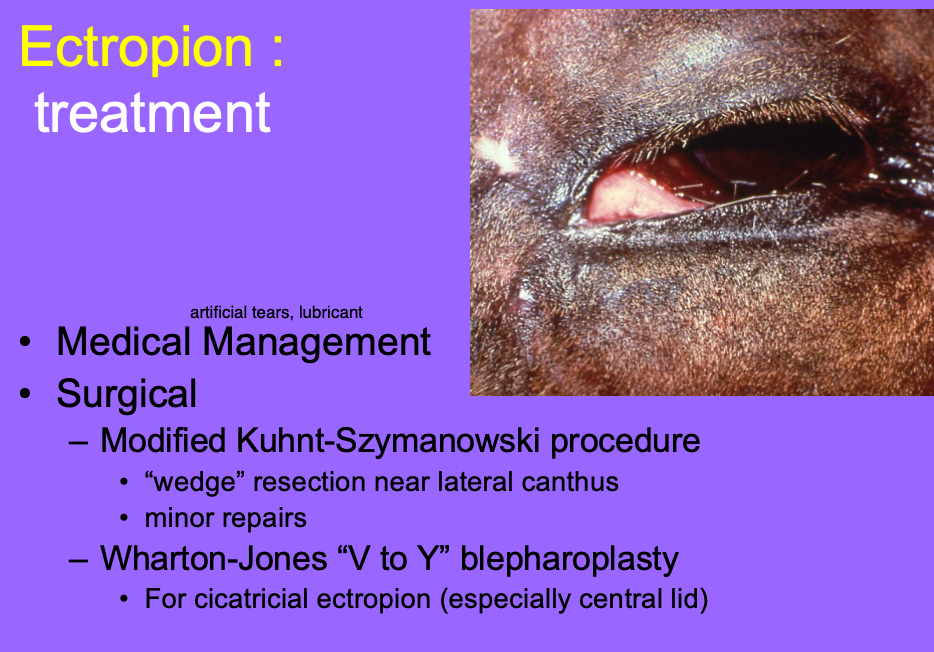
Surgical options for Ectropion
Modified Kuhnt-Szymanowski procedure - wedge resection near lateral canthus.
Wharton-Jones V to Y blepharoplasty - for Cicatricial Ectropion (esp central lid)
Cilia disorders include (3)
Distichia.
Ectopic cilia.
Trichiasis/nasal folds.
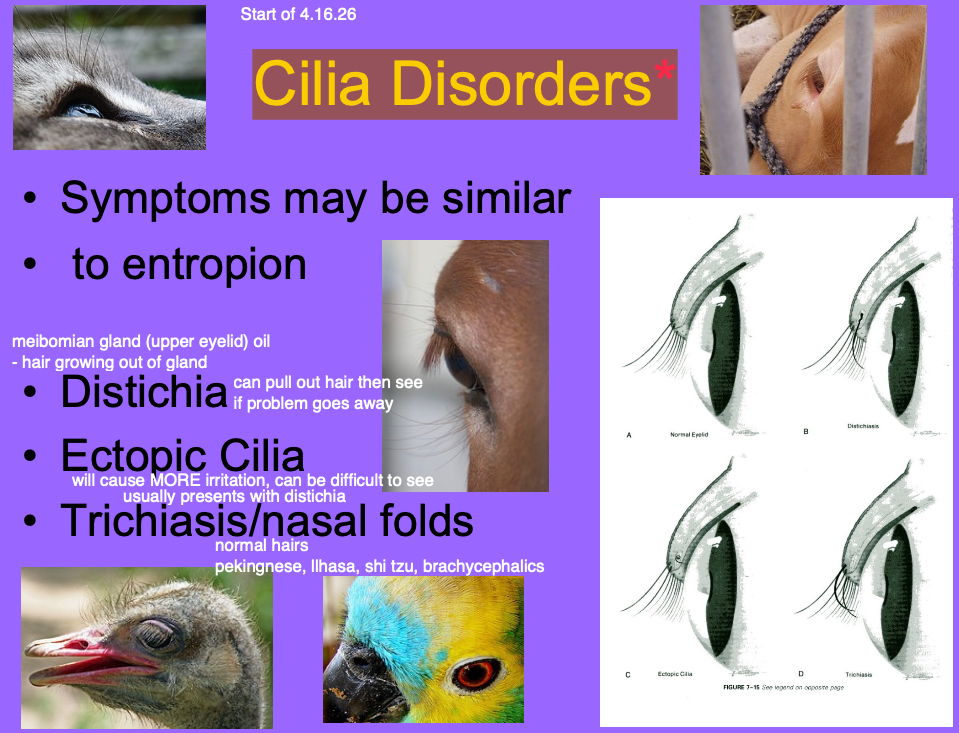
Cilia Disorders CS
Symptoms may be similar to entropion.
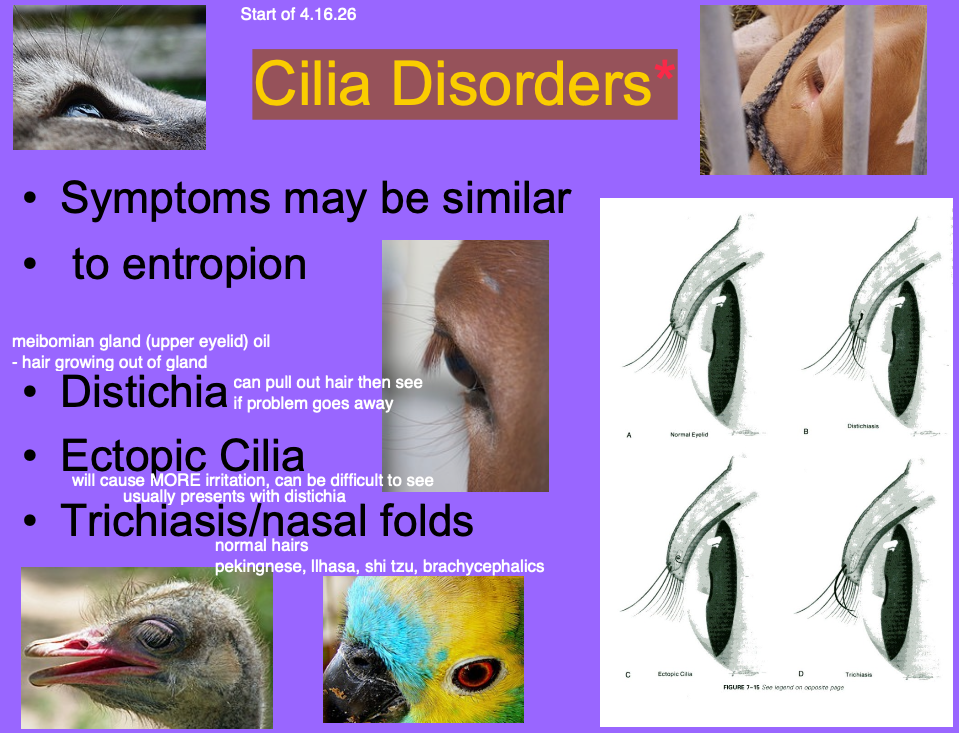
Distichia is an
extra cilia growing out of the meibomian gland opening at the eyelid margin.
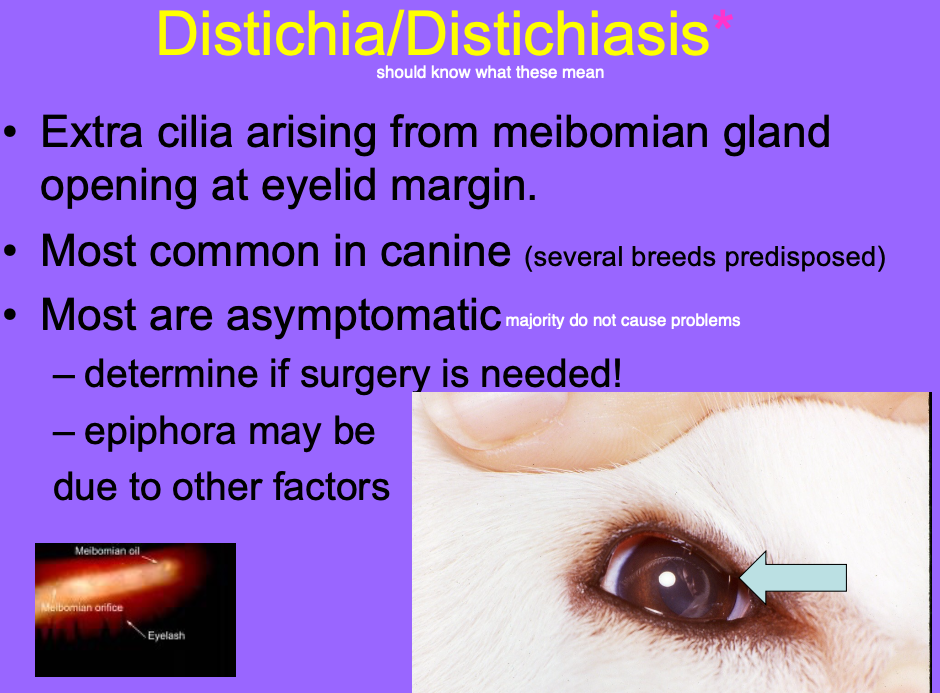
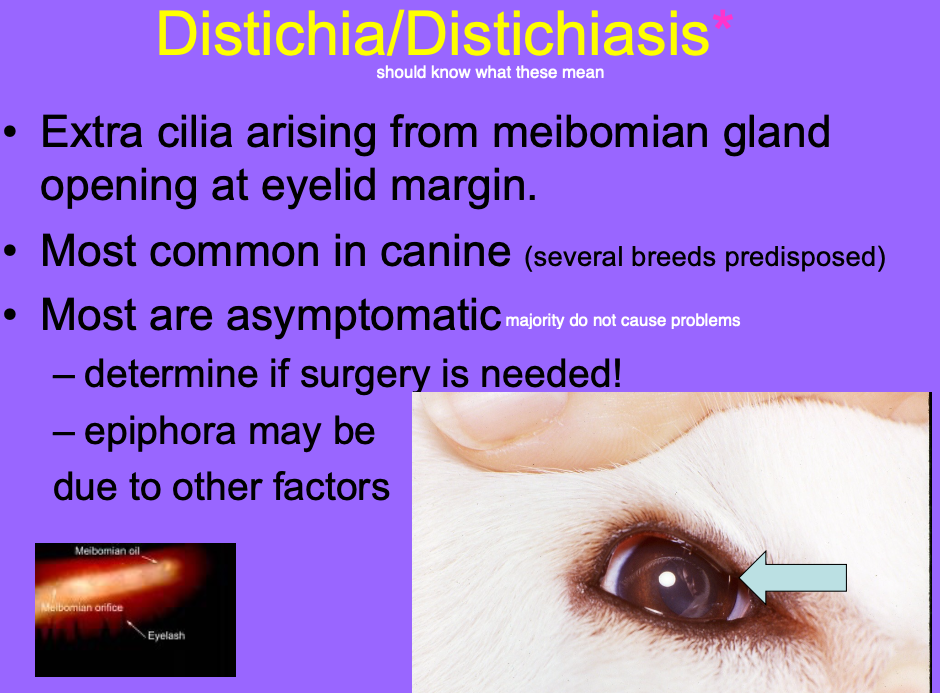
Most distichia are
asymptomatic (epiphora could be due to other factors)
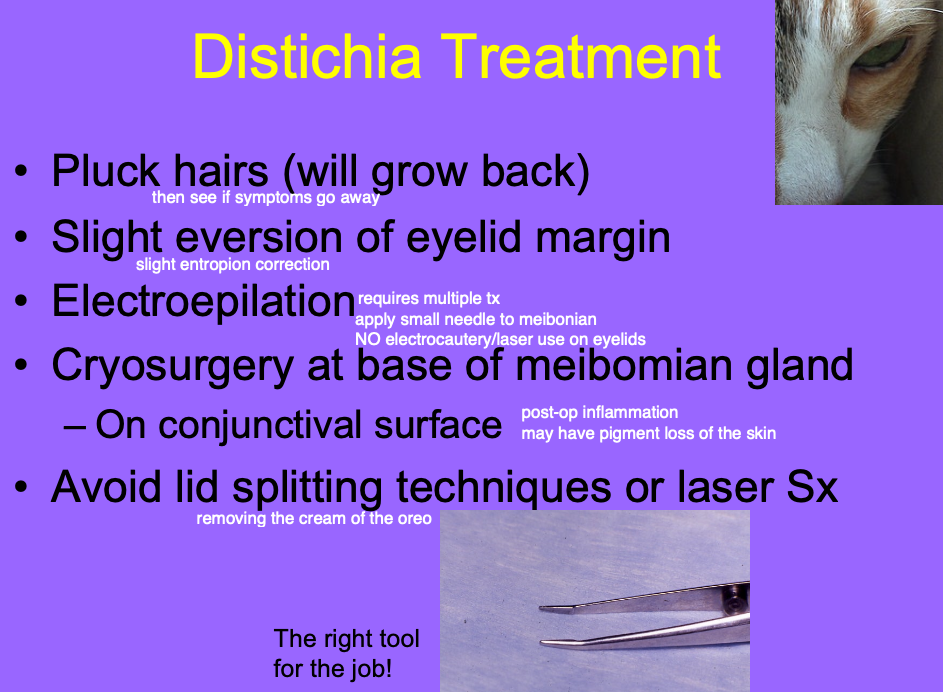
Distichia Tx
Pluck hair.
Slight eversion of eyelid margin (done if there are multiple).
Electroepilation.Í
Cryosurgery at base of meibomian gland, on conjunctival surface.
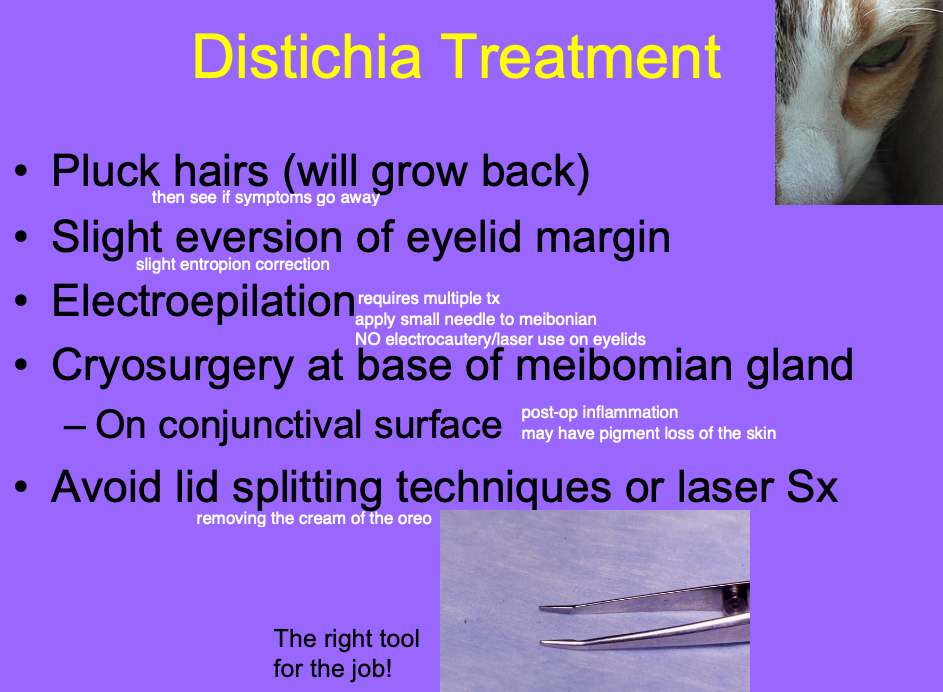
What tx do we avoid w/ Distichia
lid splitting technique or laser Sx.
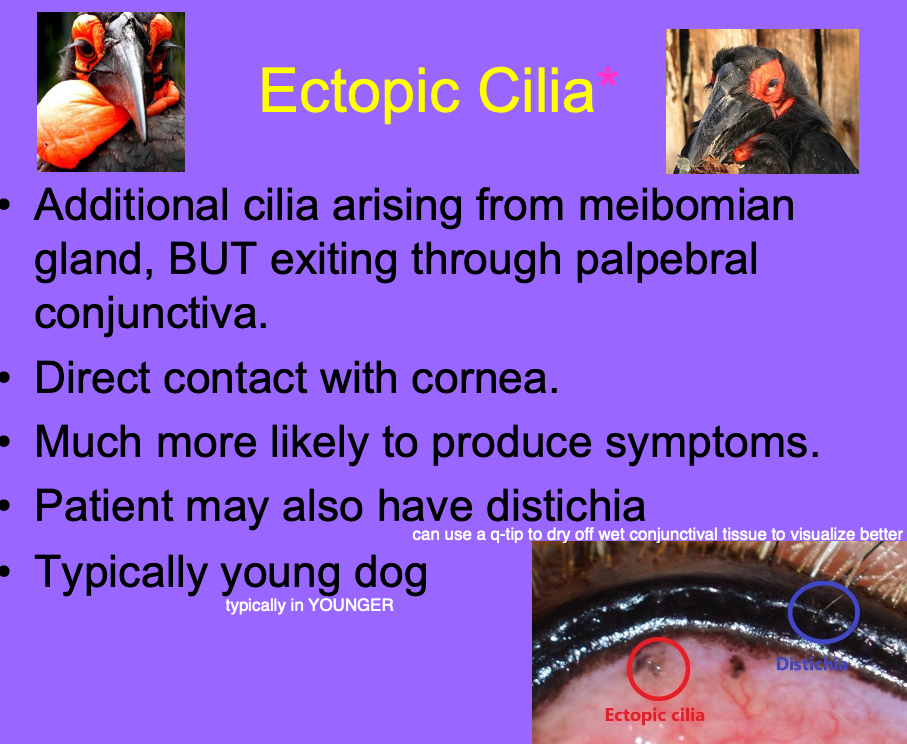
Ectopic cilia are
additional cilia arising from meibomian gland, but exiting through palpebral conjunctiva.
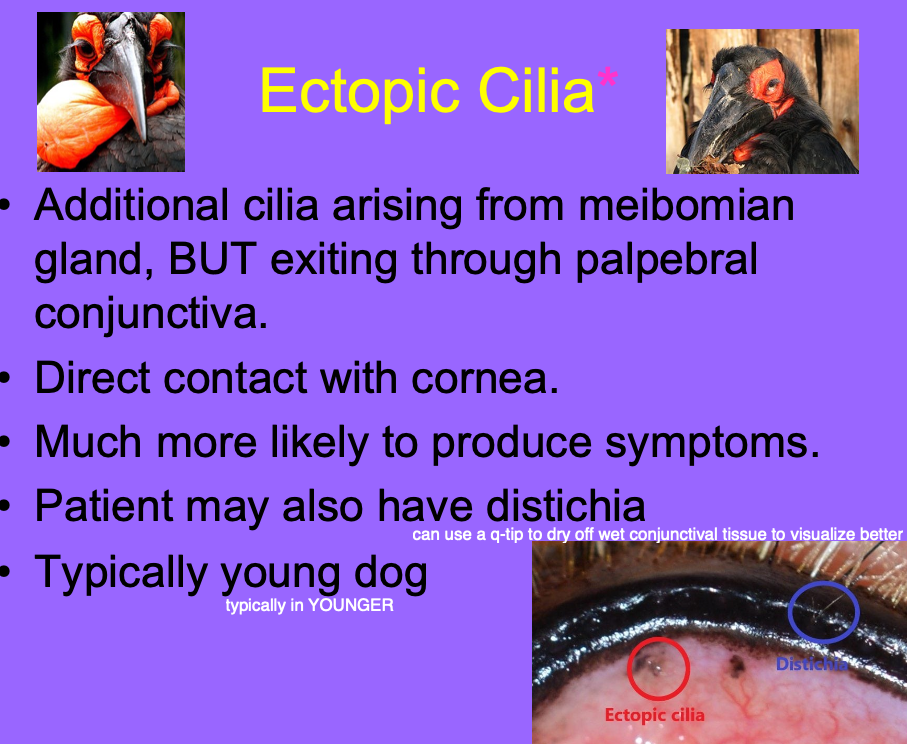
Ectopic cilia are much more
likely to produce symptoms due to direct contact w/ cornea.
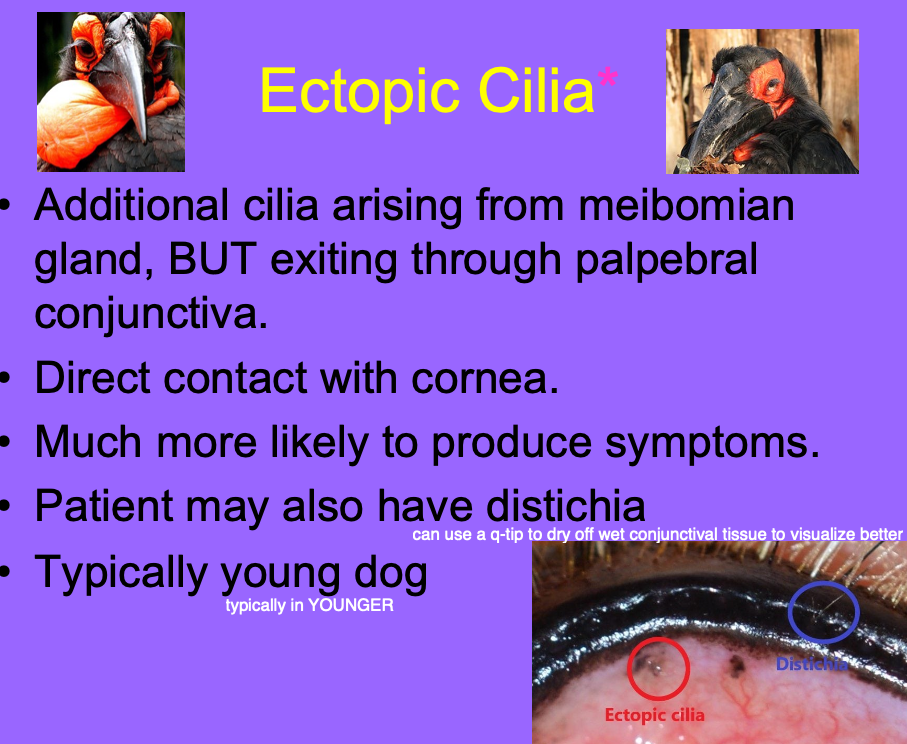
P's w/ ectopic cilia are
typically young and may also have distichia.
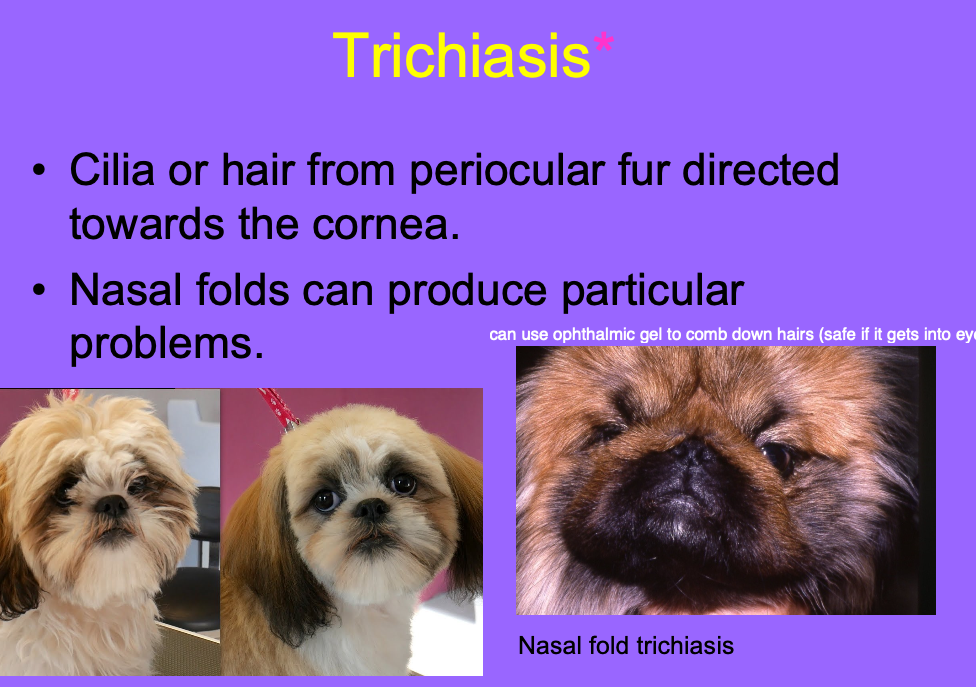
Trichiasis
Cilia or hair from periocular fur directed towards the cornea (nasal folds can produce particular problems)
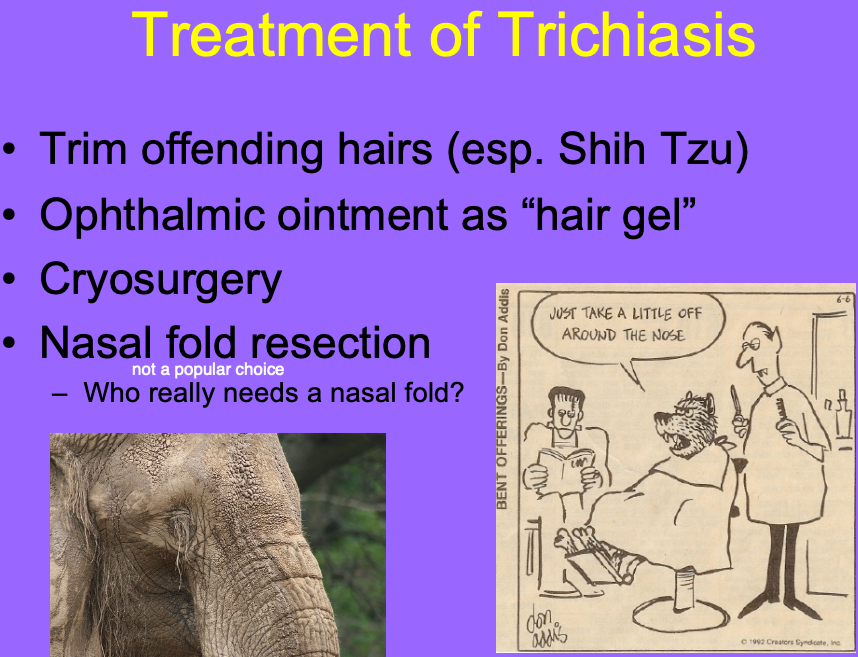
Tx of Trichiasis (4)
Trim offending hairs.
Opthalmic ointment (as hair gel).
Cryosurgery.
Nasal fold resection.
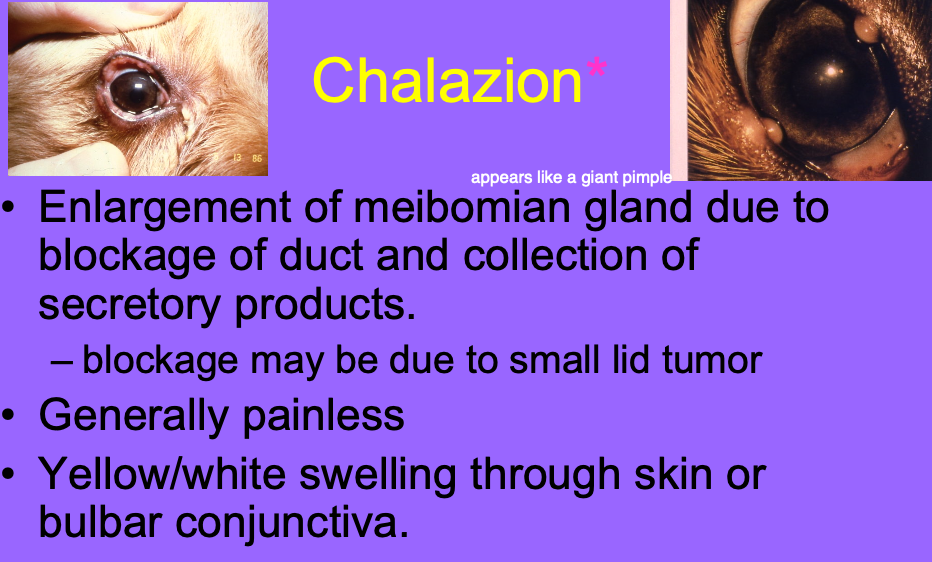
Chalazion def
Enlargement of meibomean gland due to blockage of ducts and collection of secretory products.
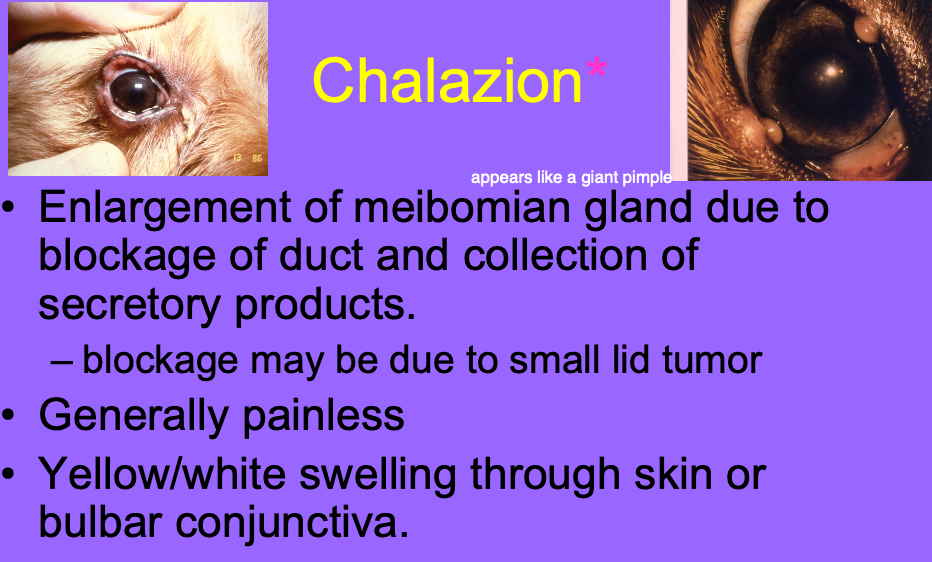
Chalazion - blockage may be due to
small lid tumor
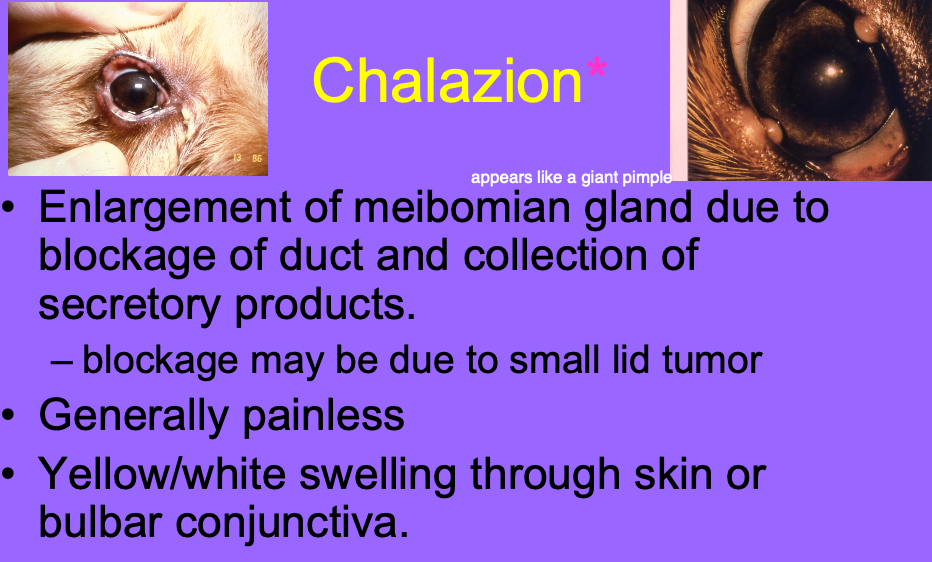
Chalazion are generally
painless. yellow/white swelling through skin or bulbar conjunctiva.
Chalazion in cats
more of a problem in lightly pigmented cats.
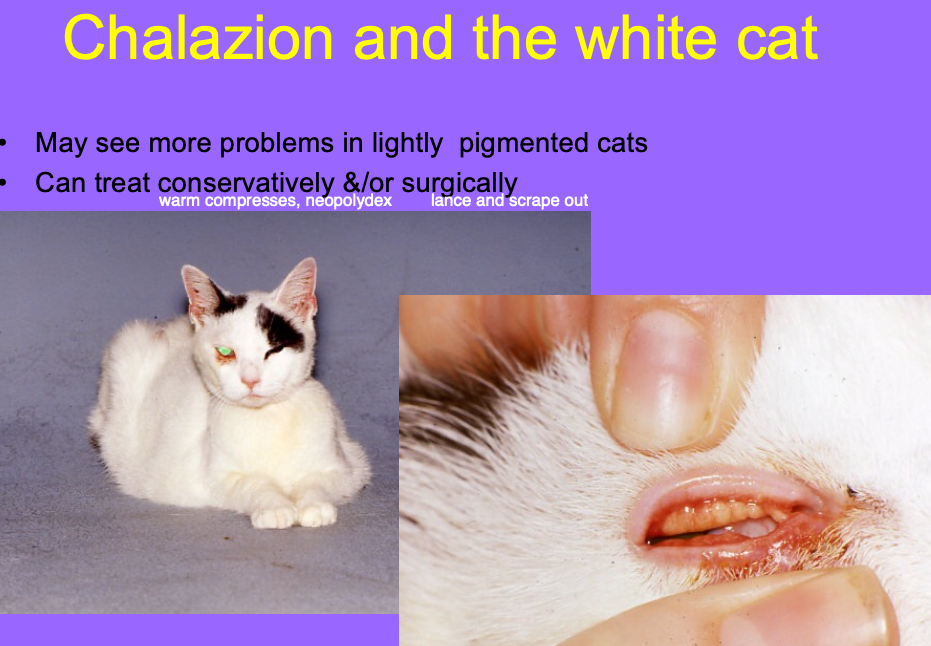
Tx for Chalazion - general
conservative and/or Sx.
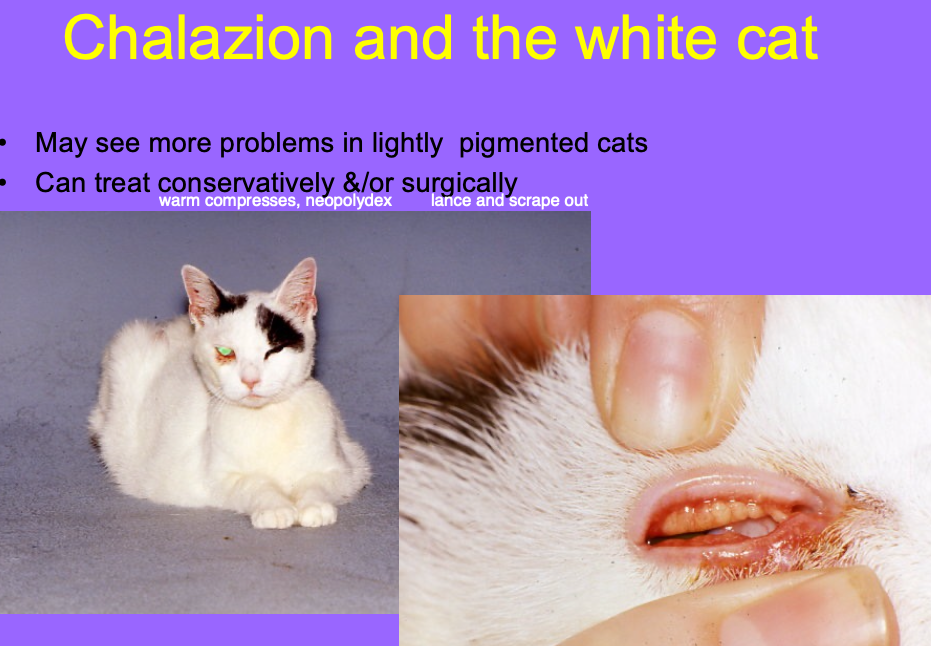
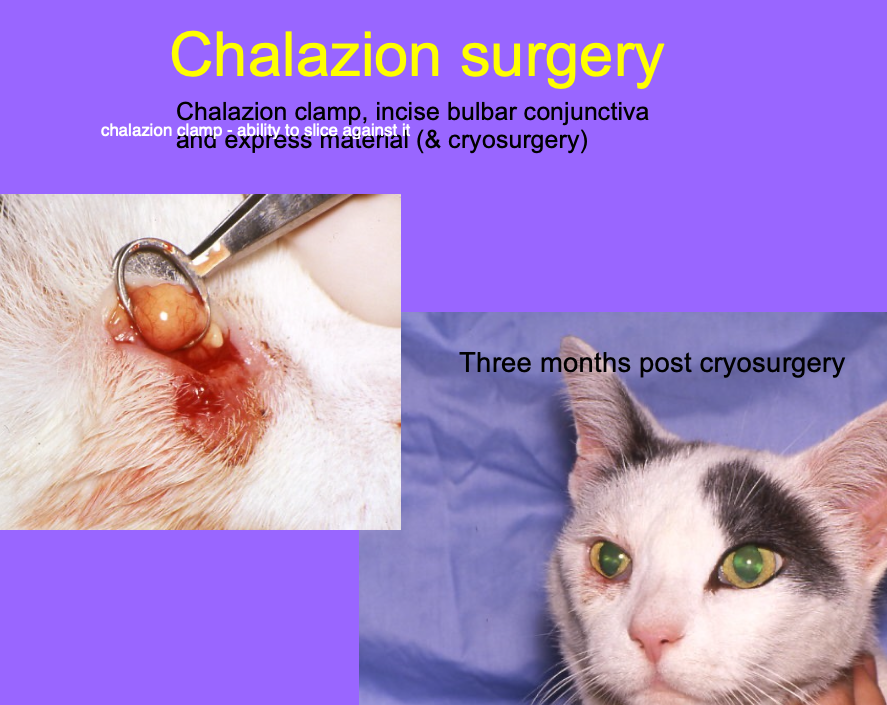
Chalazion Sx (3)
Chalazion clamp.
Incise bulbar conjunctiva and express material.
Cryosurgery.
Infection at eyelid margin (2)
Red swollen, painful area at lid margin.
Can be external or internal hordeolum.
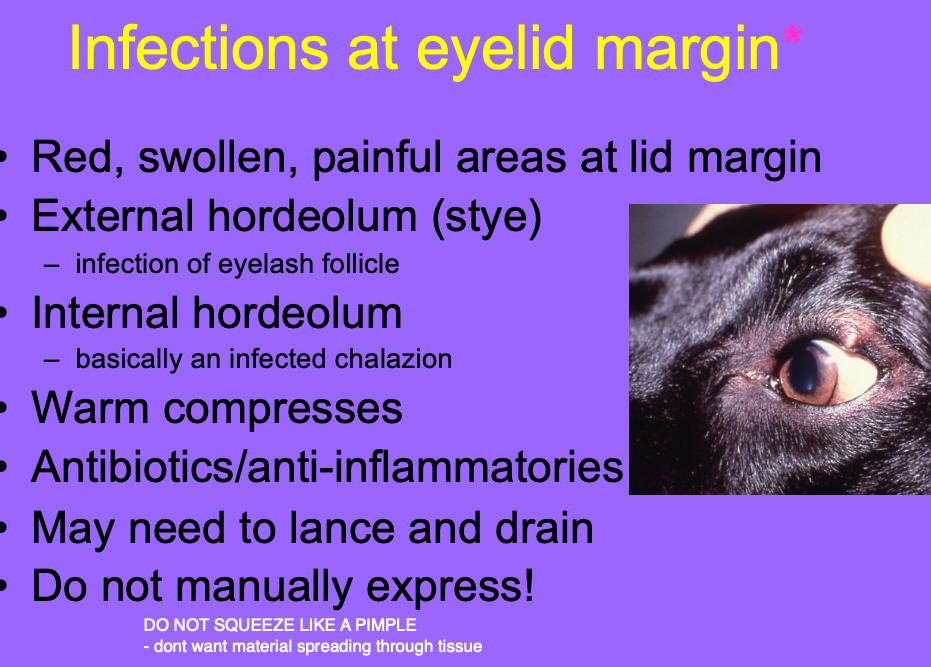
Def of external, internal hordeolum
external hordeolum (stye) - infection of eyelash follicle
internal hordeolum - infected chalazion
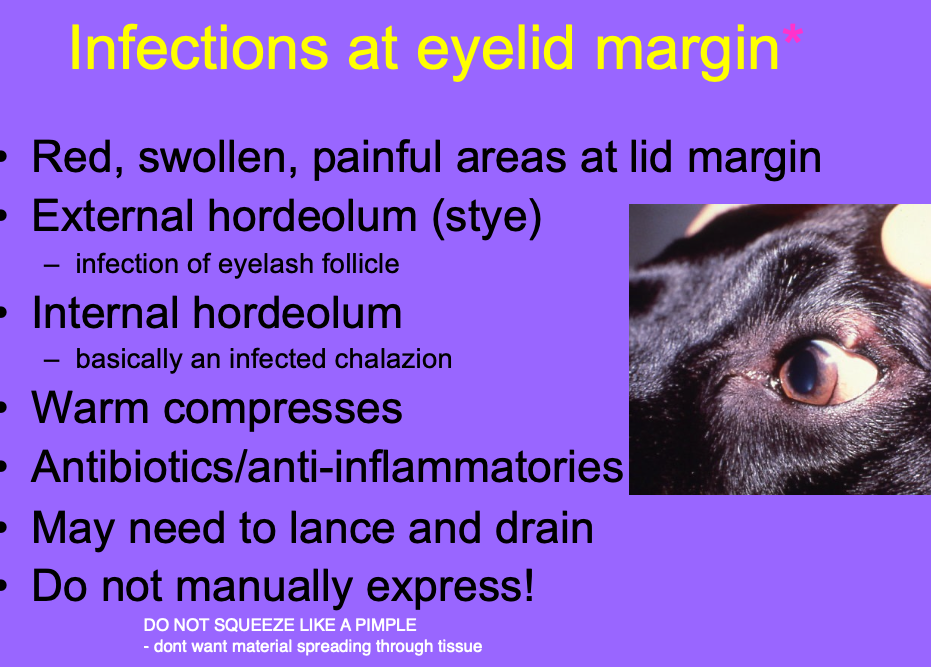
Tx for infection at eyelid margin (4)
Warm compresses.
ABX/anti-inflam.
May need to lance and drain.
Do not express manually.
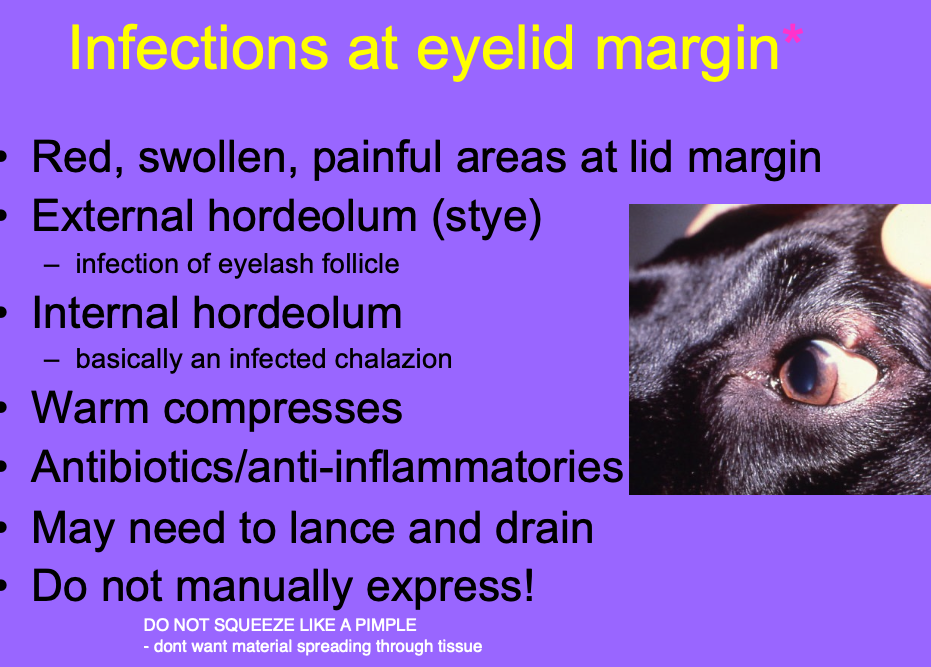
Blepharitis is
inflammation of the eyelid
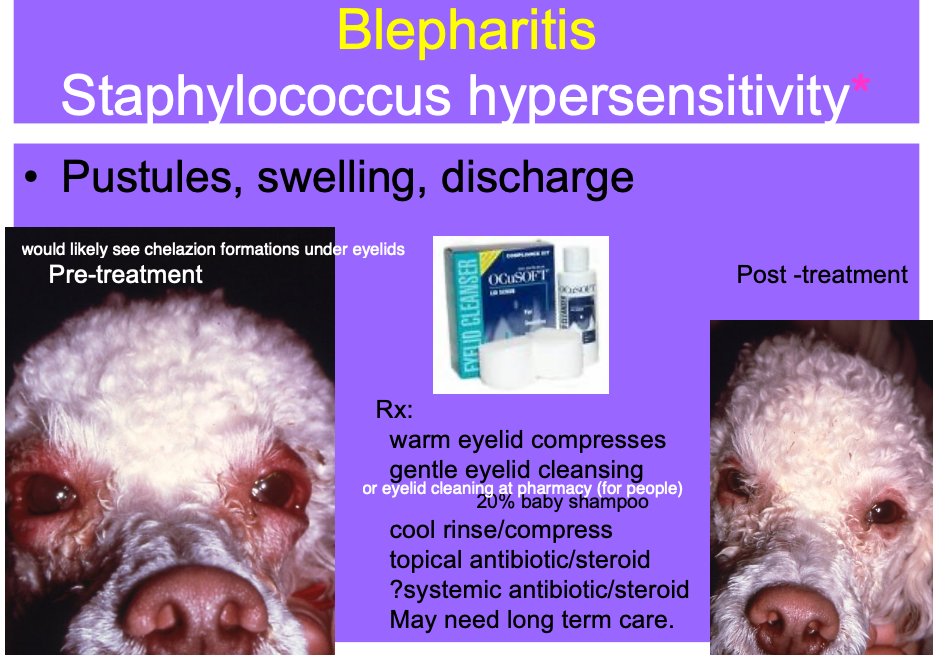
Blepharitis - staphylococcus HS CS
Pustules, swelling, discharge.
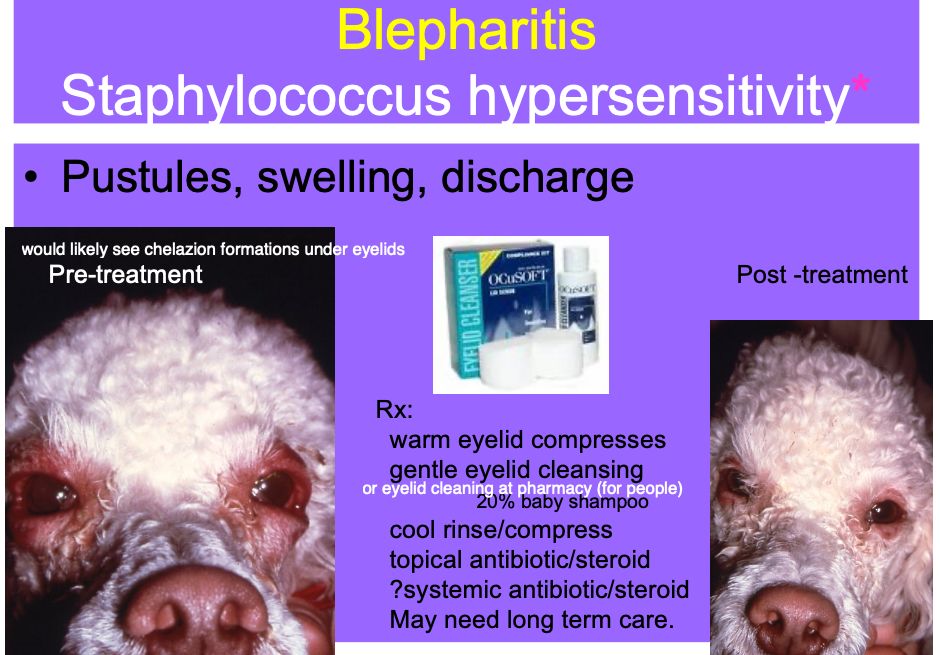
Tx for Blepharitis staphylococcus HS (5)
warm eyelid compress.
Gentle eye cleansing (baby shampoo).
cool rinse/compress.
Topical ABX/steroid
+/- systemic ABX/steroids.
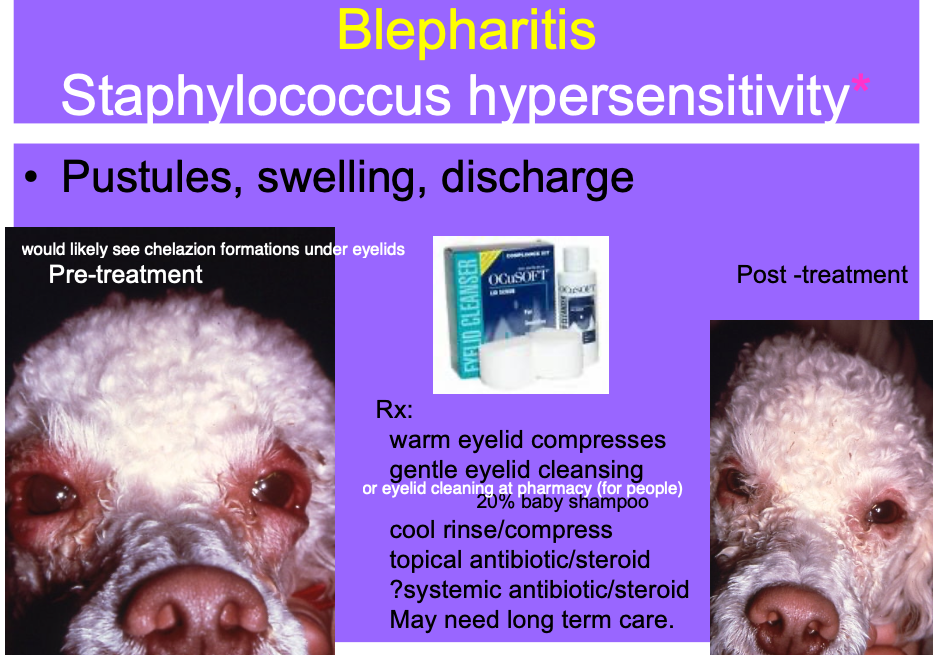
Eyelid masses include (7)
Meibomian gland tumor - Adenoma/adenocarcinoma.
Papilloma.
Benign melanoma/melanocytoma.
Malignant melanoma.
SCC.
MCT.
Sarcoid.
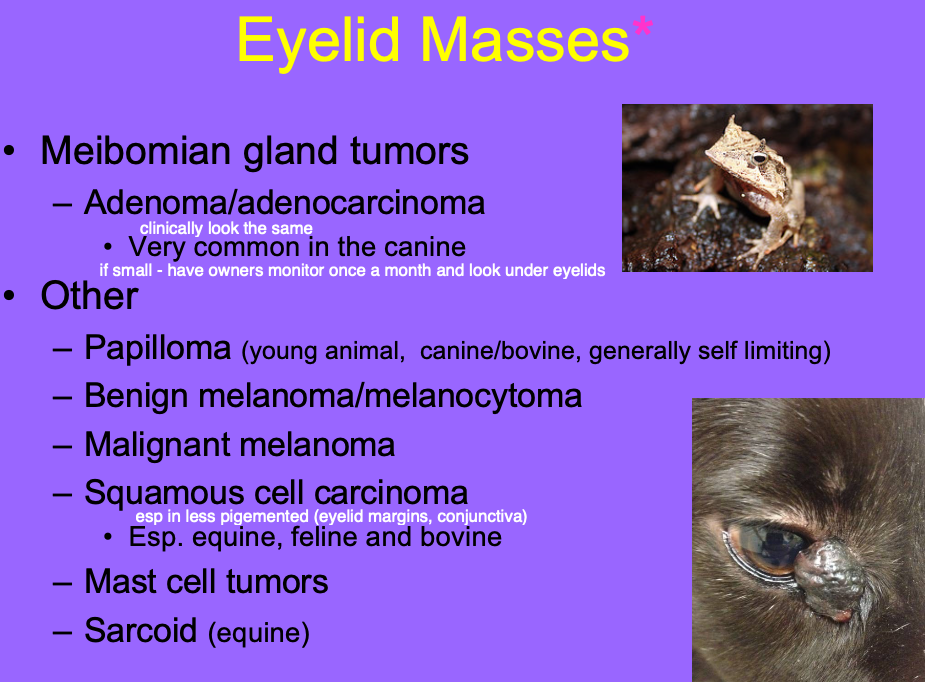
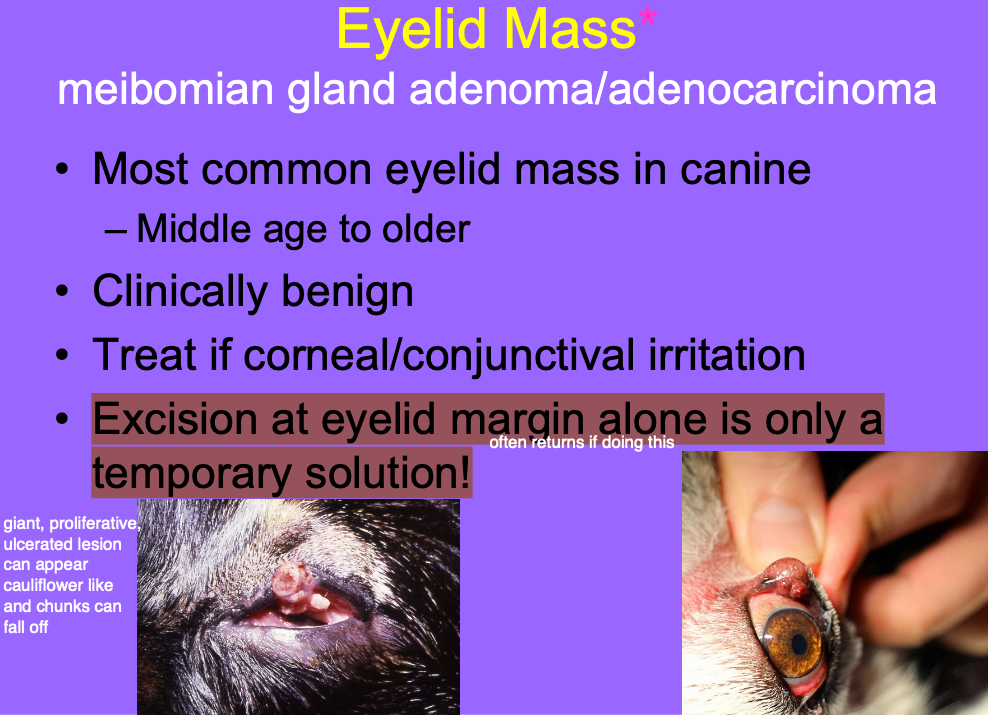
Meibomian gland adenoma/adenocarcinoma are the
most common eyelid mass in canine, usually middle to older. Are clinically benign.
Tx for Meibomian gland adenoma/adenocarcinoma
Tx if there is corneal/conjunctival irritation.
Excision at eyelid margin alone is temporary solution - will grow back.
Surgical debulk and cryo.
Eyelid Wedge Resection
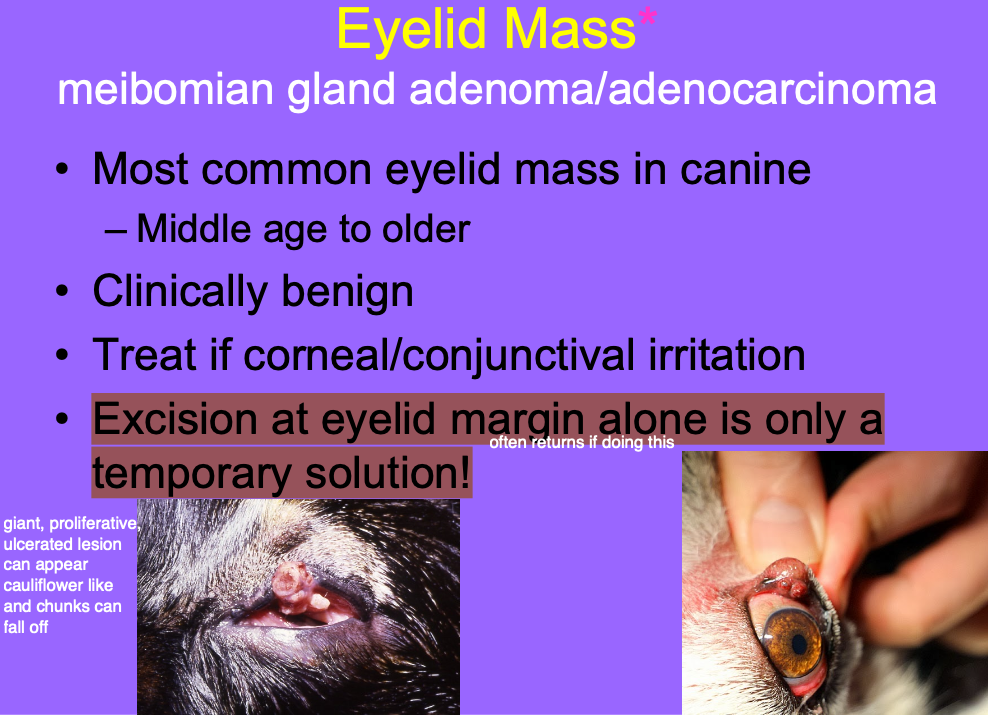
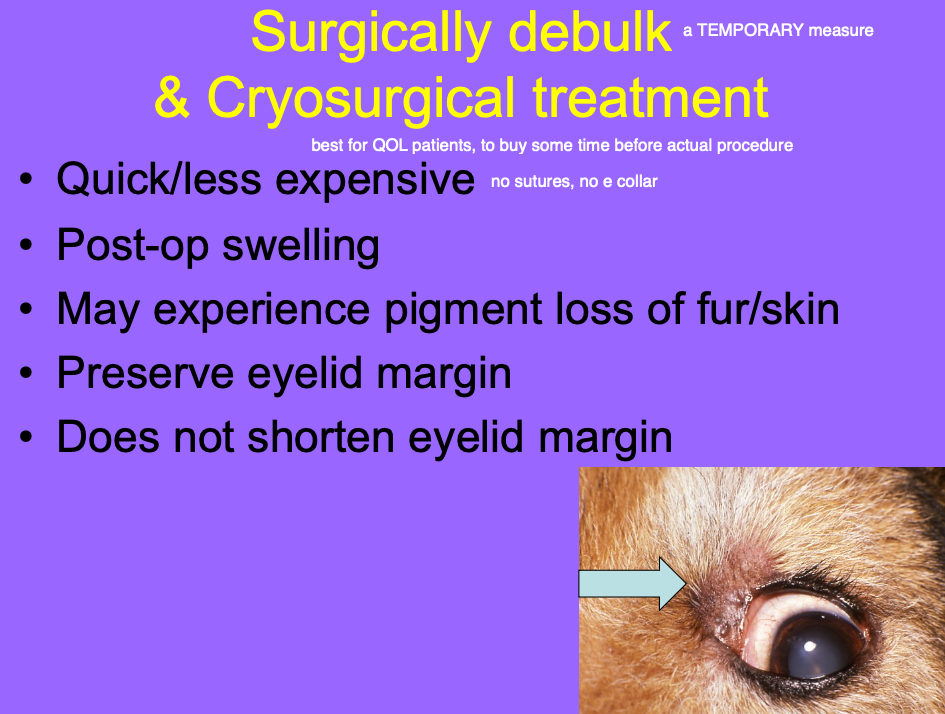
Surgical Debulking and Cryo for Meibomian gland adenoma/adenocarcinoma
will preserve and does not shorten eyelid margin.
may have pigment loss of fur/skin
Eyelid wedge resection results in
shortens eyelid margin.
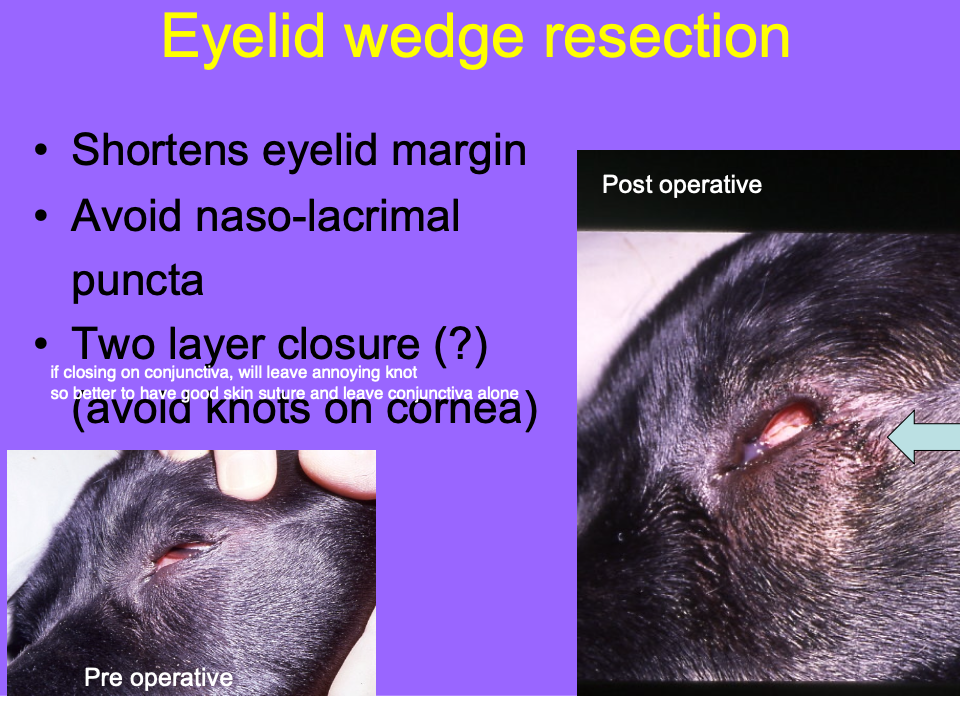
When performing an eyelid wedge resection, ensure that you
avoid nasolacrimal puncta.
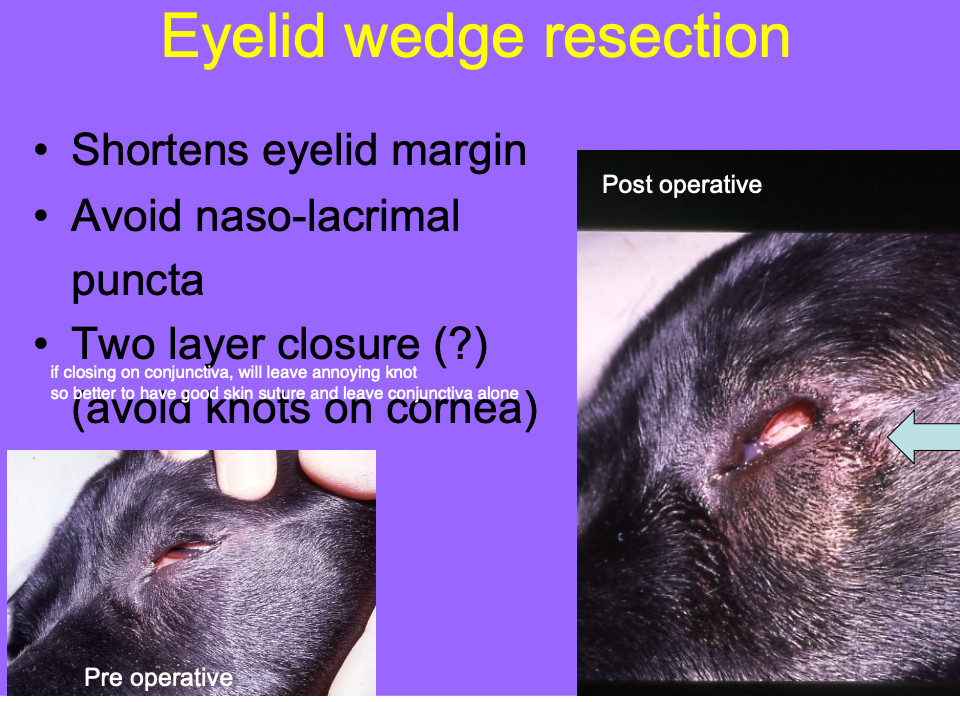
Eyelid wedge resection: suture placement
Place the suture second from the edge first, then place the edge suture.
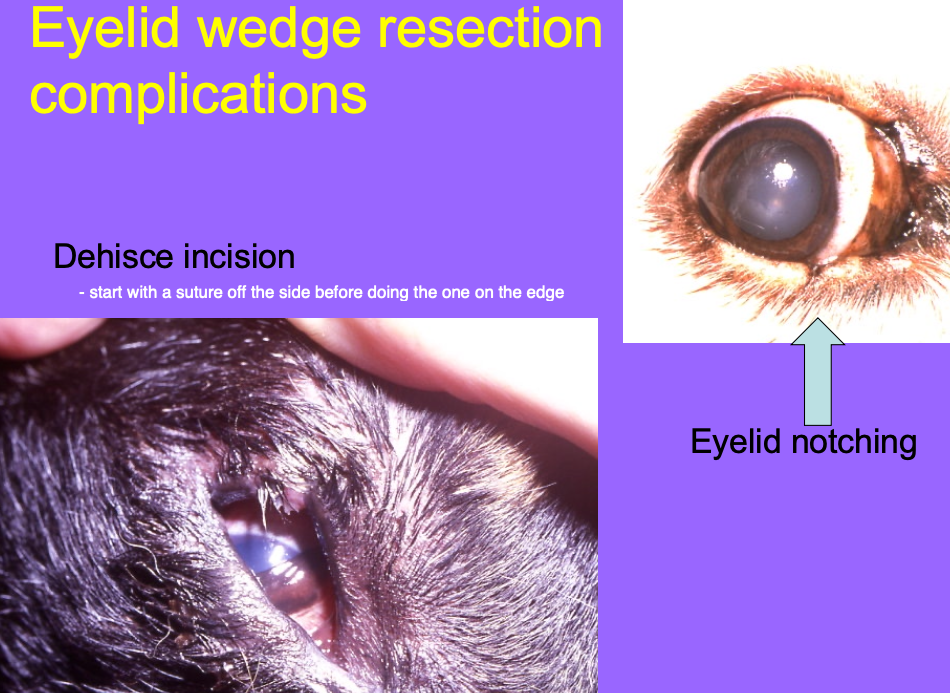
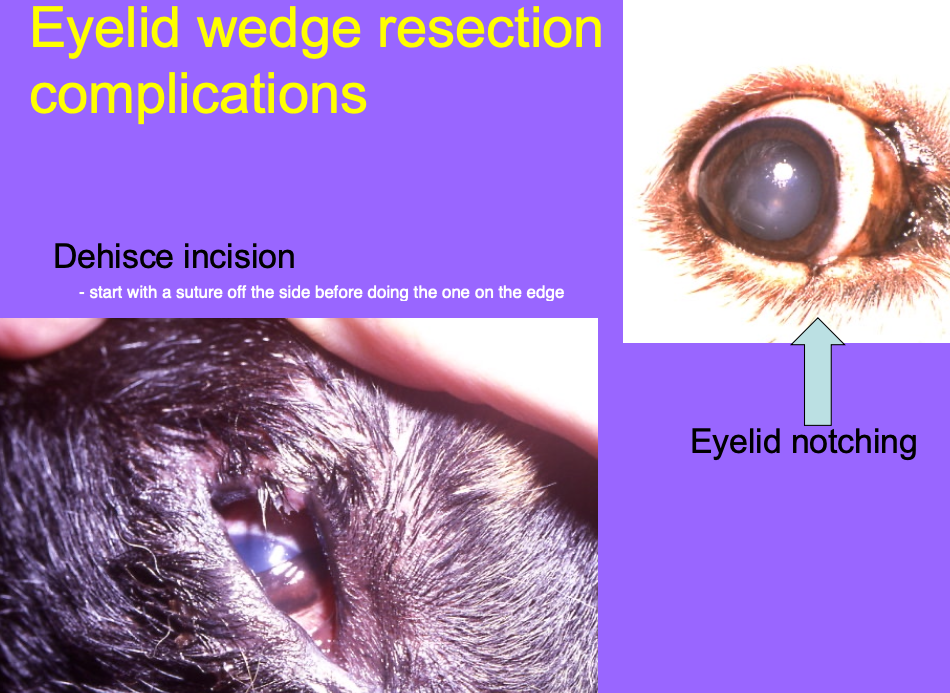
Eyelid wedge resection complications (2)
Eyelid notch.
Dehiscence.
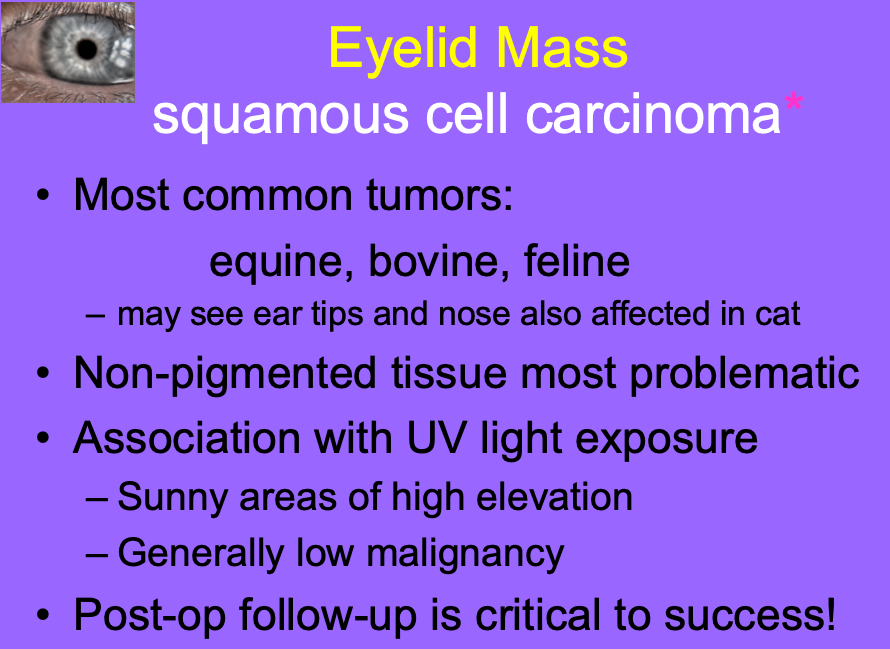
SCC eyelid mass is the most common tumors of
equine, bovine, and feline.
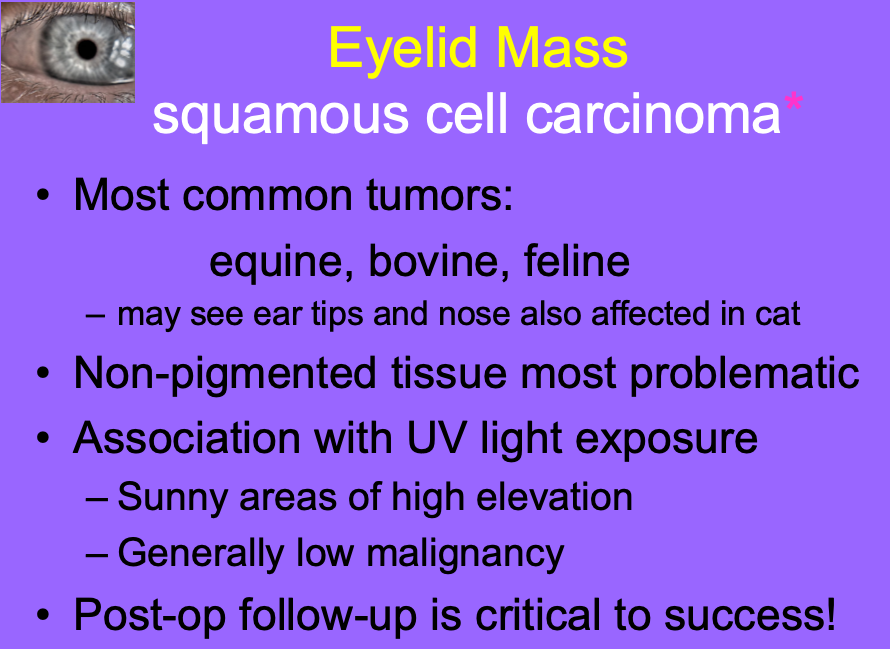
SCC eyelid masses are most promblemactic
in non-pigmented tissues
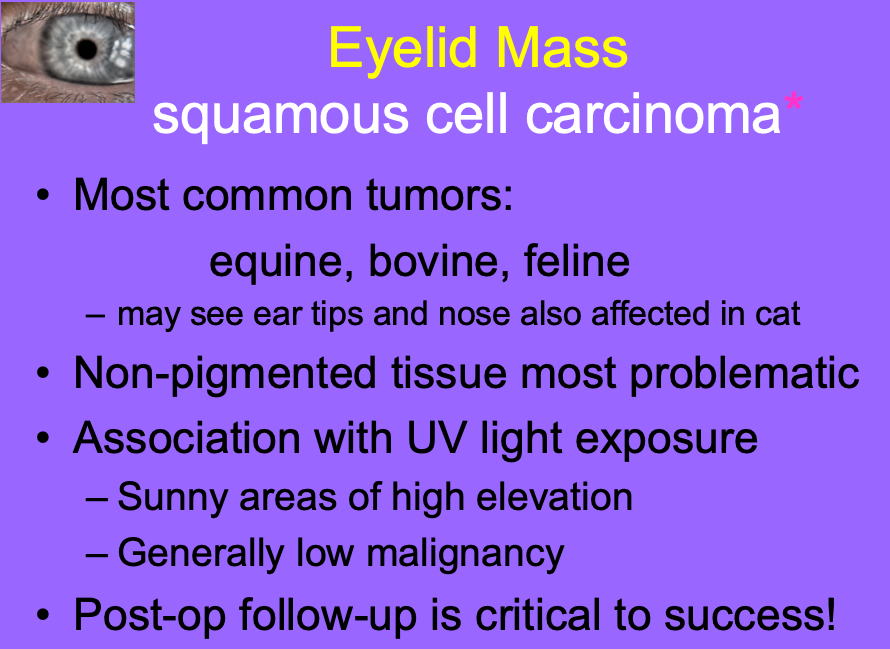
SCC of the eyelid is associated w/
UV light exposure - sunny area w/ high elevation. generally are low malignancy.
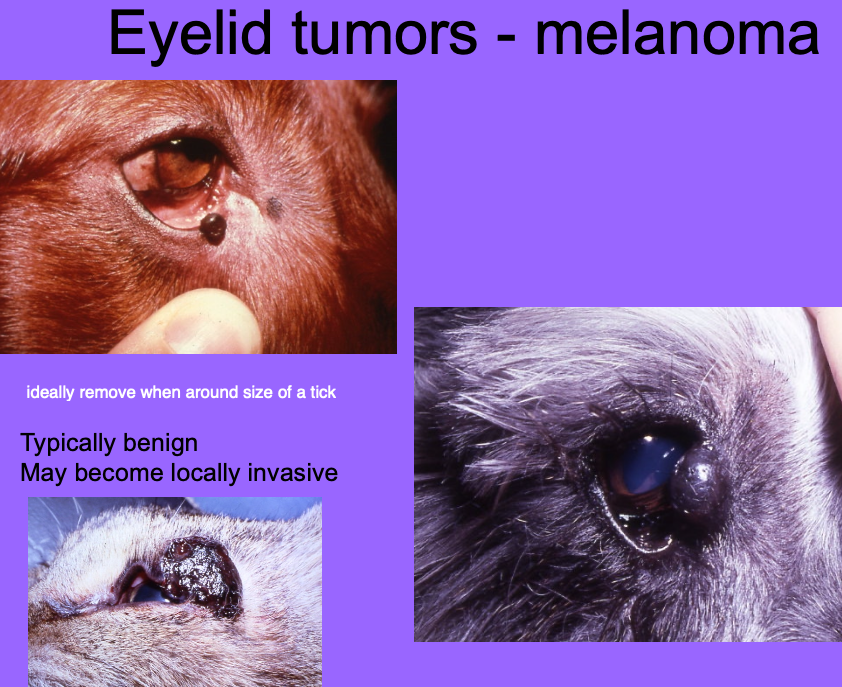
Melanoma of the eyelid
typically benign, but may become locally invasive.
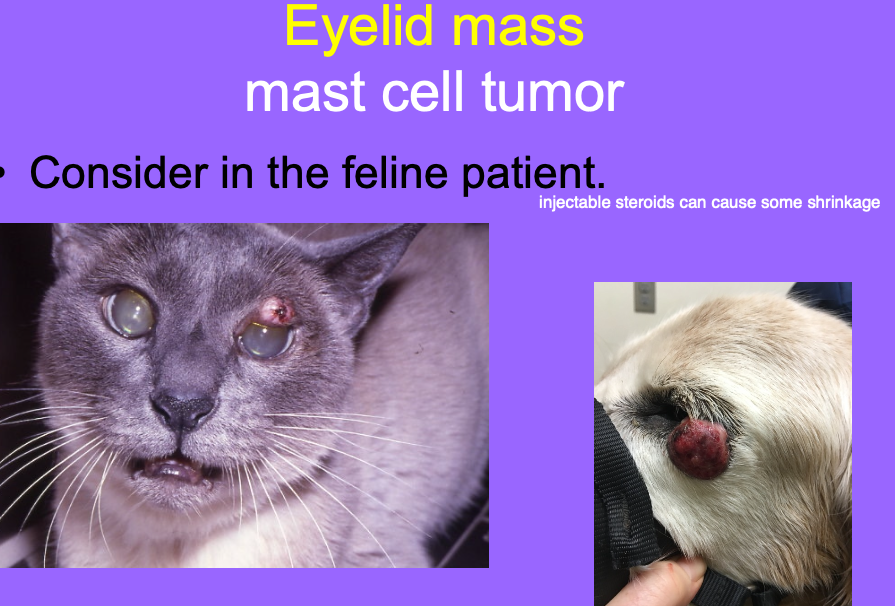
MCT of the eyelid is seen in
felines - can FNA but pre-tx
Other tx of eyelid tumor (4)
Excision of mass and advancement flaps.
RT (implants).
Chemo.
Immunotherapy.
Blepharitis other etiologies (5)
Self trauma.
Infectious.
Allergic.
Autoimmune.
Other (juvenile cellulitis, solar, zinc deficiency, seborrhea)
Infectious blepharitis (4)
mites - sarcoptes and demodex.
Ticks and flies.
fungal - ringworm.
bacterial.
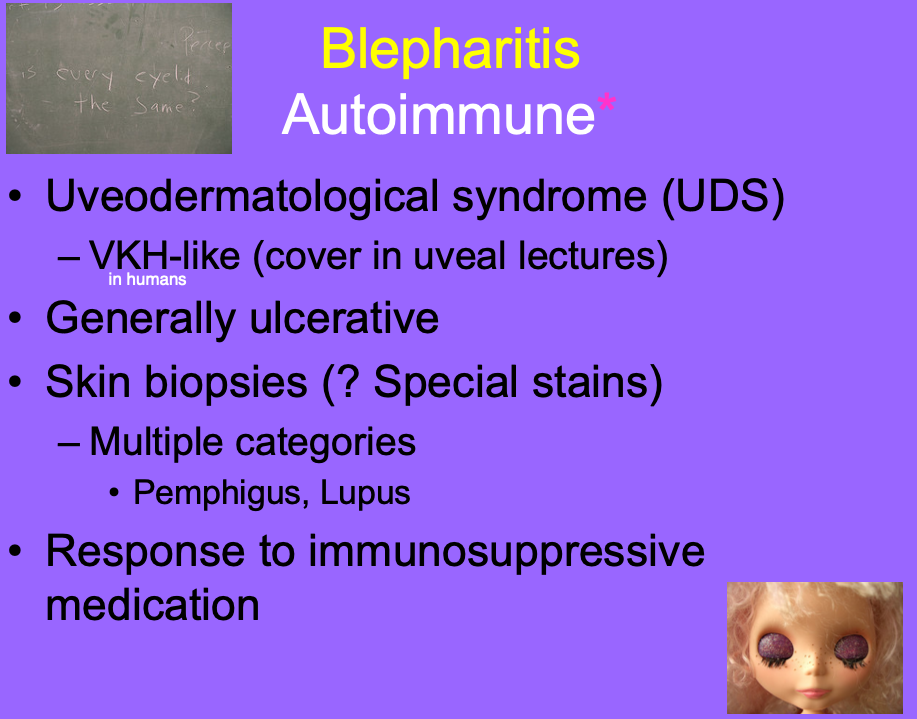
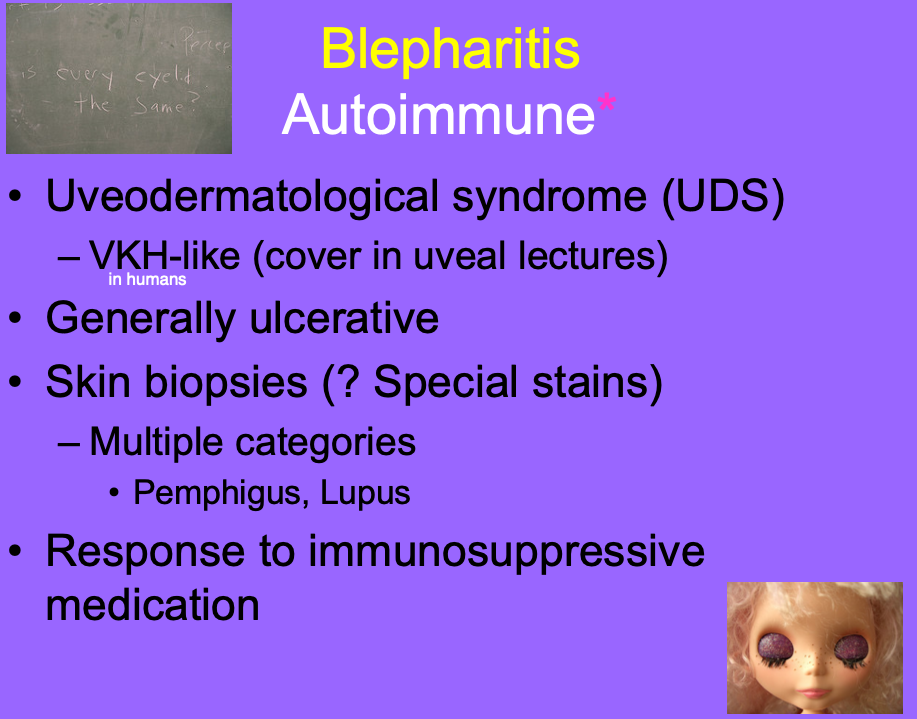
Autoimmune cause to Blepharitis
Uveodermatological syndrome (UDS)
UDS is generally
ulcerative.
UDS Dx and Tx (2)
consider skin biopsies (due to multiple catergories - pemphigus and lupus.
response to immunosuppressive meds.
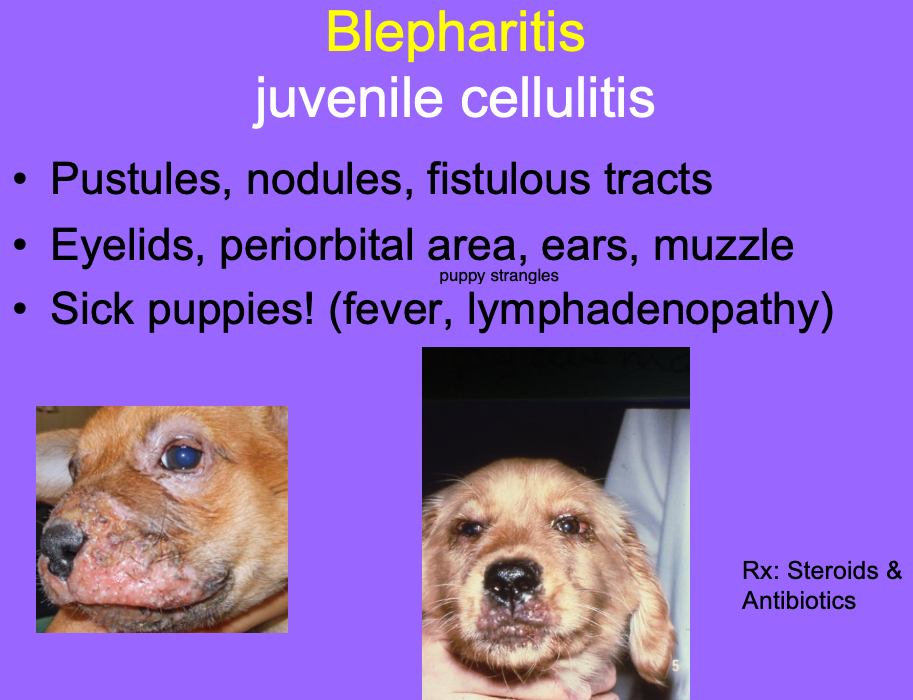
Blepharitis caused by juvenile cellulitis appearance
pustules, nodules, fistulous tracts.
Affects eyelids, periorbital area, ears, and muzzle.
Puppies are sick - fever, lymphadenopathy.
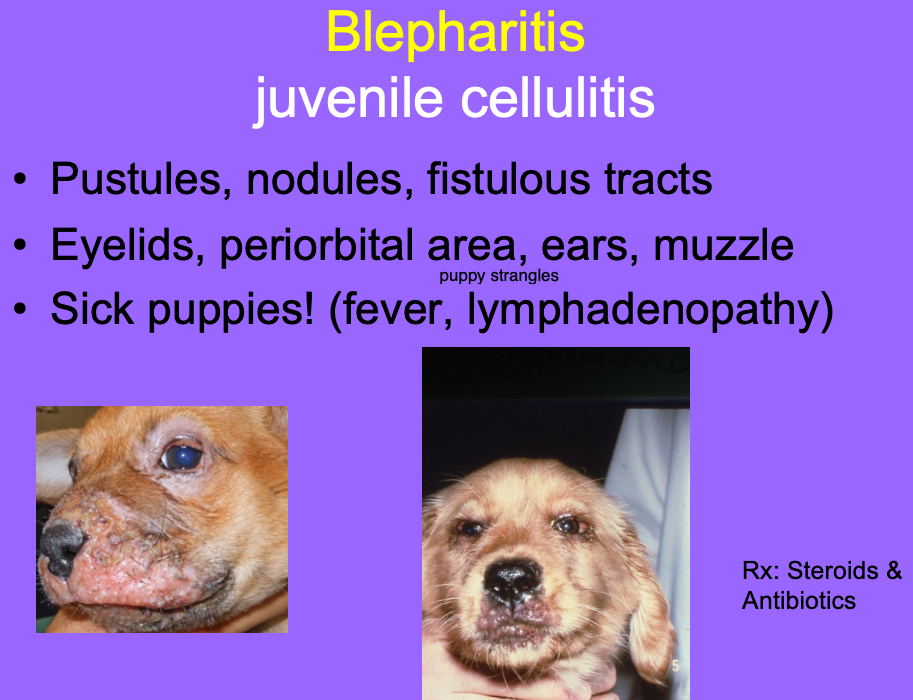
Juvenille cellulitis Tx
Steroids and ABX.
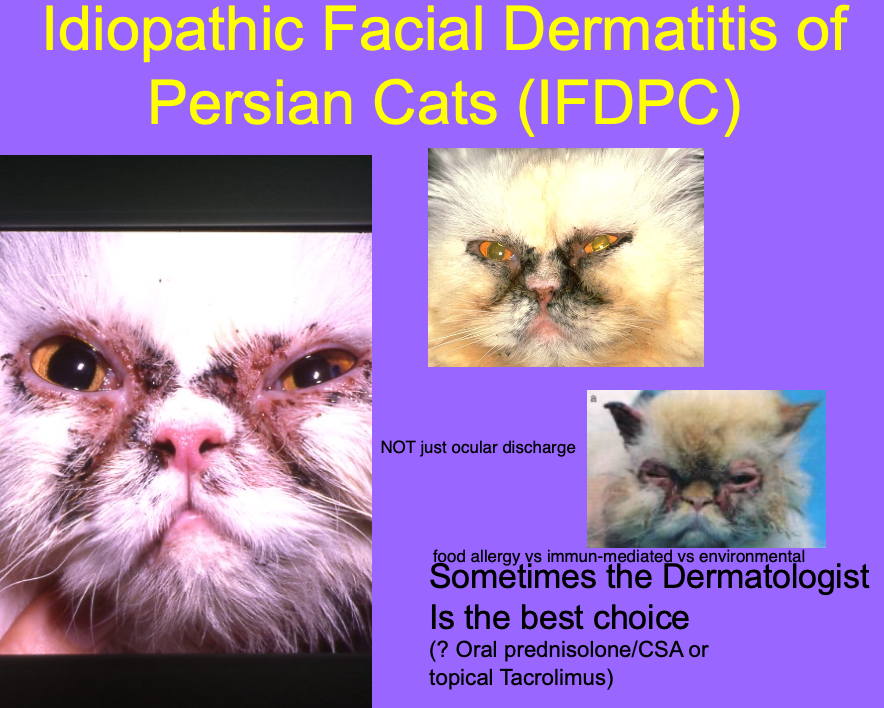
Idiopathic Facial Dermatitis of Persian Cats (IFDPC) Tx
Send to the dermatologist.
consider PO pred or topical tacrolimus.
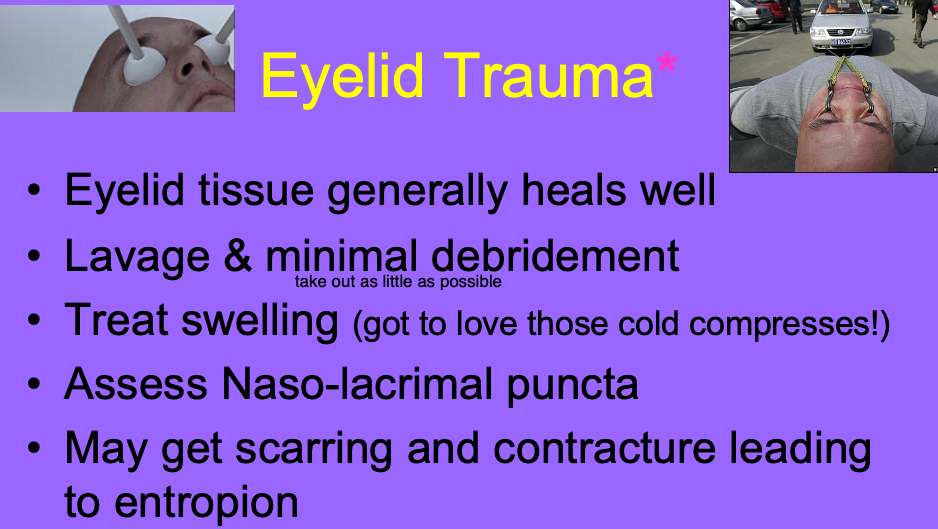
Eyelid trauma considerations (4)
Eyelid tissue generally heals well.
Lavage and minimal debridement.
tx swelling.
Assess nasolacrimal puncta.
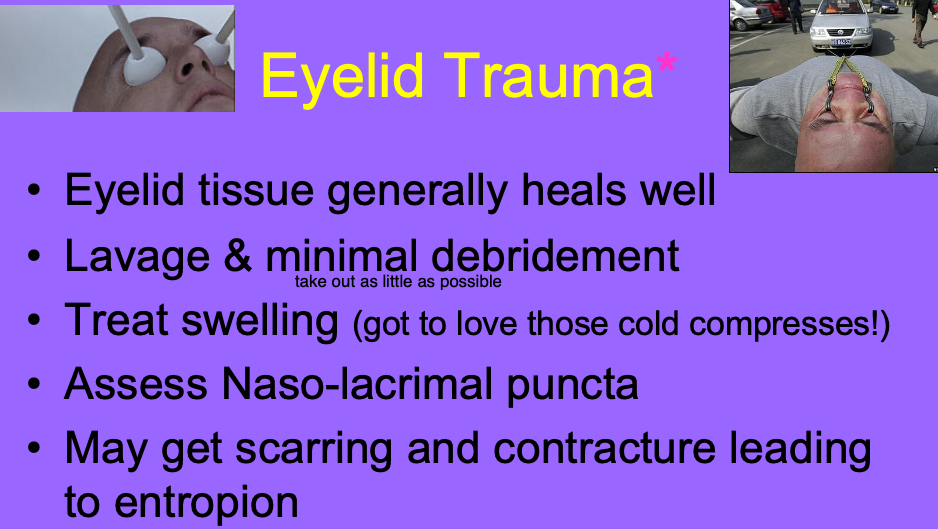
Eyelid trauma may get
scarring and contracture leading to entropion.
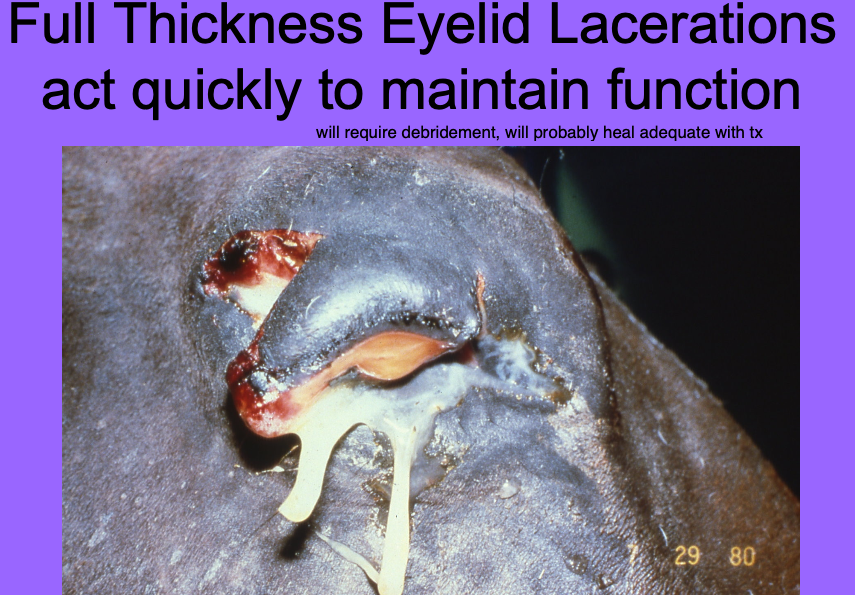
When there is a full thickness eyelid lac
act quickly to maintain fxn.
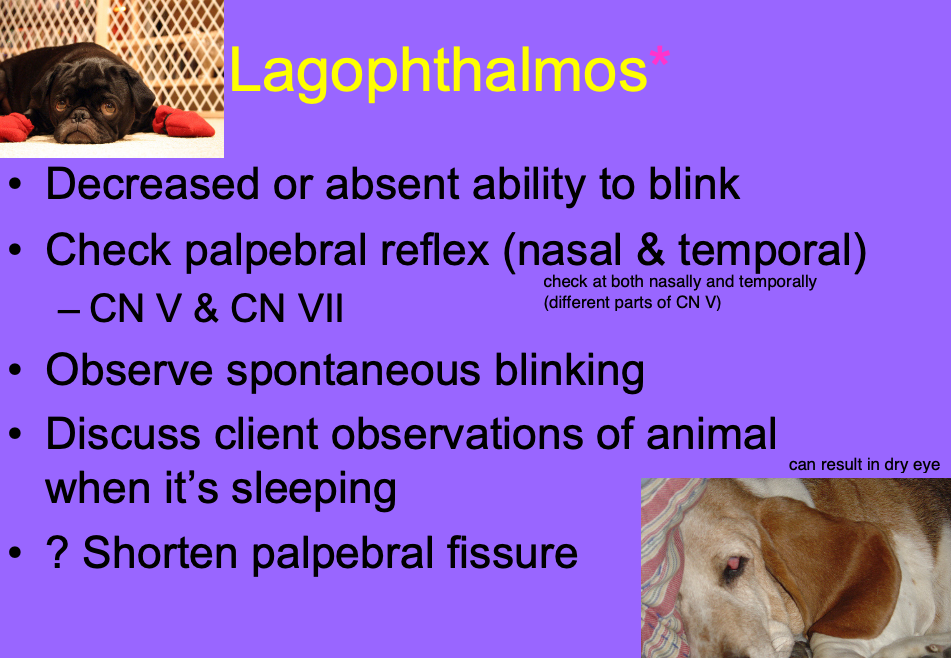
Lagophthalmos def
Decreased or absent ability to blink.
Lagophthalmos test to eval
palpebral reflex - CN5 and CN7.
Observe spontaneous blinking.
Discuss client observation of animal when its sleeping.
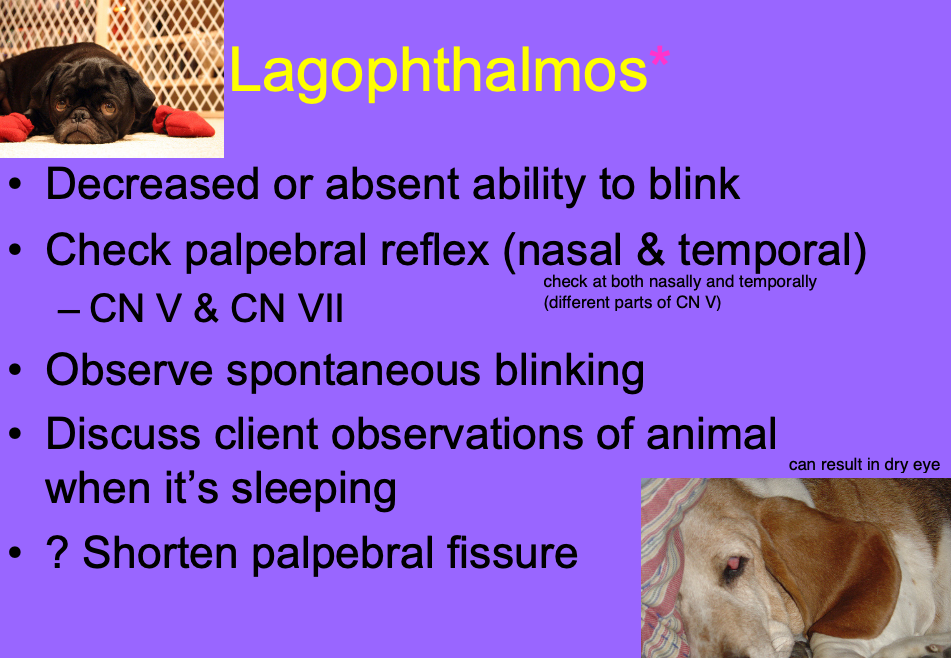
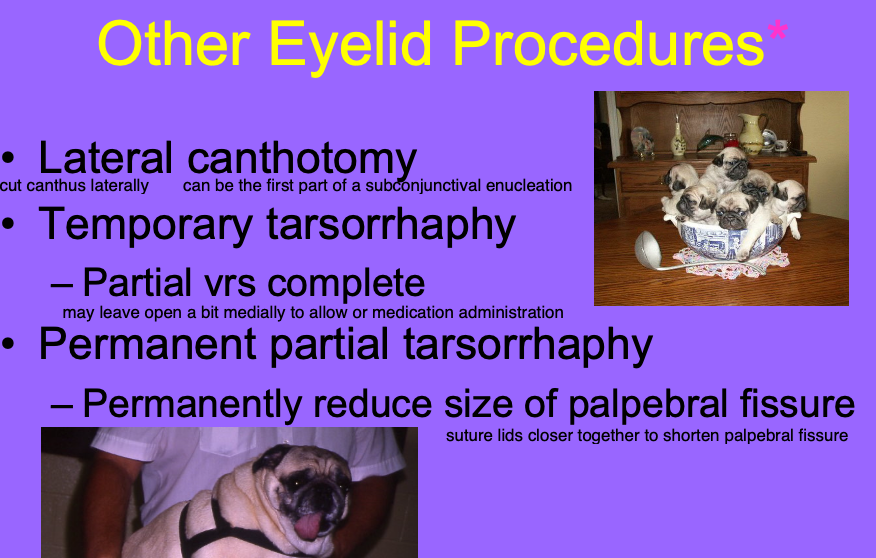
Lateral canthotomy (2)
cutting of the lateral canthus.
Done for proptosis, prior to other ocular Sx, or as the first step of subconjunctival enucleation.
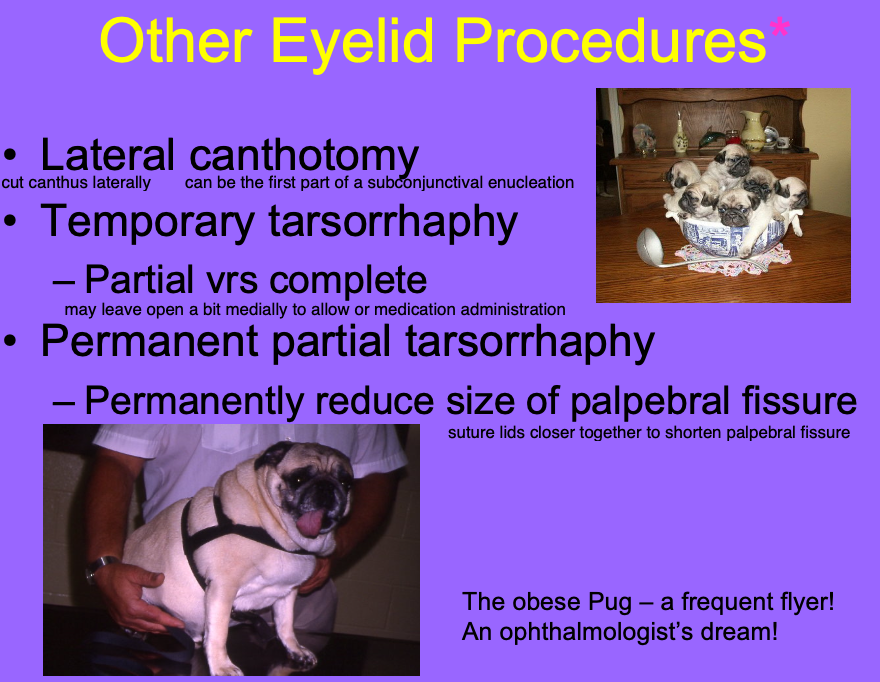
Lateral canthotomy closure (2)
two layer - make sure knots do not abrade the cornea.
might use single temporary tarsorrhaphy suture to relive tension.
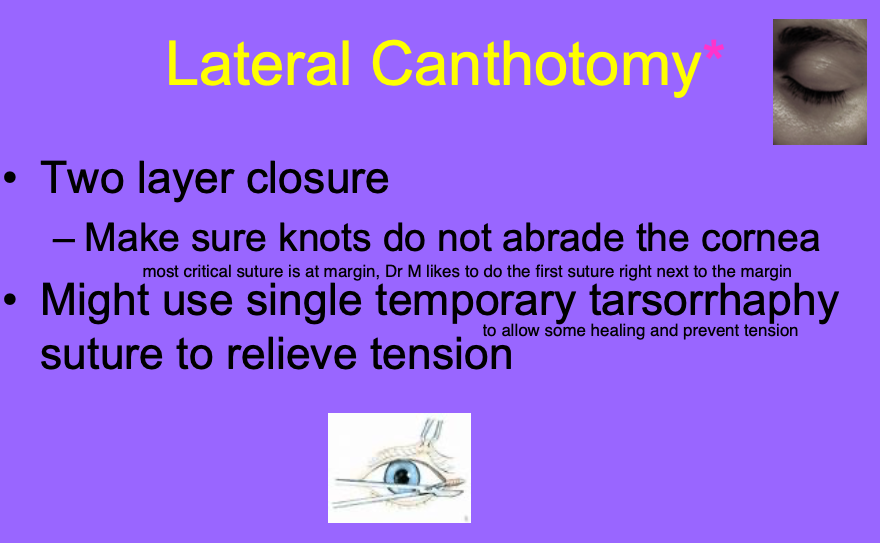
Tarsorrhaphy
suturing of the eyelids closed.
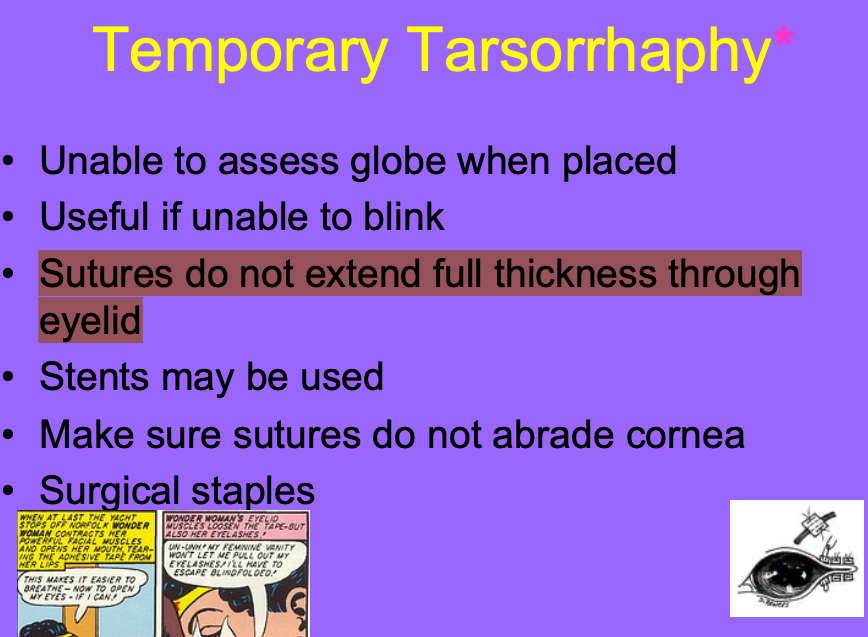
Temporary tarsorrhaphy is useful
if unable to blink.
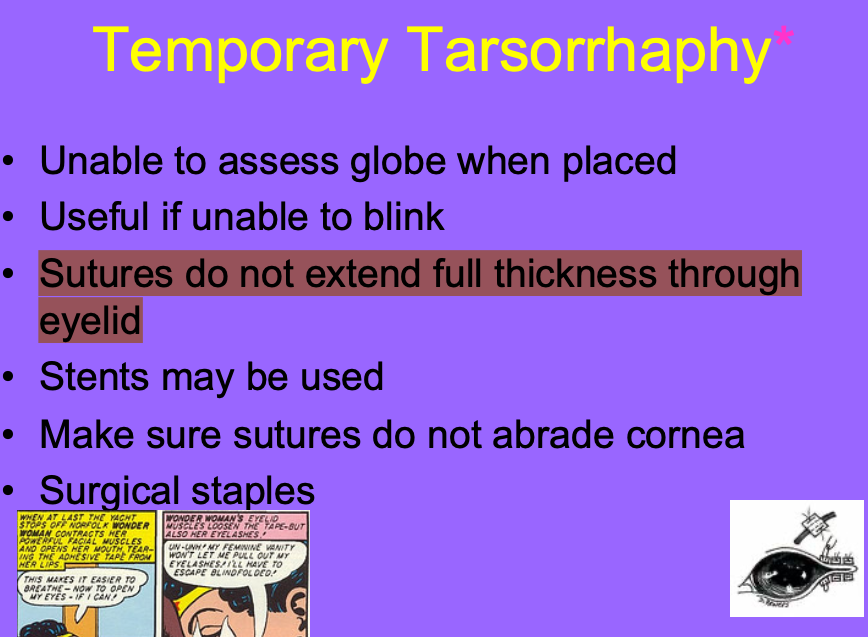
Temporary Tarsorrhaphy - sutures
do not extend full thickness through eyelid.
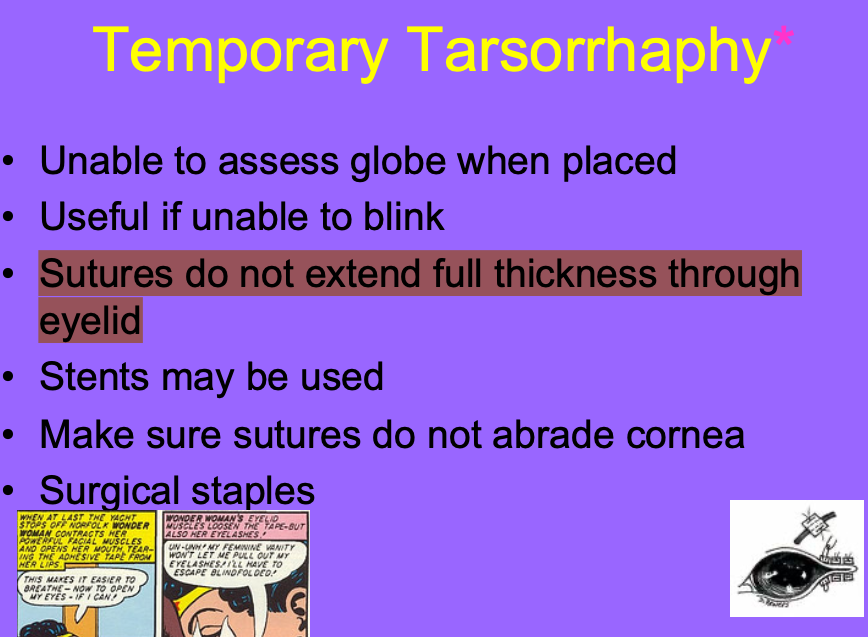
Permanent partial tarsorrhaphy is done to
permanently reduce size of palpebral fissures (reduces risk of proptosis).