Lab Exam #2 - BIO2010
 Call Kai
 Learn
Learn Practice Test
 Spaced Repetition
 Match
Match Flashcards
 Knowt Play
1/131

There's no tags or description
Looks like no tags are added yet.
Name | Mastery | Learn | Test | Matching | Spaced | Call with Kai |
|---|
No analytics yet
Send a link to your students to track their progress
132 Terms
What does the MR (Methyl Red) test measure?
The ability of bacteria to ferment glucose to an acid.
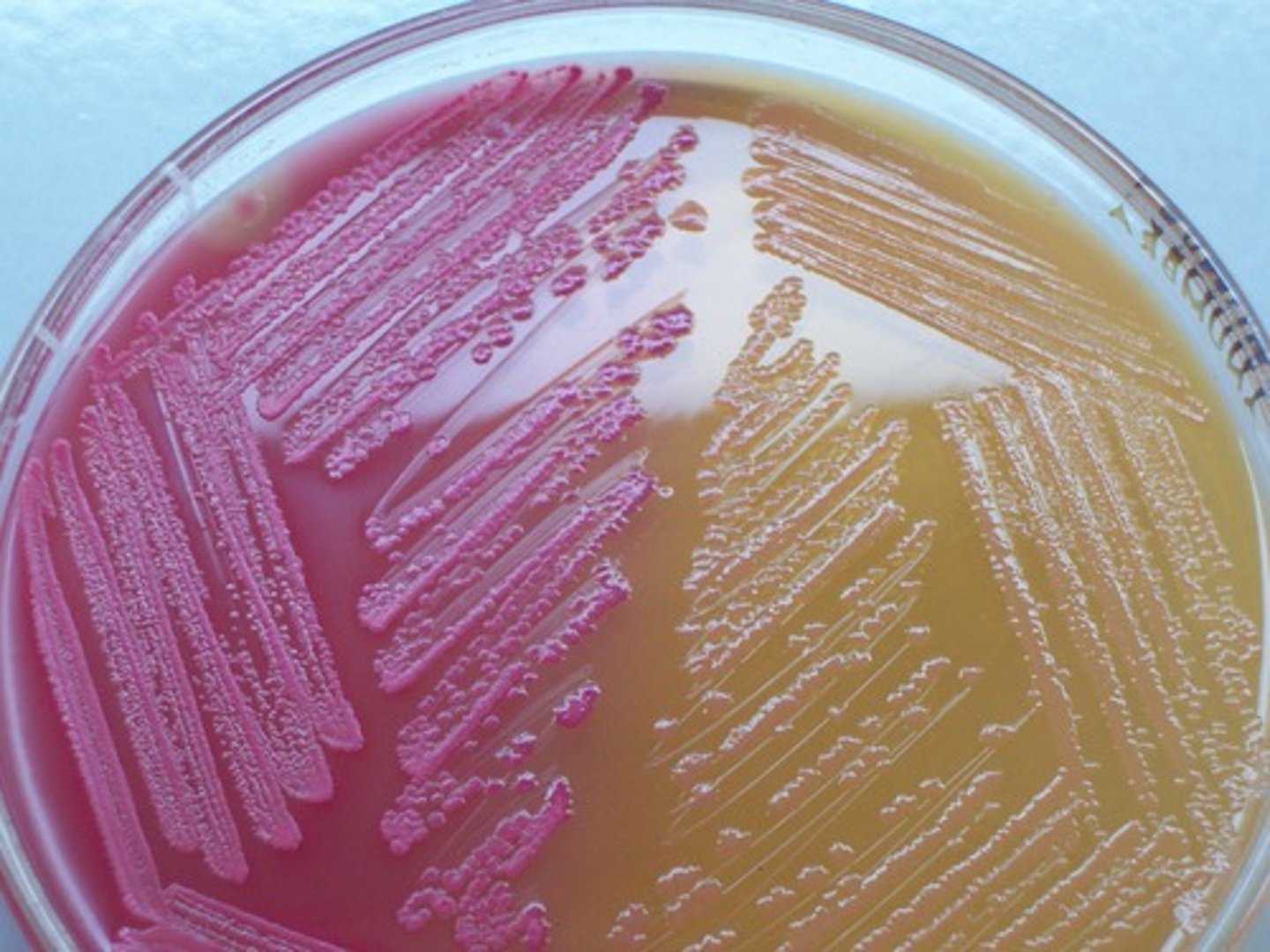
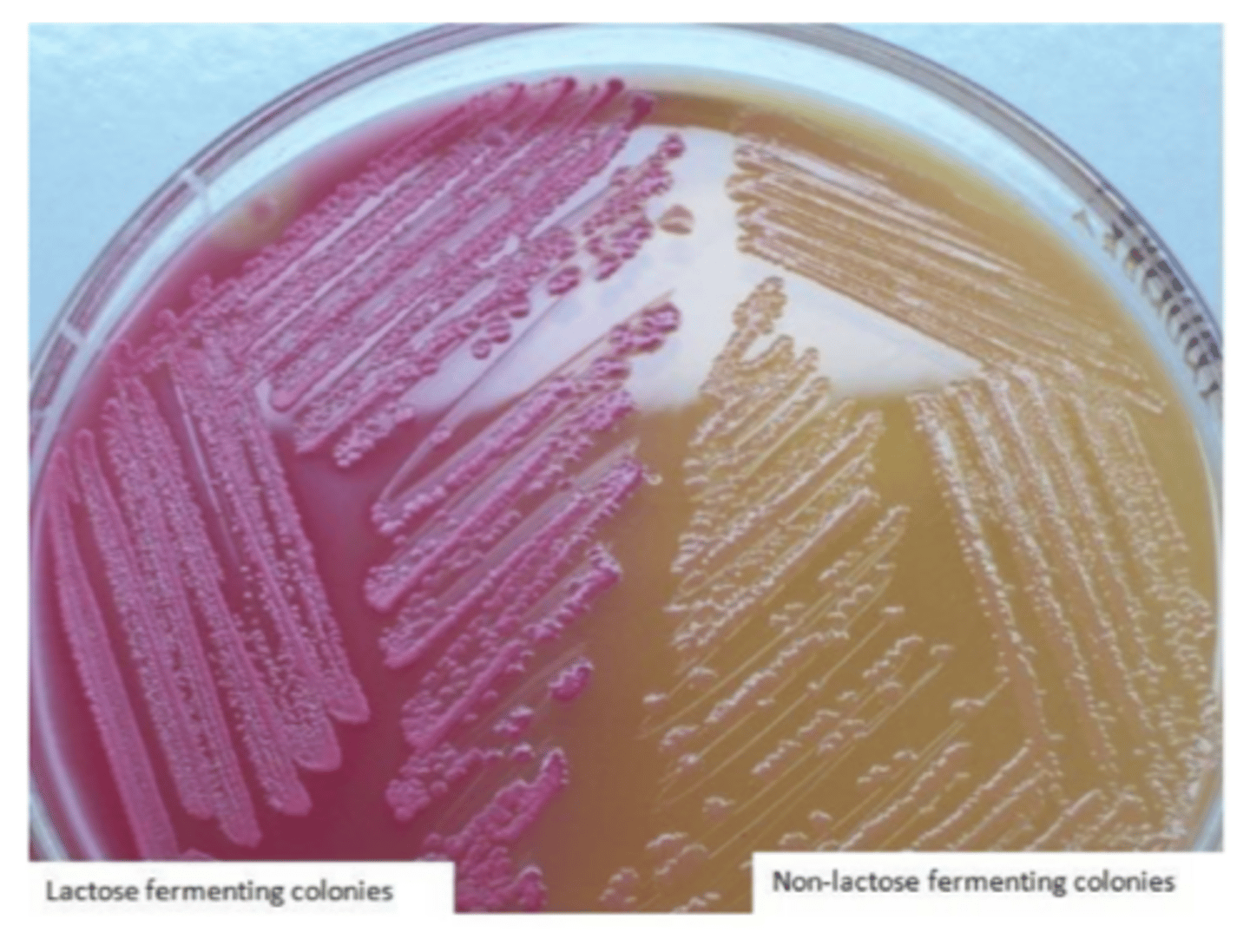
What color do lactose fermenters produce on MacConkey's agar?
Bright pink or red colonies
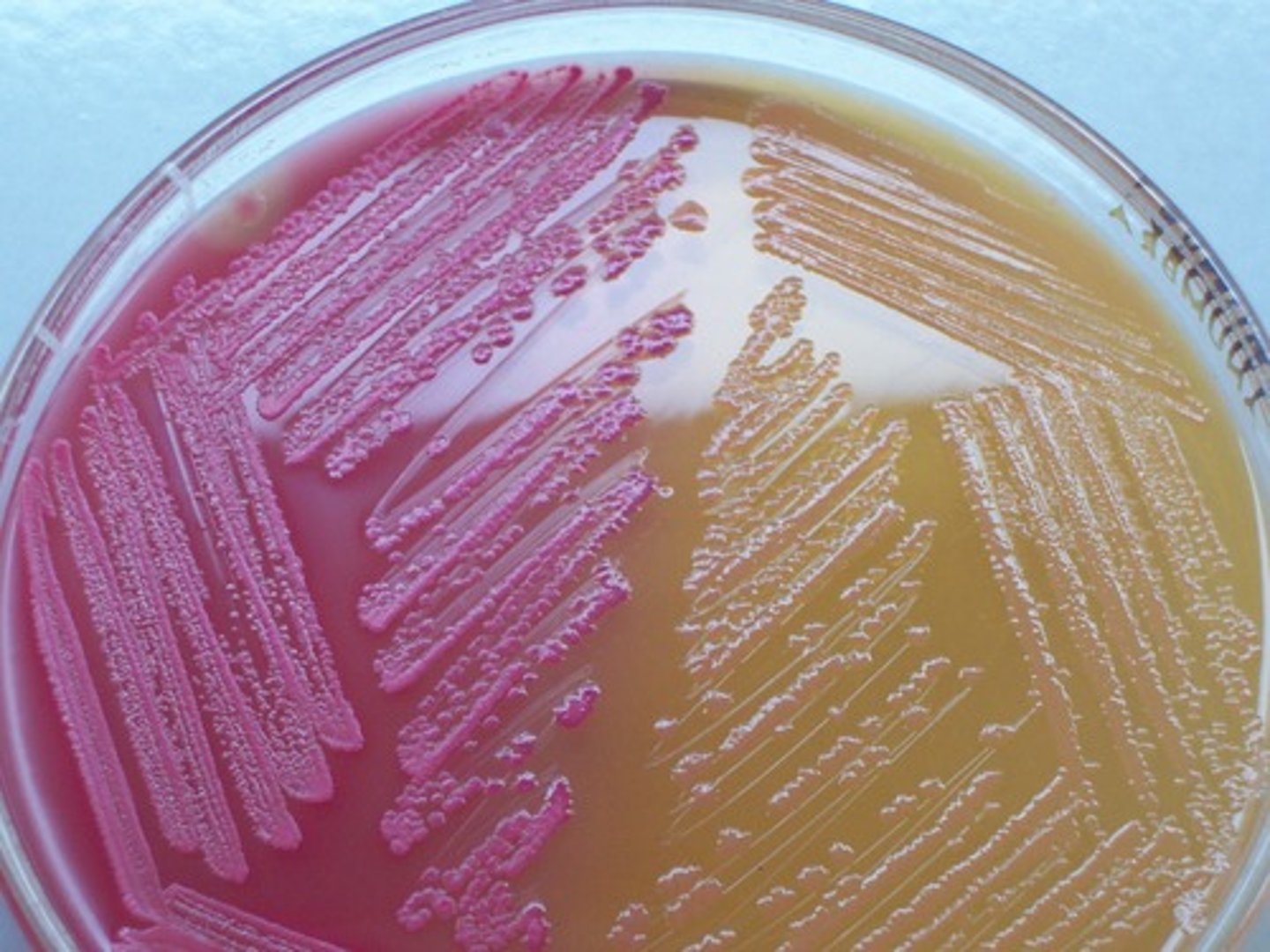
What color do non-fermenters produce on MacConkey's agar?
Tan or white colonies
What does the IMViC series differentiate?
Escherichia coli from Enterobacter/Klebsiella group.
What does the Indole test measure?
The ability of bacteria to convert tryptophan to indole.
What is the procedure for the Indole test?
Use trypticase soy broth, incubate, then add Kovac's reagent; a red reaction indicates indole is present.
What type of bacteria does MacConkey's agar selectively grow?
Gram negative bacteria (pink)
What is the selective factor in MacConkey's agar?
Crystal violet and bile salts
What does MacConkey's agar contain as a substrate?
Lactose
What is the pH indicator used in MacConkey's agar?
Neutral red
What is the procedure for the MR test?
Inoculate MR broth, incubate, then add methyl red indicator; a red reaction indicates acid is present.
What does a yellow to orange result in the MR test indicate?
Acid is NOT present.
What does the VP (Voges Proskauer) test measure?
The ability of bacteria to convert glucose to non-acidic end products such as acetoin.
What is the procedure for the VP test?
Inoculate VP broth, incubate, add Barritt's A and B, incubate at 37°C for at least 15 minutes; a pink color indicates acetoin is present.
What is a key note about the MR and VP tests?
Bacteria cannot metabolize glucose using both pathways; there can only be a positive MR test and a negative VP test or vice versa.
What does the Simmons Citrate test measure?
The ability of bacteria to ferment citrate.
What indicates a positive result in the Simmons Citrate test?
The bromthymol blue pH indicator changes from green to royal blue.
What does MSA stand for in microbiology?
Mannitol salt agar
What is the selective agent in MSA agar?
7.5% NaCl
Which type of microorganisms can grow on MSA agar?
Salt-tolerant Staphylococci
What substrate does MSA agar contain for fermentation testing?
Mannitol
What pH indicator is used in MSA agar?
Phenol red
What indicates a positive test for fermentation on MSA agar?
Red media turns bright yellow due to acid production
What is a presumptive test for Staphylococcus aureus?
Mannitol fermentation on MSA agar
What selective agents are contained in CNA (Columbia CNA agar)?
Colistin and nalidixic acid
What type of microorganisms does colistin inhibit?
Most Gram negative microorganisms
Is CNA (Columbia CNA agar) a differential culture media?
Yes, it contains blood
What type of reactions can be observed on CNA (Columbia CNA agar)?
Hemolytic reactions
Can Pseudomonas grow on CNA (Columbia CNA agar)?
Yes, Pseudomonas (a Gram negative) may grow on this media
What type of media is a Blood Agar Plate (BAP)?
Enriched media and differential, but not selective.
What percentage of sheep's blood is contained in a Blood Agar Plate?
5% sheep's blood.
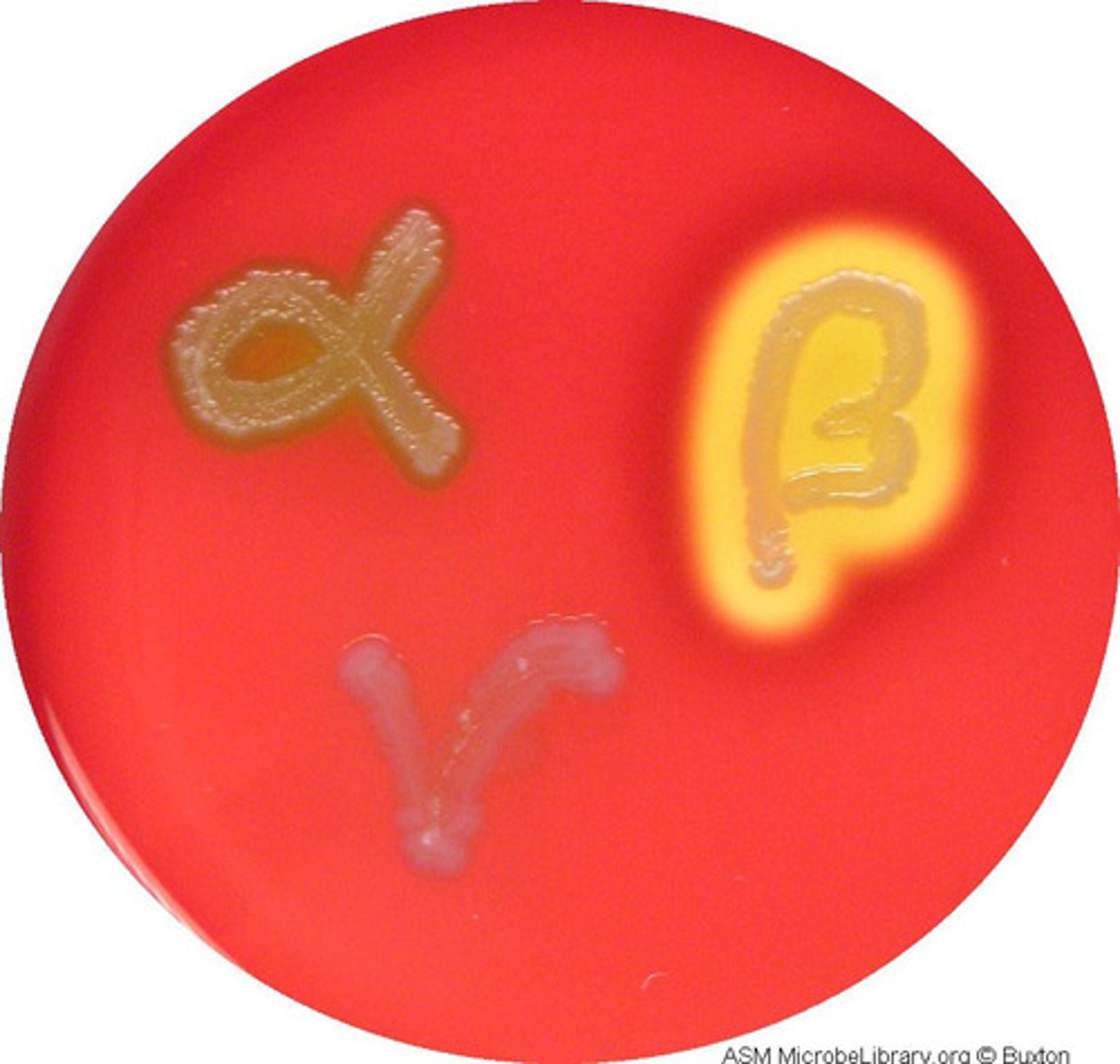
What is beta hemolysis?
Complete hemolysis of hemoglobin, resulting in clearing of RBCs.
Which bacteria are associated with beta hemolysis?
Streptococcus pyogenes and Staphylococcus aureus.
What is alpha hemolysis?
Partial hemolysis of hemoglobin, resulting in an olive green color.
Which bacteria are associated with alpha hemolysis?
Streptococcus pneumoniae.
What is gamma hemolysis?
No alteration of the blood agar.
Which bacteria are associated with gamma hemolysis?
Some Staphylococcus epidermidis.
What is the selective agent in Bile Esculin Agar?
Bile
What happens to Streptococcus in Bile Esculin Agar?
It will be lysed by bile and cannot grow.
What type of molecule is esculin?
A glycoside - a sugar molecule bonded by an acetyllinkage to an alcohol.
What is the role of ferric citrate in Bile Esculin Agar?
It acts as a color indicator.
What enzyme do bacteria use to split esculin in Bile Esculin Agar?
Esculinase
What product is released when esculin is split by bacteria?
Esculetin
What color complex forms when esculetin reacts with ferric citrate?
A phenolic iron complex.
What color change indicates a positive result in Bile Esculin Agar?
The agar turns dark brown to black.
What is a presumptive test for in Bile Esculin Agar?
Enterococcus durans
What does the catalase test differentiate?
It differentiates Streptococci and Enterococci from Staphylococci and Micrococci.
What is the reaction that catalase catalyzes?
2H2O2 → 2H2O + O2
How do you perform the catalase test?
Place one drop of hydrogen peroxide on a glass slide and add a small loop of microorganisms from a pure culture.
What indicates a catalase positive result?
Large oxygen bubbles will appear.
Which bacteria are catalase positive?
Staphylococcus and Micrococcus.
Which bacteria are catalase negative?
Streptococci and Enterococci.
What is the mannitol fermentation result for Staphylococcus aureus?
Positive
What is the mannitol fermentation result for Staphylococcus epidermidis?
Negative
What type of hemolysis does Staphylococcus aureus exhibit?
Beta hemolysis
What type of hemolysis does Staphylococcus epidermidis exhibit?
Gamma hemolysis
What is the DNAse test result for Staphylococcus aureus?
Produces a clear halo (positive)
What is the DNAse test result for Staphylococcus epidermidis?
Does not produce a clear halo (negative)
What is the coagulase test result for Staphylococcus aureus?
Positive
What is the coagulase test result for Staphylococcus epidermidis?
Negative
What type of hemolysis is Streptococcus pneumoniae?
Alpha hemolytic
What type of hemolysis is Streptococcus pyogenes?
Beta hemolytic
What type of hemolysis is Enterococcus durans?
Weak beta hemolytic
What test is used to confirm Streptococcus pneumoniae?
Sensitivity to Optochin (taxo P disc)
What indicates sensitivity in the Optochin test for Streptococcus pneumoniae?
Zone of inhibition
What test is used to confirm Streptococcus pyogenes?
Sensitivity to Bacitracin (Taxo A disc)
What indicates sensitivity in the Bacitracin test for Streptococcus pyogenes?
Zone of inhibition appearing as an area of no hemolysis around the disc
What test is used for Enterococcus durans on Bile Esculin Agar?
Uses Esculinase enzyme to hydrolyze esculin to esculetin
What indicates a positive result for Enterococcus durans on Bile Esculin Agar?
Black precipitate from ferric citrate reacting with esculetin
Is Enterococcus durans sensitive to Optochin?
No, it is resistant
Is Enterococcus durans sensitive to Bacitracin?
No, it is resistant
What does carbohydrate fermentation test?
It tests the ability of bacteria to ferment different carbohydrates into acid and may liberate gas.
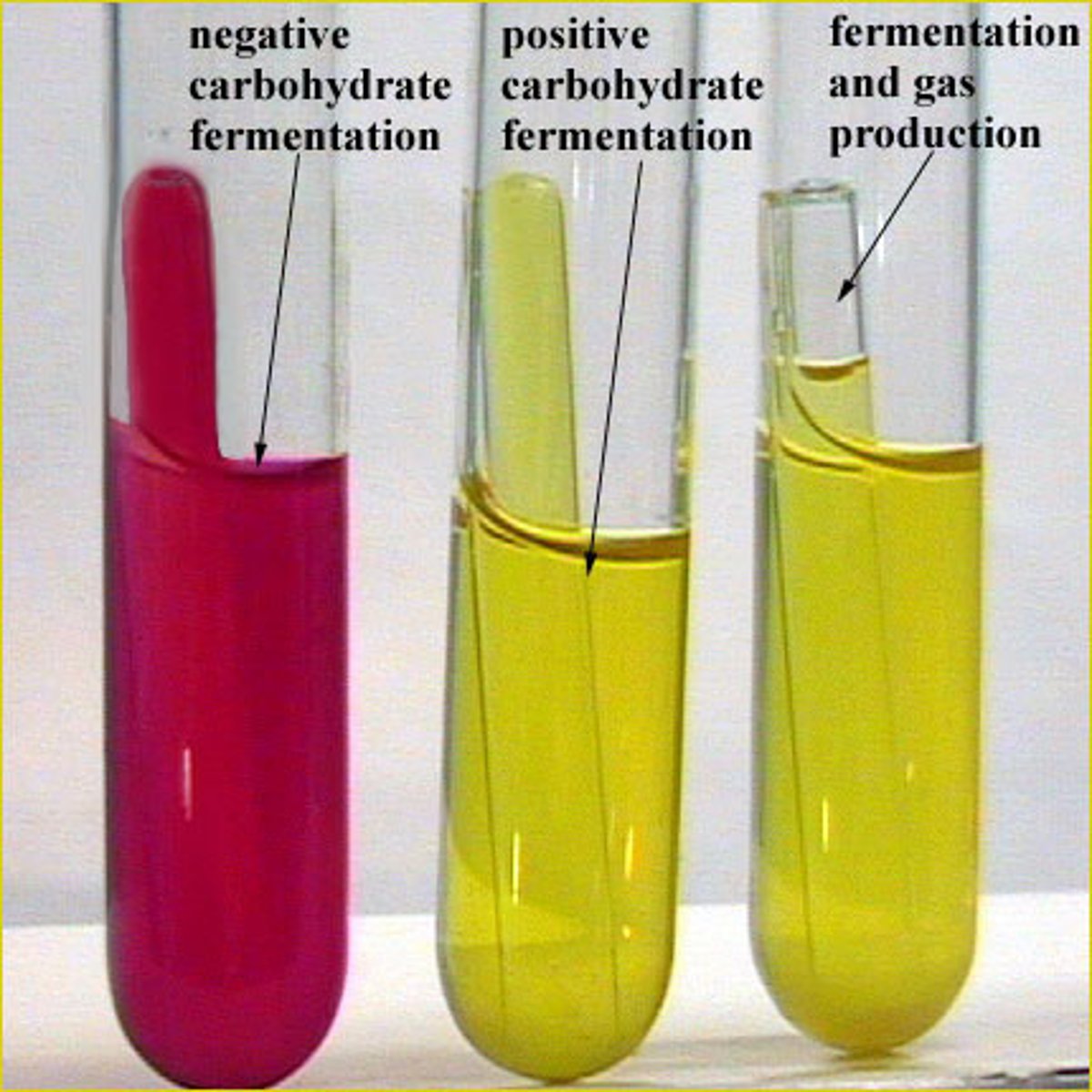
What do carbohydrate fermentation tubes contain?
They contain media, a test carbohydrate (such as lactose, sucrose, or glucose), a phenol red pH indicator, and a small inverted test tube called the Durham tube.
What indicates acid production in carbohydrate fermentation?
The phenol red will turn from red to yellow in color.
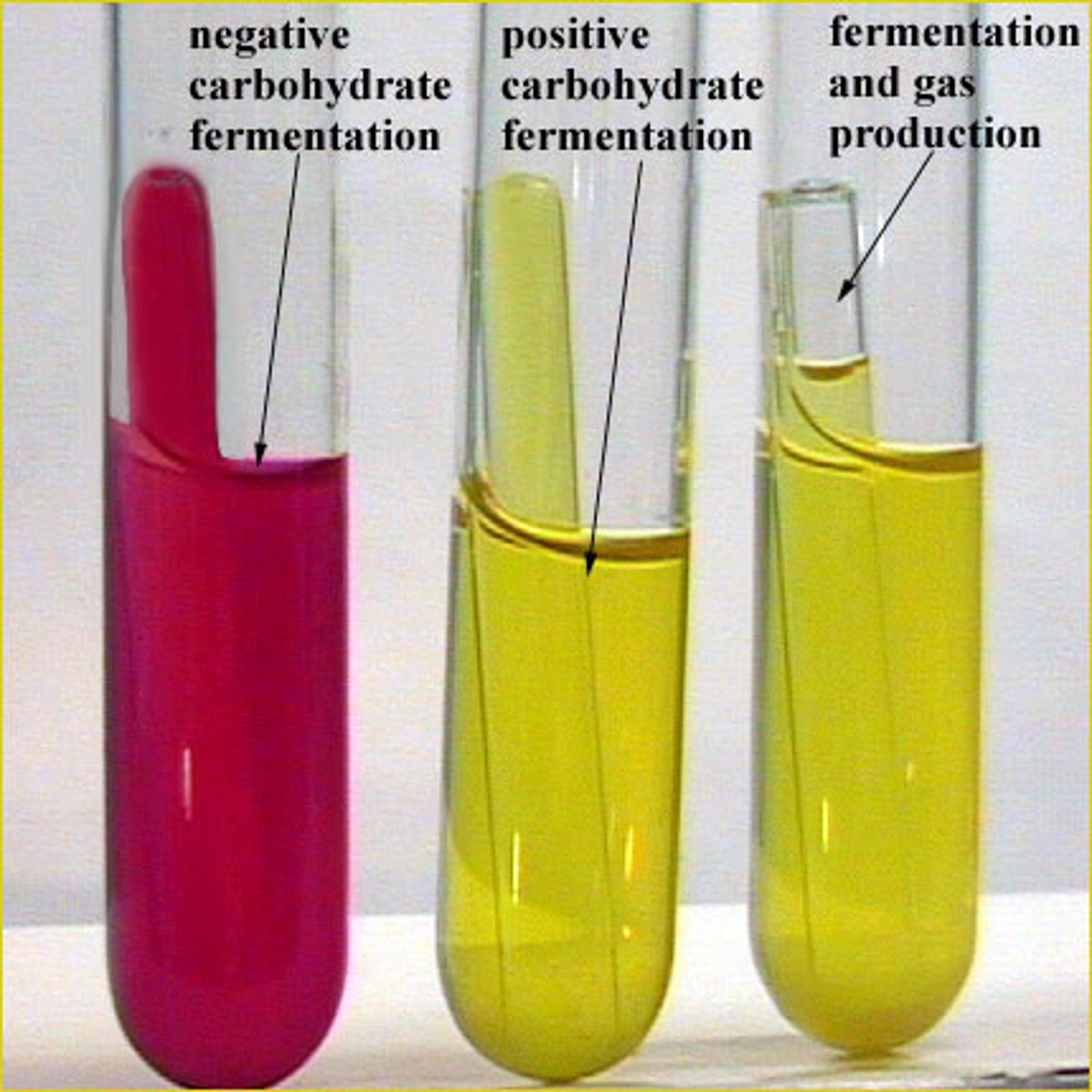
What indicates gas production in carbohydrate fermentation?
A bubble (empty space) will be seen in the inverted Durham tube.
Which bacteria are negative for glucose, lactose, and sucrose fermentation?
Pseudomonas and Neisseria.
What does the nitrate reduction test measure?
The ability of bacteria to reduce nitrate (NO3) to nitrite (NO2), ammonia (NH3), or nitrogen gas (N2).
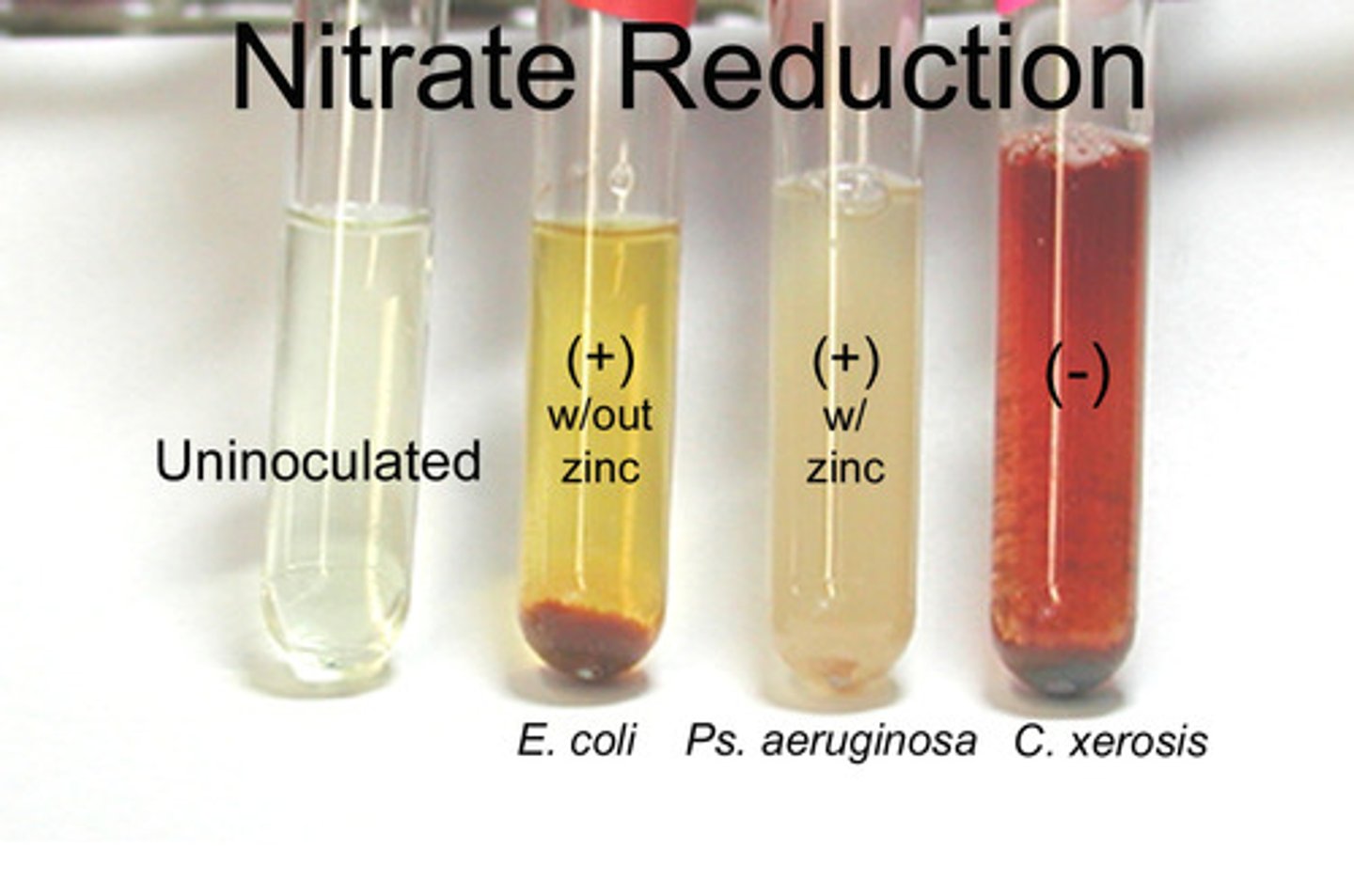
What substrate is used in the nitrate reduction test?
Tryptic nitrate broth contains the substrate nitrate.
What reagents are added to test for nitrite in the nitrate reduction test?
Sulfanilic acid and alpha-naphthylamine.
What indicates that bacteria have the enzyme nitrate reductase in the nitrate reduction test?
A bright red color change occurs immediately after adding reagents.
What should be done if there is no color change after adding sulfanilic acid and alpha-naphthylamine?
Add a small amount of powdered zinc metal to the tube.
What does a pink/red color change after adding zinc indicate?
Nitrate in the tube has not been reduced, indicating the bacteria lack enzymes for the metabolic pathway.
What does no color change after adding zinc indicate in the nitrate reduction test?
The bacteria had both nitrate reductase and nitrite reductase, converting nitrate first to nitrite and then to ammonia or nitrogen gas.
What is the purpose of the Kirby Bauer sensitivity test?
To interpret the susceptibility of an organism to various antibiotic discs.
What is measured in millimeters in the Kirby Bauer test?
Zones of inhibition.
What do you compare the zones of inhibition to in the Kirby Bauer test?
An interpretation chart.
What factors influence diffusion rates on the agar in the Kirby Bauer test?
Concentration and molecular mass of the antimicrobials.
What does a large zone of inhibition generally indicate?
Sensitivity to the antibiotic.
What does a small zone of inhibition generally indicate?
Resistance to the antibiotic.
What type of media is used for throat culture?
BAP (Blood Agar Plate)
What types of hemolytic bacteria are most commonly found in the throat of a healthy person?
Alpha and gamma hemolytic bacteria
What type of hemolytic bacteria may be found in a throat culture if the person is a carrier?
Beta hemolytic bacteria, most probably Streptococcus pyogenes
What does any growth from a MacConkey's agar throat culture indicate?
Ingestion of contaminated food
What is food intoxication?
Poisoning caused by eating foods that contain toxins produced by microorganisms. The illness comes from the toxin, not the organism itself.
Examples of Food Intoxication
Staphylococcus aureus toxin
Clostridium botulinum (botulism)
Bacillus cereus emetic toxin
What does the MPN test detect?
The presence of coliforms (Gram (-), lac+), an indicator organism.
What are the three parts of the MPN test?
Presumptive, confirmatory, and completed.
What is the presumptive part of the MPN test?
Addition of samples into a set of 5 lactose tubes, each in decreasing amount, after diluted 10x and 100x.
How do you interpret the results of the presumptive MPN test?
Count the number of positive tubes (yellow + gas) in each set in this order: set 1, set 2, and set 3.
What is the threshold for potable water in terms of coliforms?
Less than 2 coliforms per 100 mL.
What media is used in the confirmatory part of the MPN test?
Eosin Methylene Blue media.