Ion basis of electrical signaling - chapter 2
 Call Kai
 Learn
Learn Practice Test
 Spaced Repetition
 Match
Match Flashcards
 Knowt Play
1/73

There's no tags or description
Looks like no tags are added yet.
Name | Mastery | Learn | Test | Matching | Spaced | Call with Kai |
|---|
No analytics yet
Send a link to your students to track their progress
74 Terms
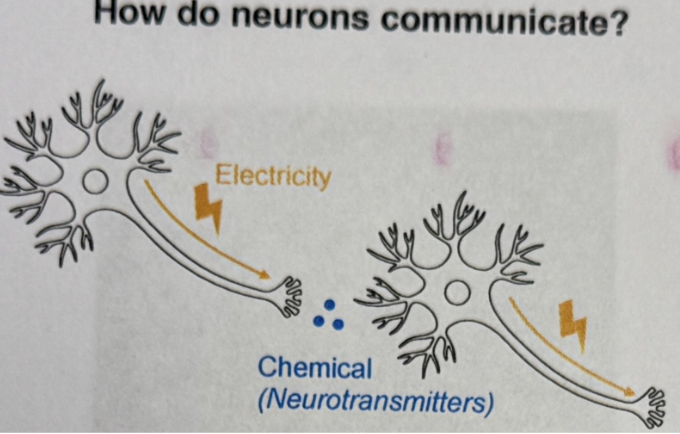
how do neurones communicate?
Neurons behave by two types of signals: electrical or chemical signals
threshold potential
certian level of membrane potential where action potential occurs
Electrical signals
Electricity travels through axon terminal and releases neuro transmitters which dendrites of other neuron sense
control movement and more
Luigi Galvani
1797
Exp: Accidentally electrically stimulated a frog leg and the frog leg kicked
Discovered: Electrical current can activate muscle
Galvanize = to shock or excite
Discovered bioelectricity by showing that nerves and muscles generate electrical signals
Edward Hitzig and Gustav Fritsch
1879
Discovered: stimulation of cortex can move limbs
Discovered localized motor function with their experiments in dogs.
Wilder Penfield
Exp: doing awake Surgery on pt with epilepsy
Discovered: Stimulation of cortex can evoke memories or laughter
Mapped the human cortex through electrical stimulation and produced homunculus
Why do we use electricity for signalling?
Bc electricity is fast and speed is needed
For ex. If you are walking and your foot steps on a pin if your brain doesn’t get the signal to move your foot right away you may get severely injured. But since electricity is fast your brain gets signals fast and you can avoid/minimize injury
why are squids fast and useful to scientists?
Squid are fast bc the neurons innervating their jet propulsion muscles have very large axons
Squids giant axon is a LOT bigger than a mammalian axon
This is useful to scientist bc big things are easier to handle experimentally
Squid giant axon is easily accessible
two conditions for each membrane of cells
1) There are different ion concentrations across the membranes
2) membranes are selectively permeable to some ions
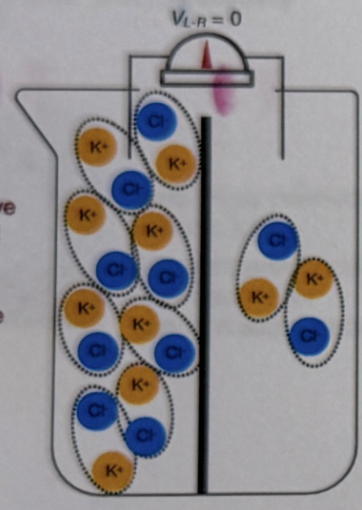
beaker example for electrochemical equilibrium (first part - just normal beaker with normal partition)
Imagine you have beaker with a solid divider (vertical) that partitions it into two departments. On the left side their is very high concentrated potassium chloride and right side there is a less concentrated solution(less potassium and chloride ions) of potassium chloride. Voltage difference between two sides is 0.
This is bc within each side, and negative charges are equally balanced. No net charge on either side, so the difference between the sides = 0
beaker example for electrochemical equilibrium (second part - just normal beaker with broken partition)
Now if the divide had holes permeable only to potassium ions (K+). This would cause K+ ions to move down their concentration gradient causing some K+ ions on left side to move to right side. So then we have more negative charge on left side since more K+ ions moved to right.
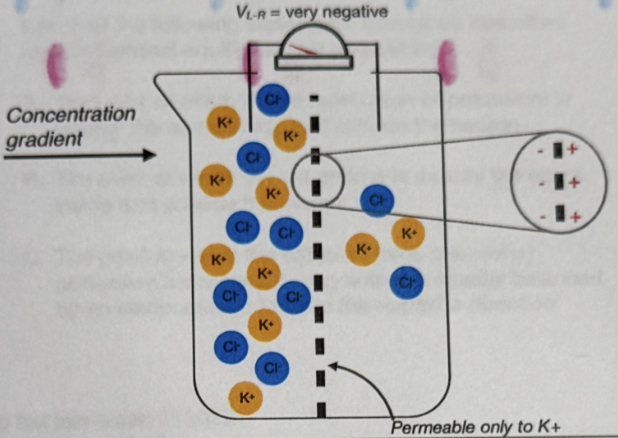
beaker example for electrochemical equilibrium (third part - just normal beaker with broken partition
Overtime the positive potassium ions will start being attracted to negative charge on the left side causing them to flow towards the left side. Eventually the electrical force will counterbalance concentration force. So concentration gradient is towards right and electromotive force is towards left causing them to balance each other out over time.
This is bc no net flow of ion in either direction. Electrical force and chemical diffusion force are equally balanced.
Once at the point of equilibrium: V(L-R) = negative —> potassium's equilibrium potential (Ek)
Voltage difference between left and right at potassium equilibrium potential will be negative when at equilibrium
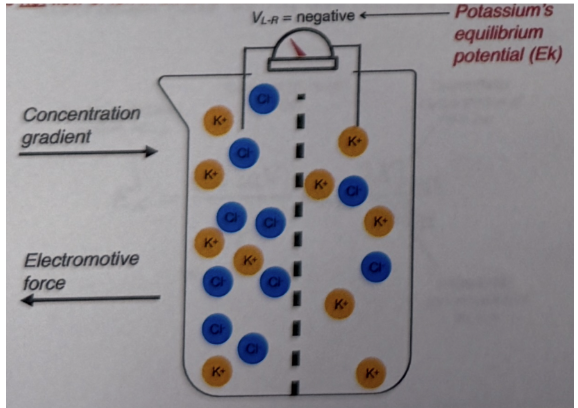
electrochemical equilibrium
exact balance between two opposing forces
concentration gradient and opposing electrical gradient
purpose of cell membrane
prevents the flow of ions (semi-permeable membrane)
acts as a divider
Membrane acts as an insulator - does not allow electrical current to flow across
Hydrophobic phospholipid bilayer prevent movement if ions
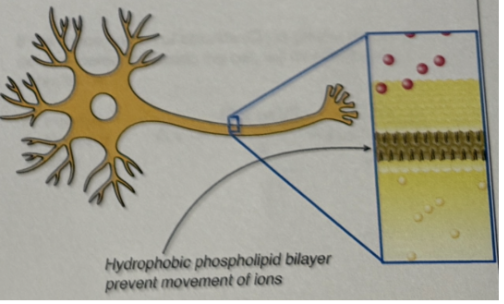
[K+] for cell membrane
High [K+] in the intracellular space
Low [K+] out in extracellular space
![<ul><li><p>High [K+] in the intracellular space</p></li><li><p>Low [K+] out in extracellular space</p></li></ul><p></p>](https://assets.knowt.com/user-attachments/2e029be2-9641-42c3-ae51-bb964c424623.png)
ion channels
allow for selective membrane permeability
Allow for passive diffusion of ions down their concentration gradient
proteins that allow only certain kinds of ions to cross the membrane in the direction of their concentration gradients
which of the following statements accurately describes electrochemical equilibrium for potassium?
a)The point at which the concentration of potassium is exactly the same inside and outside the neuron
b) The point at which the net charge is exactly the same inside and outside the neuron
c) The point at which the diffusion force created by potassium’s concentration gradient is exactly balanced by an electromotive force in the opposite direction
C) The point at which the diffusion force created by potassium’s concentration gradient is exactly balanced by an electromotive force in the opposite direction
equilibrium potential
electrical potential generated across the membrane at electrochemical equilibrium (potential difference between outside and inside compartments)
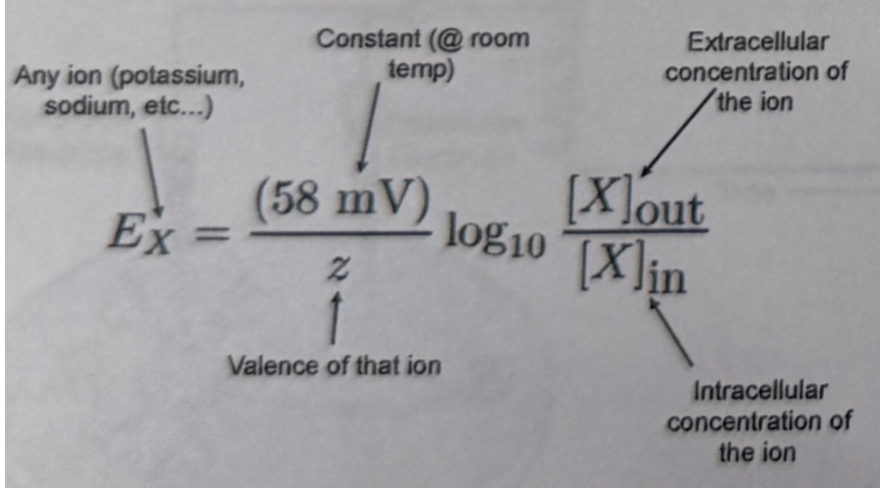
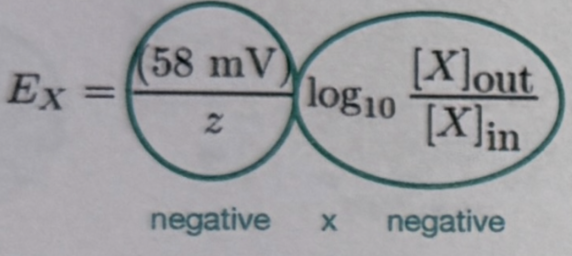
Nernst equation
used to calculate equilibrium potential for individual ions
electric potential overcoming concentration gradient
concentration gradient or the way the ions move can be affected by the electric potential (if making something more negative/positive)
potassium valence?
+1
chloride valence
-1
sodium valence
+1
Nernst equation example
Potassium concentration (mM) Intracellular - 400 and Extracellular is 20
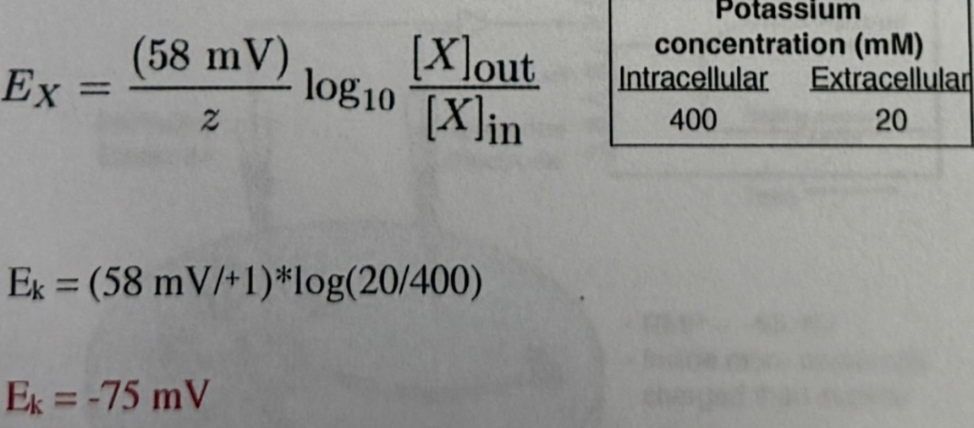
TopHat: If the concentration of chloride (Cl-) is greater inside the cell compared to outside the cell, will it’s equilibrium potential be positive, negative or zero?
positive because both terms negative
ion pumps
establish and maintain concentration gradients (sets equilibrium potential for each ion) -> REQUIRES ENERGY
Active transporters
type of ion pump
maintain ion concentration gradients across plasma membrane
not passive diffusion so uses energy typically in form of ATP (not always though)
actively move ions into or out of cells against their concentration gradient
active transporters and ion channels relationship
channels and transporters work against each other generating the resting membrane potential, action potentials, and the synaptic potentials and receptor potentials that trigger action potentials
Sodium-potassion pump
For every three sodium ions pumped outside cell, 2 potassium ions are pumped inside the cell
what works to maintain resting membrane potential?
Channels and transporters work against each other to maintain RMP
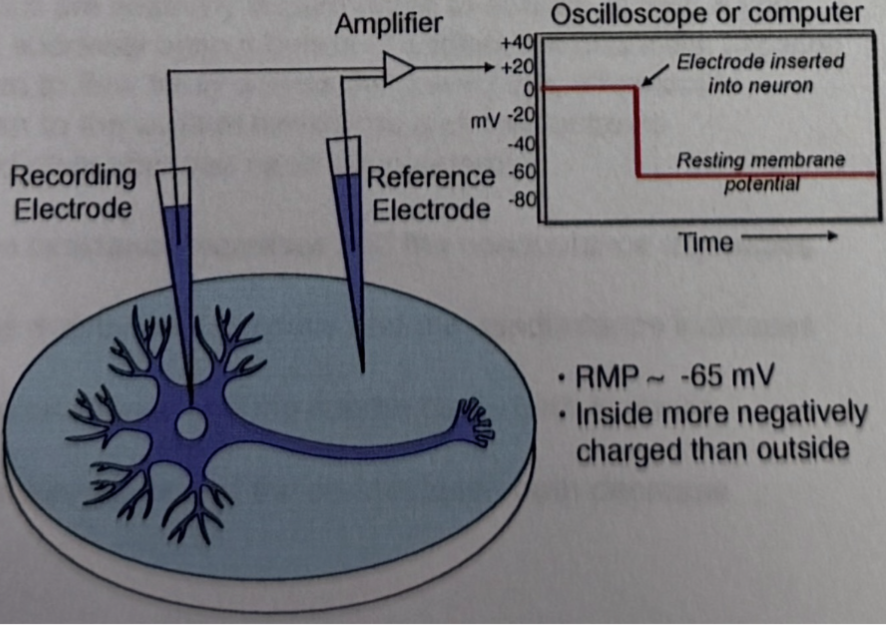
In vitro intracellular recording - how it works
Extracted brain from organism and kept brain alive and sliced brain and put slice on dish and zoomed in using microscope to look at neuron
To measure electrical signals of neurons take a glass pipette (recording electrode) and stab it into the neuron (intracellular space)
Another glass pipette is stabbed in the bath solution (reference electrode)
They both go through an amplifier so we can measure difference inside and outside of cells
RMP is (inside-outside)
Resting membrane potential (RMP)
The difference in voltage between the inside and outside of the cell at rest
what is typical RMP?
RMP -> Typically -65
INSIDE MORE NEGATIVELY CHARGED THAN OUTSIDE OF CELL
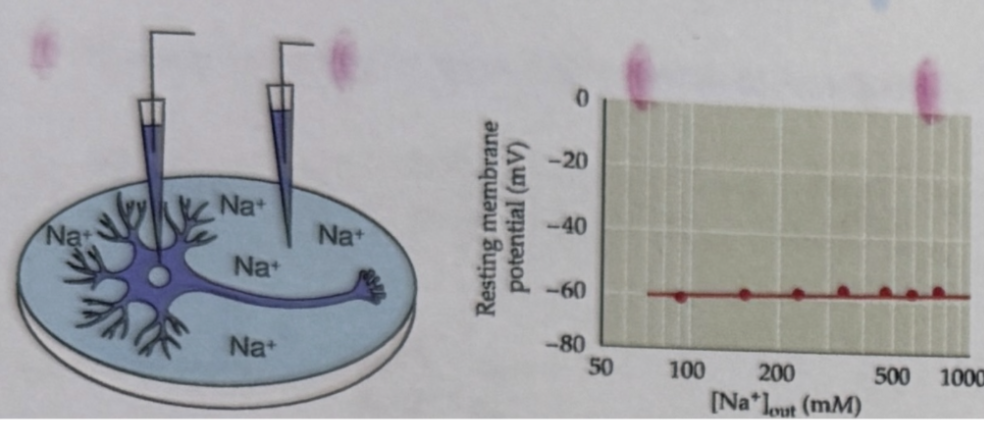
Using an in vitro intracellular recording approach, how would you determine whether sodium contributes to the resting membrane potential?
Record RMP by changing or removing sodium concentration in bath and see how it affects RMP
RMP doesn't or barely changes so sodium doesn’t really contribute to RMP (or very very little)
This is bc membrane is (essentially) impermeable to sodium at rest and therefore doesn’t really contribute to the resting membrane potential
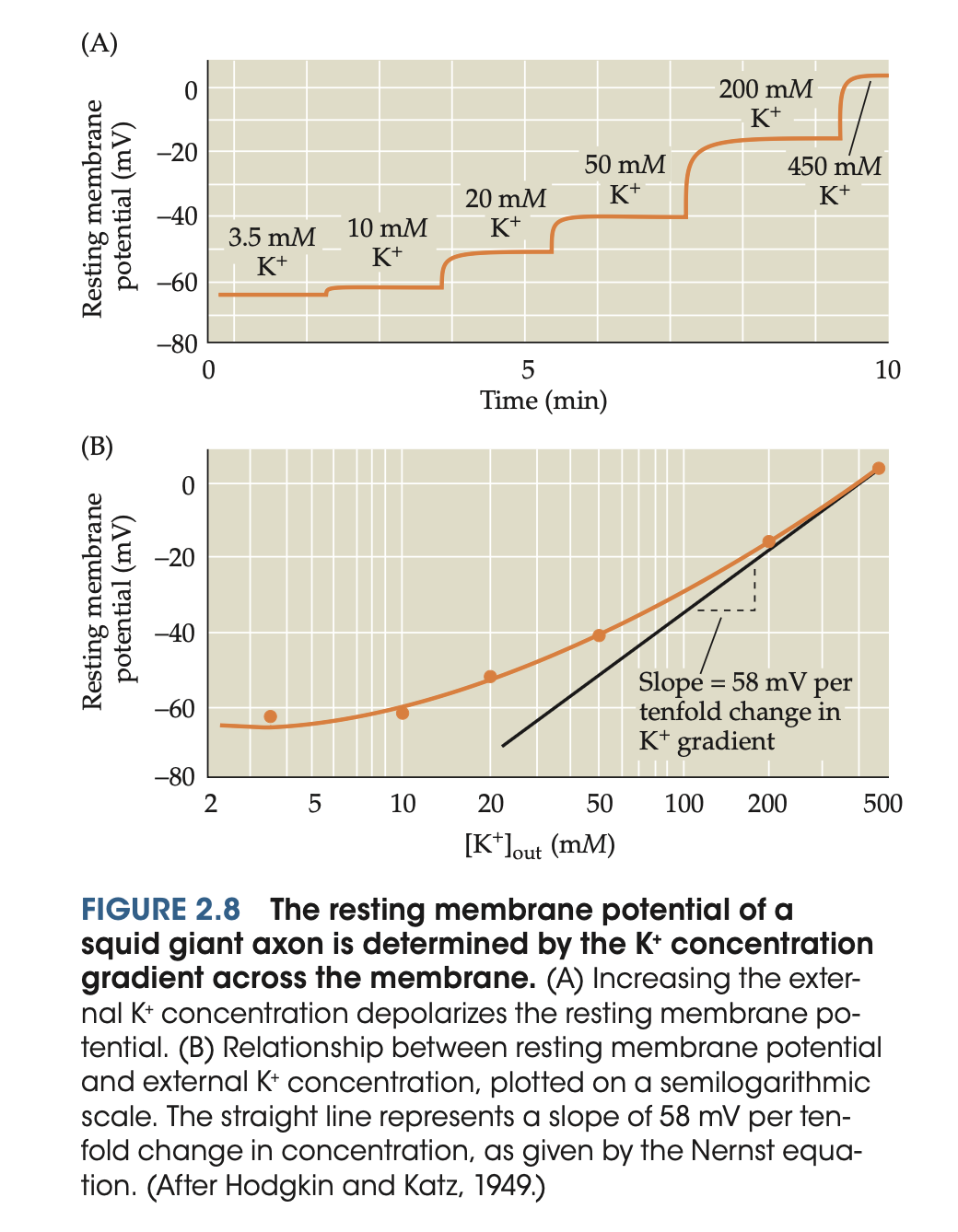
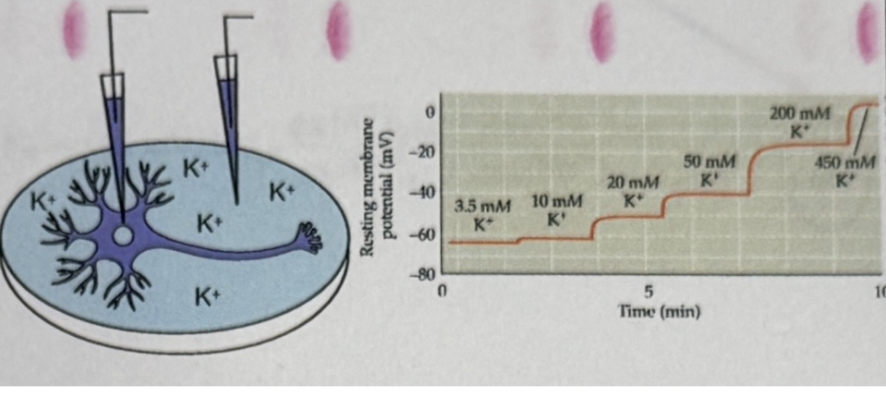
How do you determine which ions are responsible for resting membrane potential?
Did same thing as above for potassium.
Found that as extracellular potassium concentration increased RMP increased which shows potassium plays a very big role in setting RMP
Membrane is very permeable to potassium at rest
Goldman equation
equation that takes into account concentration gradients of permanent ions and permeability to membrane
since potential is also dependent on how permeable the membrane is to different ions
calculates resting membrane potential of cell
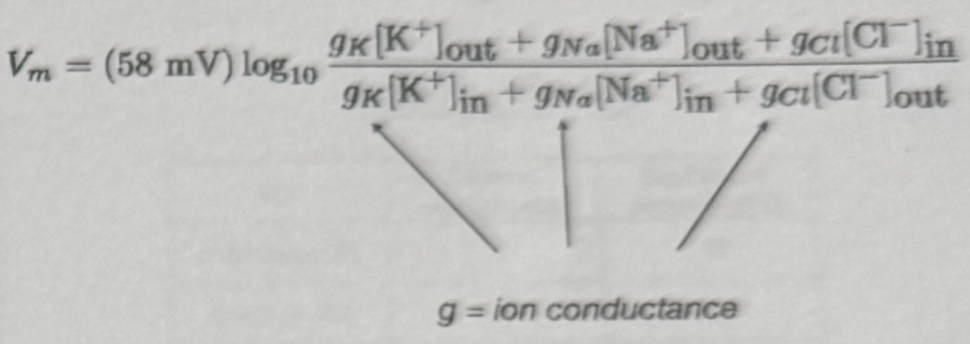
why is chloride the opposite in goldman equation
Chlorides is opposite bc chloride has negative valence
Ohm’s Law
Ohm’s Law: I = V/R
I = current
V = voltage
R = resistance
Ohm’s Law: I = V*G
G = conductance
calculating conductance?
G = 1/R
G = conductance
Conductance is essentially membrane permeability
Neurons are relatively impermeable to sodium at rest. If you could suddenly open a bunch of sodium ion channels, allowing sodium to flow freely across the membrane, what would happen to the sodium resistance and conductance immediately after you open the channels?
a) the resistance increases and the conductance decreases
b)The resistance decreases and the conductance increases
c) the resistance and the conductance both increase
d)The resistance and the conductance both decrease
b) the resistance decreases and the conductance increases
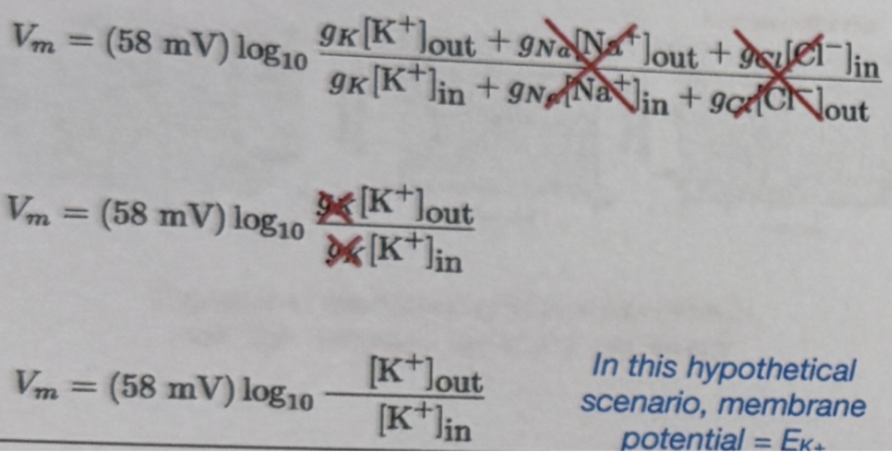
Goldman equation - imagine a membrane thats impermeable to Na+ and Cl-
becomes Nernst equation
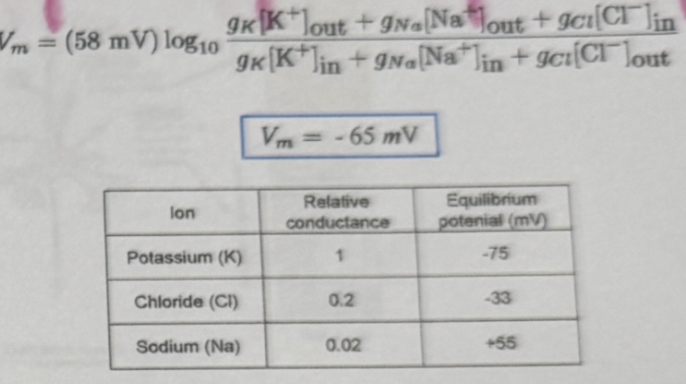
Ion - relative conductance - equilibrium potential (mV) [need to memorize values]
Vm = -65mv which also shows how potassium plays largest role in RMP(most permeable to potassium) and sodium smallest
relative conductance - how permeable the membrane is to that ion
Equilibrium potential - the membrane voltage where that ion would be in balance
RMP recap
Active transporters establish and maintain concentration gradients
Ion channels allow ions to passively diffuse down concentration gradient
Number of ion channels in membrane sets conductance for that ion
Together, ion conductances and concentration gradients control the resting membrane potential
The neuron is a battery, storing potential energy (in the form of chemical concentration gradients) for later use
action potential role
action potential is an electrical signal that travels along axons and briefly abolishes the negative resting potential and makes the transmembrane potential positive.
are responsible for long range transmission of information within the nervous system
Use stored energy to generate action potentials
(aka spike, or impulse)
how do neurons encode and transmit information
Neurons encode and transmit information via transient changes in the membrane potential
Changes in membrane potential can differ in their sign, temporal dynamics, and trigger
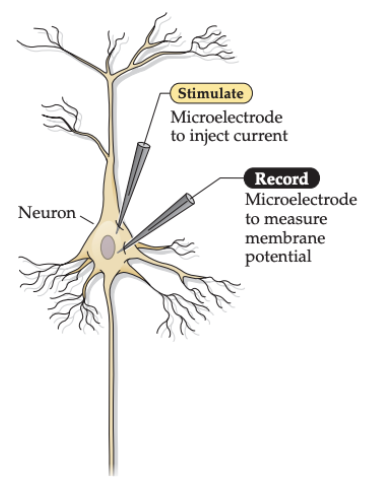
hyperpolarization - in terms of ___ and what happens
Negative membrane deflections
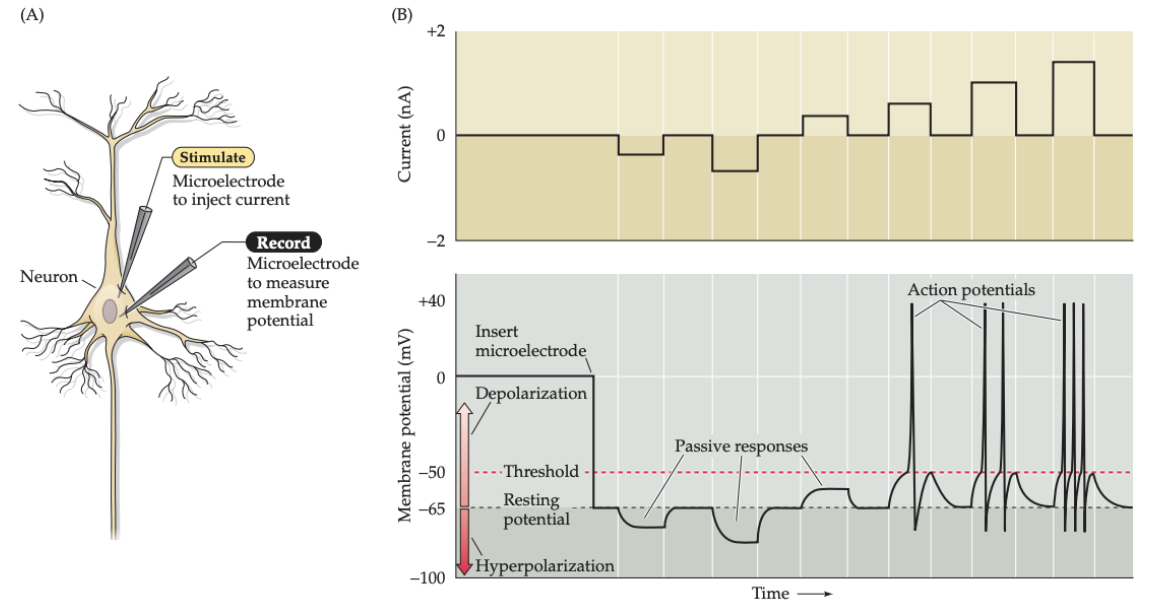
If current delivered makes membrane potential more negative (hyperpolarization) -> nothing dramatic happens, membrane potential just changes in proportion to magnitude of injected current (called passive electrical responses)
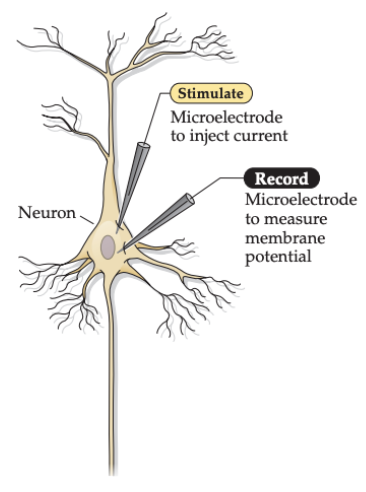
depolarization - in terms of ___ and what happens
Positive membrane deflections
If current delivered makes membrane potential more positive (depolarization) -> once reach threshold potential an action potential occurs
action potentials - how they occur
Action potentials are all-or-none (either occurs or it doesn’t) — threshold voltage
what does a large positive current injection cause
Beyond threshold, larger current injections will not elicit larger depolarizations. They’ll instead elicit more action potentials not “greater” action potentials
You inject a neuron with 1.5 nA of current,. The neuron responds by eliciting an action potential. When you inject 2 nA of current, will the amplitude of the action potential increase, decrease, or stay the same?
stays the same bc more current j produces more action potentials
how are action potentials generated?
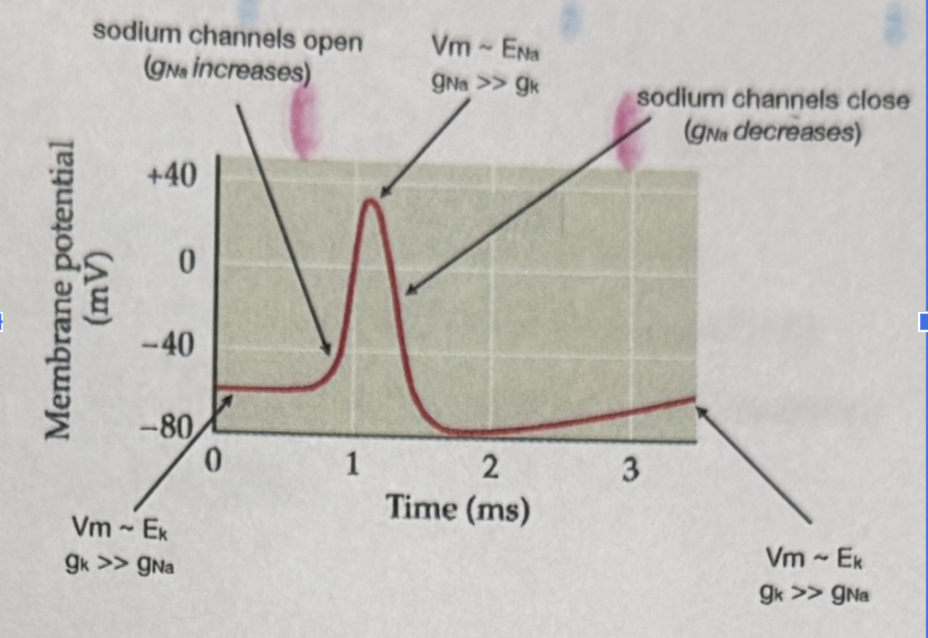
Generated by selective changes in the permeability of the neuronal membrane
At rest (~ −70 mV):
gK>gNa (The membrane is much more permeable to K⁺ than Na⁺)
more K+ inside cell than outside due to ion transporters
why resting potential is negative
Therefore:
Vm≈EK
Because potassium dominates, the membrane potential sits near the potassium equilibrium potential.
Depolarization (Rising phase)
gNa increases because the sodium channels opened and sodium rushes in
more sodium outside a neuron than inside because of ion pumps(higher concentration outside than inside)
transient increase in Na+ permeability → membrane potential becomes more positive
gNa> gK
So now:
Vm≈ENa
Because sodium conductance dominates, the membrane potential moves toward Eₙₐ (around +60 mV).
That’s why the voltage shoots upward.
This is the steep rising phase of the action potential.
Peak of Action Potential
At the top:
gNa≫gKg_{Na} \gg g_KgNa≫gK
VmV_mVm is close to ENaE_{Na}ENa
It doesn’t quite reach +60 mV because:
Sodium channels begin inactivating
Potassium channels begin opening
Repolarization (Falling phase)
The graph says:
sodium channels close (gNa decreases)
Now:
Na⁺ channels inactivate
K⁺ channels are open
gK≫gNa
So:
Vm≈EK
The membrane potential moves back toward the potassium equilibrium potential.
Hyperpolarization (Undershoot)
K⁺ channels stay open briefly.
Because:
gK still high (even higher than rest causing undershoot)
The membrane potential goes even closer to (or slightly past) EK.
This causes the small dip below resting potential.
action potential generation steps (short)
neuron at RMP (about -65 mV)
some stimulus depolarizes neuron (-55 mV)
Voltage gated sodium channels open allowing sodium ions to flow inside the cell
At peak voltage gated Na+ channels close and voltage-gated potassium channels open causing K+ to rush out of the cell, bringing the membrane potential back down towards negative.
Hyperpolarization (Undershoot): K+ channels stay open a bit too long, causing the membrane potential to briefly become more negative than the resting potential (below -70 mV)
Return to Resting State: K+ channels close, and the [sodium-potassium pump] restores the original resting ion concentrations.
how is membrane potential determined and action potential in terms of conductance
The membrane potential is determined by which ion has the highest conductance at that moment. (more permeable?)
If gK dominates → Vm≈EK
If gNa dominates → Vm≈ENa
The action potential is essentially a shift in conductance dominance:
K⁺ dominates at rest
Na⁺ dominates during the spike
K⁺ dominates again during repolarization
Why use action potentials? Why isn't passive just enough?
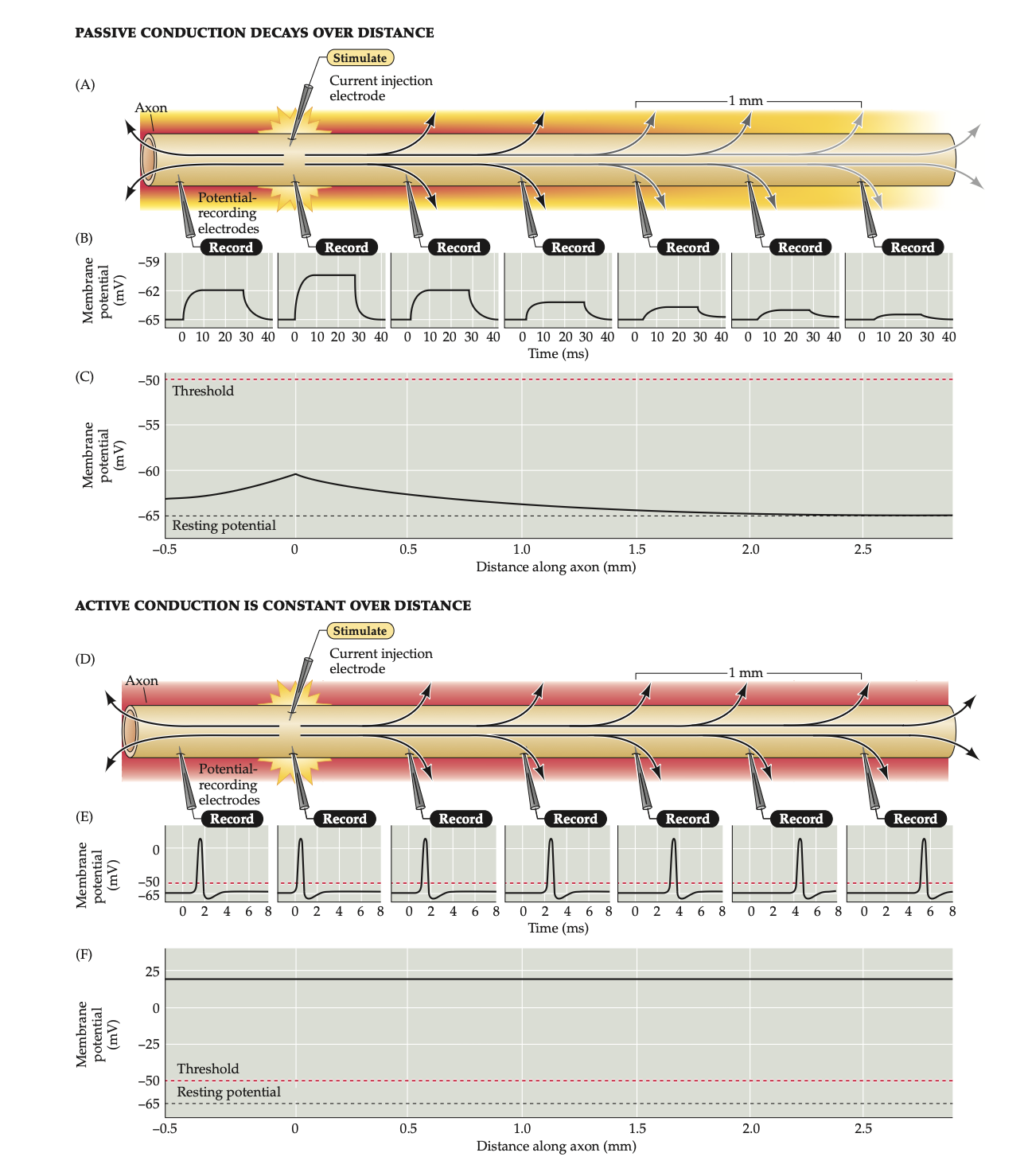
If you record current at different locations on axon as you move further and further from stimulation site response decreases. This is because current leaks out of cell over time. - so only really works for shortest axons (1mm or less)
Current can “leak” out of membrane which can be a problem bc how can brain control arms and legs
Loss becomes significant after only about 1-2 mml
The way our systems solve that is through action potentials in order to maintain signals? Across long distances
Basically keeps message intact
an action potential of constant amplitude is observed along the entire length of the axoncircumvents inherent leakiness of neurons
passive signaling
Small current input -> membrane potential below threshold -> passive response
active signaling
Large current input -> membrane potential above threshold -> action potential (active response)
receptor potentials
due to activation of sensory neurons by external stimuli such as light, sound, or heat (usually resulting in transient changes i the resting membrane potential)
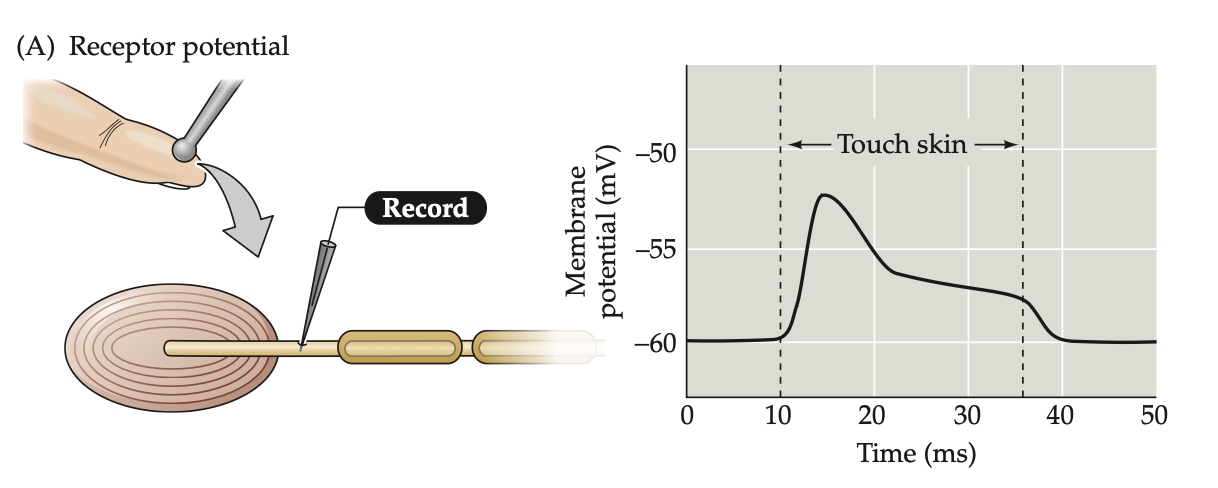
types of neuronal electrical signals (electric signalling)
receptor potentials
synaptic potential
action potential
synaptic potentials
communication between neurons at synaptic contacts
activation of synapses generates synaptic potentials which allow transmission of information from one neuron to another
hyperpolarization
membrane potential becomes more negative
depolarization
membrane potentials becomes more positive than resting potential
passive electrical responses
a change in a neuron’s membrane potential that occurs without opening voltage-gated ion channels and without generating an action potential.
how does the current used to evoke an action potential affect the amplitude of it.
it does not; action potentials are all or none
however, it can affect the number of action potentials that fire
intensity of a stimulus us encoded in the frequency of action potentials not their amplitude
action potential vs synaptic and receptor potential
amplitudes for synaptic and receptor potential are impacted based on sensory stimulus and number of synapses activated
anesthesia and electrical signals
work by interfering with electrical signalling mechanisms of neurons
blocks action potential propogation
relative conductance - potassium
1
relative conductance - Cl
0.2
relative conductance - Na
0.02
equilibrium potential (mV) - potassium
-75
equilibrium potential (mV) - chloride
-33
equilibrium potential (mV) - sodium
+55
resting potential ion concentrations
much more K+ inside the neuron than outside
much more Na+ outside the neuron than inside
Alan Hodgkin and Andrew Huxley
In 1949 conducted experiment on living squid giant axon to see how RMP was affected when changing the external K+ concentration
as external K+ increased, the resting membrane potential becomes less negative
when external K+ = inside K+ → K+ equilibrium potential was 0 mV → RMP was 0 mV
Overall showed that resting neuron most permeable to K+ than any other ion (Na+ and Cl- influence but A LOT LESS);
more K+ inside than outside
lowering external Na+ concentration reduces the rate of rise of the action potential and its peak amplitude but very little effect on RMP