A&P II- Cellular Respiration
 Call Kai
 Learn
Learn Practice Test
 Spaced Repetition
 Match
Match Flashcards
 Knowt Play
1/9

There's no tags or description
Looks like no tags are added yet.
Name | Mastery | Learn | Test | Matching | Spaced | Call with Kai |
|---|
No analytics yet
Send a link to your students to track their progress
10 Terms
Metabolism and Nutrition
Metabolic reactions: consumed nutrients ->chemical energy and raw materials -> body’s growth, repair, and normal functioning
Metabolism: sum of all body chemical reactions
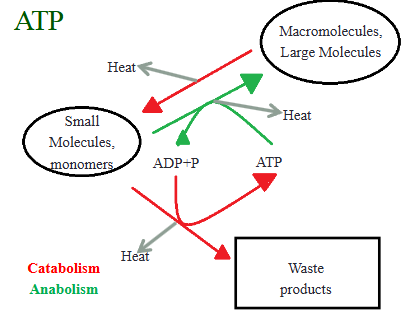
Catabolism:
breaking down larger molecules into smaller molecules.
Exergonic: provide more energy than they consume
Provides energy and raw materials for
Anabolism :
building up smaller molecules into larger molecules.
Endergonic; consume more energy than they produce
Growth and Repair
A nutrient is a “food or liquid that supplies the body’s metabolic needs".
Nutrients include:
Necessary chemical
Water, Minerals(inorganic), Vitamins (organic)
Fuel for energy
Carbohydrates, Lipids, (Proteins)
Building block or raw material
Carbohydrates, Lipids, (Proteins)
ATP
Cellular reactions create/use energy in the “high-energy” phosphate bonds of ATP, where it can be released quickly and easily
ATP temporarily stores and transfers energy given off in catabolic reactions and transfers it to anabolic reactions that require energy
Redox reactions
REDOX reactions
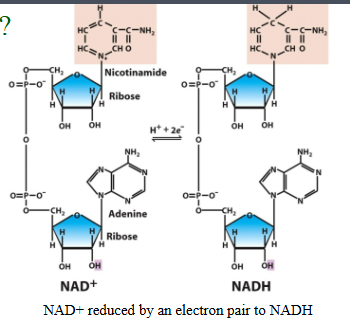
Chemical reactions in which a pair of electrons are exchanged
Oxidation: removal (Loss) of electrons
Reduction: addition (Gain) of electrons
Oxygen REALLY attracts electrons
Reducing oxygen (and oxidizing something else) gives energy
Biological REDOX reactions often move hydrogen ions along with the electrons and so are called dehydrogenation (REDOX ) reaction
The electrons/hydrogen are transferred to intermediaries NAD, or FAD (B vitamins)
Carbohydrate Metabolism
Glucose is the body’s preferred source of fuel
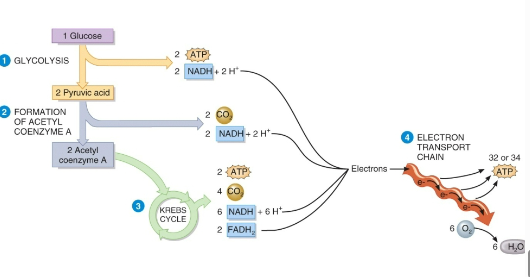
The oxidation of glucose to form ATP...
Glucose (C6H12O6) + O2 CO2 + H2O + ATP
... is known as “Cellular Respiration” and occurs in 4
Glycolysis : Glucose -> 2 Pyruvic Acid +2[H2] +2 ATP
Formation of Acetyl CoA: 2{Pyruvic Acid->Acetyl + CO2+[H2]}
Krebs/Citric Acid Cycle : 2{Acetyl->2 CO2+ATP+4[H2]}
Electron Transport Chain: 6{O2+2[H2]->2 H2O+~5 ATP}
![<ul><li><p>Glucose is the body’s preferred source of fuel</p></li><li><p>The oxidation of glucose to form ATP...</p></li></ul><p>Glucose (C6H12O6) + O2 CO2 + H2O + ATP</p><p>... is known as “Cellular Respiration” and occurs in 4</p><ul><li><p>Glycolysis : Glucose -> 2 Pyruvic Acid +2[H2] +2 ATP</p></li><li><p>Formation of Acetyl CoA: 2{Pyruvic Acid->Acetyl + CO2+[H2]}</p></li><li><p>Krebs/Citric Acid Cycle : 2{Acetyl->2 CO2+ATP+4[H2]}</p></li><li><p>Electron Transport Chain: 6{O2+2[H2]->2 H2O+~5 ATP}</p></li></ul><p></p>](https://assets.knowt.com/user-attachments/a0950d01-1fcc-49a4-90b4-86960e9c9a78.png)
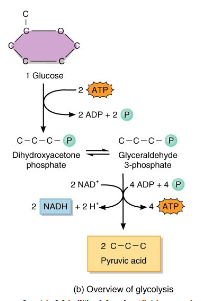
Glycolysis
1st step in cellular respiration
one 6-carbon molecule of glucose into two 3-carbon molecules of pyruvate (pyruvic acid) in a series of steps
It occurs in the cytoplasm/cytosol
It does not require oxygen
Glucose is
Phosphorylated with ATP
Oxidized
Phosphorylates ATP
Broken down to pyruvate
Produces
2 net ATP
2 NADH
2 pyruvate
Pyruvate->AcetylCoA OR Lactic acid
2nd step in cellular respiration
Possibility - depends on the availability of enough oxygen!
Aerobic (oxygen is present) the cell will form acetyl-CoA and continue cellular respiration
Anaerobic the cell will form lactic acid to remove the Hydrogen generated by glycolysis (removing NADH and restoring NAD+)
Formation of Lactic Acid takes place in the cytoplasm/cytosol
Pyruvate + NADH-> Lactic Acid + NAD+
Formation of Acetyl-CoA takes place in the mitochondria
Pyruvate + CoA+NAD+ -> Acetyl-CoA+ NADH + CO2
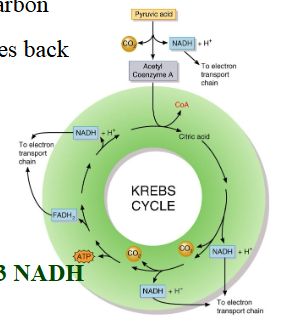
Krebs/ Citric Acid Cycle
In the matrix of the mitochondria
Acetyl-CoA "drops off" the 2-carbon Acetyl fragments, the CoA diffuses back to “reload”
Each turn of the cycle, completely oxidizes an Acetyl
Yields:
2 CO2, 1 ATP, 1 FADH2, and 3 NADH
Electron Transport Chain
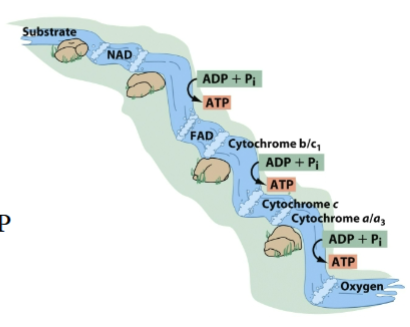
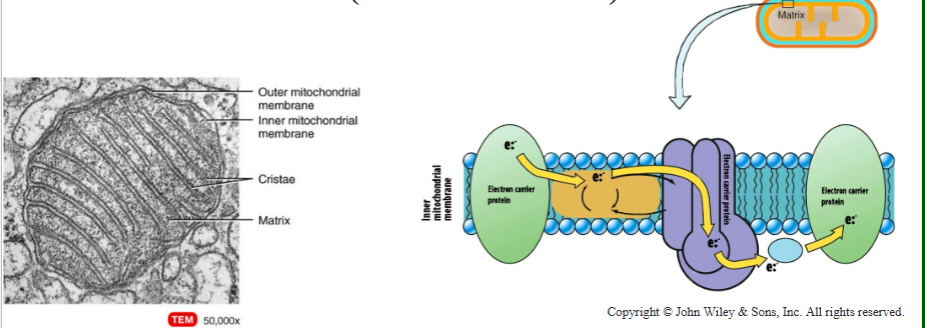
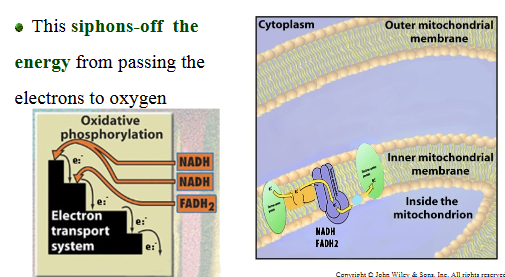
Electron transport chain – (ETC) takes the electrons through a series of redox reactions until they reach oxygen
series of cytochromes: electron carriers embedded within the inner membrane of the mitochondrium (folded into cristae)
Cellular Respiration
Transferred electrons passed frome one cytochrome to another, from high energy level to a lower energy level
This siphons-off the energy from passing the electrons to oxygen
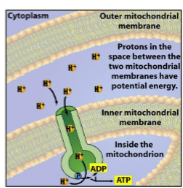
'Electron transfer energy' captured by pumping H+ ions into the inner mitochondrial space.
Creating a proton motive force
Concentration gradient and an Electrical gradient
H+ ions flow back across the membrane. The channels through which the H+ ions flow (in the inner mitochondrial membrane) are tied to an ATP synthase that generates ATP from ADP and P
Oxygen becomes the final electron acceptor
The oxygen forms H2O (metabolic water – about 200 ml/day)
The other product is
3 ATP per NADH
1-2 ATP per FADH2
For a total of 32-34 ATP
Summary of Cellular Respiration
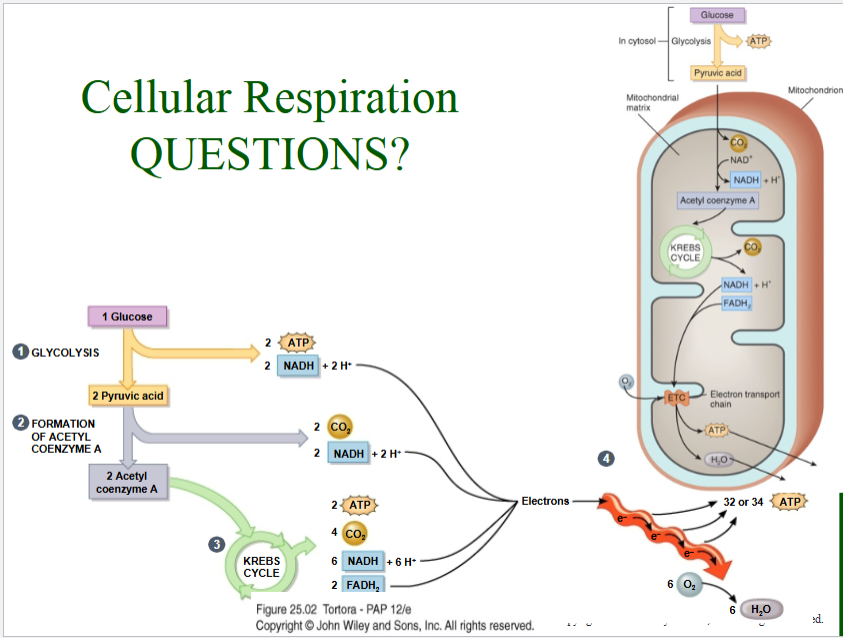
Total oxidation of 1 molecule of glucose:36-38 molecules of ATPs
4 ATP: substrate level phosphorylation (directly transferring a high energy phosphate from one organic molecule to another) in glycolysis and the Krebs cycle
either 32 or 34 ATP: oxidative phosphorylation using the cytochromes of the electron transport chain