Emotion (Psych 001) - Andrew Ward
 Call Kai
 Learn
Learn Practice Test
 Spaced Repetition
 Match
Match Flashcards
 Knowt Play
1/23

There's no tags or description
Looks like no tags are added yet.
Name | Mastery | Learn | Test | Matching | Spaced | Call with Kai |
|---|
No analytics yet
Send a link to your students to track their progress
24 Terms
emotion
a response of the whole organism, involving (1) physiological arousal, (2) expressive behaviors, and (3) conscious experience
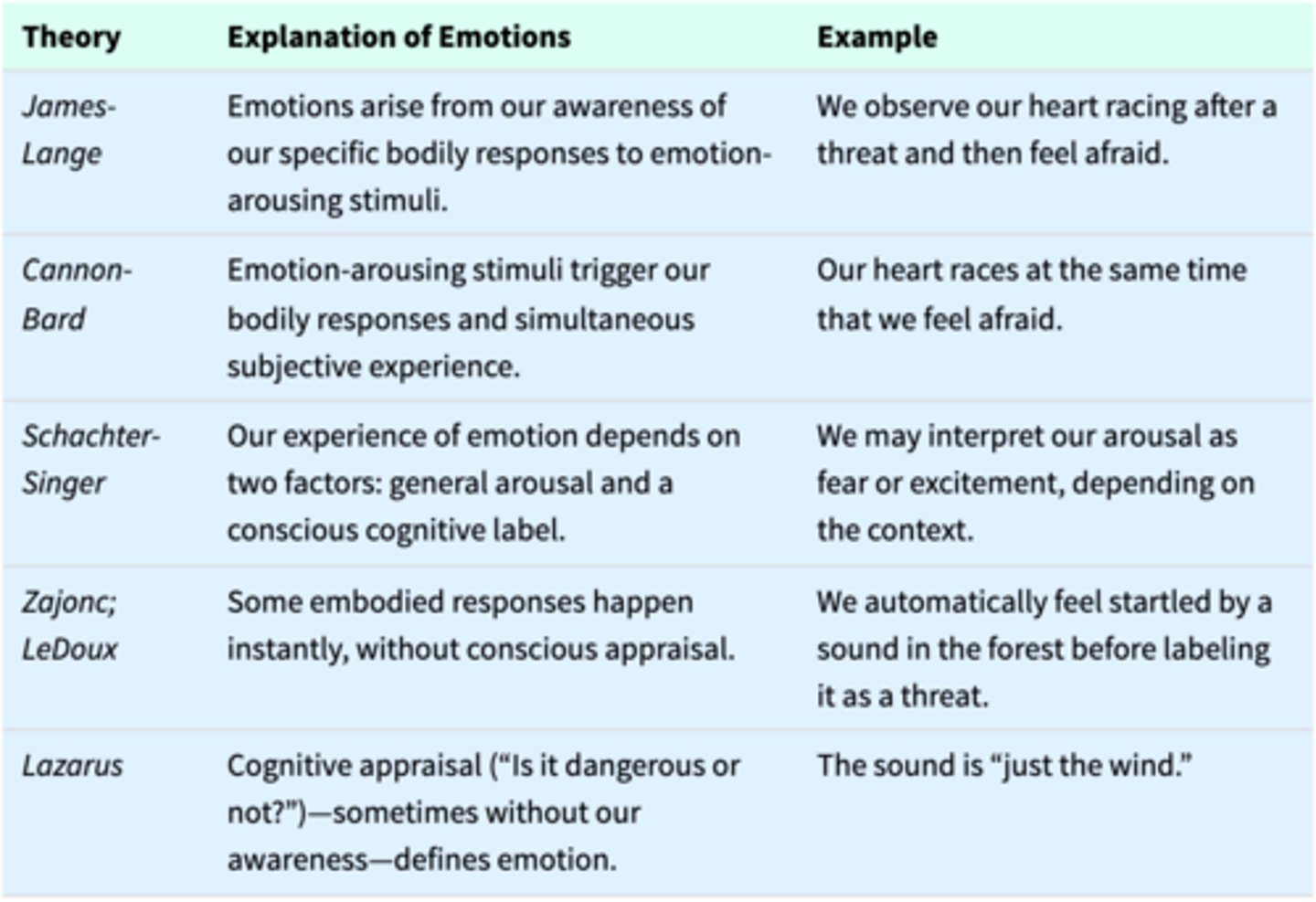
James-Lange Theory
the theory that our experience of emotion is our awareness of our physiological responses to emotion-arousing stimuli
stimulus -> body response -> experienced emotion
eg. feeling angry because we hit someone
Cannon-Bard Theory
the theory that an emotion-arousing stimulus simultaneously triggers (1) physiological responses and (2) the subjective experience of emotion
heart starts pounding as you get scared
Schachter-Singer (1962)
Cognitive Labelling Theory Participants told they would be given vitamin supplement. Instead, participants were injected with adrenaline and then exposed to confederate in waiting room who was either playful or angry. Participants interpreted same physiological arousal to happiness or anger depending on confederate.
two-factor theory
the Schachter-Singer theory that to experience emotion one must (1) be physically aroused and (2) cognitively label the arousal
arousal fuels emotion, cognition channels it
spillover effect
arousal response to one event spills over into our response to the next event
eg. stanley cup riots
emotion theories
1) James-Lange theory
2) Cannon-Bard theory
3) Schachter-Singer theory
4) Zajonc; LeDoux
5) Lazarus
sympathetic nervous system
mobilizes body for action, directs adrenal glands to release epinephrine/adrenaline and norepinephrine/noradrenaline, provides energy thru glucose from liver to bloodstream
polygraph
a machine used in attempts to detect lies that measures several of the physiological responses (such as perspiration, heart rate, and breathing changes) accompanying emotion
facial feedback effect
the tendency of facial muscle states to trigger corresponding feelings such as fear, anger, or happiness
smiling can make you happier
behaviour feedback effect
the tendency of behaviour to influence our own and others' thoughts, feelings, and actions
skipping --> happy
slouching --> unhappy
Catharsis
in psychology, the idea that "releasing" aggressive energy (through action or fantasy) relieves aggressive urges
ways to manage anger
wait, find a healthy distraction or support, distance yourself
feel-good, do-good phenomenon
people's tendency to be helpful when in a good mood
also works in reverse, bc doing good strengthens social relationships
positive psychology
the scientific study of human flourishing, with the goals of discovering and promoting strengths and virtues that help individuals and communities to thrive
subjective well-being
self-perceived happiness or satisfaction with life. Used along with measures of objective well-being (for example, physical and economic indicators) to evaluate people's quality of life.
pillars of positive psychology
1. positive well-being: satisfaction w past, happiness w present, optimism ab future
2. positive traits: enhancing courage, creativity, integrity, wisdom, etc.
3. positive groups, communities, and cultures
Income satiation
point at which we make enough money to satisfy our comfort and security needs, more money doesn't make us much happier
diminishing marginal utility
adaptation-level phenomenon
our tendency to form judgments (of sounds, of lights, of income) relative to a neutral level defined by our prior experience
relative deprivation
the perception that one is worse off relative to those with whom one compares oneself
misattribution of arousal (excitation transfer)
the process whereby people make mistaken inferences about what is causing them to feel the way they do
eg. men approached by hot woman on shaky bridge call more than those on sturdy bridge, thinking their fear is lust
social comparison
evaluating one's abilities and opinions by comparing oneself with others
upward: comparing to those better off
downward: comparing to those worse off
spreading of alternatives
Alternatives are seen as more different (the one we chose as better, the one we rejected as worse) after we choose compared to before
form of resolution of cognitive dissonance
hedonic treadmill
tendency for our moods to adapt to external circumstances
return to base over time