L24: Cytoskeletal Motor Proteins

0.0(0)
Studied by 0 people
call kaiCall Kai
learnLearn
examPractice Test
spaced repetitionSpaced Repetition
heart puzzleMatch
flashcardsFlashcards
GameKnowt Play
Card Sorting

1/23

encourage image

There's no tags or description

Looks like no tags are added yet.

Last updated 8:51 PM on 4/9/26
Name
Mastery
Learn
Test
Matching
Spaced
Call with Kai

No analytics yet

Send a link to your students to track their progress

24 Terms

1
New cards

Myosin

Myosin = actin-based motor proteins

  • Couple energy from ATP hydrolysis

  • Mechanochemical enzymes = convert chemical energy → mechanical energy

  • (+) end directed motors = move toward (+) end of actin

    • EXCEPTION: Myosin VI (6) moves toward (-) end of actin
<p><strong>Myosin</strong> = actin-based motor proteins </p><ul><li><p>Couple energy from <u><mark data-color="#fcf697" style="background-color: rgb(252, 246, 151); color: inherit;">ATP hydrolysis</mark> </u></p></li><li><p><u><mark data-color="#ebc6ff" style="background-color: rgb(235, 198, 255); color: inherit;">Mechanochemical enzymes</mark></u> = convert chemical energy → mechanical energy </p></li><li><p><u><mark data-color="#c0ffcc" style="background-color: rgb(192, 255, 204); color: inherit;">(+) end directed motors</mark></u> = move toward <span style="color: green;">(+) end of actin</span></p><ul><li><p>EXCEPTION: <span style="color: red;">Myosin VI (6)</span> moves toward (-) end of actin</p></li></ul></li></ul><p></p>
2
New cards

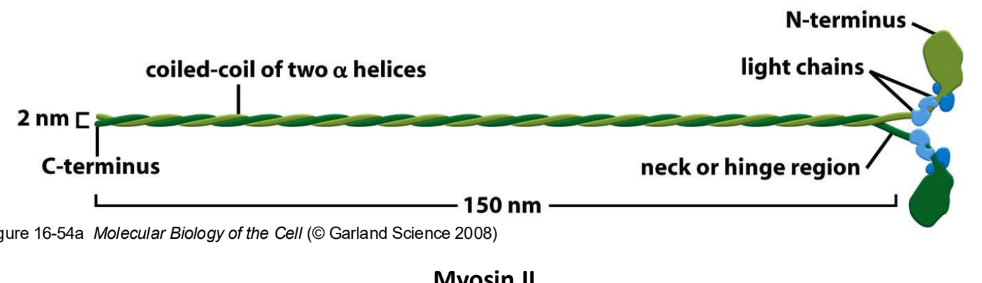
Explain the structure of Myosin complexes

Myosin = 2 heavy chains + 4 light chains

  • Myosin heavy chain = Head, neck, tail domain

    • Head domain = actin-binding + ATPase activities

      • Determines direction of movement

    • Neck domain = myosin light chain binding site

      • Structural + regulatory roles

    • Tail domain = different b/w different myosin

      • Determines specific properties

  • Myosin light chain = small polypeptide that binds to + stabilizes “neck” domain of myosin heavy chains
<p><strong>Myosin</strong> = 2 heavy chains + 4 light chains</p><ul><li><p><strong>Myosin heavy chain</strong> = Head, neck, tail domain</p><ul><li><p><u>Head domain</u> = actin-binding + ATPase activities </p><ul><li><p>Determines direction of movement</p></li></ul></li><li><p><u>Neck domain</u> = myosin light chain binding site </p><ul><li><p>Structural + regulatory roles </p></li></ul></li><li><p><u>Tail domain</u> = different b/w different myosin</p><ul><li><p>Determines specific properties </p></li></ul></li></ul></li></ul><ul><li><p><strong>Myosin light chain</strong> = small polypeptide that binds to + stabilizes “neck” domain of myosin heavy chains</p></li></ul><p></p>
3
New cards

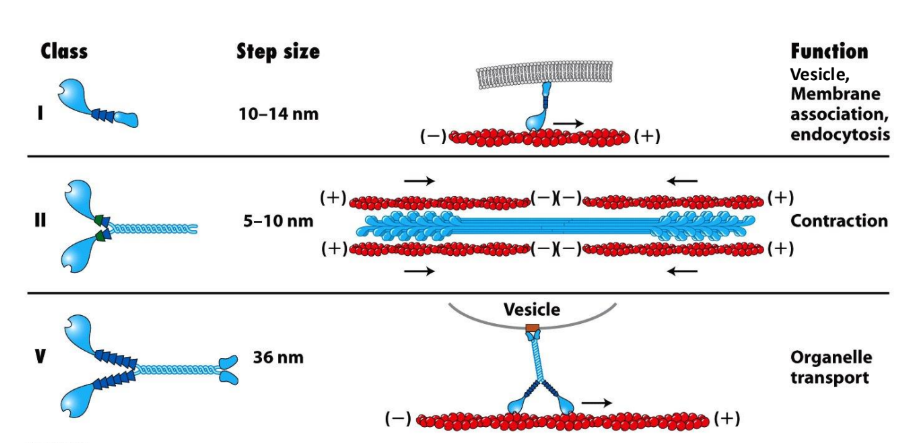
What do myosin tail domains define? Explain functions of Myosin I, Myosin II, and Myosin V

Specific properties of myosin determined by tail domains

  • Myosin I = bound to membrane ≠ dimerize, single-headed

    • Tails = different

      • Some have 2nd binding site → sliding

      • Some have membrane binding sites → bind to vesicles/organelles

        • Vesicle, membrane association, endocytosis

  • Myosin II = assembled into bipolar filaments = contraction (muscle contraction, contractile ring)

  • Myosin V = dimerized, organelle transport

    • Oddball = does processive movement (single motor molecule to take multiple steps along filament w/o detaching)
<p>Specific properties of myosin determined by tail domains</p><ul><li><p>Myosin I = bound to membrane ≠ dimerize, single-headed</p><ul><li><p>Tails = different</p><ul><li><p>Some have 2nd binding site → sliding</p></li><li><p>Some have membrane binding sites → bind to vesicles/organelles</p><ul><li><p>Vesicle, membrane association, endocytosis </p></li></ul></li></ul></li></ul></li><li><p>Myosin II = assembled into bipolar filaments = contraction (muscle contraction, contractile ring)</p></li><li><p>Myosin V = dimerized, organelle transport </p><ul><li><p>Oddball = does processive movement (single motor molecule to take multiple steps along filament w/o detaching)</p></li></ul></li></ul><p></p>
4
New cards

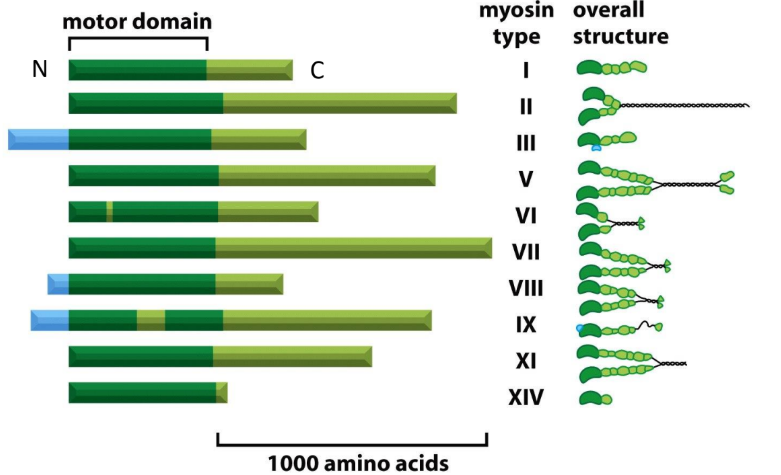
Which myosin have functions that are not as well understood?

Myosin III, IV, and VI-XV

  • Conserved head domains

  • Variable tail regions

5
New cards

Which myosin is the only known myosin to move towards the (-) end of F-actin?

Myosin VI (6)

6
New cards

Myosin II = conventional myosin

Myosin II = conventional myosin = first myosin discovered, most abundant type in muscle + non-muscle cells

  • 2 heavy chains + 4 light chains = 6 proteins total

  • Tails = long α helices that mediate further polymerization of Myosin II → bipolar thick filaments

<p><strong>Myosin II</strong> = conventional myosin = first myosin discovered, most abundant type in muscle + non-muscle cells </p><ul><li><p>2 heavy chains + 4 light chains = 6 proteins total </p></li><li><p>Tails = long α helices that mediate further polymerization of Myosin II → bipolar thick filaments</p></li></ul><p></p>
7
New cards

Explain how actin filament sliding assay works

How does ATP affect movement?

What 2 ideas does this sliding assay support?

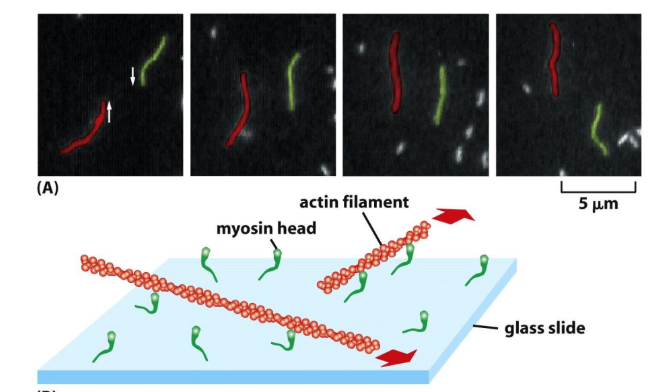
Actin filament sliding assay = demonstrate motor function of Myosin

  • Myosin molecules stuck to glass (tails bound, heads free)

  • Fluorescent actin filaments added (labeled w/ phalloidin)

    • Filaments stick to Myosin on glass

  • ATP

    • No ATP → myosin binds tightly to actin

    • ATP → myosin moves actin

  • Myosin walk to (+) end & are bound to glass

    • (-) end is leading movement

    • MUST BE BOUND TO @ LEAST 2 MYOSIN (directionality)

  1. ATP hydrolysis = coupled to Myosin motility

  2. Myosin ATPase activity = actin activated

    1. Actin absent = 4 ATP/hour

    2. Actin present = 20 ATP/hour

      1. Ensures myosin = active + using ATP w/ actin presence
<p>Actin filament sliding assay = demonstrate motor function of Myosin</p><ul><li><p>Myosin molecules stuck to glass (tails bound, heads free) </p></li><li><p>Fluorescent actin filaments added (labeled w/ phalloidin) </p><ul><li><p>Filaments stick to Myosin on glass </p></li></ul></li><li><p>ATP </p><ul><li><p>No ATP → myosin binds tightly to actin</p></li><li><p>ATP → myosin moves actin</p></li></ul></li><li><p>Myosin walk to (+) end &amp; are bound to glass</p><ul><li><p>(-) end is leading movement </p></li><li><p>MUST BE BOUND TO @ LEAST 2 MYOSIN (directionality)</p></li></ul></li></ul><p></p><ol><li><p>ATP hydrolysis = coupled to Myosin motility </p></li><li><p>Myosin ATPase activity = actin activated </p><ol><li><p>Actin absent = 4 ATP/hour</p></li><li><p>Actin present = 20 ATP/hour </p><ol><li><p>Ensures myosin = active + using ATP w/ actin presence</p></li></ol></li></ol></li></ol><p></p>
8
New cards

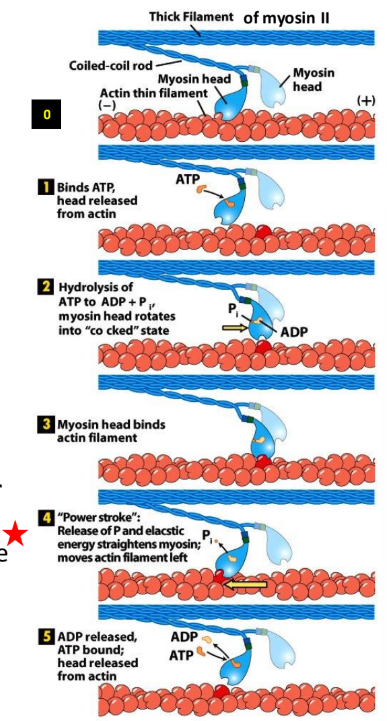
Explain the myosin-actin cross bridge cycle + 5 stages

Myosin-actin cross-bridge cycle = fundamental, repeating process of muscle contraction where myosin heads bind to actin filaments, undergo a “power stroke” to pull them inward + detach, driven by ATP

Only 1 head can be undergoing process @ one time

  1. Rigor state

    1. ATP binding site = empty

    2. Myosin = tightly bound to actin

      1. Rigor mortis of dead body = all muscles = tense (no ATP) → all myosin tightly bound to actin

  2. ATP binding

    1. ATP binding cleft = closes

    2. Actin binding cleft = opens

      1. Interaction w/ actin = weak → myosin lets go of actin

  3. ATP hydrolysis

    1. ATP hydrolysis: ATP → ADP

    2. Δ Conformation → head moves forward, head binds to actin

      1. Head moves to new position BEFORE rebinding to filament

  4. Pi release

    1. Power stroke = myosin head pulls actin thin filament towards center of sarcomere (powered by release of Pi)

  5. ADP release

    1. Myosin = rigor state

    2. ATP exchange releases head from actin

    3. Mechanism = still debated

<p><strong>Myosin-actin cross-bridge cycle</strong> = fundamental, repeating process of <u>muscle contraction</u> where myosin heads bind to actin filaments, undergo a “power stroke” to pull them inward + detach, driven by ATP</p><p>Only 1 head can be undergoing process @ one time </p><ol><li><p><strong>Rigor state</strong></p><ol><li><p>ATP binding site = empty </p></li><li><p>Myosin = tightly bound to actin </p><ol><li><p><u>Rigor mortis of dead body</u> = all muscles = tense (no ATP) → all myosin tightly bound to actin</p></li></ol></li></ol></li><li><p><strong>ATP binding </strong></p><ol><li><p>ATP binding cleft = closes</p></li><li><p>Actin binding cleft = opens</p><ol><li><p>Interaction w/ actin = weak → myosin lets go of actin</p></li></ol></li></ol></li><li><p><strong>ATP hydrolysis</strong></p><ol><li><p>ATP hydrolysis: ATP → ADP </p></li><li><p>Δ Conformation → head moves forward, head binds to actin </p><ol><li><p>Head moves to new position BEFORE rebinding to filament </p></li></ol></li></ol></li><li><p><strong>Pi release </strong></p><ol><li><p>Power stroke = myosin head pulls actin thin filament towards center of sarcomere (powered by release of Pi)</p></li></ol></li><li><p><strong>ADP release</strong></p><ol><li><p>Myosin = rigor state</p></li><li><p>ATP exchange releases head from actin </p></li><li><p>Mechanism = still debated </p></li></ol></li></ol><p></p>
9
New cards

What is special about myosin V dimers?

Myosin V dimers = unconventional

  • Processive movement = 2 myosin V heads coordinated to interact w/ same actin filament

    • @ least 1 head always in contact w/ actin

  • Allows myosin V to carry cargo

Myosin II cannot move processively

  • 2 heads act independently

10
New cards

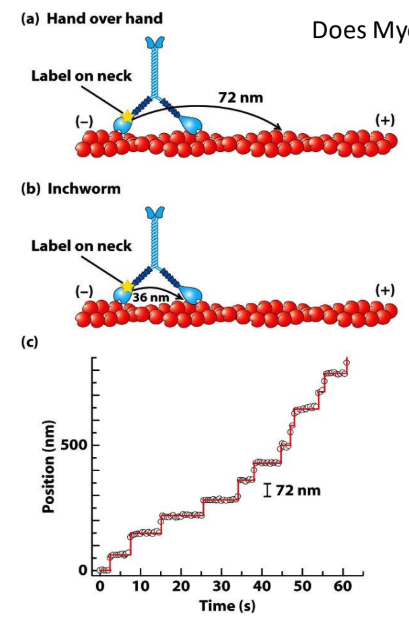
What are the 2 models for Myosin V movement?

How can the step size of Myosin V be used to determine the correct model?

Processive movement = motor can walk on filament w/o detaching/falling off

  1. Hand-over-hand = rear detaches → moves ahead of other head → alternate positions

  2. Inchworm = one head consistently in front

Myosin V step size = 72 nm = 36 nm b/w 2 myosin heads x 2

  • Fluorescent tracking experiment = track position of1 myosin head over time

  • 72 nm = Hand-over-hand model

<p>Processive movement = motor can walk on filament w/o detaching/falling off</p><ol><li><p>Hand-over-hand = rear detaches → moves ahead of other head → alternate positions</p></li><li><p>Inchworm = one head consistently in front</p></li></ol><p></p><p>Myosin V step size = 72 nm = 36 nm b/w 2 myosin heads x 2</p><ul><li><p>Fluorescent tracking experiment = track position of1 myosin head over time</p></li><li><p>72 nm = Hand-over-hand model </p></li></ul><p></p>
11
New cards

What is the major difference b/w conventional and unconventional myosin?

Myosin II = conventional myosin = heads independently move

Myosin V = unconventional myosin = heads coordinate movement

12
New cards

What diseases can be caused by mutations in myosin genes?

MYH9 gene → Myosin IIA → bleeding problems, hearing loss, kidney disease, cataracts

Arg702 → decrease platelets, early-onset renal disease, hearing loss in infancy

Myosin VI ablation = deafness in mice

Myosin VII mutation → deafness + blindness in humans

13
New cards

What was used to isolate two classes of MT motor proteins?

In vitro motility assays

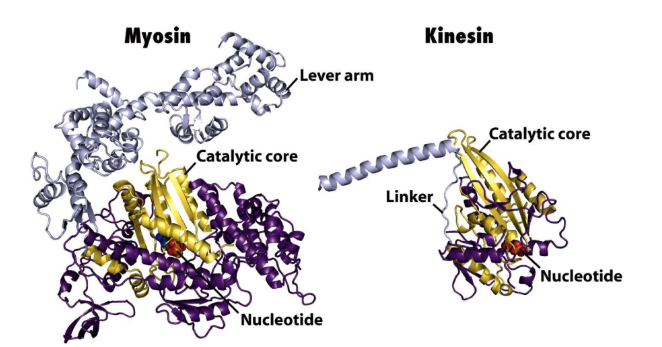
  • Kinesins = similar ATP binding/hydrolytic core domain to myosin

  • Dynein = unique catalytic core

<p>In vitro motility assays</p><ul><li><p><strong>Kinesins</strong> = similar ATP binding/hydrolytic core domain to myosin</p></li><li><p><strong>Dynein</strong> = unique catalytic core</p></li></ul><p></p>
14
New cards

Kinesins definition + 3 classes

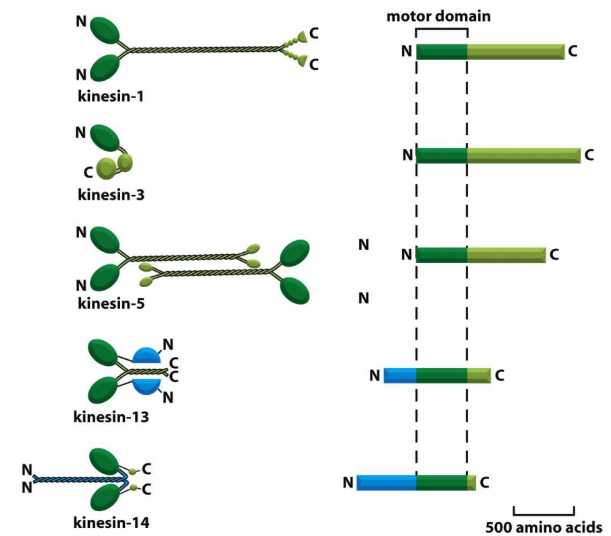
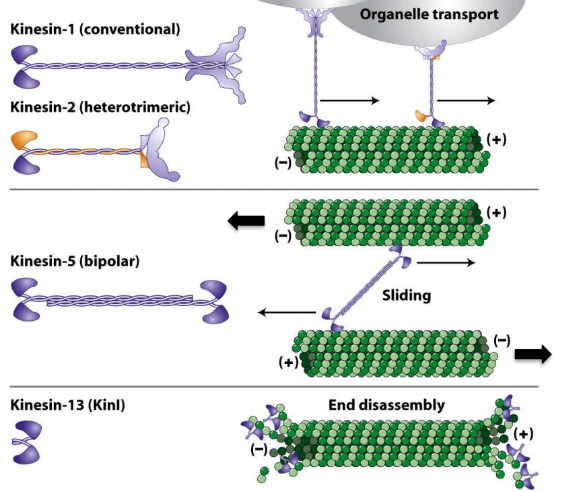
Kinesins = MT-activated mechanochemical ATPases

  • Kin-N Kinesin = motor domain @ N-terminus of protein

    • → (+) ends

    • Conventional kinesins

  • Kin-C Kinesin = motor domain @ C-terminus of protein

    • → (-) ends (rare)

  • Kin-I Kinesin = INTERNAL motor domain

    • Do not move along MTs

    • Bind MT ends → protofilament peeling

    • Kinesin-13

<p><strong>Kinesins</strong> = MT-activated mechanochemical ATPases</p><ul><li><p><strong>Kin-N Kinesin</strong> = motor domain @ N-terminus of protein</p><ul><li><p>→ (+) ends</p></li><li><p>Conventional kinesins</p></li></ul></li><li><p><strong>Kin-C Kinesin</strong> = motor domain @ C-terminus of protein</p><ul><li><p>→ (-) ends (rare)</p></li></ul></li><li><p><strong>Kin-I Kinesin</strong> = INTERNAL motor domain</p><ul><li><p>Do not move along MTs</p></li><li><p>Bind MT ends → protofilament peeling</p></li><li><p>Kinesin-13</p></li></ul></li></ul><p></p>
15
New cards

Describe structure of conventional kinesin

Conventional Kinesin = first Kinesin discovered + best characterized

  • 2 heavy chains + 2 light chains

  • Heavy chains

    • Motor domain head @ N-terminus

    • Neck domain

    • Tail/stalk domain = α-helical coiled-coil

  • Light chains

    • @ C-terminus of tail region

    • Opposite to motor heads

    • Bind to cargo (organelles + vesicles)

<p><strong>Conventional Kinesin</strong> = first Kinesin discovered + best characterized </p><ul><li><p>2 heavy chains + 2 light chains </p></li><li><p><strong>Heavy chains</strong></p><ul><li><p>Motor domain head <span style="color: green;">@ N-terminus</span></p></li><li><p>Neck domain</p></li><li><p>Tail/stalk domain = α-helical coiled-coil </p></li></ul></li><li><p><strong>Light chains </strong></p><ul><li><p><span style="color: red;">@ C-terminus</span> of tail region</p></li><li><p>Opposite to motor heads</p></li><li><p>Bind to cargo (organelles + vesicles) </p></li></ul></li></ul><p></p>
16
New cards

Explain how the microtubule gliding assay works

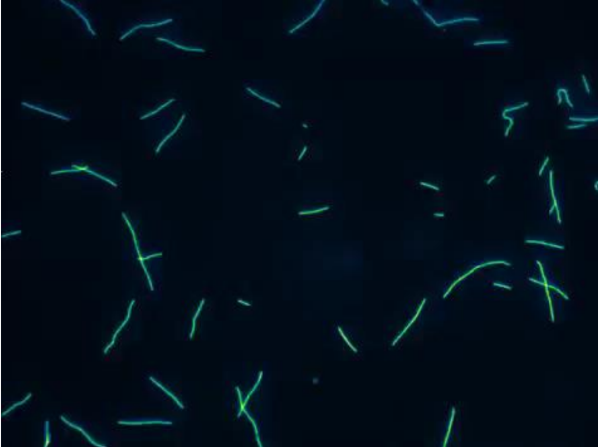
MT Gliding Assay = demonstrate Kinesin motor function

  • Tails = attached to coverslips

  • Head = exposed

    • Fluorescent MTs moved around by head

  • Generally = Kin-N Kinesins (walk to (+) end)

    • (-) end MT = leading movement

  • Kin-C Kinesin (walk to (-) end)

    • (+) end MT = leading movement

<p>MT Gliding Assay = demonstrate Kinesin motor function </p><ul><li><p>Tails = attached to coverslips</p></li><li><p>Head = exposed </p><ul><li><p>Fluorescent MTs moved around by head </p></li></ul></li><li><p>Generally = Kin-N Kinesins (walk to (+) end)</p><ul><li><p>(-) end MT = leading movement </p></li></ul></li><li><p>Kin-C Kinesin (walk to (-) end)</p><ul><li><p>(+) end MT = leading movement</p></li></ul></li></ul><p></p>
17
New cards

Explain the kinesin cross-bridge cycle

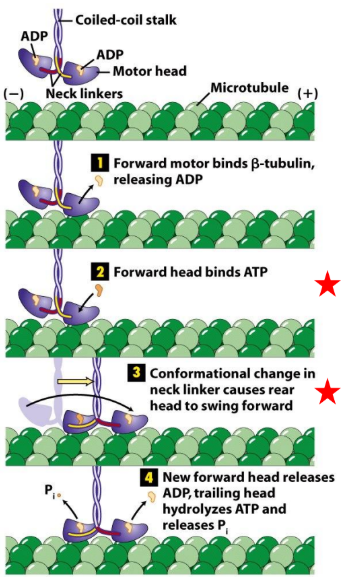
ATP hydrolysis + Pi release → associated w/ Δ conformation of head/neck

  1. ATP binds to forward head → Δ conformation in neck linker

  2. Rear head swings forward past front head

  3. New forward head release ADP

<p>ATP hydrolysis + Pi release → associated w/ Δ conformation of head/neck</p><ol><li><p>ATP binds to forward head → Δ conformation in neck linker</p></li><li><p>Rear head swings forward past front head</p></li><li><p>New forward head release ADP </p></li></ol><p></p>
18
New cards

What kind of movement do kinesin motor proteins do?

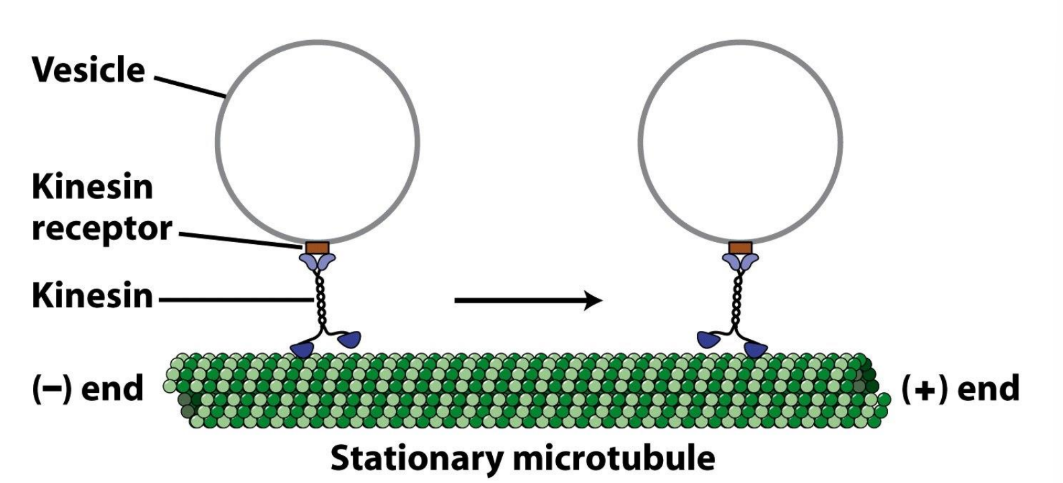
Processive movement = movement over long distances w/o dissociating

  • Important for long-distance transport of vesicles + organelles
<p>Processive movement = movement over long distances w/o dissociating </p><ul><li><p>Important for long-distance transport of vesicles + organelles</p></li></ul><p></p>
19
New cards

Define dyneins + describe its structure + 2 types

Dyneins = mechanochemical enzymes that use energy from ATP hydrolysis to (-) end directed movement along MTs

Structure = 2-3 heavy chains w/ unknown # of intermediate + light chains

  • Microtubule binding domain = 2 “feet” walking on MT

  • ATPase domain = bind + hydrolyze ATP → Δ conformation

  • Dynactin binding domain = bind to dynactin complex

    • Dynactin complex = intermediate b/w dynein + cargo

Cytoplasmic Dynein = most common form, many cellular functions

Ciliary/Flagellar Dynein = molecular motor → MT sliding → bending motions of cilia + flagella (microscopic hair-like appendages on eukaryotic cell surface → facilitate movement)

20
New cards

Describe power stroke of dynein + how it can be observed

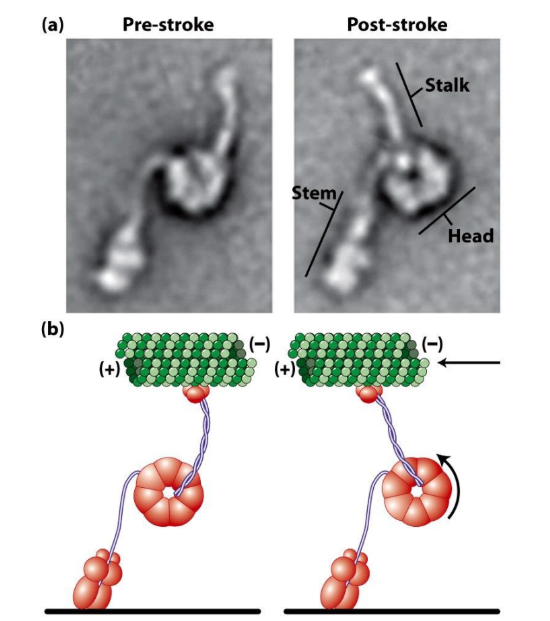
Dynein power stroke = driven by ATP hydrolysis

Electron micrographs before + after power stroke

  • Δ angle b/w stem + stalk domains

<p>Dynein power stroke = driven by ATP hydrolysis </p><p>Electron micrographs before + after power stroke </p><ul><li><p>Δ angle b/w stem + stalk domains </p></li></ul><p></p>
21
New cards

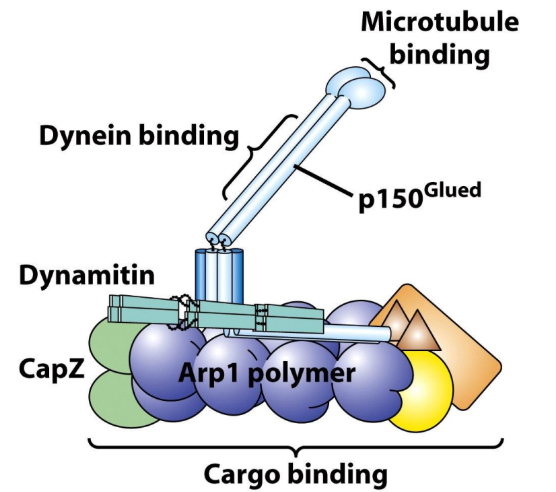
Dynactin complex

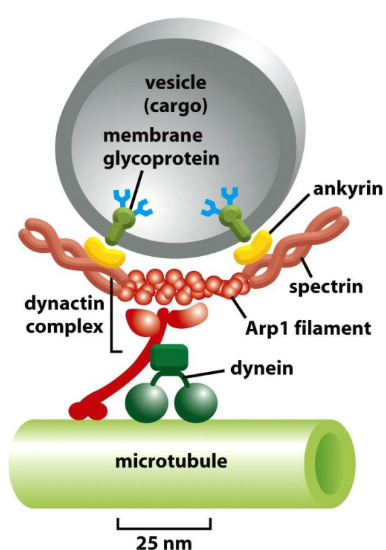
Dynactin complex = multiunit protein complex = intermediate b/w Dynein and cargo

  • Dynein DOES NOT directly bind to cargo

  • Critical for cytoplasmic Dynein function

  • Mediate attachment of Dynein to cargo

  • ~11 proteins

<p>Dynactin complex = multiunit protein complex = intermediate b/w Dynein and cargo </p><ul><li><p>Dynein DOES NOT directly bind to cargo </p></li><li><p>Critical for cytoplasmic Dynein function </p></li><li><p>Mediate attachment of Dynein to cargo</p></li><li><p>~11 proteins</p></li></ul><p></p>
22
New cards

What part of dynactin complex is used to attach to surface of vesicle cargo?

Actin Related Protein 1 (Arp1) filament of dynactin complex → interact w/ Spectrin/Ankyrin membrane complexes of vesicle cargo membrane
<p><strong>Actin Related Protein 1 (Arp1) filament</strong> of dynactin complex → interact w/ <u>Spectrin/Ankyrin membrane complexes</u> of vesicle cargo membrane</p>
23
New cards

Microtubule motors in disease

  • Kinesin deficiencies → Charcot-Marie-Tooth Disease, some kidney diseases

  • Dynein deficiencies → chronic respiratory tract infections (cilia ≠ function w/o dynein)

  • Dynactin Complex mutations (p150Glued subunit) → familial + sporadic ALS

  • Ciliary + Intraflagellar Transport defects → autosomal recessive polycystic kidney disease (ARPKD), retinal degeneration, other sensory disorders

24
New cards

Explain melanosomes movement

A. Where are the microtubule (+) ends and (-) ends?

B. Are Kinesins or Dyneins important for melanosome localization in high cAMP?

C. Are Kinesins or Dyneins important for melanosome localization in low cAMP?

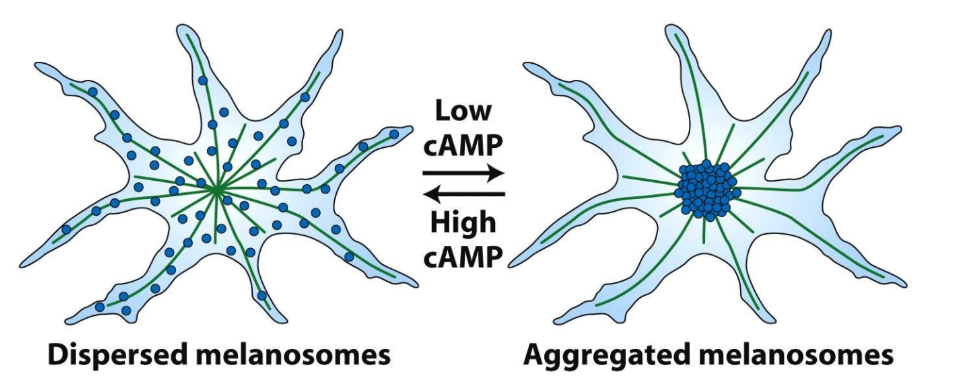
cAMP → dispersed melanosomes

cAMP → aggregated melanosomes

A. (-) ends = MTOC/centrosome, (+) ends cell periphery

B. cAMP → dispersed melanosomes → Kinesins

C. cAMP → aggregated melanosomes → Dyneins
<p><span style="color: green;">↑</span> cAMP → dispersed melanosomes</p><p><span style="color: red;">↓</span> cAMP → aggregated melanosomes</p><p>A. (-) ends = MTOC/centrosome, (+) ends cell periphery</p><p>B. <span style="color: green;">↑</span> cAMP → dispersed melanosomes → Kinesins </p><p>C. <span style="color: red;">↓</span> cAMP → aggregated melanosomes → Dyneins</p><p></p>