Photometry (conceptual)
 Call Kai
 Learn
Learn Practice Test
 Spaced Repetition
 Match
Match Flashcards
 Knowt Play
1/65

There's no tags or description
Looks like no tags are added yet.
Name | Mastery | Learn | Test | Matching | Spaced | Call with Kai |
|---|
No analytics yet
Send a link to your students to track their progress
66 Terms
what is the difference between photometry & radiometry?
photo - includes human sensitivity
radio doesn't
a relative luminous efficiency (Vλ) ranges from Vλ = ____ to Vλ = ____
0-1
relative luminous efficiency (Vλ)
Vλ = 1 when λ=____
555nm
(max luminous)
relative luminous efficiency (Vλ)
Vλ = 0 when λ = ____
380nm or 760nm
(min luminous)
the maximum absolute luminous efficiency (Kλ) for humans is...
683 lumens/watts
wavelength of 555 nm corresponds to Vλ = _____ and Kλ = ____
Vλ = 1
Kλ = 683 lumens/watt
radiant energy is measured in... (what units?)
joules
luminous energy is measured in... (what units?)
talbots
radiant flux is measured in... (what units?)
Watts
or Joules/sec
luminous flux is measured in... (what units?)
lumens
def of power/flux
energy flow
(energy per second)
def of intensity
flux produced at a certain angle
radiant intensity is measured in... (what units?)
watts/steradians
luminous intensity is measured in... (what units?)
lumens/steradians
or candelas
difference between intensity & intensity per area
intensity is used for point sources
intensity per area is used for extended sources
radiant intensity per area is measured in... (what units?)
watts/area
or steradians/area
luminous intensity per area is measured in... (what units?)
lumen/area
or sterandians/area
or candelas/area
what are the basic 5 steps that can be used to solve problems with primary light sources?
1. solve for Eλ
2. solve radiant flux
3. solve for Ieλ
4. solve for Iλ
5. solve for luminance or illuminance
irradiance is measured in... (what units?)
watts/area
illuminance is measured in... (what units?)
lumen/area
what is the difference between primary & secondary light sources?
primary - the source of light produces its own light
secondary - the source of light is a reflection off of a surface
circular light sources are __(point/extended)__ sources
extended
secondary (or "reflected") light sources are considered __(point/extended)___ sources
extended
the sin^2 law is only used for _____ light sources
circular
def of retinal illumination
amount of light falling on retinal
what units in Eret in? (retinal illumination)
trolands
advantages of Maxwellian view
bypass pupil, high levels of light on retina
Eret NOT affected by pupil size
what is Stiles-Crawford Effect type 1?
BRIGHTNESS difference between central & peripheral retina
center - brighter
peripheral - dimmer
** wavelength-dependent
what is Stiles-Crawford Effect type 2?
COLOR difference between central & peripheral retina
periphery shifts to shorter wavelengths (more blue)
what is the difference between incandescence & luminescence light sources?
incandescence - light from thermal excitation of solid, liquid, gas
luminescence - light of electric discharge from the gas
Planck's Law (for incandescent light sources)
describes output spectrum
will change with temperature & substance type
* works for black bodies *
Kirchoff's Law (for incandescent light sources)
emissivity = absorbance
Stefan-Boltzmann Law (for incandescent light sources)
* works for black bodies *
that's all I know
Wien's displacement (for incandescent light sources)
hotter source = BLUER light (shorter wavelength) & more efficient
the output from an incandescence light source can be described using ___ temperature & ____ temperature
distribution temperature & color temperature
efficiency of a typical incandescent bulb
10-25 lumens/watt
max efficiency of an incandescent light source
683 lumens/watt
efficiency of the sun (an incandescent source)
85 lumens/watt
efficiency of a low pressure mercury lamp
35-65 lumens/watt
WITH FLUORESCENCE: 80 lumens/watt
t or f: the spectrum from a low pressure mercry lamp is continuous
false
which has a better efficiency: incandescent or luminescence light sources?
luminescence
efficiency of a high pressure mercury lamp
100 lumens/watt
t or f: mercury lamps emit a wide spectrum
true
efficiency of a low pressure sodium lamp
140 lumens/watt
t or f: low pressure sodium lamps emit a wide spectrum
false, they release monochromatic light
efficiency of a high pressure sodium lamp
120 lumen/watt
t or f: high pressure sodium lamps emit a wide spectrum
true, they emit multiple colors
the lowest energy state of a photon is called...
ground state (E0)
how do you solve for the absorbed/emitted energy of a photon?
E1 - E0 = hc/λ
to create fluorescence, the emitted λ needs to be __(longer/shorter)__ than the absorbed λ
λemit > λabsorb
what is the difference between fluorescence & phosphorescence?
phosphorescence is stable for a longer time ("time delay")
t or f: lasers emit a wide spectum
false, they emit monochromatic light
steps to create a laser beam
1. pump e- to excited state
2. e- naturally falls to metastable state
3. when e- falls to ground state, it emits a photon, which starts a cascade
t or f: lasers are an example of photoelectic effect
false, lasters use phosphorescence
def of photoelectric effect
occurs in metals
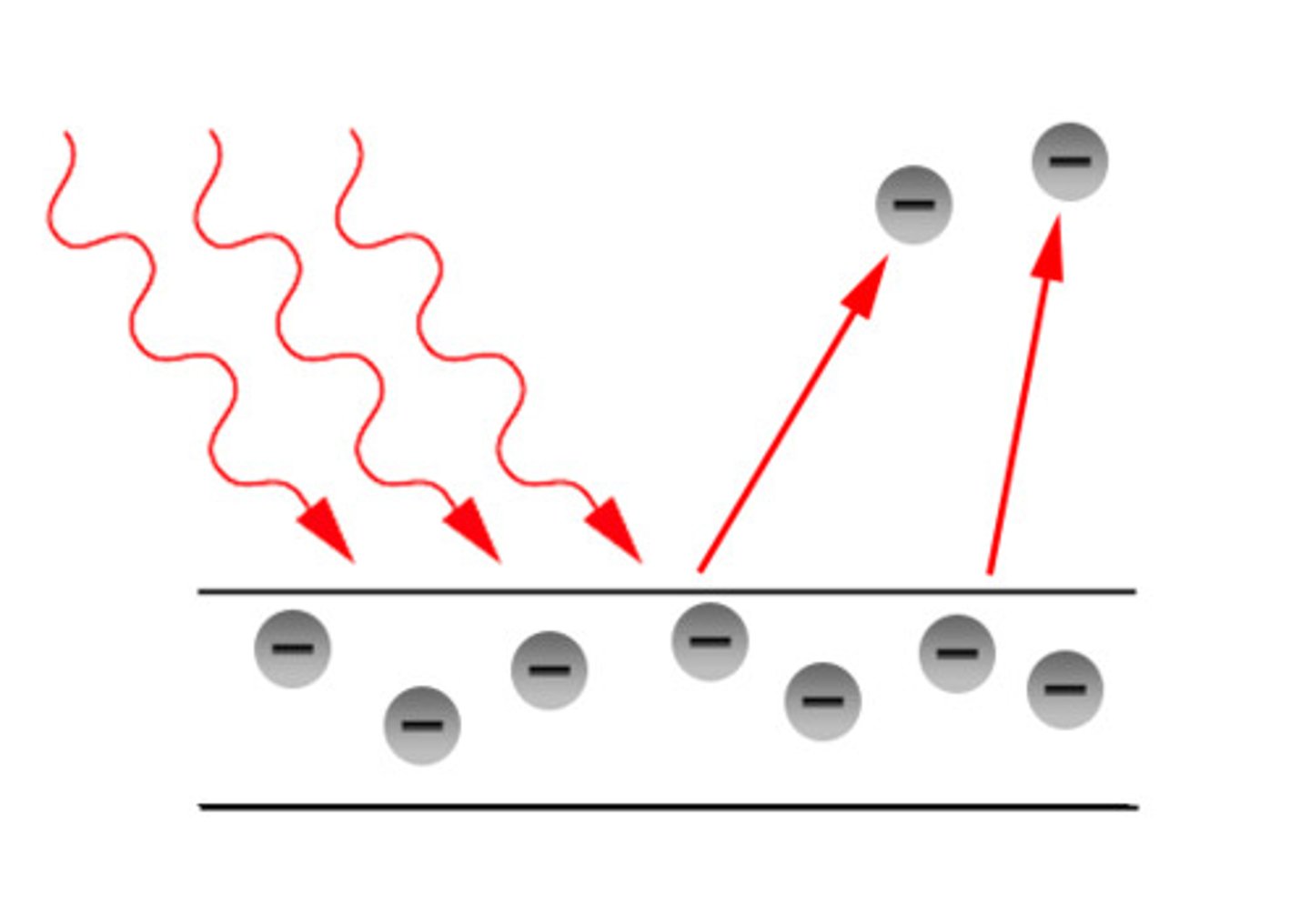
outer vs inner photoelectic effect
outer: e- kick out of metal
inner: e- move around in the metal
t or f: LEDs emit a wide spectrum
false, they emit monochromatic light even though it is white
t or f: LEDs are an example of fluorescence
true
advantages of LEDs
instant on/off
long life
high efficiency
low temperature
what is an interference filter? what kind of light leaves the filter?
filters light so that only wavelengths of the same harmonic passes through
"monochromatic" light - only one wavelength is in the visible spectum
4 ways to make a neutral density filter
thin plastic filter
carbon in glass
polaroids (Law of Malus)
episcotister (sectored disk)
color temperature changes filters are measure in ____ units
MIRED
humans can see a color change when there is a __#__ MIRED difference
5
examples of cut-off filters
UV coating, blue blockers
what are cut-off filters?
filters out light past a certain wavelength
what is a bandpass filter? what light leaves the filter?
narrow range of wavelengths can pass through
(i.e. will only permit blue light to pass)