physics - topic 8: global challenges
 Call Kai
 Learn
Learn Practice Test
 Spaced Repetition
 Match
Match Flashcards
 Knowt Play
1/39

There's no tags or description
Looks like no tags are added yet.
Name | Mastery | Learn | Test | Matching | Spaced | Call with Kai |
|---|
No analytics yet
Send a link to your students to track their progress
40 Terms
What are the estimated speeds for walking, running, cycling, and driving on motorways and quiet roads?
Walking- 3mph
Running- 6.7mph
Cycling- 12.3mph
Driving (motorway)- 70mph
Driving (quieter roads)- 30mph
What is the difference between thinking and braking distance?
Thinking- The distance the vehicle travels in your reaction time
Stopping- The distance it takes for you to come to a stop
What factors can affect braking distance?
Speed
Ice
Brake/tire conditions
Mass of the car (passengers)
What factors can affect thinking distance?
Fatigue or illness
Drugs
Alcohol
Distractions e.g. phone
What parts of a car can reduce forces in a collision?
Crumple Zone - deforms on impacts and absorbs KE
Airbags - cushioning
Anti Lock Braking Systems - brakes switch on and off so they don’t lock
Seatbelts
What experiment can test reaction time?
Ruler Drop Experiment
What happens in a nuclear power station?
Nuclear fuel (e.g. uranium) undergoes nuclear fission
The energy released heats water into steam
The steam turns the turbine
The turbine drives a generator, which produces electricity
Advantages: reliable, no CO₂ during generation, high energy output
Disadvantages: radioactive waste, expensive
What happens in a fossil fuel power station?
Fossil fuels are burned
The heat boils water to form water
Steam turns a turbine
The turbine drives a generator which produces electricity.
Advantages: reliable, high power output.
Disadvantages: non-renewable, releases CO₂ and pollutants.
Examples of renewable energy:
Solar
Wind
Tidal
Geothermal (hot energy under the earth)
Biofuel/biomass
Examples of non-renewable energy:
Fossil fuels (coal, oil, natural gas)
Nuclear energy (uranium)
What is the voltage and hertz of a UK plug?
230V, 50Hz
What is the National Grid?
A system consisting of cables and transformers that link power houses to consumers (houses or factories).
Do step-up transformers increase or decrease current? Why?
Decrease - Minimses power loss
Do step-down transformers increase or decrease voltage? Why?
Decrease - Provides safe and usable power to homes
What are the three wires in a UK plug?
Brown Live Wire- Carries current at a high voltage into the appliance
Blue Neutral Wire- Makes the circuit complete so current can flow
Earth Wire- A safety device to prevent the appliance becoming live
Where are the wires located in the plug?
Brown - Right (connected to fuse)
Blue - Left
Green/yellow earth - Top
All wires are connected to a cable grip, which connects to the outer insulation.
What are the two safety features on a plug?
Earth Wire:
Thick with low resistance
If there is a fault, the current travels through this wire to the ground
Fuse:
A hollow tube with wire running down the middle
If too much current flows, it melts the fuse and the circuit will break
How do you determine which fuse to get?
Divide the power rating (Watts) by the mains voltage (230V) to get the current. Round this number up.
What are the electricity safety features found in a house? Where is it found?
Isolating Transformers
Same turns on both coils
Allows you to use an electrical device without being connected to the mains
E.g. found in bathrooms for charging electric brushes
Double Insulation
Outer plastic casing replaces an earth wire
Prevents shock when touched
Circuit Breakers
Found in the fuse box
The circuit breaker ‘trips’ and breaks when current is too high
Prevents overheating
What is the outwards structure of the Earth?
Inner iron core (solid), outer core (liquid), mantle (solid), crust (solid)
What are the boundaries between tectonic plates called?
Fault lines
What causes seismic waves?
The sudden slip of the plates
What are the characteristics of P and S waves?

What do the waves look like when travelling through the Earth?
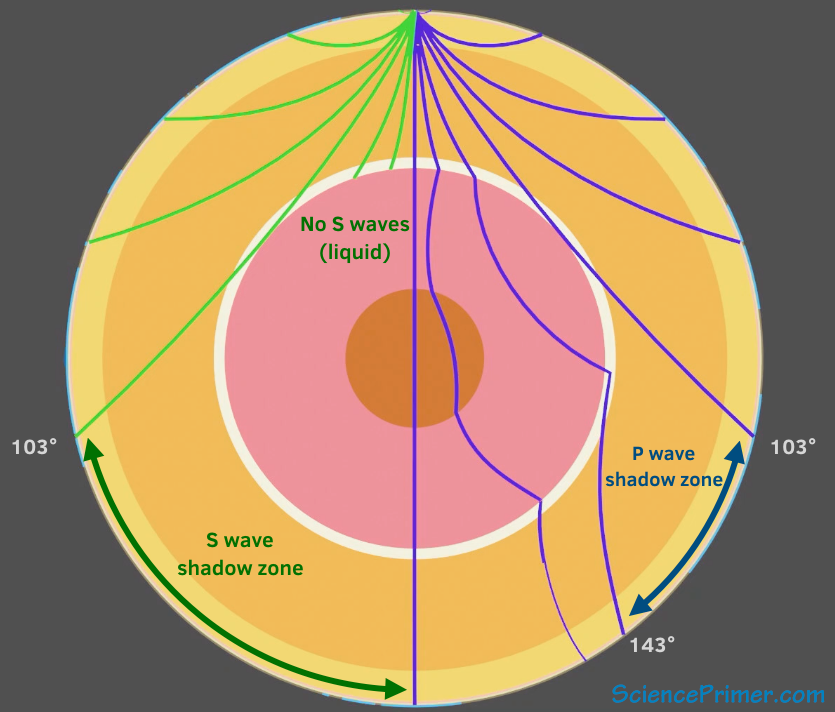
How to remember what P-waves travel through?
P-Waves are superior
So they travel through liquids AND solids
Why are p and s waves refracted when travelling through the layers of the Earth?
The density is changing
What do we call the area that the waves don’t reach? What does each one prove?
Shadow Zone
S-Wave shadow zone - Proves the Earth has a liquid outer core
P-Wave shadow zone - Proves the Earth has an iron inner core
What is a black body? Example?
A body that emits and absorbs every type of radiation (e.g. stars, black holes)
What is Wien’s Displacement Law?
As an object heats up, its peak wavelength of radiation decreases. It shifts towards the blue-end of the spectrum.
What are the planets in our solar system?
Mercury
Venus
Earth
Mars
Jupiter
Saturn
Uranus
Neptune
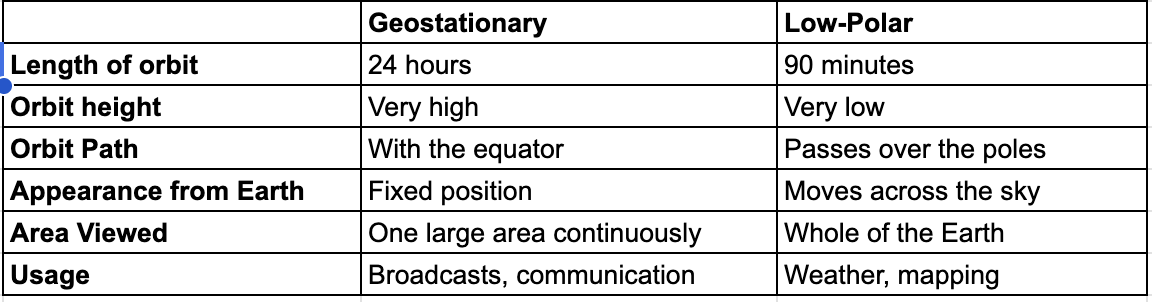
What are the two types of satellites and their characteristics?
What is the centripetal force?
The force directed to the centre of orbit
What provides the centripetal force of a celestial object?
The gravitational force between the object and the sun.
What is the relationship between force and distance in orbit?
As distance increases, force decreases (inverse square law)
What sequence do all stars follow up to main sequence?
Form in interstellar gas clouds (nebulae)
Nebulae collapse due to gravitational force, forming a protostar
Nuclear fusion starts - hydrogen fuses into helium
Star is stable due to balanced outward (pressure) and inward (gravitational ) forces
What is the life cycle of a low mass star (e.g. our sun) after main sequence?
Helium begins to fuse together and the star expands to form a red giant.
Its outer layers of gas are ejected to form a planetary nebula.
A white dwarf is left behind, which is the hot core.
This cools to form a black dwarf.
What is the life cycle of a high mass star after main sequence?
Heavier elements begin to fuse, and the star expands to form a red supergiant.
Eventually fusion reaches iron, and its outer laters collapse into the star.
The core ricochets, creating a supernova.
If the remaining core is larger, it becomes a black hole.
If not, it becomes a neutron star.
What is the Big Bang?
A theory on the beginning of the universe.
It claims that the universe started at a singular point, which is where all matter and energy was created.
The single point ‘exploded’ and begun to expand.
What is the evidence for the Big Bang?
Red Shifts
Light from distant galaxies is shifted towards the red end of the spectrum
The further away a galaxy is, the greater the red-shift
This shows galaxies are moving away from us
Therefore, the universe is expanding
Cosmic Microwave Background Radiation
Scientists Penzias and Wilson discovered that there was microwave radiation coming from all directions
This is believed to be the VL and IR left from the Big Bang
The radiation has been stretched over-time, so it now has a wavelength in the microwave region of the EM spectrum
What is the process of the greenhouse effect?
Short wavelength radiation (UV, VL) heats up the Earth’s surface
The Earth emits a longer wavelength radiation (IR)
Radiation is absorbed by greenhouse gases
Radiation is re-radiated in all directions incl. back to Earth