ACG4401 Exam 1 - Gerard (FSU)
 Call Kai
 Learn
Learn Practice Test
 Spaced Repetition
 Match
Match Flashcards
 Knowt Play
1/56

There's no tags or description
Looks like no tags are added yet.
Name | Mastery | Learn | Test | Matching | Spaced | Call with Kai |
|---|
No analytics yet
Send a link to your students to track their progress
57 Terms
What 3 factors interact to influence the likelihood of fraud?
Financial pressure, Opportunity, Lack of Integrity
How do the 3 factors interact?
When financial pressure is high, opportunity exists due to weak controls, and integrity is low, the likelihood of fraud is very high.
What duties should be segregated in an effort to prevent fraud?
Authorization, Custody of assets, and Recording of transactions
How do fraud perpetrators rationalize their acts?
They often view it as a loan they intend to repay, especially under financial pressure.
What are the red flags discussed in the video?
Financial pressures, personality changes, poor money management, living beyond means, outside business interests, poor internal control, too much trust in key employees
Who is ultimately responsible for Financial Statements and controls?
management
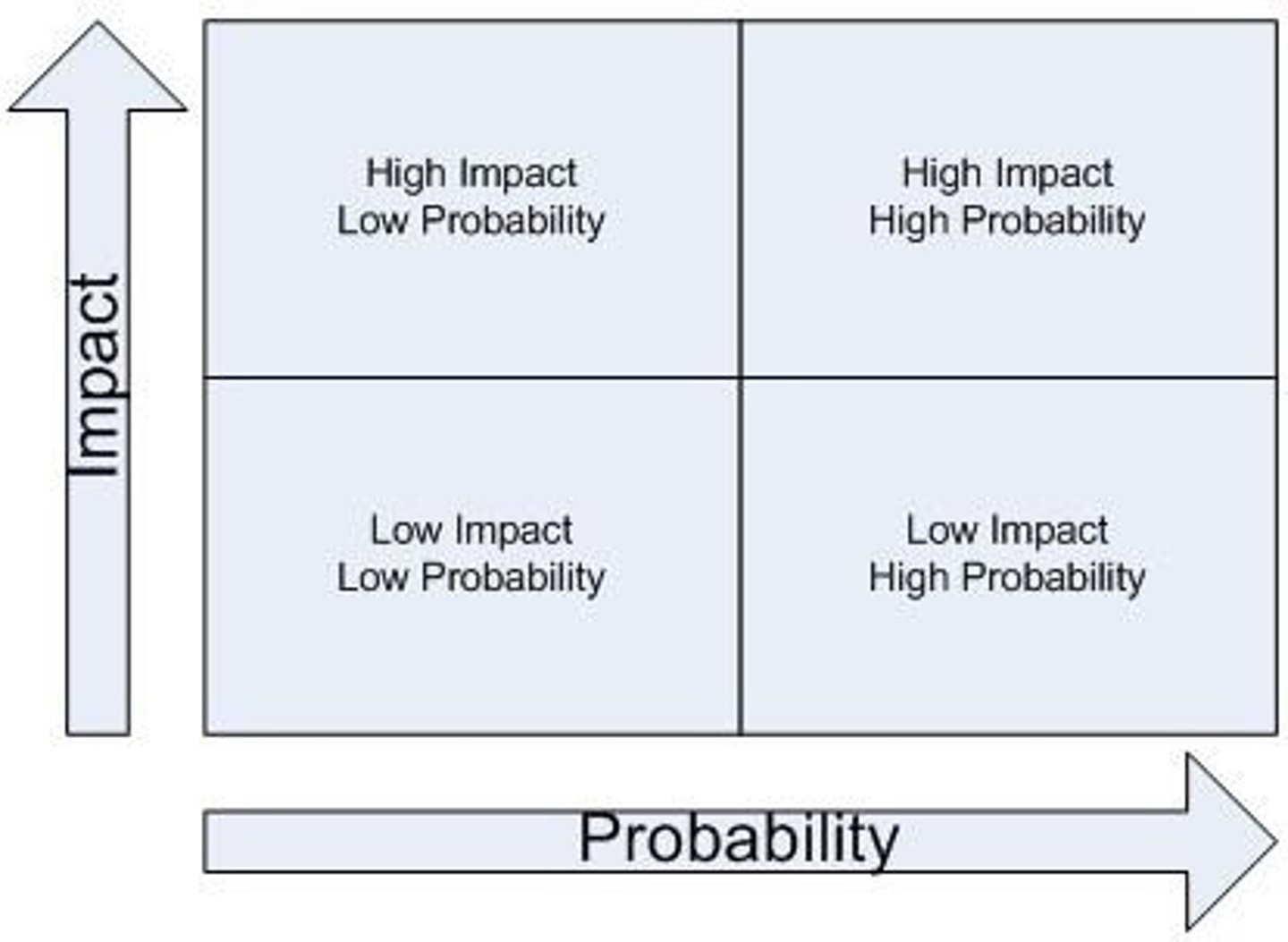
Assess the materialization of risk. (prioritization)
SOX 302 CEO and CFO responsibilities
The CEO and CFO must certify the accuracy of financial reports and internal controls (SOX 302)
SOX 404 responsibilities of management
Establishing and maintaining internal controls, preparing the financial statements, and assessing the effectiveness of internal controls (SOX 404).
SOX 404 Auditor responsibilities
Expressing an opinion on the fairness of the financial statements and, for public companies, evaluating and reporting on the effectiveness of internal controls (also under SOX 404)
Definition of internal control
Process, affected by an entity's board of directors, management, and other personnel, designed to provide reasonable assurance regarding the achievement of objectives relating to operations, reporting, and compliance
COSO Framework [internal control]
Control Environment, Risk Assessment, Control Activities, Information & Communication, Monitoring
COSO Framework Objectives
Operations, Reporting, Compliance
COSO Objective:Operations
Effectiveness and efficiency of operations
COSO Objective: Reporting
reliability of financial and non-financial reporting
COSO Objective: Compliance
adherence to applicable laws and regulations
What are the terms auditors use to describe a company with effective controls versus ineffective?
Effective: unqualified opinion, clean
Ineffective: qualified opinion, control deficiency, significant deficiency, material weakness
Internal controls can't eliminate all risk due to
Human error, collusion, management override, and cost/benefit constraints
Internal controls provide reasonable, not ____ assurance
absolute
Preventative Controls:
Stop errors or fraud before they occur
Detective Controls
Identify issues after they happen
Corrective controls
Fix problems that have been detected.
Segregation of Duties
Segregation of duties separates incompatible tasks—authorization, recordkeeping, and custody—to reduce fraud risk.
(Violations occur when one person can both commit and conceal errors or theft.)
No need to remember answer
Examples of segregation of duties
Warehouse clerk can both hold and dispose of inventory → may cover up theft.
Sales manager approves credit and writes off bad debts → may benefit personally.
Shop foreman handles time cards and paychecks → may pay ghost employees.
Accounting clerk posts and reconciles accounts → can hide embezzlement.
General audit issues with user accounts and groups/roles (NOS & application software)
Auditors look for inappropriate access, unused or dormant accounts, excessive privileges, and lack of role-based controls. Risks include users having access beyond their job needs, poor password policies, and weak user management.
Difference between IT general controls (ITGCs) and application controls (ITACs)
IT General Controls (ITGCs) relate to the overall IT environment supporting all applications, ensuring proper development, security, and operation of systems (e.g., IS policies, staff separation, disaster recovery).
Application Controls (ITACs) are specific to individual applications and focus on ensuring data accuracy, completeness, and authorization within those applications (e.g., input validation, access controls)
No Answer, just study
(from SUA Guide book)
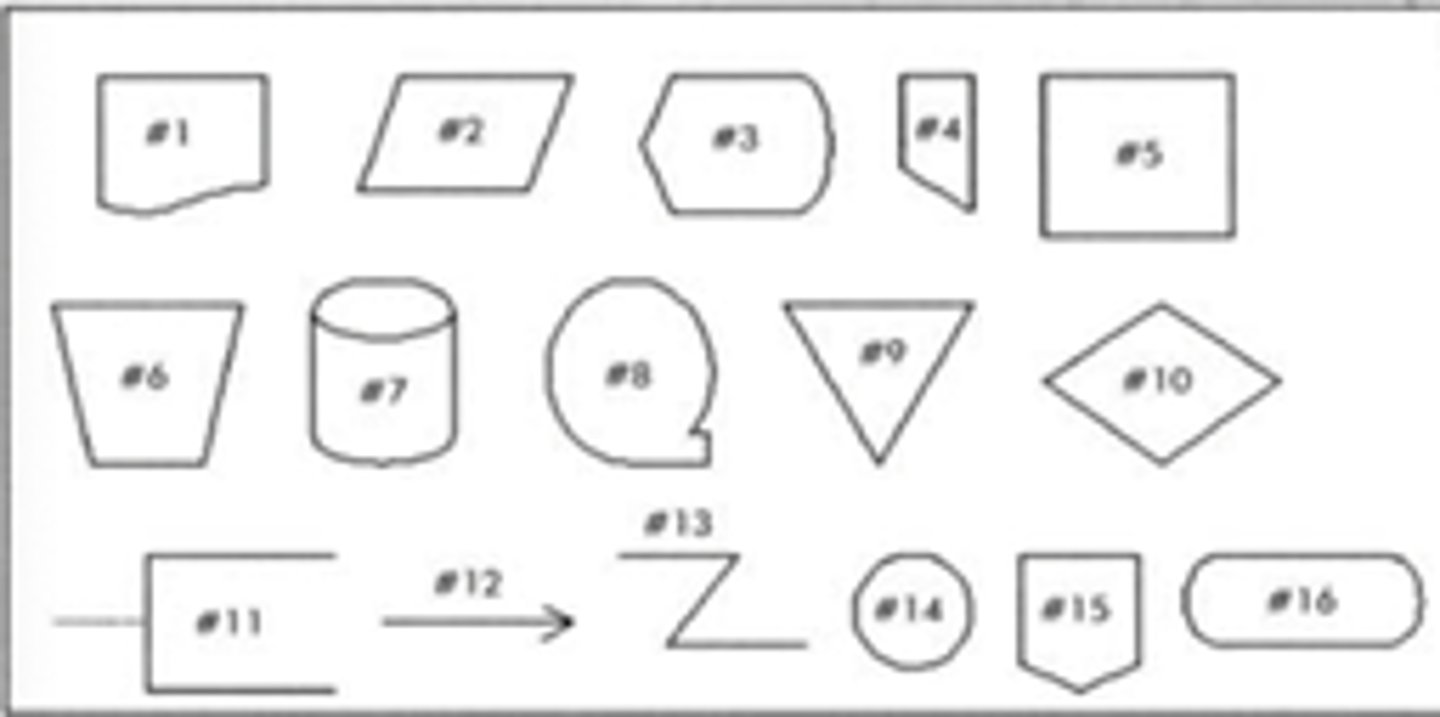
#1- Document
#2- Journal/Ledger Symbol
#3- X
#4- ? - result of manual process
#5- X
#6- Manual Operation or Process
#7- Disk Memory (for data)
#8- Magnetic Tape (for data)
#9- Off-line storage
#10- Decision
#11- X
#12- Flowlines. Solid is document, Dotted is information
#13- X
#14- On-Page Connector
#15- Off-Page Connector
#16- Terminator. Beginning, ending, or interruption of flowchart
**rectangle with the top sloping upwards is a manual input (keyboard inputting data)
Master Files
Permanent file with current status records (e.g., inventory, customer accounts). Continuously updated; like subsidiary ledger; used for reporting.
Transaction Files
Temporary file of similar transactions grouped for processing (e.g., sales transactions)
Transaction files are used to update _____ files after editing for accuracy
I apologize its hard to make this short
Describe the general guidelines for flowcharts
1. Understand the system fully (interview users, observe, read documentation).
2. Identify entities (departments, functions, external parties) and document flows.
3. Use columns to separate entities and label them.
4. Flowchart normal operations; exceptions with annotations.
5. Flow direction: top to bottom, left to right.
6. Clear start and end; show document origins and final destinations.
7. Use standard symbols, drawn neatly or with software.
8. Label all symbols with clear descriptions; use annotations if needed.
9. Number documents on multiple copies, showing numbers on flowcharts.
10. Precede manual process symbols with input and follow with output; show document moves between functions.
11. Use connectors sparingly; label off-page connectors clearly.
12. Use arrowheads on all flow lines for clarity.
13. Keep flowcharts to one page if possible; number pages if multiple.
14. Show documents/reports in the creating functional area first, then transfer.
15. Data entering/retrieved from computer files must go through a processing step.
16. Use lines from documents to files to show filing; no manual process needed for filing.
17. Start with rough sketches; refine through drafts.
18. Review flowchart with knowledgeable people for accuracy and consistency.
19. Redesign to avoid clutter and crossed lines; prepare final clean copy.
20. Include flowchart name, date, and preparer on each page.
no answer
Know the flowchart patterns.
Study all flowcharts in the given SUA booklet
Chart of Accounts
List of all accounts used by a business in its accounting system.
Ex: Assets, Liabilities, Equity, Revenues, Expenses.
General Journal
Used to record infrequent or unique transactions that do not fit into a special journal
Each entry in the general journal includes:
date, accounts debited and credited, amounts, and a brief explanation.
Special Journals
Used to record routine, repetitive transactions.
Examples of Special journals
Sales Journal
Cash Receipts Journal
Purchases Journal
Cash Disbursements Journal
Payroll Journal
Subsidiary Ledgers and Related Transactions
Accounts Receivable Subsidiary Ledger
Accounts Payable Subsidiary Ledger
Fixed Asset Subsidiary Ledger
Employee Earnings Subsidiary Ledger
How does the subsidiary leger relate to the general ledger?
Column totals from special journals are posted periodically to the General Ledger accounts.
How are financial statements prepared?
Start with a trial balance, make adjusting entries, and use the adjusted trial balance to prepare the income statement, retained earnings statement, and balance sheet.
What is the role of the general ledger?
It records all account activity and holds the data used to create financial statements. Every journal entry is posted here.
What is the Income Summary account for?
It temporarily holds total revenues and expenses during closing to calculate net income, which is then moved to Retained Earnings.
How do closing entries work and when?
Done at the end of the period:
- Close revenues and expenses to Income Summary
- Close Income Summary to Retained Earnings
- Close Dividends to Retained Earnings
What accounts are closed?
Only temporary accounts: revenues, expenses, dividends, and Income Summary. Permanent accounts stay open.
What items are used to prepare a bank reconciliation?
> Bank Statement: Shows the bank's record of deposits, checks, and ending balance.
> Cash Account (General Ledger): The company's version of cash activity.
> Outstanding Checks: Checks written by the company not yet cleared by the bank.
> Deposits in Transit: Deposits recorded in the books but not yet shown on the bank statement.
> Bank Service Charges: Fees deducted by the bank but not yet recorded in the books.
How are cash receipts controlled
> Prelisting of Cash Receipts: Every check or payment received is recorded immediately upon receipt.
> Cash Receipts Journal: All incoming cash is entered here daily.
> Deposit Slips: Used to verify that all cash/checks received were deposited.
> Bank Reconciliation: Confirms that what's deposited matches what's in the bank.
**segregation of duties
[Practice Question]
Which of the following best describes the principle of segregation of duties in internal controls?
a. ensuring that one person is responsible for all aspects of a transaction to maintain accountability
b. dividing responsibilities among different individuals to reduce the risk of error or fraud
c. allowing employees to rotate duties periodically to prevent collusion
d. implementing strict access controls to sensitive information
b. dividing responsibilities among different individuals to reduce the risk of error or fraud
[Practice Question]
Which element of the fraud triangle is most likely to be influenced by an employee's financial difficulties?
a. opportunity
b. pressure
c. rationalization
d. integrity
b. pressure
[Practice Question]
Which of the following is not one of the five components of internal control as defined by the COSO framework?
a. control environment
b. risk assessment
c. information and communication
d. financial reporting
d. financial reporting
[Practice Question]
Which of the following is an example of an input control in an IT application?
a. user access reviews
b. backup procedures
c. edit checks
d. sandbox development environment
c. edit checks
[Practice Question]
A document indicating a reduction in the amount due from a customer because of returned goods or an allowance granted is called a...
a. debit memo
b. sales return and allowances journal
c. credit memo
d. sales invoice
c. credit memo
[Practice Question]
Waren purchased office supplies and immediately paid for them with a check. Where would this transaction be recorded?
a. purchases journal
b. general ledger
c. general journal
d. cash disbursements journal
d. cash disbursements journal
[Practice Question]
Which of the following would not be recorded in Waren's sales journal?
a. cash sale
b. credit sale
c. sales return for credit
d. all the above are recorded in the sales journal
a. cash sale
[Practice Question]
What document does a customer receive when goods are returned?
a. credit memo
b. debit memo
c. purchase order
d. receiving report
a. credit memo
[Practice Question]
Which of the following items on a bank reconciliation require an adjustment to the balance of the cash GL account?
a. outstanding checks
b. deposits in transit
c. errors by the bank
d. service charge
d. service charge
Post-Practice Question Note
Define the following: User Access Reviews, Edit Checks, Sandbox Development Environment
> A user access review is a periodic process where an organization checks who has access to its systems, applications, and data
> Edit checks are automated controls in software that validate input data for accuracy and completeness before it's processed.
> A sandbox development environment is an isolated space where developers can test new features without affecting the live system.
Post-Practice Question Note
Magnetic tapes are recorded/written...
(what is unique about the recording order)
sequentially