RAT 14, Video 1
 Call Kai
 Learn
Learn Practice Test
 Spaced Repetition
 Match
Match Flashcards
 Knowt Play
1/59

There's no tags or description
Looks like no tags are added yet.
Name | Mastery | Learn | Test | Matching | Spaced | Call with Kai |
|---|
No analytics yet
Send a link to your students to track their progress
60 Terms
What is cancer?
Disease in which cells grow uncontrollably, rapidly, and spread locally or distantly due to genetic mutations
What are proto-oncogenes?
Genes that normally promote cell growth and survival
What happens when proto-oncogenes mutate?
They become oncogenes causing uncontrolled cell growth
What are tumor suppressor genes?
Genes that regulate cell division and promote apoptosis (programmed cell death)
What happens when tumor suppressor genes are inactivated?
Unregulated cell growth and survival of mutated cells
What are DNA repair genes?
Genes that fix DNA replication errors or trigger cell death
What happens when DNA repair genes mutate?
Accumulation of mutations leading to cancer growth
What are the two main cancer groupings?
Solid Tumors/Cancer
Hematological Cancer/ Malignancies
What is a solid tumor?
A malignant solid mass named by tissue of origin
Ex: Breast Cancer, Skin Cancer, Colon Cancer, Prostate Cancer
What is a hematologic malignancy?
Cancer originating from blood, bone marrow, or lymphatic system
Ex: Leukemia, Lymphoma, MM
What are the 6 major cancer classifications?
Carcinoma
sarcoma
myeloma
leukemia
lymphoma
mixed types
What is carcinoma?
Cancer from epithelial cells
Ex: Breast Cancer, Lung Cancer, Prostate Cancer, Colon Cancer
What is sarcoma?
Cancer from connective tissues like bone or muscle
Ex: Osteosarcoma (bone), Leiomyosarcoma (smooth muscle), Rhabdomyosarcoma (skeletal muscle)
What is Myeloma?
Cancer from plasma cells origin (produced in BM)
What is leukemia?
Cancer of white blood cells
often with immature WBC overproduction
What is lymphoma?
Cancer of lymphatic system cells
What is Mixed Types cancer?
Tumors with histological features of a mixture/combo of tissues
Ex: Carcinosarcoma (carcinoma & sarcoma features)
What is staging?
Extent of cancer spread (size and metastasis)
usually drives choice of treatment, & may predict prognosis
What is grading?
Describes how abnormal cancer cells look compared to normal cells
What does a low grade prognosis mean?
Tumor cell is similar to original normal cell
Less aggressive/favorable prognosis
What does a high grade prognosis mean?
Tumor is NOT similar to original normal cell
More aggressive/unfavorable prognosis
What does TNM stand for?
Tumor size, Node involvement, Metastasis
What does T represent in TNM?
Size/extent of primary tumor
Numbered 1-4
Higher # = Larger Tumor
Ex. T4 = Largest primary tumor
What does N represent in TNM?
Number/location of Nearby lymph Nodes that have cancer
Numbered 1-3
Higher # = More lymph nodes [Ex. N2]
Number Does NOT necessarily mean exact # of lymph nodes
What does M represent in TNM?
Presence of metastasis or not
Number 0-1
0 = No spread & 1 = Spread
What is ECOG performance status?
Scale measuring patient functional status and ability to tolerate therapy
What does a lower ECOG score indicate?
Better performance status
Usually indicates better ability to both handle therapy acutely & recover after therapy
What is neoadjuvant therapy?
Treatment before main therapy to shrink tumor
Ex: Chemotherapy, RT, HT
Often referring to solid tumor cancer treatments
What is adjuvant therapy?
Systemic teatment after primary therapy to prevent recurrence
kill potential remaining cancer cells after the primary/first treatment to lower the risk of cancer coming back
Often referring to solid tumor cancer treatments
What is induction chemotherapy?
Systemic and Intense therapy to induce remission
Often referring to hematological cancer treatments
What is consolidation chemotherapy?
Systemic therapy after remission to prolong survival
Often referring to hematological cancer treatments
What is maintenance chemotherapy?
Low-dose therapy to maintain remission/prevent relapse
Often referring to leukemias
What is palliative chemotherapy?
Chemotherapy given to address symptom management &/or shrink the tumor WITHOUT expecting a cure
What is conditioning chemotherapy?
High-dose therapy before stem cell transplant
Kill off (wipe out) any remaining cancer in the bone marrow, “make room” in the bone marrow for transplant cells to “grow” (engraft), & prevent transplant rejection
Referring to hematological cancers eligible for transplant
What is a treatment course?
Plan made of multiple treatment cycles
What is a treatment cycle?
Period of treatment (“round” of therapy) followed by rest
Usually lasts several months
Often denoted in the following format: Cycle (“C”) Number (#) & Day (“D”) Number (#) → C1D1
How are chemo regimens often named?
Acronyms of included drugs (using both & generic names)
Ex: RCHOP 21-Day Cycle X 3 Cycles (Indication: DLBCL - 1st Line Therapy)
Rituximab 375mg/m2 IV INF Day 1
Cyclophosphamide 750 mg/m2 IV INF Day 1
HYDROXYDAUNORUBICIN (Doxorubicin) IV Push Day 1
ONCOVIN (Vincristine) IV INF Day 1
Prednisone 100mg PO daily Day 1-5
What determines chemo dosing?
Weight
ABW is standardly used unless otherwise directed
IBW & AdjBW may be used in specific situations/regimens, including patients with high BMI
BSA
fixed dosing
What factors affect dose adjustments?
Patient performance status (ie. ECOG Score)
Labs & other testing (ex. SCr, Tbili, ECHO, EKG, etc.)
Patient age
Patient tolerability
Previously experienced AE(s)
Intent of therapy (ie. curative, palliative, etc.)
How do you calculate BSA using Mosteller equation?
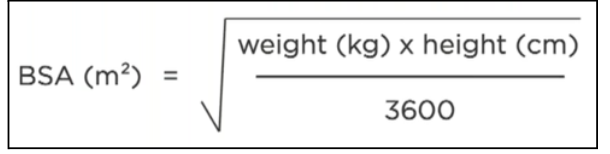
How do you calculate BSA using Du Bois calculation?
BSA (m2) = 0.007184 x [Ht (cm)0.725] x [Wt (kg)0.425]
Weight usually in ABW
What is complete response (CR)?
Disappearance of all cancer signs
What is partial response (PR)?
Reduction in tumor size in the body in response to treatment
What is progressive disease (PD)?
Cancer worsening or spreading
What is stable disease (SD)?
Cancer neither growing nor shrinking
What is relapse?
Return of cancer after remission
What is refractory disease?
Cancer resistant to treatment
What is the cell-kill hypothesis?
Each chemo cycle kills a fixed percentage of cancer cells
hence why multiple treatments are needed to obtain a “cure” &/or get cancer to an undetectable level
How does traditional chemotherapy work?
Targets rapidly dividing cells non-selectively
Why do chemo side effects occur?
Healthy rapidly dividing cells are also affected by therapy
What are common chemo side effect sites?
GI tract
hair follicles
bone marrow
gametes
What is alopecia in chemotherapy?
Hair loss due to damage to hair follicles
Occurs ~2-4 weeks into treatment
What is myelosuppression?
Bone marrow suppression → low blood counts
What AE relates to gametes with common traditional chemotherapy?
Infertility
Fertility-preserving measures prior to treatment (ie. sperm-banking or egg freezing)
What is CTCAE?
System used to grade adverse events severity
A CTCAE score of 1 indicates…
Mild – Asymptomatic or mild symptoms
A CTCAE score of 2 indicates…
Moderate – Symptoms with mild/moderate impairment in daily activity
Minimal/noninvasive intervention needed
A CTCAE score of 3 indicates…
Severe – Medically significant symptoms with severe impact to daily activity
Hospitalization/prolonged stay needed
A CTCAE score of 4 indicates…
Life-Threatening
Urgent intervention needed
A CTCAE score of 5 indicates…
Death related to AE