U1 Bio
 Call Kai
 Learn
Learn Practice Test
 Spaced Repetition
 Match
Match Flashcards
 Knowt Play
1/70

There's no tags or description
Looks like no tags are added yet.
Name | Mastery | Learn | Test | Matching | Spaced | Call with Kai |
|---|
No analytics yet
Send a link to your students to track their progress
71 Terms
Why is water considered the 'medium of life'?
• It is the site where most life processes occur. • Cell survival depends on metabolism, which consists of chemical reactions in aqueous solutions.
What are the three primary characteristics of a water molecule?
• Polarity (having positive and negative 'poles'). • Solvent properties. • Having a specific charge.
Distinguish between intramolecular and intermolecular bonds in water.
• Intramolecular bonds (polar covalent) occur within a single $H_2O$ molecule (between $O$ and $H$). • Intermolecular bonds (hydrogen bonds) occur between different $H_2O$ molecules.
What causes the polarity of a water molecule?
• Oxygen has a higher electronegativity (attraction to electrons) than Hydrogen. • This leads to unequal sharing of electrons, creating regions of partial charges ($\partial +$ and $\partial -$).
In a diagram of two water molecules, how are polar covalent and hydrogen bonds represented?
• Polar covalent bonds are shown as solid lines ('physical' bonds). • Hydrogen bonds are shown as dotted lines ('magnet' bonds).
Define 'cohesion' in the context of water properties.
• Cohesion is the attraction between two like molecules, such as two $H_2O$ molecules. • It allows for the formation of surface tension.
Define 'adhesion' in the context of water properties.
• Adhesion is the attraction between two unlike molecules, such as $H_2O$ and other polar or charged molecules. • it allows for capillary action.
How do water's solvent properties facilitate metabolism?
• Water is a 'universal solvent' that dissolves many hydrophilic/polar/charged molecules. • It provides an aqueous medium (cytoplasm) where enzymes catalyze reactions to maintain life functions.
Why are hydrophobic regions important in cell membranes?
• They maintain cell structure by causing phospholipid tails to face inward. • They ensure membrane proteins stay embedded within the membrane.
How does water function as a medium for transport in animals and plants?
• In animals, blood plasma contains water to transport dissolved nutrients, minerals, and amino acids. • In plants, phloem sap is an aqueous solution that transports sucrose, minerals, and salts.
How are non-polar molecules like $O_2$ transported in the blood?
• They must bind to another molecule to be transported. • For example, $O_2$ binds to hemoglobin in red blood cells.
What type of reaction joins nucleotide monomers to form nucleic acid polymers?
• Polymerization via a condensation reaction. • This process binds two or more molecules together and releases an $H_2O$ molecule.
compare & contrast the genetic material of living things and viruses.
• Living things use DNA as genetic material to pass information to the next generation. • Viruses use DNA or sometimes RNA as genetic material and require a host to replicate.
What are the three components of a nucleotide?
• A phosphate group (phosphorus + $O_2$). • A pentose sugar (simple 5-carbon sugar). • A nitrogenous base (nitrogen-containing molecule acting as a base).
Identify the four nitrogenous bases found in DNA.
• Adenine ($A$) • Thymine ($T$) • Guanine ($G$) • Cytosine ($C$)
Identify the four nitrogenous bases found in RNA.
• Adenine ($A$) • Uracil ($U$) • Guanine ($G$) • Cytosine ($C$)
Distinguish between purines and pyrimidines based on ring structure.
• Purines ($A$ and $G$) have a double-ring structure and are larger. • Pyrimidines ($C$, $T$, and $U$) have a single-ring structure and are smaller.
What is the role of hydrogen bonds in complementary base pairing?
• They hold the pairs together to maintain the base sequence during DNA replication. • This ensures the genetic code remains uniform across species.
Why must a purine always pair with a pyrimidine in the DNA double helix?
• It results in equal length of the pairs. • This ensures a uniform helix diameter and structural stability.
Contrast the pentose sugars found in DNA and RNA.
• DNA contains deoxyribose ($C_5H_{10}O_4$), which has one less oxygen. • RNA contains ribose ($C_5H_{10}O_5$).
Contrast the polymer structures of DNA and RNA.
• DNA is a double-stranded molecule involving hydrogen bonding. • RNA is a single-stranded molecule.
Distinguish between the leading and lagging strands during DNA replication.
• The leading strand is synthesized continuously. • The lagging strand is synthesized in Okazaki fragments due to the antiparallel nature of DNA.
What is the proofreading role of DNA polymerase III?
• It removes any nucleotide from the $3'$ terminal with a mismatched base. • It then replaces it with the correctly matched nucleotide.
Describe the formation of the DNA polymer from monomers.
• The phosphate group attaches to the $5'$ carbon of the sugar. • It then attaches to the $3'$ carbon of the next nucleotide's sugar via polymerization. • This creates a chain in the $5'$ to $3'$ direction via covalent bonds.
What components form the sugar-phosphate backbone of nucleic acids?
• The phosphate group attached to the $5'$ carbon of the pentose sugar. • The hydroxyl group attached to the $3'$ carbon of the next sugar.
What is a nucleosome, and in which cell type is it found?
• It is a histone octamer (8 proteins) wrapped in core DNA, plus an $H_1$ 'linker' histone. • It is found in eukaryotic cells, but not in prokaryotic cells.
What is the primary function of nucleosomes?
• They condense DNA to fit within the nucleus. • They allow for the organization of large amounts of DNA into a compact space.
Describe the organizational pathway from nucleosomes to chromosomes.
• Nucleosomes are linked by $H_1$ histones into $30$ nm fibers. • Fibers form loops and condense around a protein scaffold to form chromatin. • Chromatin supercoils during cell division to form chromosomes.
Define 'gene expression' in terms of phenotype.
• It is the mechanism by which genes affect the phenotype (observable characteristics, like blood type).
Identify three primary regulators of gene expression.
• Transcription factors (initiation control). • mRNA degradation (post-transcriptional control). • Methylation (epigenetic control).
Define 'epigenetics'.
• The study of changes in phenotype resulting from variations in gene expression levels without altering the DNA sequence.
How does methylation function as an epigenetic mechanism?
• A methyl group ($-CH_3$) is added to histones or DNA. • This modification regulates levels of gene expression.
What was the significance of the Hershey and Chase experiment?
• It proved that DNA, not protein, is the genetic material. • It utilized radioisotopes of phosphorus ($^{32}P$) and sulfur ($^{35}S$) as research tools.
In the Hershey-Chase experiment, why was $^{32}P$ used to label DNA?
• Phosphorus is found only in DNA and not in proteins. • This allowed scientists to track if DNA was injected into bacteria.
In the Hershey-Chase experiment, why was $^{35}S$ used to label protein?
• Sulfur is found in proteins but not in DNA. • This allowed scientists to track if protein remained outside the bacteria.
What were the results of the Hershey-Chase experiment regarding $^{32}P$ and $^{35}S$?
• $^{32}P$ (DNA) was found in the pellet, meaning it was injected into and inherited by the bacteria. • $^{35}S$ (protein) remained in the supernatant, meaning it did not enter the bacteria.
How did Chargaff's data falsify the tetranucleotide hypothesis?
• It showed that the ratio of base pairs ($A:T$ and $C:G$) were not equal across all organisms. • It disproved the idea of a repeating sequence of four bases.
Describe the structure and compartmentalization function of the nucleus.
• Structure: Double membrane (nuclear envelope) with pores; continuous with the rER. • Function: Separates DNA/RNA synthesis (inside) from protein synthesis (cytoplasm).
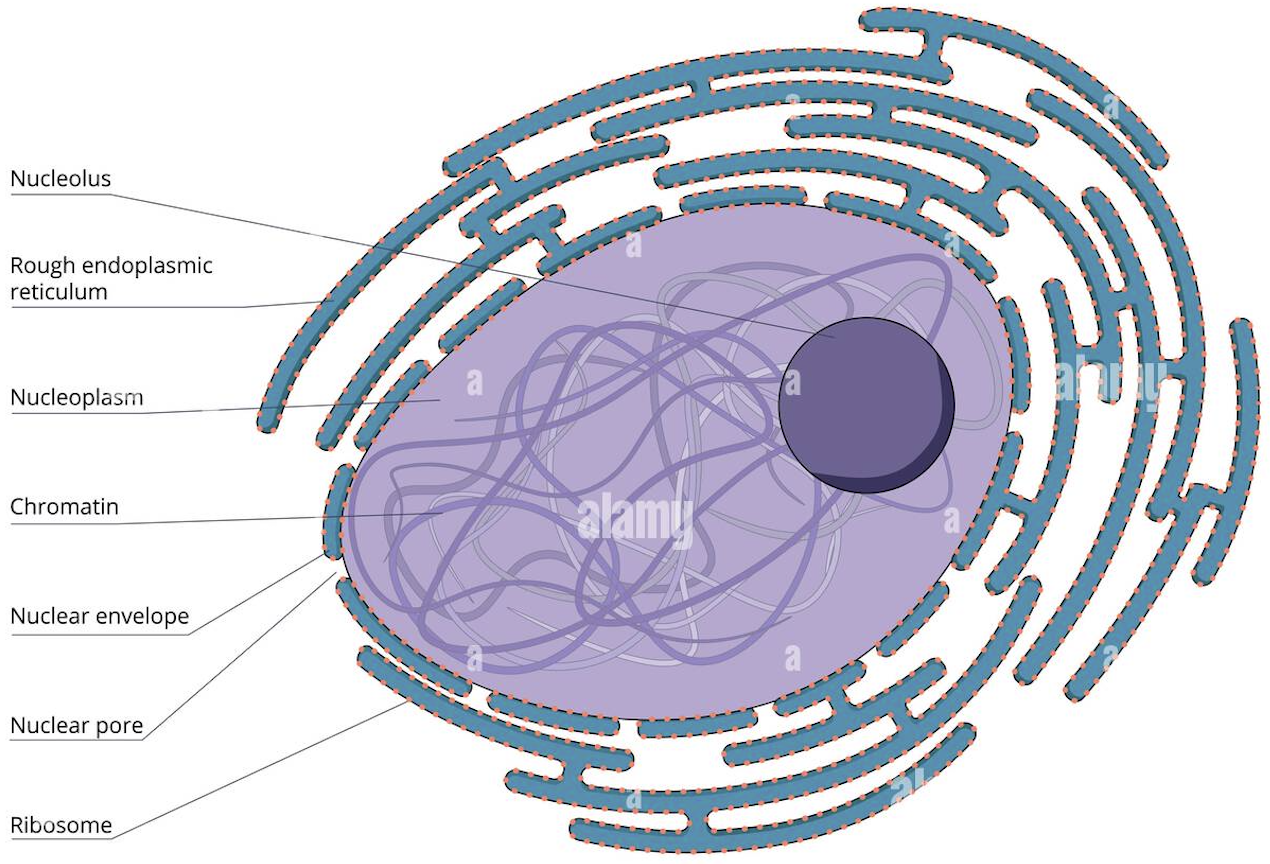
What is the function of nuclear pores?
• They act as security checkpoints to control the selective diffusion of mRNA and proteins between the nucleus and cytoplasm.
Distinguish between the functions of free and membrane-bound ribosomes.
• Free ribosomes synthesize proteins used within the cell. • Membrane-bound ribosomes (on rER) synthesize proteins for transport within the cell or secretion out of the cell.
Describe the structure of the Golgi apparatus.
• It consists of stacks of flat, membrane-bound sacs (cisternae) and vesicles. • It has a 'cis' face (entry) and a 'trans' face (exit).
What is the primary function of the Golgi apparatus?
• It is the site of protein processing, including sorting, modifying, tagging, and secretion.
Identify four types of vesicles and their specific roles.
• Secretory (transport out of cell). • Transport (move substances within cell). • Vacuoles (store water in plants to maintain osmotic pressure). • Lysosomes (contain enzymes for digestion).
What is the role of clathrin in vesicle formation?
• It assembles into a hexagonal lattice to form a protein coat around budding vesicles. • it aids in pulling, shaping, and pinching off the membrane during endocytosis.
List four examples of non-coding DNA sequences in eukaryotes.
• Promoter regions and terminator regions. • Regulatory regions (enhancers/silencers). • Introns. • Telomeres.
How do enhancer and silencer regions regulate transcription?
• Enhancers bind activator proteins to increase the rate of transcription. • Silencers bind repressor proteins to decrease the rate of transcription.
Define 'telomeres'.
• Long, repetitive non-coding sequences located at the ends of eukaryotic DNA to protect chromosome integrity.
Describe the steps of transcription initiation in eukaryotes.
• Transcription factors bind to the promoter region. • RNA polymerase attaches to the promoter. • Transcription begins downstream from the promoter.
Identify the three main steps of post-transcriptional modification in eukaryotes.
• Addition of a $5'$ methyl cap and a $3'$ poly-A tail for stability. • Splicing to remove introns (non-coding) and join exons (coding). • Alternative splicing to produce protein variations.
What is the purpose of the $5'$ methyl cap and $3'$ poly-A tail?
• They protect mRNA from degradation by enzymes. • They can be 'cut off' without damaging the actual coding sequence.
How does alternative splicing contribute to protein diversity?
• It combines different exons from the same pre-mRNA. • This allows a single gene to produce multiple variations of proteins.
List the four main stages of translation in eukaryotes.
• 1. Initiation • 2. Elongation • 3. Translocation • 4. Termination
Describe the initiation phase of translation.
• The small ribosomal subunit binds to mRNA and slides from the $5'$ end to the start codon ($AUG$). • The initiator tRNA binds to the start codon. • The large ribosomal subunit binds to the small subunit.
Identify the three internal sites of the large ribosomal subunit.
• A site (amino acid entry). • P site (polypeptide holding). • E site (exit).
Explain the processes of elongation and translocation in translation.
• A new tRNA enters the A site, and a peptide bond forms between amino acids. • The ribosome moves one codon ($5'$ to $3'$). • The tRNA in the P site shifts to the E site and exits, while the tRNA in the A site moves to the P site.
Describe the termination phase of translation.
• The process continues until a stop codon is reached. • A release factor protein binds, causing the ribosome to disassemble. • The free polypeptide, mRNA, and remaining tRNA are released.
How is translation regulated through mRNA degradation?
• If excess proteins are unneeded, transcription stops and mRNA is broken down. • This reduces the number of mRNA molecules available for translation.
Identify the enzymes involved in the three-stage degradation of mRNA.
• Decapping complex removes the $5'$ methyl cap. • Exonuclease removes nucleotides in the coding sequence. • Deadenylase complex removes adenine nucleotides from the $3'$ poly-A tail.
Describe the initial synthesis of insulin in the rER.
• It is synthesized as pre-proinsulin, which contains four sections. • These sections include a signal peptide, A chain, B chain, and C-peptide.
What structural change converts pre-proinsulin to proinsulin?
• Disulfide bridges (covalent bonds) form between the A and B chains. • The signal peptide is removed.
How is functional insulin formed in the Golgi apparatus?
• The C-peptide (C-chain) is removed from proinsulin. • This results in the final, functional insulin molecule.
How does a cell maintain a functional proteome through recycling?
• It requires constant protein synthesis balanced with constant protein breakdown. • Excess or damaged proteins are targeted and destroyed.
What is the function of ubiquitin?
• It acts as a chemical 'tag' to mark unwanted or damaged proteins for degradation.
What is the role of proteasomes in the cell?
• They are protein complexes that recognize ubiquitin tags. • They break down the tagged proteins into amino acids for recycling.
Define 'genome'.
• The complete set of genes in a cell or organism.
Define 'transcriptome'.
• The complete set of RNA molecules transcribed from the genome.
Define 'proteome'.
• The complete set of proteins translated from the genome.
Define 'metabolome'.
• The complete set of low molecular weight metabolites within an organism.
Why is the genetic code considered uniform across species?
• Complementary base pairing ensures the sequence is maintained during replication. • Most organisms use the same nitrogenous bases and triplet codes to produce proteins.
What are the two specific biological effects allowed by water's cohesion and adhesion?
• Surface tension (due to cohesion). • Capillary action (due to adhesion).
Concept: Intramolecular polar covalent bonds in water.
• Definition: Strong chemical bonds within one water molecule where oxygen and hydrogen share electrons unequally. • Example: The bond connecting the central Oxygen atom to the two Hydrogen atoms in $H_2O$.