Organic Chemistry
 Call Kai
 Learn
Learn Practice Test
 Spaced Repetition
 Match
Match Flashcards
 Knowt Play
1/61

There's no tags or description
Looks like no tags are added yet.
Name | Mastery | Learn | Test | Matching | Spaced | Call with Kai |
|---|
No analytics yet
Send a link to your students to track their progress
62 Terms
n-propyl

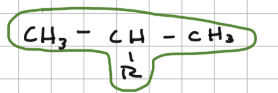
isopropyl
n-butyl

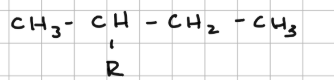
s-butyl or sec-butyl
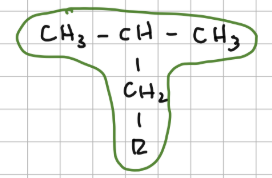
isobutyl
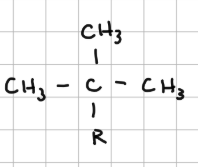
tert-butyl
Alkenes have
double bonds, more reactive than alkanes
Alkynes have
triple bonds, most reactive
when hexagon is a parent chain
benzene
when hexagon is a branch
phenyl
Ortho (o-)
beside each other (ex 1,2)
Meta (m-)
1 apart (ex 1,3)
Para (p-)
across (ex 1,4)
Geometric isomers only work for
alkenes (double bonds)
cis
at least 1 pair are on the same side
trans
at least 1 pair is on the opposite side
organic halide
halogen atom attatched on to a hydrocarbon
R—OH
alcohol
suffix: -ol
prefix: hydroxy- (benzene)
numbering priority
R—halogen
halide
prefix: chloro-,bromo-,iodo-, fluoro-
no numbering priority (branches)
R—O—R
ethers
small chain -oxy long chain name
no numbering priority
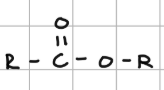
esters
parent chain ends in -oate
the other end of the chail ends in -yl like a branch
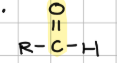
Aldehydes
suffix -al (parent chain)
numbering starts with this group - do not include in numbering
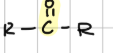
Ketones
suffix -one on the parent chain
numbering priority (only carbons)
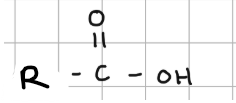
suffix -oic on parent chan
numbering priority
R—NH2
prefix amino-
give the amino numbering priority
treat the shorter side of the chain as N instead of a number
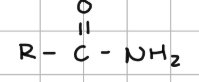
suffix -amide
numbering priority at the carbonyl group
dont number the group — it’s always at the end
R—NO2
prefix nitro-
no numbering priority
numbering priority
O=C > OH > NH2 > C=C ≥ C≡C
greater when number tie
which functional groups are always last?
carboxylic acid, amides, aldehydes
always at the end, no number when naming
What groups have a acidic pH
carboxylic acids
what groups have basic pH
amines/amides
properties of amines/amides
makes up protiens
have fish odour
properties of esters
fruit and flowery odours
properties of ketones
peheromones
other hormones in animals
properties of ethers
used as solvents for fats and oils
intermolecular forces in increasing strength
LDF < Dipole-dipole < H-bonding
voltality
how easily a substance evaporates
the stronger the intermolecular force, the weaker the volatility
solubility (like dissolves like)
polar solutes will dissolve in polar solvents
non-polar solutes will dissolve in non-polar solutes
substances will dissolve better if intermolecular forces match
size → smaller molecules dissolve better than larger molecules
Addition Reaction
D.B or T.B are broken
substituents are added on
what are the 4 types of addition reactions?
Halogenation (addition of a triple bond or double bond chain)
Hydrogenation (addition of H molecule)
Hydrohalogenation
Hydration (H2O)
Substitution Reaction
an atom replaces another atom on a single bond carbon chain
nucleophile definition
species that has lone pairs of electrons or partially negative or negative
What are the two types of substitution reactions?
alkyl halide substitution
radicals
alkyl halide substition
a strong base replacing a halide (nucleophilic substitution)
radical substition
radical is an atom with one electron short of a full shell (very reactive)
formed from UVlight
Radicals react more with…
higher degree carbons
Elimination reactions
a strong base is used to remove a substituent (leaving group) and create a double bond
elimination (opposite of addition) forming adouble bond by removing something
what are the 2 types of elimination?
halogen removal
dehydration
Teritary and Primary Halide
favours elimination at high temperatures
Secondary Halide
favours elimination with high temperature
dehydration elimination
loss of a water molecule
only with alcohols
what are the 2 types of aromatic hydrocarbon reactions?
Friedl-Crafts Reaction (electrophilic substitution)
Nitro reactions
Friedl-crafts Reaction (electrophilic substitution) Aromatic Hydrocarbon Reactions
using alkyl halides to add on a benzene ring
catalysts: AlX, or FeX3
halogens (or any -ve) atom on a benzene ring never gets subbed
electrophilic subsititution → meta is the most stable position
electrophilic definition
species that are positive or partially positive
Nitro Reactions Aromatic Hydrocarbon Reactions
substituting a hydrogen with a nitro group (-NO2) on the benzene ring
what are the 2 types of oxidation reactions?
double bond oxidation
carboxyl oxidizing
double bond oxidation reaction
strong OA such as KMnO4, strong [o], unlimited [o], Na2, Cr2O7
when D.B oxidize, they get cleaved at the D.B and will form ketones or carboxylic acids
oxidation definition
species that lose electrons
organic oxidation definition
species that gain oxygen or more bonds with oxygen
reduction reactions
hydrogenation can cause carbonyl’s to be reduced with a Pt catalyst
organic reduction reactions
less oxygens or less bonds to oxygen
what are the 3 types of condensation reactions?
esterification
ethers
alcohol + alcohol
amides
amine + carboxylic acid