Bio CURE Lab Final
 Call Kai
 Learn
Learn Practice Test
 Spaced Repetition
 Match
Match Flashcards
 Knowt Play
1/40

There's no tags or description
Looks like no tags are added yet.
Name | Mastery | Learn | Test | Matching | Spaced | Call with Kai |
|---|
No analytics yet
Send a link to your students to track their progress
41 Terms
Serological Pipettes
Used to measure and transfer larger liquid volumes, usually from 1 mL to 50 mL. They are often used with a pipette pump and are common in preparing solutions. Less precise than micropipettes.
Micropipettes
Used for very small volumes, measured in microliters (µL). Different types are designed for ranges: P20 (2–20 µL), P200 (20–200 µL), P1000 (100–1000 µL). More precise than serological pipettes.
Enzymes
Proteins that speed up chemical reactions by lowering activation energy. They are not used up during reactions and are highly specific, binding only certain substrates.
Substrate and Product Levels During a Reaction
At the start of a reaction, substrate concentration is high and product concentration is low. As the reaction continues, substrate concentration decreases and product concentration increases.
Monosaccharides
Simple sugars made of one sugar unit, such as glucose, fructose, and galactose.
Disaccharides
Made of two monosaccharides joined by a glycosidic bond, such as lactose (glucose + galactose), sucrose (glucose + fructose), and maltose (glucose + glucose).
Glucose Oxidase/Peroxidase Assay
Used to detect glucose concentration; glucose oxidase converts glucose into gluconic acid and hydrogen peroxide, while peroxidase reacts with hydrogen peroxide to produce a colored product.
Lactose Intolerance
Occurs when a person does not produce enough lactase needed to digest lactose, leading to symptoms such as gas, bloating, diarrhea, stomach cramps, and nausea.
Parts of a Scientific Paper
Includes Title, Abstract, Introduction, Methods, Results, Discussion, Conclusion, and References. Each section has its own purpose in conveying research findings.
Citations
Give credit to sources to avoid plagiarism. MLA uses author and page number, while APA uses author and year.
Hypothesis
Predicts what will happen in an experiment, includes independent and dependent variables, and is testable. Format: If [independent variable], then [dependent variable], because [scientific reason].
Reading Figures
When reading a figure, focus on the title, captions, axis labels, and look for trends and comparisons between groups.
Lactase Persistence
Refers to the continued production of lactase into adulthood, while lactase non-persistence (lactose intolerance) means lactase production decreases after childhood.
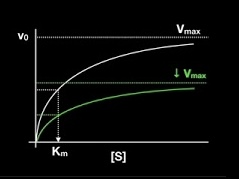
Vmax
Maximum reaction rate when all enzyme active sites are occupied. Increasing enzyme concentration increases Vmax.
Km
Substrate concentration required for the enzyme to reach half of Vmax. Low Km means strong substrate binding, and high Km means weak binding.
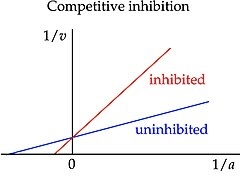
Competitive Inhibition
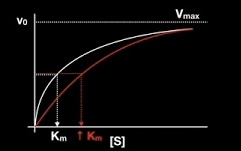
An inhibitor competes with substrate for the active site, increasing Km but not changing Vmax.
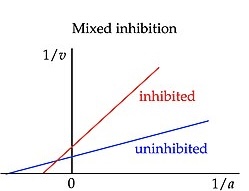
Noncompetitive Inhibition
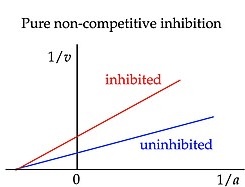
An inhibitor binds to a site other than the active site, changing the enzyme shape and reducing activity. Km does not change, but Vmax decreases.
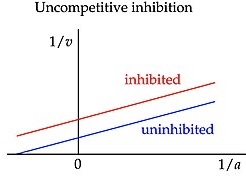
Uncompetitive Inhibition
Inhibitor binds only after substrate is attached, decreasing both Km and Vmax.
Lineweaver-Burk Plot
A double reciprocal plot derived from the Michaelis-Menten equation showing 1/v versus 1/[S]. Y-intercept = 1/Vmax; X-intercept = -1/Km.
Effect of Increasing Substrate
Increases reaction rate until Vmax is reached.
Does not change Km or Vmax.
Michaelis-Menten Graph
X-axis = substrate concentration [S]
Y-axis = reaction velocity (v)
Shape is a curve that rises quickly and then levels off at Vmax.
Km is found at half of Vmax.
Effect of Increasing Enzyme
Increases Vmax.
Does not change Km.
Competitive Graph
Lines intersect at y-axis
Noncompetitive Graph
Lines intersect at x-axis
Uncompetitive Graph
Lines are parallel
Dehydration Synthesis
Joins monosaccharides together by removing water.
Hydrolysis
Breaks disaccharides apart by adding water.
Lactose
Glucose + Galactose
Sucrose
Glucose + Fructose
Maltose
Glucose + Glucose
Introduction paragraph
Broad to Narrow, FUNNEL
Conclusion paragraph
Narrow to broad, TRIANGLE
Difference between Lactose Non-Persistence and Lactose Intolerance
LNP is the genetic, natural decline of the lactase enzyme after infancy, whereas lactose intolerance in the symptomatic clinical condition resulting from consuming dairy.
Converting MM into LWB
To convert a Michaelis-Menten plot (hyperbolic curve of 𝑣0 vs. [𝑆]) into a Lineweaver-Burk plot (straight line), take the reciprocal of both the initial reaction velocity (𝑣0) and substrate concentration ([𝑆]). This "double reciprocal" transforms the equation 𝑣0 = 𝑉𝑚𝑎𝑥[𝑆]𝐾𝑚 + [𝑆] Into 1/𝑣0 = 𝐾𝑚𝑉𝑚𝑎𝑥 1/[𝑆] + 1/𝑉𝑚𝑎𝑥
Competitive LWB
Uncompetitive LWB
Mixed LWB
Non-Competitive LWB
Competitive MM
Uncompetitive MM
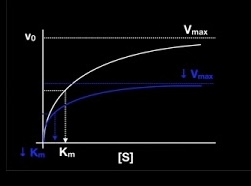
Non-Competitive MM