Adv bio but no muscle parts
 Call Kai
 Learn
Learn Practice Test
 Spaced Repetition
 Match
Match Flashcards
 Knowt Play
1/62

Earn XP
Description and Tags
Yippee kay yay
Name | Mastery | Learn | Test | Matching | Spaced | Call with Kai |
|---|
No analytics yet
Send a link to your students to track their progress
63 Terms
Anterior
Toward the front of the body
Posterior
Toward the back of the body
Superior
Toward the head or upper part of the body
Inferior
Toward the feet or the lower part of the body
Medial
Toward the midline of the body
Lateral
Away from the midline of the body
Proximal
Closer to the point of attachment
Distal
Farther from the point of attachment
Supine
Body is lying on its back
Prone
Body is lying face down
Lateral
The body is laying on one side
Muscles
bundles, sheets, or rings of tissue that produce movement by contracting and pulling on the structures to which they are attached
duct
to bring
extens
to stretch out
fibr
fibers
flex
to bend
Kinesi
movement
Fasci
fibrous band
my
muscul
myos
muscle
plant
sole of foot
ten
tend
tendin
tendon
rotat
to revolve
tend
tendon
vers
to turn
ab
away from
ad
toward
circum
around
e
outward
asthenia
weakness
ion
action
kinesia
movement
tonia
tone
trophic
pertaining to development
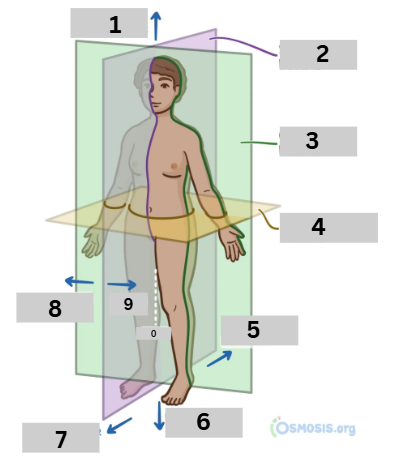
Anatomical positions of the body
standard body orientations used in anatomy to describe the location of structures
Anatomical directions
standard terms used to describe the location of body parts relative to each other when the body is in the anatomical position
Muscles
Bundles of parallel muscle tissue fibers. As these fibers contract (shorten in length) they produce movement of or within the body
Skeletal Muscle
Smooth Muscle
Cardiac Muscle
three types of muscle tissue
voluntary or involuntary
Muscle tissue may be either _____ or _______
Skeletal Muscle
A __________ is directly or indirectly attached to a bone and produces voluntary movement of the skeleton
striated
Skeletal muscles are also referred to as _____ Muscle because of its striped appearance
Fascia tapers
The ________ at each end of a skeletal muscle to form a very strong tendon
Motor neurons
Skeletal muscles are stimulated by _________ of the nervous system
myoneural junction
The point at which the motor nerve contacts a muscle fiber is called the __________
Smooth muscle
muscle tissue is found in association with internal organs
Visceral muscle
Smooth muscles are also known as _______
walls of the hollow organs
Smooth muscle is found in the ___________
involuntary
Smooth muscles are responsible for the __________ associated with movement of the internal organs
Cardiac muscle
makes up the wall of the heart
Myocardium
Cardiac muscles are also known as _________
Origin
the less movable of the two bones is considered to be the starting point of the muscle
Insertion
the more movable bone is considered to be where the muscle ends
Action
the type of movement a muscle produces
Antagonistic pairs
meaning that they produce opposite actions
Superior
1
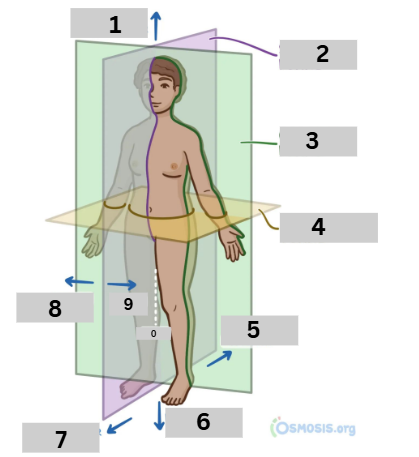
sagittal plane
2
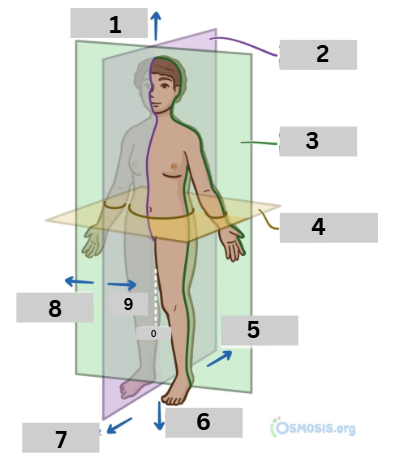
Coronal Plane
3
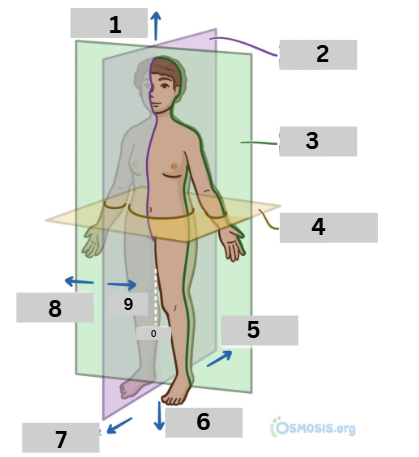
Transverse PLane
4
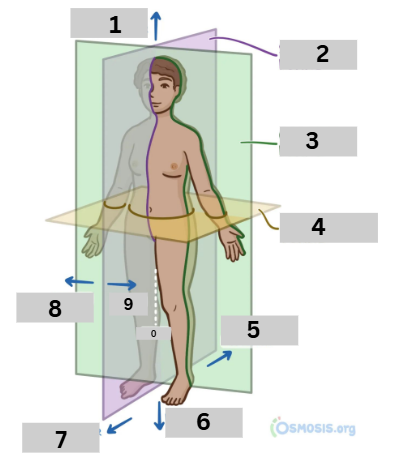
Posterior
5
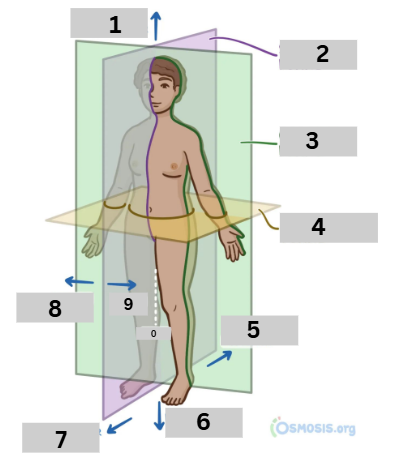
Inferior
6
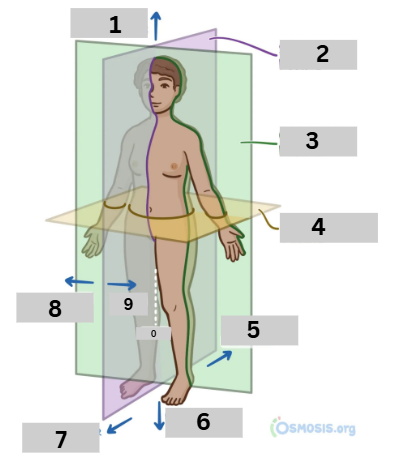
Anterior
7
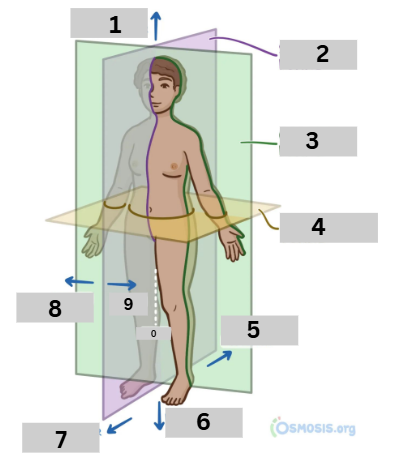
Lateral
8
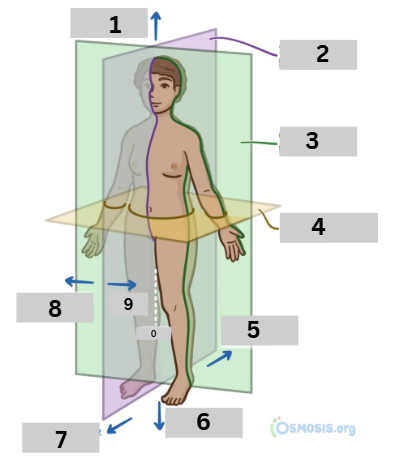
Medial
9
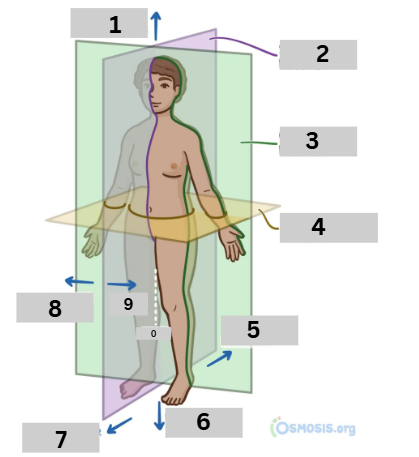
Midline
0